Alcohol Marker Marketing Tactics: Let's Stop Buying the Lies
Are you tired of the non-stop marker ads and sponsored videos for inexpensive markers and marker supplies?
Amy gets angry about wasting money on Ohuhu’s Bleed-Proof Marker Pad and offers tips for dealing with deceptive videos and sponsored content.


After the disastrous testing results of Ohuhu’s newest paper creation, I got to wondering…
Why do we keep falling for cheap alcohol marker advertisements and sponsored videos?
My feed at YouTube is flooded with Ohuhu themed videos. Ohuhu ads follow me around the internet.
Ohuhu even runs ads on my video where I very clearly tell people not to waste money on Ohuhu’s Bleed-Proof Marker Pad!.
The cheap marker marketing is out of control!
SPONSORED VIDEOS: LET’S STOP FALLING FOR THE LIES
Click below to begin video OR watch at YouTube here.

WALK OF SHAME:
PLEASE AVOID THIS PRODUCT AT ALL COSTS
I will not be linking to this truly terrible product in my article today. Here’s what it looks like, please avoid it.
Watch how I struggled to use this paper.
And I have 30 YEARS OF MARKER EXPERIENCE.
If I struggle to work with this paper, how easy will it be for you?

ETHICS & HUMAN RIGHTS
Pause for a moment to think about something:
Ohuhu products are marketed EVERYWHERE.
Market-saturation advertising campaigns are not cheap and beyond that, they offer free products to every YouTube channel, even extremely small channels. So there are tons of videos released every month fueled by free merchandise.
And yet Ohuhu’s products are all bargain-basement inexpensive.
It doesn’t add up.
The only way to make this all happen is to use low quality ingredients or pay extremely low wages to the workers making it. Or both.
Something here feels very suspicious.
I DO NOT RECOMMEND OHUHU BLEED PROOF PAD. If you want an Ohuhu paper product, please try this sketchbook instead:


LEARN MORE ABOUT MARKER PAPER:

Click above to watch video at YouTube
MARKER PAPER MASTER CLASS: Amy explores her gigantic stash of art paper. Which brands are suitable for alcohol markers?
Livestream includes demonstration on how to test marker paper and pros/cons of each paper discussed.
LEARN TO BLEND
ARTISTIC COLORING KITS

WE TEST COPIC INK

COPIC COLOR PALETTES

UNDERPAINT WITH COPIC

SUPPLIES FOR “TOMATO SLICE” ILLUSTRATION:

Ohuhu Bleed Proof Marker Pad: The Worst Paper for Alcohol Markers?
What’s the best brand of paper for coloring and blending with alcohol markers?
Amy evaluates Ohuhu Bleed Proof Marker Pad, sharing how the paper reacts to Copic Markers. Learn the pros and the many, many, many cons.

After over a decade of coloring joy, my favorite marker paper was discontinued.
Now I’m testing new marker papers, hoping to find a suitable replacement.
This paper search isn’t just for me— between my online classes, monthly challenge groups, and my YouTube channel, I teach thousands of students every year how to color with Copic Markers.
Now I’ve purchased 40+ brands and styles of paper, searching desperately for a replacement.
Here are my test results for Ohuhu Bleed Proof Marker Pad.
IS OHUHU BLEED-PROOF MARKER PAD GOOD FOR COPIC MARKERS?
In today’s video, art instructor and professional illustrator Amy Shulke tests Ohuhu Bleed-Proof Marker Pad to evaluate:
How is dual sided paper different from other papers?
Does Ohuhu make a good dual sided paper or are there better examples?
How well do Copic Markers blend on Ohuhu Marker Pad?
Would Ohuhu Markers blend better than Copics on Ohuhu Marker Pad?
Is Ohuhu Marker Pad a good paper for beginners? Is it good for colorists or marker artists?
Plus, Amy shares her coloring process and thoughts as she works with Ohuhu paper.
Demonstration: Coloring a realistic tomato wedge with Copic Markers on Ohuhu Marker Pad
In this series of videos, Amy provides an eye-opening look at popular brands of paper. You'll never look at marker paper the same way again.
Click below to begin video OR watch at YouTube here.

And here’s part two of the Ohuhu Bleed-Proof project.
Part 1 covered the marker paper itself. (click above)
In Part 2, (click below) we discuss how to be smarter consumers and avoid deceptive marketing tactics. Plus, I show how I rescued the terrible tomato sketch with colored pencils.

WALK OF SHAME:
PLEASE AVOID THIS PRODUCT AT ALL COSTS
I will not be linking to this truly terrible product in my article today. Here’s what it looks like, please avoid it.
Watch how I struggled to use this paper.
And I have 30 YEARS OF MARKER EXPERIENCE.
If I struggle to work with this paper, how easy will it be for you?
OHUHU BLEED-PROOF MARKER PAD: FACTS & SPECIFICATIONS
I DO NOT RECOMMEND OHUHU BLEED PROOF PAD. If you want Ohuhu paper, please try this better sketchbook instead:

WEIGHT: 150 gsm. / 90 lb. Note: this is extremely thin for a blending style paper.
WARNING: THE WEIGHT OF THIS PAPER IS MISLEADING. At 150gsm, this paper is already on the thin side but with the bleed-proof layer running through the center, it’s best to think of this as two sheets of EXTREMELY thin paper glued back to back. This paper is actually more like 75 gsm from a marker standpoint. See “Absorbency” below for more info.
COLOR: Light gray. Even X-Press It (a notoriously bluish paper) is whiter than Ohuhu Marker Pad
BACK/FRONT: Color on either side
DUAL SIDED: Ink will not bleed through this paper leaving you free to color on both sides. Note: because this paper is so thin, some buckling will occur which technically can damage the the art on the other side. This isn’t color-bleeding through but it does make the page difficult to scan or photograph properly. Professionals should avoid dual side coloring for everything but hobby use.
BLENDABILITY: Terrible. The fibers in this paper should never be used for marker paper.
FINISH: Feels like drawing paper. Rougher than marker paper should be.
SIZING: No. Sizing would be an improvement but Ohuhu always does the bare minimum they can get away with.
LONGEVITY: Who knows— and even if they claimed to be acid free, Ohuhu has a long track record of lies.
COMPOSITION: Label says “mix” but this feels and performs like a pure wood pulp paper. Claims to be FSC certified which is for wood pulp. Also label also features a recycle logo which is a noble idea but in art paper, recycled material indicates an inferior paper for quick sketching and studies— not suitable for finished artwork.
FEATHERING: Slight feathering but not enough to leak outside stamp lines or line art. You’ll notice the feathering when drawing thin lines with marker, they fatten as they dry.
ABSORBENCY: Not thirsty. Ink stays on the surface and often dries as a sticky dark patch without absorbing down into the paper. The problem is, this paper is so thin, there’s no place for the ink to absorb into. Ohuhu is sacrificing absorbency to give you a dual-sided paper. Is it worth it?
DRY TIME: Extremely long open time. The long dry time is due to the fact that the ink has nowhere to go and sits as a thick sticky puddle on the surface.
SATURATION POINT: 4 layers of Copic (bleeding-through to the paper below). 4 layers is pitifully little and comparable to generic thin office copy paper.
MIXED MEDIA: Slightly toothy for light layers of colored pencil. Suitable for water-based pens and markers but does not tolerate watercolor.
AVAILABILITY: This is a trendy product due to heavy marketing, so Ohuhu products are frequently out of stock. Distributors located in the US, EU, UK, and Japan although I’ve never seen it on store shelves in the US. Perhaps the distributors are drop shipping only?
MADE IN: China
HOW TO TEST PAPER FOR ALCOHOL MARKER COMPATIBLITY:
The most common paper testing videos on YouTube are worthless. Someone blends two colors in a messy stripe. Then they draw a circle and attempt to make it look like a dimensional sphere…

YouTube style marker testing tells you nothing about the paper. On the other hand, it reveals a lot about the inexperienced person doing the testing.
Here’s the problem:
In the blending stripe, they often butt the colors next to each other, using a ton of ink to to scrub the middle ground to “see if they blend”.
In the sphere test, they use weird marker combinations which would challenge even a professional. They over-ink the paper, scrub, and work the blending zones to death.
Now ask yourself: Who blends like this? Nobody.
Paper testing should mimic real-world coloring situations.
Test with a blending combination you’re very comfortable with.
Use the same blend for EVERY test so you can compare results!
Color a stamp or shape you know well.
Your tests should match the size you normally color.
If the paper makes you struggle to blend with your NORMAL coloring techniques— don’t give it extra ink or try to help the paper pass the test.
Good paper will easily pass the test without help.
Don’t waste time and money coloring on paper that requires help.
TEST RESULTS & OBSERVATIONS FOR OHUHU BLEED-PROOF MARKER PAD
Here’s what I learned about this over-hyped and over-marketed paper
See the video for more in-depth observations and details.
“Orange Slice” by the author, Amy Shulke, 2024. Size: 8x8”. Copic Marker and Prismacolor Colored Pencils on X-Press It Blending Card.
Complete supply list at the bottom of this article.
Ohuhu products are student grade— at best. Anyone expecting a top quality, artist grade product at this price is deluding themselves.
Ohuhu “Marker Pad” is a soft, toothy paper. It is NOT smooth. It doesn’t feel like other marker papers and it doesn’t behave like other marker papers for a simple reason. It’s not marker paper.
Easily feeds through a standard office printer. There, that’s the best I can say about it.
Press EXTREMELY lightly when drawing on OMP with pencil. This is an extremely soft paper with a fragile tooth. It is easy to damage the surface with firm pressure.
OMP is very gray. Cardmakers and artists who scan their work for reproduction may want to reconsider using a paper this far from white.
OMP is a composite paper. Every sheet contains a moisture-proof polymer layer running through the middle. This prevents marker from leaking through to the other side.
Ohuhu Marker Pad does not bleed through to the other side. But there are at least 5 brands of better bleed-proof paper on the market which perform better with markers.
OMP is two sheets of 45 lb. paper glued back to back. Even though the label claims 150gsm/90 lbs, the polymer barrier prevents the ink from accessing more than half the thickness of the paper.
9. OMP does not feather excessively but in testing with alcohol markers, all thin lines slowly grew fatter. Fineline Micron and Copic Multiliner pens remained stable but anything juicy spreads.
10. Ink puddles and pools, often drying to with a metallic sheen and noticeable sitckiness. Several YouTubers who received free paper mention “Ohuhu warned me that ink will smear, so give it a few seconds.”
11. OMP is made from wood pulp which has long been known to stain on contact with alcohol ink. This makes blending harder, and as I found, sometimes impossible.
12. OMP is not recommended for watercolor or watermedia. A light layer of water-based markers will be fine but do not expect to blend or layer because the paper easily pills.
ETHICS & HUMAN RIGHTS
Pause for a moment to think about something:
Ohuhu products are marketed EVERYWHERE. In fact, I fully expect Ad-Sense to place Ohuhu ads on this article and also on my videos at YouTube.
Market-saturation advertising campaigns are not cheap and beyond that, they offer free products to every YouTube channel, even extremely small channels. So there are tons of videos released every month fueled by free merchandise.
And yet Ohuhu’s products are all bargain-basement inexpensive.
It doesn’t add up.
The only way to make this all happen is to use low quality ingredients or pay extremely low wages to the workers making it. Or both.
Something here feels very suspicious.
I DO NOT RECOMMEND OHUHU BLEED PROOF PAD. If you want an Ohuhu paper product, please try this sketchbook instead:
ARTIST RECOMMENDATIONS:
BEGINNERS: No, I do not recommend Ohuhu Bleed-Proof Marker Pad for beginners or anyone uncertain about good blending technique. This is a staining paper which does not allow enough ink to correct or smooth the inevitable bad blends.
HOBBY/STAMP/COLORISTS: No, I do not recommend Ohuhu Bleed-Proof Marker Pad for hobby use. This is a very gray, very frustrating paper.
INTERMEDIATE/ADVANCED COLORING: No, I do not recommend Ohuhu Bleed-Proof Marker Pad for skilled colorists, realistic marker painting, marker sketching, and anyone who draws/colors with alcohol marker only. While you can learn to make it work, it’s not worth the frustration.
MIXED MEDIA: Ohuhu Bleed-Proof Marker Pad accepts light amounts of colored pencil but do not expect many layers. Do not use watercolor or try to blend water-based products.
LEARN MORE ABOUT MARKER PAPER:
Click above to watch video at YouTube
MARKER PAPER MASTER CLASS: Amy explores her gigantic stash of art paper. Which brands are suitable for alcohol markers?
Livestream includes demonstration on how to test marker paper and pros/cons of each paper discussed.
LEARN TO BLEND
ARTISTIC COLORING KITS
WE TEST COPIC INK
COPIC COLOR PALETTES
UNDERPAINT WITH COPIC
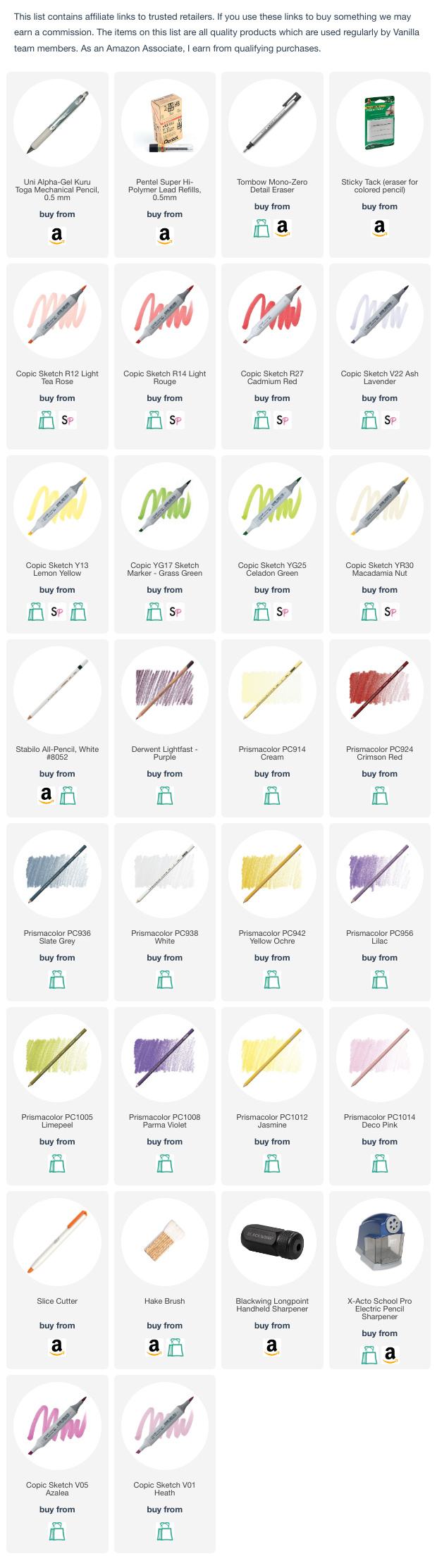
SUPPLIES FOR “TOMATO SLICE” ILLUSTRATION:

X-Press It Blending Card: The Best Paper for Alcohol Markers?
What’s the best brand of paper for coloring and blending with alcohol markers?
Amy evaluates X-Press It Blending Card, sharing how the paper reacts to Copic Markers. Learn the pros, cons, and what makes this expensive paper truly unique .

After over a decade of pure coloring joy, my favorite marker paper was discontinued.
Now I’m shopping for a new best paper for alcohol markers.
This paper search isn’t just for me— between my online classes, monthly challenge groups, and my YouTube channel, I teach thousands of students every year how to color with Copic Markers.
Now I’ve purchased 40+ brands and styles of paper, searching desperately for a replacement.
Here are my test results for X-Press It Blending Card.
IS X-PRESS IT BLENDING CARD GOOD FOR COPIC MARKERS?
In today’s video, art instructor and professional illustrator Amy Shulke tests X-Press It Blending Card to evaluate:
What is Blending Card?
Why is this paper so expensive? Is it worth the price?
How well do Copic Markers blend on X-Press It?
Is X-Press It a good paper for beginners? Is it good for artists?
Plus, Amy uses chemistry to prove why commonly recommended X-Press It “dupes” are absolutely NOT good substitutes for XPI.
Demonstration: Coloring a realistic, juicy orange slice.
Amy provides an eye-opening look at popular brands of paper. You'll never look at marker paper the same way again.
Click below to begin video OR watch at YouTube here.
X-PRESS IT BLENDING CARD: FACTS & SPECIFICATIONS

WEIGHT: 250 gsm. / 92 lb.
COLOR: Cool White (looks bluish in comparison to standard white)
BACK/FRONT: color on either side
BLENDABILITY: A self-blending paper. Makes blending extremely easy.
FINISH: Hot press with a secondary polish. Almost no tooth, feels very slick and almost glassy.
SIZING: We suspect there’s a light sizing spray.
LONGEVITY: Acid free and archival
COMPOSITION: Cotton fiber blended with high levels of calcium carbonate
FEATHERING: No feathering
ABSORBENCY: Not thirsty, ink stays on the surface of the paper for several minutes before sinking into the fibers.
DRY TIME: Long open time— prolongs the dry time for alcohol ink
SATURATION POINT: 16 layers of Copic (bleeding-through to the paper below)
MIXED MEDIA: Not suitable for mixed media— Almost no tooth for colored pencils. Easily damaged by water.
AVAILABILITY: In the United States, only available as 8x5x11” loose sheets in packs of 25 or 125. Available in other sizes and formats in Australia. Order online as this is a rare find on store shelves.
LIMITATIONS: Difficult to purchase in some countries.
MADE IN: An Australian company. Manufactured in the EU but cut, packaged, and distributed from Melbourne, Australia.
HOW TO TEST PAPER FOR ALCOHOL MARKER COMPATIBLITY:
The most common paper testing videos on YouTube are worthless. Someone draws a box, then blends inside the box with a random combination of markers.
YouTube style marker testing tells you nothing about the paper. On the other hand, it reveals a lot about the inexperienced person doing the testing.
Here’s the problem:
They often butt the colors next to each other, then use several markers to scrub the connection points to “see if they blend”.
Then they draw a circle and attempt to shade it into a sphere, often using incredibly bad blending combinations which would challenge even the professionas. They over-ink the paper, scrub, and work the blending zones to death.
Now ask yourself: Who blends like this? Nobody.
Paper testing should mimic real-world coloring situations.
Test with a blending combination you’re very comfortable with.
Use the same blend for EVERY test so you can compare results!
Color a stamp or shape you know well.
Your tests should match the size you normally color.
If a test-paper makes you work harder or if it looks bad with your NORMAL coloring techniques— don’t give it extra ink or try to help the paper pass the test.
Good paper will easily pass the test without help.
Don’t waste time and money coloring on paper that requires help.
TEST RESULTS & OBSERVATIONS FOR X-PRESS IT BLENDING CARD
Here’s what I learned about this commonly misunderstood paper
See the video for more in-depth observations and details.

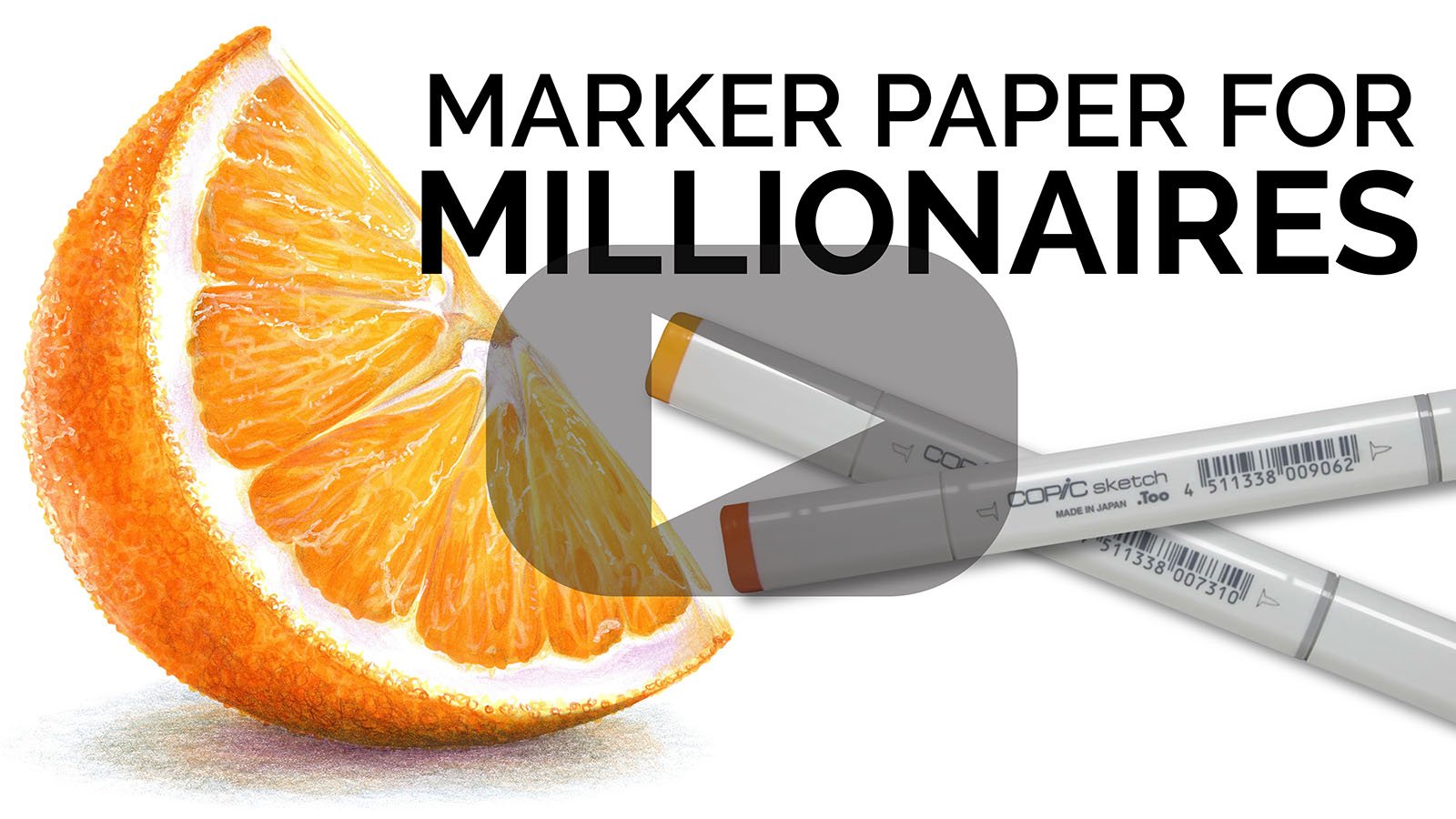
“Orange Slice” by the author, Amy Shulke, 2024. Size: 8x8”. Copic Marker and Prismacolor Colored Pencils on X-Press It Blending Card.
Complete supply list at the bottom of this article.
X-Press It Blending Card is probably the most expensive marker paper on the market. At first glance, many people are put-off by the price. Our look at the ingredients and the manufacturing process helps to explain the expense. The benefits may make it worth the price.
XPI accepts stamp ink and dries quickly. Please use Copic compatible ink (Amazon link) because no paper can make an incompatible ink safe for use with Copics.
Easily feeds through a standard office printer.
Press very lightly when drawing on XPI with pencil. It is easy to damage the surface of XPI with firm pressure.
XPI is easily damaged by water. Do not use water-based markers. Do not eat or drink near your project. Try not to sneeze near it! (Not kidding)
XPI does not feather or wick color outside the lines.
Alcohol inks are visible on the backside but in years of use, I’ve almost never experienced any bleed-through… and in those cases, I was being stupid.
Strathmore Bristol tolerates more layers of ink than most papers I’ve tried.
8. XPI has almost no tooth and is not an easy surface for colored pencil. For best results, use soft and waxy pencils and don’t expect more than 2 layers.
9. XPI is a slow drying paper. This long “open time” instantly improves the look of even beginner blending.
10. XPI is ideal for beginners. I highly recommend this paper for learning and it’s mandatory in all my beginner classes.
11. Slightly blotch blends on XPI will often fix themselves overnight. I call this the Copic Fairy effect and I teach students how to encourage fairy results.
12. Bristol has a blue-white color and may not be suitable for card makers or paper crafters. It clashes with white cardstock and many patterned papers.
ARTIST RECOMMENDATIONS:
BEGINNERS: Yes, I highly recommend X-Press It Blending Card for beginners or anyone uncertain about good blending technique. The smoothness and ease of blending on XPI encourage the development of excellent marker technique.
HOBBY/STAMP/COLORISTS: I recommend X-Press It Blending Card for every level of coloring; but remember, price is an issue. Evaluate whether your coloring style truly needs a high performance paper.
INTERMEDIATE/ADVANCED COLORING: Highly recommend for skilled colorists, realistic marker painting, marker sketching, and anyone who draws/colors with alcohol marker only.
MIXED MEDIA: Recommend with caution. XPI accepts light amounts of colored pencil but do not expect many layers. Do not use watercolor or water-based products.
LEARN MORE ABOUT MARKER PAPER:
Click above to watch video at YouTube
MARKER PAPER MASTER CLASS: Amy explores her gigantic stash of art paper. Which brands are suitable for alcohol markers?
Livestream includes demonstration on how to test marker paper and pros/cons of each paper discussed.
LEARN TO BLEND
ARTISTIC COLORING KITS
WE TEST COPIC INK
COPIC COLOR PALETTES
UNDERPAINT WITH COPIC
SUPPLIES FOR “ORANGE SLICE” ILLUSTRATION:
Strathmore Bristol 300: The Best paper for Alcohol Markers?
What’s the best brand of paper for coloring and blending with alcohol markers?
Amy evaluates Strathmore Bristol 300 Smooth, sharing how the paper reacts to Copic Markers. Learn the pros and cons of this student grade Bristol Board.

After over a decade of pure coloring joy, my favorite marker paper was discontinued.
Now I’m on the hunt for a new best paper for alcohol markers.
This isn’t just for fun and it’s not for website clicks— between my online classes, monthly challenge groups, and my YouTube channel, I teach thousands of students every year how to color with Copic Markers.
When our paper disappeared, it rattled the foundations of my marker school.
Now I’ve purchased 40+ brands and styles of paper.
Here are my test results for Strathmore Bristol 300 Smooth.
Psssttt… what was that favorite paper? Cryogen Curious Metallic White produced by the Arjo Wiggins Company, 1761-2022. Rest in Peace.
Many thanks to the kind readers and students who’ve tracked down secret stashes of this paper for me. Unfortunately, because I teach, I can not work on discontinued paper. It’s best to look forward, not back.
Having said that, I’ll name my next dog after the first person to find this same paper for sale under another brand.
IS STRATHMORE BRISTOL BOARD GOOD FOR COPIC MARKERS?
In today’s video, art instructor and professional illustrator Amy Shulke tests Strathmore Bristol 300 Smooth to evaluate:
What is Bristol Board?
What is the difference between Bristol Board and Bristol Paper?
Which type of Bristol Board is best with alcohol markers?
How well do Copic Markers blend on Bristol Board?
Is Bristol a good paper for beginners?
Plus, how to test various kinds of paper to select those which work best with illustration markers.
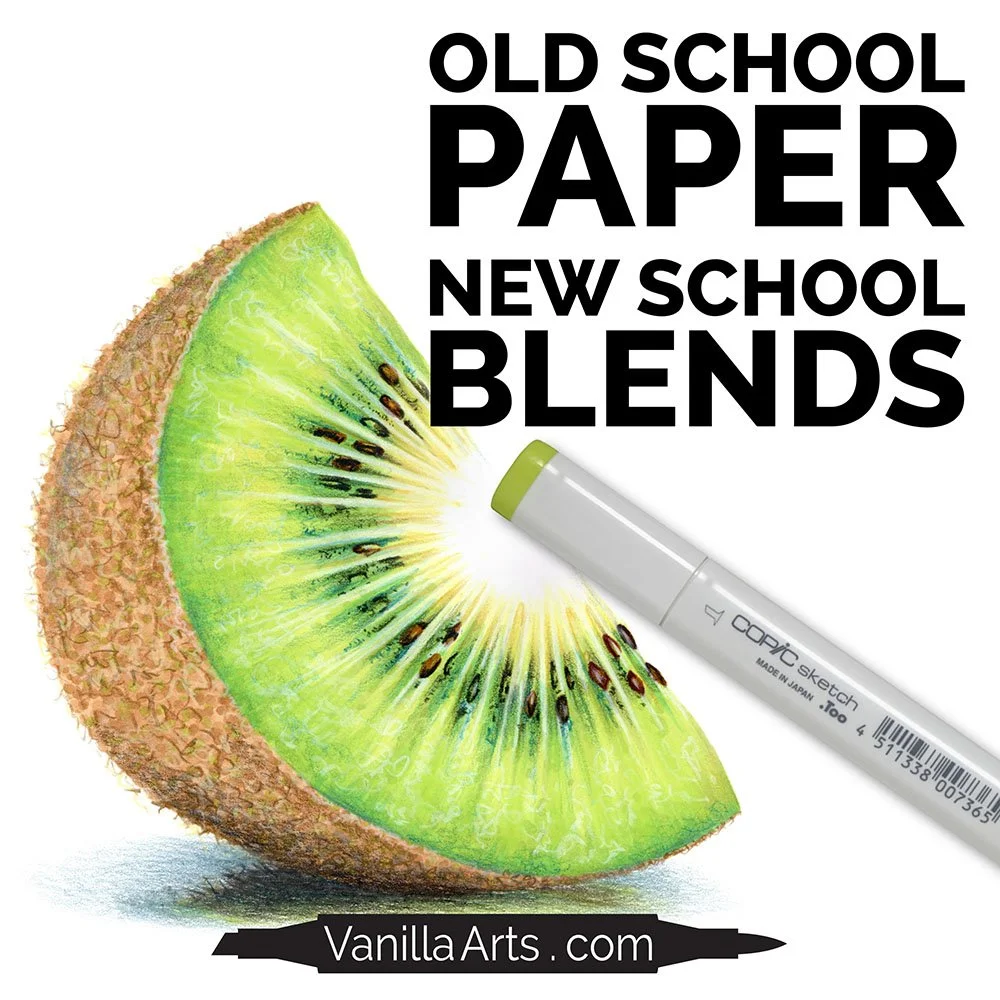
Demonstration: Coloring a realistic, vibrant slice of kiwi fruit.
Amy provides an eye-opening look at popular brands of paper. You'll never look at marker paper the same way again.
Click below to begin video OR watch directly on YouTube here.

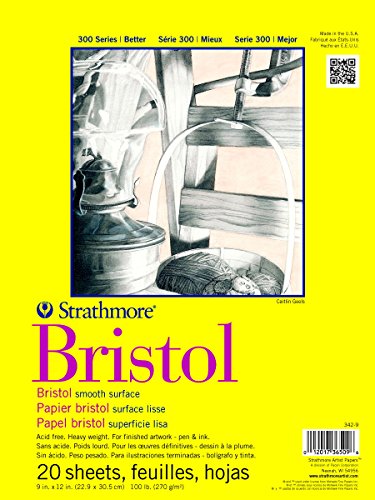
STRATHMORE 300 BRISTOL SMOOTH: FACTS & SPECIFICATIONS
WEIGHT: 270 gsm. / 100 lb.
COLOR: Standard white, not artificially brightened but still a clean white
BACK/FRONT: color on either side
BLENDABILITY: Allows easy blending once the user applies enough ink.
FINISH: “Smooth” finish is hot press and lightly polished but retains some tooth texture. Does not feel slick or satiny. Both Smooth and Vellum styles work with alcohol markers but the Smooth finish blends easier.
SIZING: No sizing. If there is a coating, it’s very minor.
LONGEVITY: Acid free and archival
COMPOSITION: Cotton/wood fiber blend
FEATHERING: Minimal feathering
ABSORBENCY: Slightly thirsty but not excessive
DRY TIME: Moderate open time— this paper holds a lot of ink, so the more you layer, the longer it takes to dry
SATURATION POINT: 17 layers of Copic (bleeding-through to the paper below)
MIXED MEDIA: Excellent for mixed media— markers, fine-line pens, colored pencils, and light water-media. Not recommended for heavy watercolor.
AVAILABILITY: This product is easily available on store shelves in the US and Canada; in most art and craft stores but also some big chain retailers.
SIZES: Available in glue-bound pads— 9x12”, 14x17, and 19x24”. Also available in 22x28” sheets and 10 yard rolls.
MADE IN: the United States
HOW TO TEST PAPER FOR ALCOHOL MARKER COMPATIBLITY:
YouTube style marker testing tells you nothing about the paper. On the other hand, it reveals a lot about the person doing the testing.
The most common paper testing videos on YouTube are worthless.
In other videos, someone draws a box, then blends inside the box with a random combination of markers.
Here’s the problem:
They often butt the colors next to each other, then use several markers to scrub the connection points to “see if they blend”.
Then they draw a circle and attempt to shade it into a sphere, often using some of the worst blending combinations I’ve ever seen. The over-ink the paper, scrub, and work the blending zones to death.
Now ask yourself: Who would ever blend like this? And when was the last time you needed to color a big ugly ball?
Paper testing must always mimic real-world coloring situations.
Use the marker colors you use every day.
Test the blending combinations you use most often.
Keep using the same blend for every test so you can compare results!
Color a stamp or shape you’re familiar with.
Your test swatches should match the size and scale you normally color.
If a test-paper makes you work harder or if it looks bad with your NORMAL coloring techniques, don’t struggle to make it work
You’re not supposed to fight with the paper!
TEST RESULTS FOR STRATHMORE BRISTOL 300 SMOOTH
Here’s what I learned about this old school paper.
See the video for more in-depth observations and details.
“Kiwi Slice” by the author, Amy Shulke, 2024. Size: 8x8”. Copic Marker and Prismacolor Colored Pencils on Strathmore Bristol 300 Smooth.
Complete supply list at the bottom of this article.
Strathmore Bristol is self-described as a student grade paper. Normally, I do not use student grade anything but in this case, I don’t notice a big difference between the student level (300) or the artist grades (400, 500).
Strathmore Bristol accepts stamp ink and dries quickly. Please use Copic compatible ink (Amazon link) because no paper can make an incompatible ink safe for use with Copics.
You will need a heavy-duty printer to print digital stamps onto Strathmore Bristol Board. It is thick like poster-board and resists bending. (I print on Bristol with this printer - Amazon link).
Strathmore Bristol is too thick for tracing. Even with 2 ply, not much light comes through with a lightboard.
Strathmore Bristol does not feather or wick color outside the lines.
Alcohol inks are visible on the backside but in months of testing, there has been no bleed-through, nothing even close enough to leave ink on my desk.
Strathmore Bristol tolerates more layers of ink than any other paper I’ve tried. You can really abuse this paper without damaging the look of your coloring.
8. Even with the “Smooth” surface, Strathmore Bristol has more tooth than paper developed for use with markers. You’ll feel more friction as you color but it’s not unpleasant or problematic. This tooth is actually a bonus if you use colored pencil with markers.
9. Bristol is a thirsty paper. I find myself coloring with a heavier pressure on Bristol than I normally use.
10. Blending on Bristol requires a bit more moisture but once you figure it out, the blends come easily and they’re very smooth. Because of the learning curve, Bristol is not suitable for beginners. Save this for after you learn how to blend.
11. Blends often “mellow and mature” as the ink settles into paper designed for markers. Your project often looks smoother but also less bright the next day. This mellowing DOES NOT happen with Strathmore Bristol. Choppy blends on Bristol will not fix themselves overnight.
12. Bristol could be the thickest paper you’ve ever colored on and may not be suitable for card makers or paper crafters who layer hand-colored elements with decorative papers and sentiments.
ARTIST RECOMMENDATIONS:
I do not recommend Strathmore Bristol 300 for beginners or anyone uncertain about good blending technique. Save this paper until after you’ve mastered smooth marker blending techniques.
I recommend Strathmore Bristol 300 Smooth for hobby level stamping and coloring— but remember, it’s THICK!
I highly recommend Strathmore Bristol 300 Smooth for mixed media artists who combine markers with colored pencil.
I highly recommend Strathmore Bristol 300 Smooth for my intermediate to advanced students. I will be teaching on this paper until I find the perfect marker paper.
LEARN MORE ABOUT MARKER PAPER:
Click above to watch video at YouTube
MARKER PAPER MASTER CLASS: Amy explores her gigantic stash of art paper. Which brands are suitable for alcohol markers?
Livestream includes demonstration on how to test marker paper and pros/cons of each paper discussed.
LEARN TO BLEND
ARTISTIC COLORING KITS
WE TEST COPIC INK
COPIC COLOR PALETTES
UNDERPAINT WITH COPIC
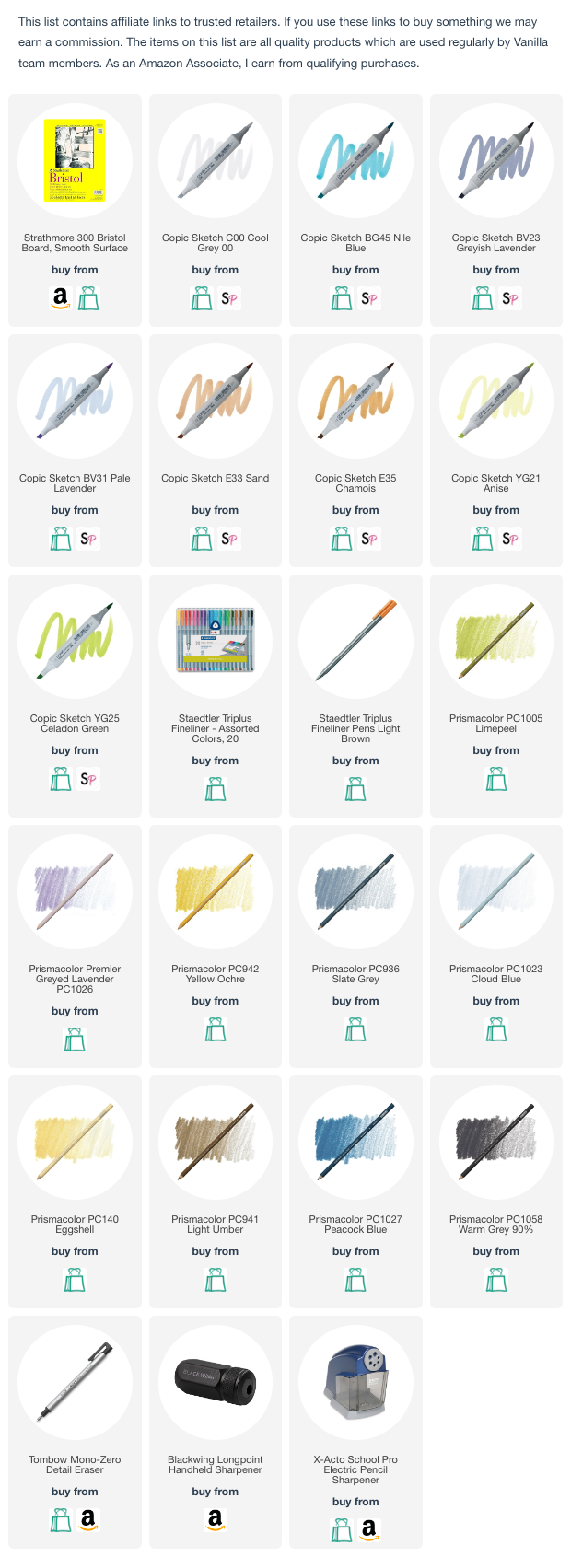
SUPPLIES USED IN “KIWI SLICE” ILLUSTRATION: