Best Beginner Copic Marker Blends: Green & Yellow-Green
Which Green and Yellow-Green Copics are Best for Beginners?
I asked three of my favorite marker instructors about which green and yellow-green markers they recommend for first time colorers.
Which markers offer students the best value?
Which Copic G and YGs are versatile enough to color many different green items?
Which green blending combinations do we teach with?
Which YG and G markers do we use in our own work?


Are you new to Copic Markers and wondering which colors to purchase first?
When you’re a beginner, selecting a handful of starter markers can be intimidating. There are so many colors! Which is best?
Is this a good green? It’s pretty but will it blend with anything?
Even with an art degree, I made rookie mistakes. Many of the Copics from my first set of 72 are still gathering dust today!
If I could go back in time, I’d focus on useful blending combinations rather than boxed sets and random Copics from the clearance bin. It’s only a bargain if you actually use the marker!
In the spirit of helping you avoid my mistakes, I started to wonder:
Which Green and Yellow-Green Copics are Best for Beginners?
I asked three of my favorite marker instructors about which green and yellow-green markers they recommend for first time colorers.
Which markers offer students the best value?
Which Copic G and YGs are versatile enough to color many different green items?
Which green blending combinations do we teach with?
Which YG and G markers do we use in our own work?
Which G and YG Copics are Best for Beginners?
If you’re new to Copic Markers, we recommend YG03 & YG17 as your starter greens. Add to this combination depending upon your taste. YG67 makes an excellent dark. YG21 adds light. For realism, underpaint with blue or violet.
We don’t recommend G markers for beginners. Skip the Gs to save money.
Let’s talk to four Copic instructors to learn more about Copic their favorite G and YG blending combinations.
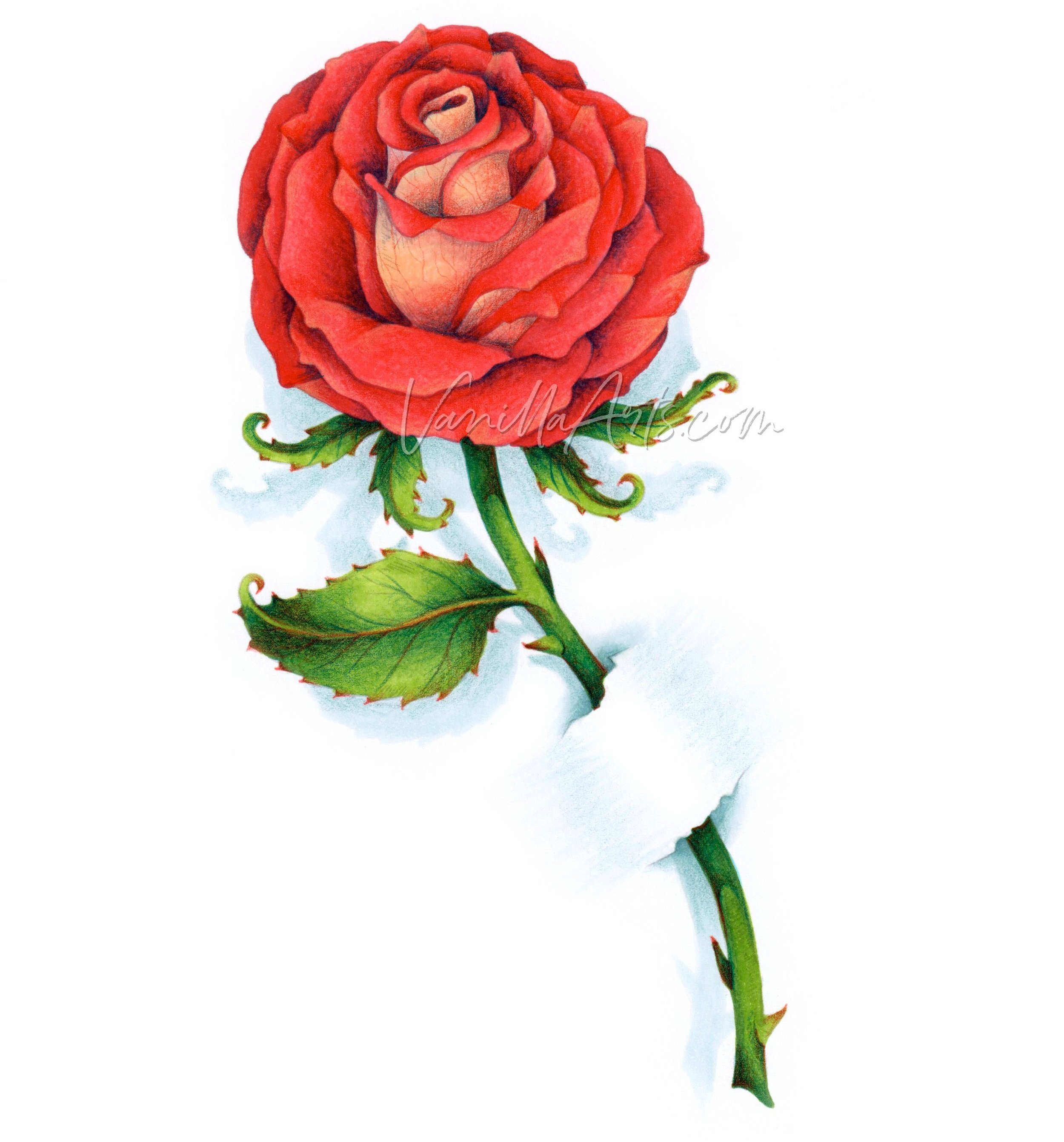
“Rosie Gets the Blues” Image from PowerPoppy.com, modified and colored by the author, Amy Shulke. Copic Markers and Prismacolor Colored Pencils on X-Press It Blending Card. Amy’s online class featuring this image teaches the secrets to easy complimentary blending. More info here.
Michelle Houghton’s Favorite Green and Yellow-Green Copics
Note: As of 2024, Michelle is not currently teaching Copic classes. Find Michelle on her Copic in the Craftroom channel at YouTube and at Scrapweaver.com
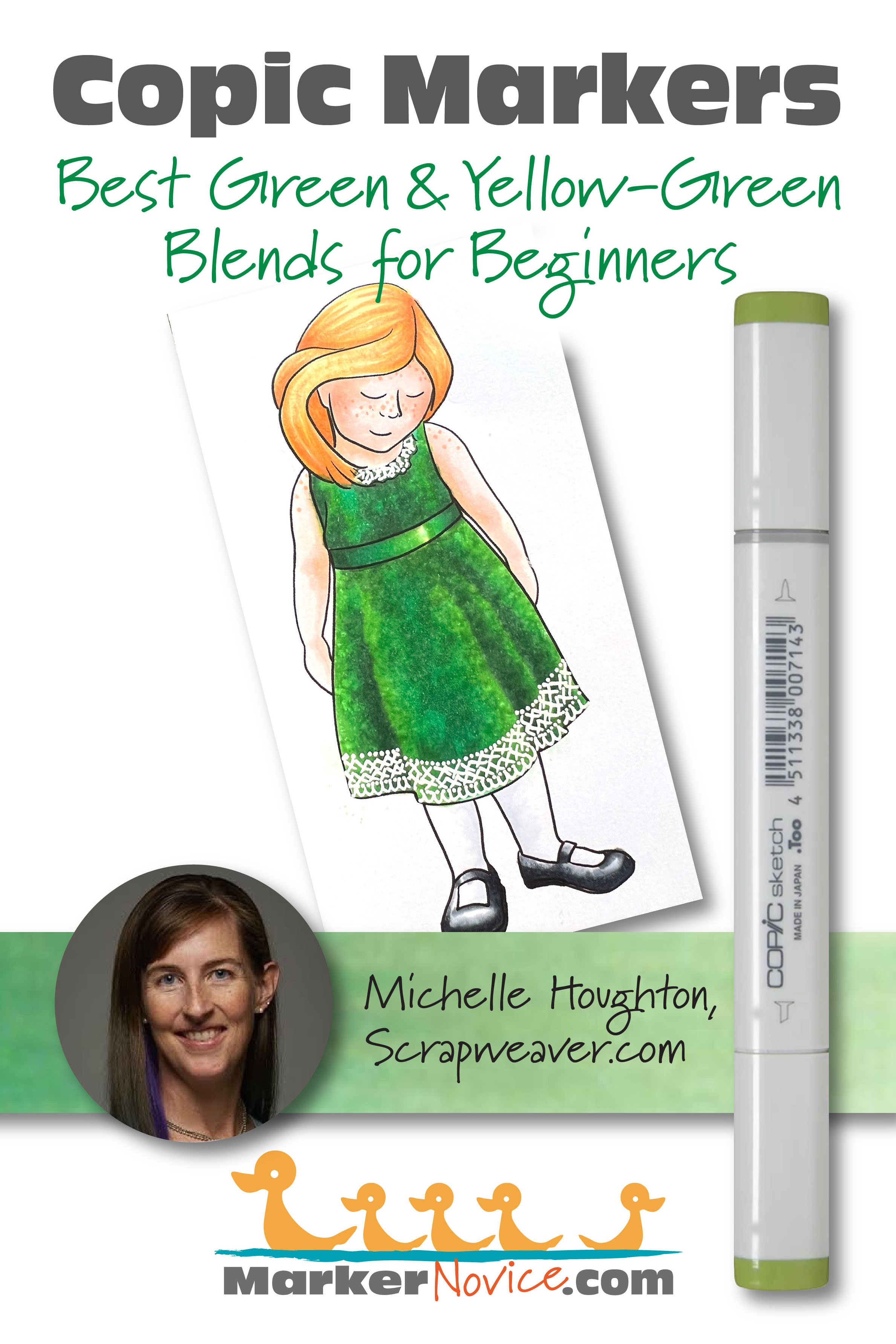
Before we get to Michelle’s marker recommendations, I’d like to point something out…
Did you notice that this article covers both Green and Yellow-Green markers families?
There’s a reason.
All four Copic instructors in this article agree: We do not use G markers enough to recommend them for beginners.
Especially not when there are so many beautiful and easy-blending Yellow-Greens available!
Michelle explains why:
The G green Copic family regularly gets passed over for the yellow greens at my desk.
I think it has to do with WHAT I am coloring. Often, I’m coloring areas of foliage, leaves, grass, trees, etc. When I look at green objects in nature, they tend to lean toward the yellow side of the green family, so naturally, I reach for my YG markers.
I may use a G marker to cool the color of a leaf in cast shadow or for plants which lean into the blues like the needles on evergreen trees.
But more often than not, when I reach for a G Copic it’s for clothing or accessories, something that could just as easily be colored red or blue. In these cases, I’m choosing to color them green because I feel guilty for not using my G markers more often.
This is why you’ll see a strong theme repeated by each instructor here today.
Independently, we all find ourselves using YG markers far more than Gs.
So now that we’ve discussed what we don’t use, let’s get to the recommendations.
Michelle recommends YG01-YG03-YG63 for beginners.
As someone who teaches realistic coloring classes, I love Michelle’s YG combination even though I’ve never tried it before.
My reasoning is this:
YG01 is a lovely pale green with a strong feeling of sunshine to it.
YG03 is the easiest blending marker in the entire Copic collection. This marker is perfect for beginners because it literally blends with anything— I’ve even blended YG03 with Black 110 before!
And YG63 is one of my go-to green markers for realism. It has a gentle murkiness to it which perfectly captures the look of chartreuse in the shade.
I followed up with Michelle, to ask if she could also give you a good G combination— just in case someone reading this already owns a few Gs.
Michelle says:
“I don’t often reach for the G’s but when I do it is either G21-G24-G17 or G40-G43-G46”
Notice how Michelle jumps from the G-Twenties to G17? That’s particularly interesting to me. I’ll have more thoughts on this in my recommendation section below.
In the meantime, be sure to watch Michelle’s Copic in the Craftroom videos at YouTube. She has a ton of G and YG demos and tips for you. I’m only linking here to half of what she has available! Michelle is a valuable resource you simply can not miss.
Michelle’s YG info:
Michelle’s G info:
__________
Michelle is an elementary school teacher (BS Fine Arts, MA Education) with over 20 years of paper-crafting experience. She’s is a former Copic Certification Regional Instructor for Imagination International. Michelle runs the Copic in the Craftroom website and YouTube channel. Her Copic College events are favorites with Copic fans at all levels.. Visit her at Scrapweaver.com.
WE ASKED YOU!
Half of Vanilla Arts readers say YG67-YG17-YG03-YG01 is their favorite green blending combination.
And here’s where there may be a bit of bias showing…
Most Vanilla Arts readers are also Vanilla Arts students and I teach with these greens.
But for people to overwhelmingly cite this as their favorite and to use it in their personal work? It’s a sign that this combination not only blends easily but also looks great!
Cordine van der Touw’s Beginner Yellow-green Blend
See Cordine’s latest projects on her Facebook page here. You can also find her at Copic Marker Europe and Cordine’s latest classes for Copics at Colourstock.
Cordine recommends YG67-YG17-YG03 for your first green blending combination.
Cordine says:

I love the Vanilla combination of YG67-YG17-YG03, colored dark to light. I frequently underpaint it with B34.
This combination is easy to change around. I can go darker if I underpaint with B34 or go lighter if I leave the YG67 out of the combination.
What’s interesting is that Cordine’s tulips here use my Vanilla-student green combination and yet I didn’t recognize it!
This is because every colorer changes the look of a blending combination based upon their unique coloring instincts.
Cordine used the darker markers sparingly which makes her leaves look sunkissed and lightweight.
Compare Cordine’s leaves to the color swatch behind her photograph. I colored the swatch! We used the same markers and yet they look totally different!
I color like me and Cordine colors like Cordine. We’re different people and our coloring looks different too.
That’s actually a great beginner tip: Don’t feel bad when you faithfully follow a marker recipe but get different results. Everyone creates a distinctive look because we all use the colors in unique ratios. As long as it looks good, it doesn’t have to match the original sample!
And what about G markers?
When I asked Cordine for her favorite G combination, she quickly responded, “Nope, I pass on this color”.
Keep reading because Elena can help explain why we’re all less than enthusiastic about Copic’s G Markers.
__________
Cordine is an office manager in The Netherlands. She’s an avid paper crafter who loves card making, scrapbooking, and coloring stamps with Copic and colored pencils. She has taught Copic since 2013 for Colourstock as the Benelux region representative (Netherlands, Belgium, and Luxembourg). Contact Cordine here.

Elena Cazares’ Favorite YG Copic Blend
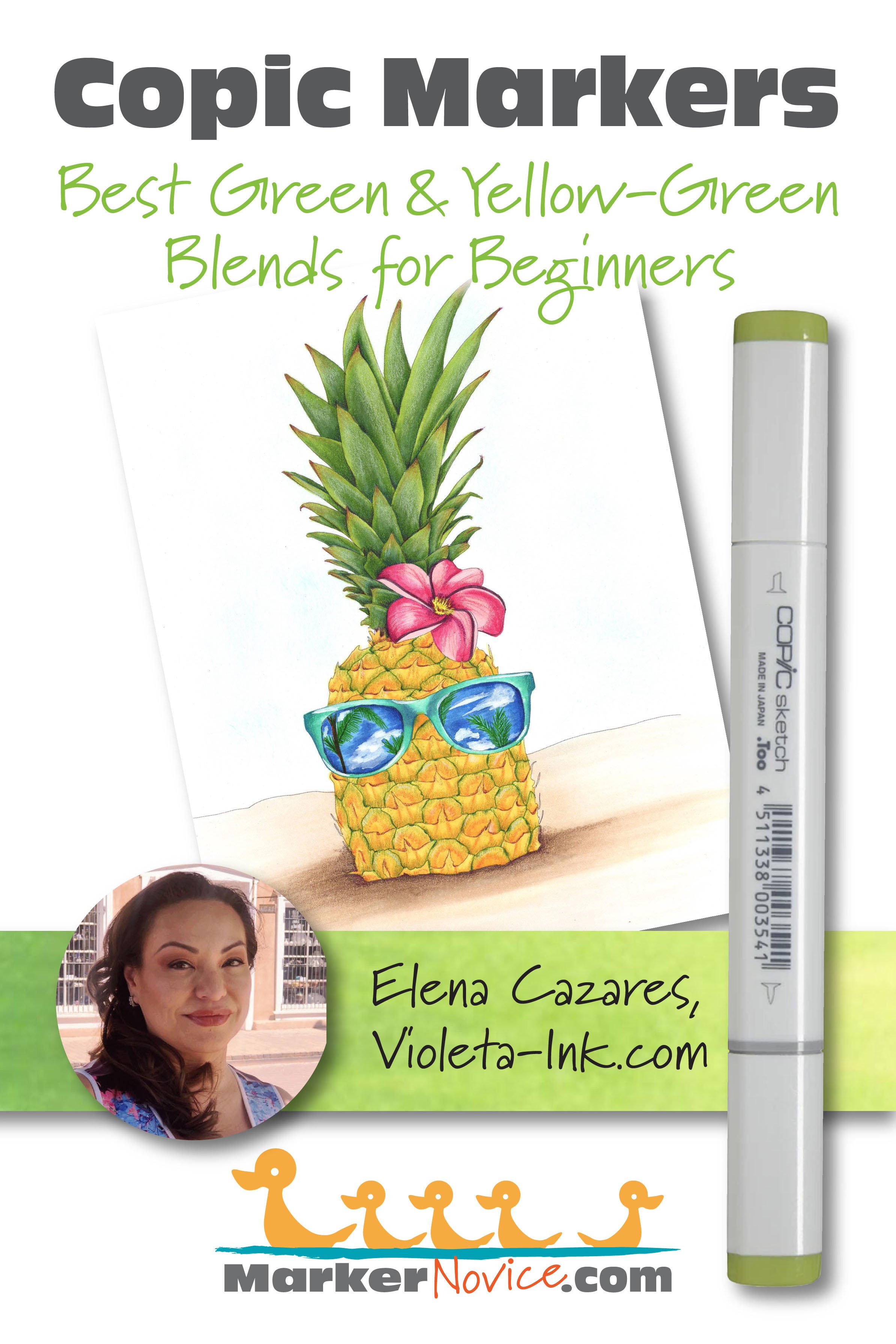
Elena recommends B34-YG17-YG03-YG00 for beginners. She colors them dark to light.
For Elena’s combination (as with all underpainting combinations) you must cover the blue completely with the YG17 to create the look of dark green.
Why does Elena love this B to YG combination so much?
This combo blends beautifully and it’s my safe haven. When I challenge myself on the flower petals or other hard parts of an image, I always fall back on this easy-blend recipe because I know it will work.
It’s a safe green but it’s definitely not plain looking!
The blue provides lots of shadiness to the darker end but YG03 and YG00 are bright and happy. This gives you lots of value range and makes your leaves very dimensional.
Plus, YG03 is just an amazing blender. Every marker blends when YG03 is there to make them play nice!
And what about a G marker recommendation?
I love to color botanicals and the G family doesn’t give me the natural, organic feel I want. So I really don’t have a G combination to recommend.
The G greens all have blue hints, especially the lightest ones. G colored leaves just don’t look right to me. They give off a mint feeling which I really don’t like. I want my flowers to be warm and full of life!
I will use Gs if I can’t avoid it, like for a class or in a demonstration but I don’t get excited about them. I bought almost all the G markers at once and was really disappointed with the way they looked. I thought I was getting a bargain but I just don’t use them a lot. I could have saved the money and bought better paper or coloring classes sooner!
Amy Shulke’s Favorite YG and G Blending Combinations
Hey, that’s me! You can find me here at MarkerNovice.com or at my artistic coloring site, VanillaArts.com.
So let’s get this out of the way right now. In some of my “Best Beginner Blend” articles, the four instructors here often disagree. Sometimes we disagree as a matter of taste, sometimes we’re simply recommending what we’re used to teaching with.
But today, we’re ALL in complete agreement. Beginners can skip the G family of markers.
In fact, we basically skipped a G article today. The Greens are so unnecessary that we couldn’t even give them their own spotlight.
I do not recommend G Copics for beginners because the Green family are harder to blend.

Ease of blending is incredibly important in my classes!
I only teach the blending process in a few beginner classes. After that, my workshops focus on more important things like underpainting, color sculpting for realism, casting shadows, and developing your artistic voice.
We don’t have time to waste on blending technique so I’m never going to tell students to drag out stubborn markers which misbehave or make them want to cry.
Besides, even if you do blend G markers well, they’ll still look weird and artificial. So all that work, for no payoff? No thanks!
If you didn’t catch the hint from Cordine and Elena above…
I teach beginner classes with YG17 and YG03. We underpaint them with either B34 or B23.
My personal favorite YG combination is BG05-YG17-Y03.
And if I’m shooting for realism, I use BV23-YG17-YG03.
See how I’m using the same two YG markers and changing the underpaint based on the situation? That’s versatility!
Plus, YG17-YG03 blends like a dream. You can blend it in your sleep.
You can see BG05-YG17-YG03 at work in my rose project here. A lot of folks assume I used green markers but that’s the magic of underpainting! I can shift the temperature of YG markers to create the look of a G marker without the notorious G behavioral issues.
Behavior issues?
More about green Copic behavior issues in the next section down but for now, understand that Gs are not beginner friendly. This makes it really hard for me to recommend a G blending combination today.
But if you’re going to push me— on a personal level, I’m very drawn to G24. The color indicator on the G24 cap is enticing, it’s my ideal greeny-green. “Willow” is a beautiful color and probably the most organic G marker Copic makes.
The problem is that there’s no one for G24 to play with. Normally we’d combine G24 with other markers from the G-Twenty family but G24 sits in-between two evil stepsisters. G28 refuses to blend with anyone and G21 has so much solvent in the mixture that it erases almost any color it touches.
So I can’t recommend G24 but I do want to try Michelle’s G21-G24-G17 combination. Maybe that’s the trick? I don’t know.
Like Michelle, I also use the G-Forty family but I add violet. I’ve taught with the G-Forties but they make a stylized green, not a realistic one.
And I’m very glad Michelle was so honest earlier about Green Guilt. I’ve felt the same thing. I don’t use G markers very often but I know my students want to learn how to use every Copic color. So when you see me using G, it’s usually because I’m catering to students, not because I like G markers.
If I have to recommend a G Copic combination, try V20-G46-G43-G40… but honestly, I’d skip it and purchase more YGs instead.

Do beginners need to underpaint green?
Not really.
If you’ve never drawn, painted, or used Copics before… well, there’s a lot to learn about Copics before you’re not a beginner anymore.
So concentrate on learning to blend before worrying about how to underpaint.
But once you’re blending well?
Yellow-Green is the easiest of all the Copic families to underpaint.
This is why I teach beginners to underpaint YG from the start. It’s the perfect introduction to underpainting because friendly markers like YG03 make the process so forgiving.
And once you learn to underpaint YGs, you can translate the technique to the other less-friendly color families.
But here’s the other reason why I encourage you to eventually add underpaint: Copic does not make many markers in realistic shade colors.
Real shade is not darker, real shade is murky.
Copic specializes in bold and bright colors, so when it comes time to color realistic shade and shadow with Copic, you have to mix correct shading colors yourself.
Underpainting is how we create new Copic colors.
Underpainting makes realistic coloring much easier.
Give underpainting a try with the YG family. They’re the easiest way to start.

Can you mix Copic G and YG markers together?
Absolutely!
You can blend any Copic marker with any other Copic marker.
Yes, some markers blend together more easily and some blends are definitely prettier than others…
But all Copics can blend with each other.
Why are green Copics stubborn?
G Copics have a few behavioral quirks. They’re stubborn blenders.
We actually call G28 “Satan’s Spit” because this marker doesn’t want to play nice with anyone.
(Make G28 your last green marker purchase. Use G29 instead.)
As a beginner, you may think of Copics as one kind of marker which comes in many colors…
But that’s not how it works.

Every Copic color uses a different ink formula. Each ink has unique behaviors and characteristics.
Copics are more like 358 people who all happen to find themselves in the same pizzeria on a Friday night. They all like pizza but the similarities end there.
The G family relies on several green inks which all have the nasty habit of staining the paper.
G ink is a “staining ink”; it soaks into the heart of the paper fibers and it doesn’t want to budge. This makes blending a challenge for beginners and frankly for advanced colorers who aren’t paying attention.
Staining inks make your blends look unsmooth or “choppy” but they also cause other issues:
Over-inking & oily patches
Shattering
When a green ink stains the paper, it requires more coats of blending ink to smooth the blend. Because you’re using more ink to blend, you run the risk of soaking the paper to the point where the paper can’t physically absorb more ink. When you over-ink, your coloring looks blotchy and oily.
Shattering is when you hit a medium or dark color with so much blending ink that the dark colorant starts to break apart into its simple ingredients. Green ink is a mixture of blue and yellow ink, so when green shatters, you’ll see blotches of yellow or blue and sometimes even pink, usually around the edges of a heavily blended area.
Yellow-Green ink is different. YG is a combination of green ink plus yellow ink. Yellow is the easiest-to-blend ink Copic makes. YG is a tame domesticated version of the ferocious green tiger.
This is why I use YG markers in beginner classes. The yellow ingredients make your life easier.
Why do light green Copics look a bit blue?
In the last section, I talked about G ink being a mixture of blue and yellow inks. I also said YG ink is G plus extra yellow ink.
The amount of yellow in the ink recipe determines whether the green is warm or cool.
More yellow = warm green
Less yellow = cool green
The entire G family is a cool green. They have more blue colorant than yellow.
Now here’s where artistic chemistry comes into play.
The lightest markers in every family end in zero. That zero indicates that the ink inside the marker has been diluted with a lot of solvent. Solvent basically “waters down” (dilutes) the color until it looks pale to you when applied to paper.
Less solvent = dark color
More solvent = pale color
Now remember when I said G was a mixture of blue plus yellow?
And you recall me saying that Y was the friendliest, easiest to blend of all the Copic inks?
And think back to when I said G can shatter if flooded with too much solvent?
At the factory, they add large amounts of solvent to G ink to make markers like G0000, G000, G00, G12, G21, or G40— they hyper-dilute the color to the point where the ink mixture is barely stable. It wants to shatter. The yellow is hanging on with all it’s might but there’s just soooooo much solvent. Often the yellow just slowly fades away…
Which leaves you with blue being the most visible color on the paper.
Pale G markers look bluish because the yellow has died.
So there you go,
The Best Green and Yellow-Green Copic Blending Combinations
If you’re new to Copic Markers, we highly recommend YG03 and YG17 as your starter greens. Frankly, I think you can use them for a lifetime.
What you add to this combination is entirely up to you. YG67 makes an excellent dark. YG21 or YG00 can add light. Or try underpainting with B34, BG05, or BV23… it’s really up to you!
Amy Shulke is a professional illustrator who has used Copic Markers since 1990. She teaches artistic coloring classes online at VanillaArts.com and locally in mid-Michigan.
Marker Novice is Amy’s completely free resource devoted to beginner marker education. For intermediate/advanced artistic coloring articles, see her Studio Journal here.

Marker Testing: Colors Mentioned Above


NOT RECOMMENDED - READ WHY


My love is like a red, red Copic…
Join Amy for a fun artistic coloring lesson in the Vanilla Workshop
Rosie Gets the Blues - Copic Marker + Prismacolor Colored Pencil
This Marker Painting Workshop was recorded live and demonstrated in real-time with no speed coloring or edits. Edited classes with perfect narration tend to make the coloring process look faster, easier, and smoother than it really is. Stop comparing yourself to the supermodel version of an artist!
Real time coloring with real mistakes and real fixes.
Class Printable Pack Includes:
Class syllabus with detailed recipe guide
Full color project sample
Guide to Copic base
Detailed color map
Project inspiration references



Best Yellow Blending Combinations for Copic Marker Beginners: Tips from 4 Instructors
Which Yellow Copics are Best for Beginners?
I asked three of my favorite marker instructors about which yellow markers they recommend for first time colorers.
Which yellow markers offer students the best value?
Which Copic Ys are versatile enough to color many different yellow items?
Which yellow blending combinations do we teach with?
Which Y markers do we use in our own work?

Are you new to Copic Markers?
When you’re starting out with no markers and no money, the first few marker purchases are exciting but also nerve wracking. It feels great to get started but if you’re honest, you really don’t know for sure if you’re buying the right colors.
I remember those days. I debated every color and every purchase— this blue or that blue? Is this a good yellow or is that one better?
Even with an art degree, I still made mistakes. Many of the markers from my first box of 72 are still gathering dust today!
If I could go back and change the past, I’d focus on useful blending combinations rather than buying boxed sets and grabbing any Copic in the clearance bin. It’s only a bargain if you actually use the marker!
In the spirit of helping you avoid my mistakes, I started to wonder:
What’s the best yellow blending combination for Copic Marker beginners?
I asked three of my favorite marker instructors about which yellow markers they recommend for first time colorers.
Which yellow markers offer students the best value?
Which Copic Ys are versatile enough to color many different yellow items?
Which yellow blending combinations do we teach with?
Which Y markers do we use in our own work?
Which Yellow Copics are Best for Beginners?
We highly recommend Copic’s Y-Ten series of yellow markers for beginners and those building a small, versatile alcohol marker collection. Y17-Y15-Y13 make an easy blending bright yellow or try Y15-Y13-Y11 for a softer look. Both are versatile yellows for any occasion.
Let’s talk to four Copic instructors to learn more about Copic yellow blending combinations.

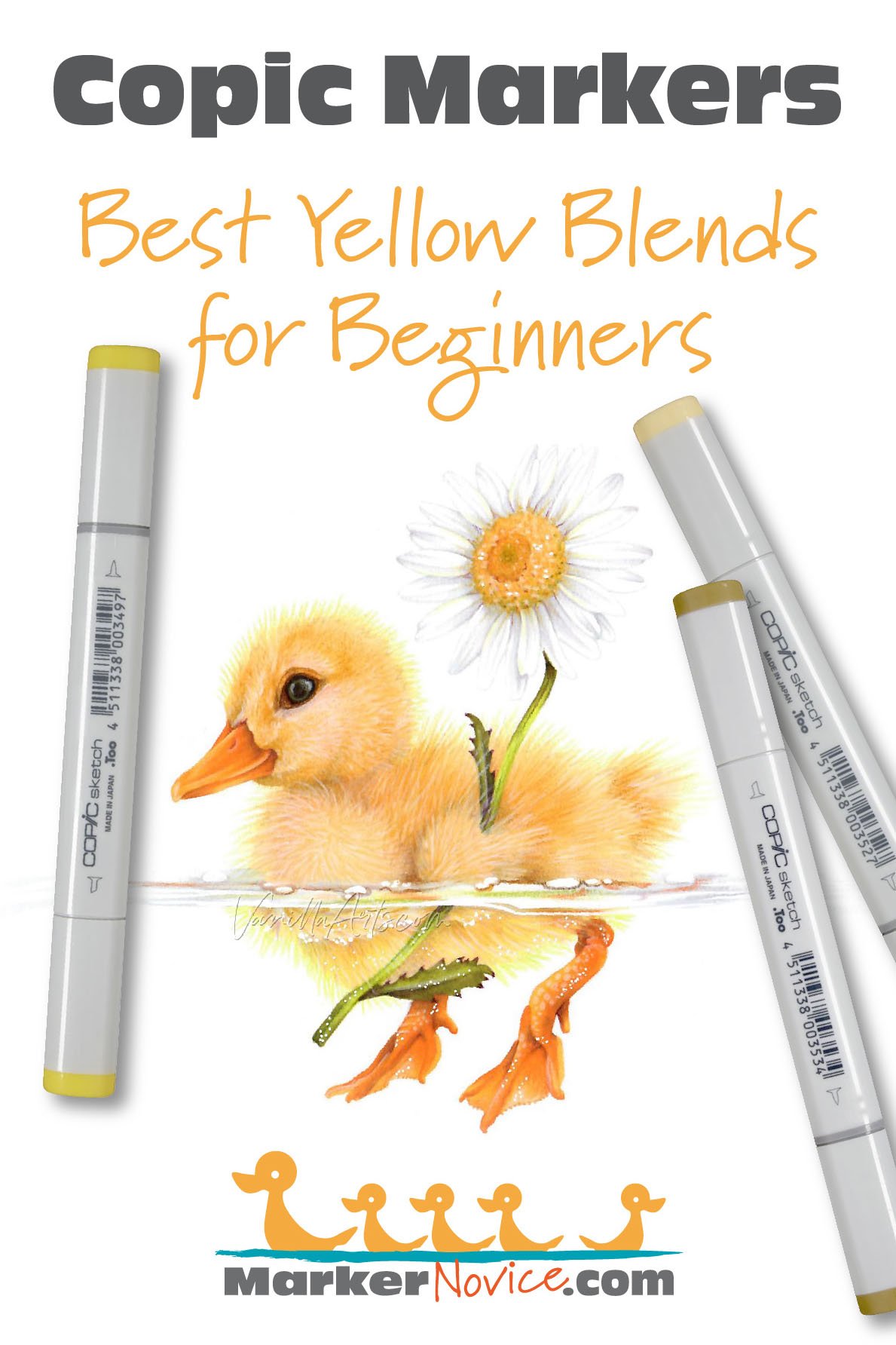
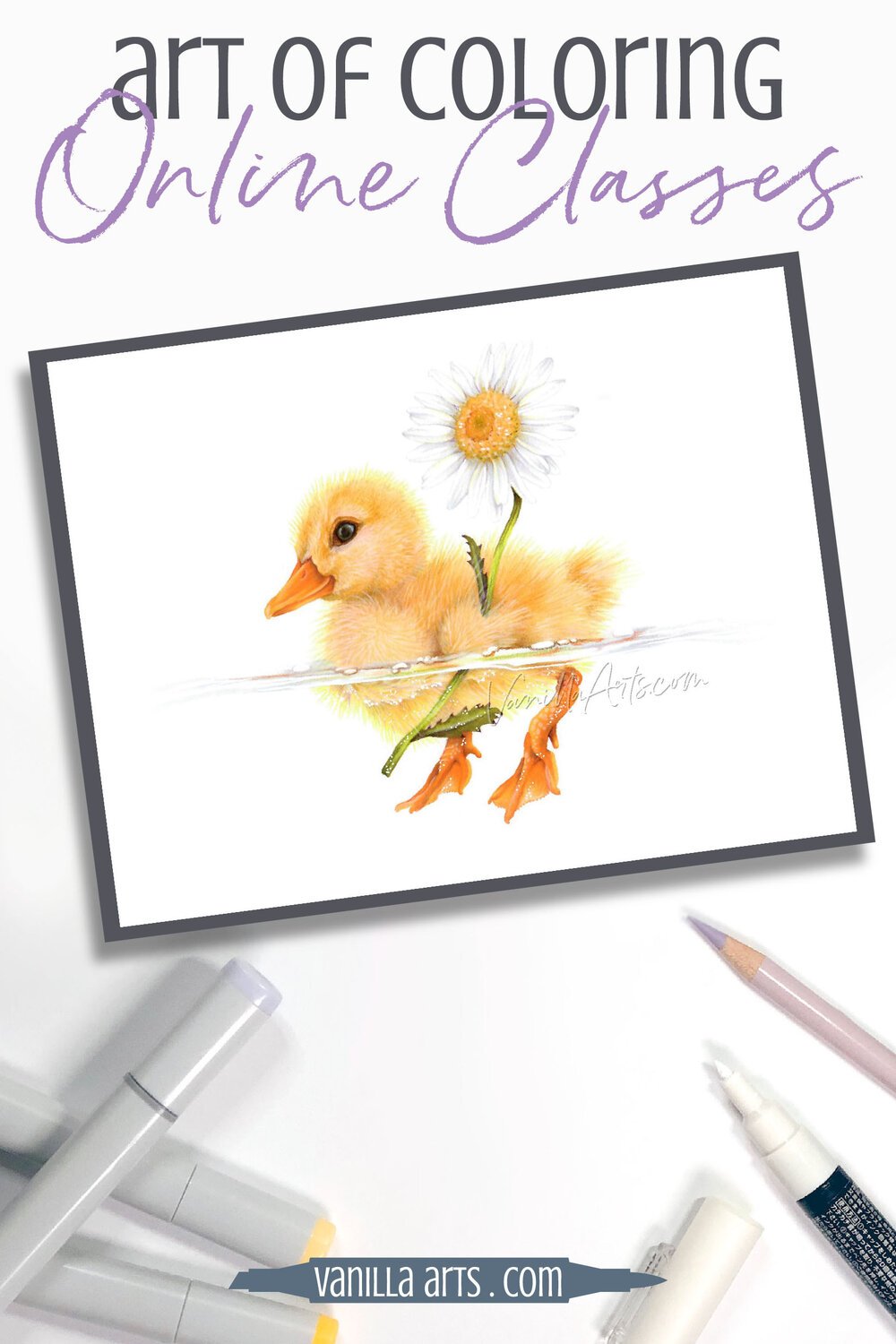
“Daisy Duckling” by the author, Amy Shulke. Copic Markers and Prismacolor Colored Pencils on Cryogen Curious Metallic White 89 lb. paper. This project is featured Amy’s online class teaching how to develop fuzzy fur or downy feathers. More info here.
Michelle Houghton’s Favorite Yellow Copics
Find Michelle on her Copic in the Craftroom channel at YouTube and at Scrapweaver.com
Michelle recommends Y21-Y23-Y26-Y28 for beginners.
She colors them light to dark.
I think Michelle might be a yellow fan. Whenever I’ve asked her for color recommendations, she’s given me one suggestion. This time, she pretty much mentioned every yellow Copic makes.
The girl likes yellow.
Michelle says:
The ones I reach for most are Y00, Y21, and Y28. Then I work in Y21, Y23, or Y26 depending on the situation.
But oh, I really love the Y-Thirties too!
You may find Michelle’s choice a bit surprising. The Y-Twenty family is not what a beginner usually thinks of when someone says “yellow”.
The Twenties are very organic and natural looking yellow; they’re a a brassy gold which reminds me of Naples Yellow. There’s a noticeable earthiness to the Y-Twenties. They’re much more muted than rubber-duckie yellows.
And yet the Twenties are absolutely gorgeous!
Michelle’s choice is smart. She colors many flowers and even when she’s coloring a cartoon stamp, it still has a nature-girl feel to it. Michelle’s yellow blend fits her personality so well!
Here’s Michelle demonstrating the Y30s here:
And here’s a handy comparison of the different yellow groups:
__________
Michelle is an elementary school teacher (BS Fine Arts, MA Education) with over 20 years of paper-crafting experience. She’s is a former Copic Certification Regional Instructor for Imagination International. Michelle runs the Copic in the Craftroom website and YouTube channel. Her Copic College events are favorites with Copic fans at all levels.. Visit her at Scrapweaver.com.
WE ASKED YOU!
What’s the favorite yellow blending combo for Vanilla Arts readers? Y13-Y15-Y17 won hands-down. It wasn’t even close!
Keep reading because this combo is also recommended by 2 instructors here today!
Cordine van der Touw’s Beginner Yellow Blend
Find Cordine’s latest projects on her Facebook page here. You can also find her at Copic Marker Europe and Cordine’s latest classes for Copics at Colourstock.
Cordine recommends Y13-Y15-Y17 for your first yellow blending combination.
Cordine says:

This is a bright yellow combination which is useful on its own but it can also be modified.
I love how I can add for example Y38 for a darker yellow combination or add Y11 for a lighter yellow combination.
This seems to be the driving theme behind all of Cordine’s Copic blending recipes.
She starts with a core blending combination but then adds markers to the dark end to make the color deeper. Or she’ll add a few lighter markers to shift the combination lighter. and brighter.
Far too many beginners think they need totally new yellow combinations for everything they want to color. Instead, Cordine uses her core group to create a full range of yellows.
Cordine proves that you can do a lot with a small but smart collection of basic blends.
__________
Cordine is an office manager in The Netherlands. She’s an avid paper crafter who loves card making, scrapbooking, and coloring stamps with Copic and colored pencils. She has taught Copic since 2013 for Colourstock as the Benelux region representative (Netherlands, Belgium, and Luxembourg). Contact Cordine here.
Elena Cazares’ Favorite Yellow Copic Blend
Elena recommends Y17-Y15-Y13 for beginners. She colors them dark to light.
Elena says:
I have several favorite yellows but I keep coming back to this classic and it’s a good one for beginners to start with. Y17 is sunny and bright but not wimpy. It reminds me of a sunny-side-up egg!
I also use Y08-Y06-Y04 a lot but that combination has a little hint of green to it. It works for flowers but most beginners wouldn’t want that greenishness if they were coloring eggs.
Uhm… cooking tips aside, notice that Cordine and Elena recommend the same combination and yet their yellow items look different?

This is one of the hardest concepts to convey to beginners. Many colorers spending a lot of time collecting marker recipes and blending combination swatches assuming that if they use that exact blending combination, they’ll get the same results.
But there are so many variables to blending—
Did you apply the color dark to light or light to dark?
How fast or slow do you color?
What is the ratio of dark ink to light ink used?
What pressure was used to apply the dark ink?
How generous was the blending coat?
Did you reblend several times?
Are you using the same brand of paper?
Change one or more of these factors and you’ll change the look of the blending combination.
Every person using this yellow Copic Marker blending combination will get slightly different results.
Cordine and Elena’s coloring looks different because they’re different people with different processes— even though they’re using the same markers. This is also why your project will differ from theirs.
Who colored it is usually more of a factor than what they used.
Amy Shulke’s Favorite Yellow Markers
Hey, that’s me! You can find me here at MarkerNovice.com or at my artistic coloring site, VanillaArts.com.

My favorite yellow blending combination is B60-Y35-Y21.
No, that’s not a typo. I really do use B60 in this yellow blend.
And yes, I teach this blue-yellow underpainting combination to my beginner level students— often in their very first class.
Underpainting is not nearly as difficult as it sounds.
It’s deeper thinking, not harder coloring.
Why do I add blue to my yellow blending combination?
Because although Copic makes 20 different yellows, they really don’t make natural looking shade yellows.
And I know, right now you’re thinking: But I’ve seen lots of tutorials on YouTube where they shade with something like Y19 or maybe an orange or brown marker.
Nope. That’s what they do but it doesn’t look realistic. Shade isn’t just a darker version of the original color. Shade also isn’t more saturated than the base color. When you pull out a Y marker which ends in 8 or 9, you’re just getting a more intense yellow, not shade.
Take a look at my duckling here. Check out the shady area under his chin. There’s not a lot of light hitting inside the fold of his neck, is there?
And that’s my point. Copic doesn’t make a good yellow to use in these crevices.
So I fall back on my painter’s background and I make my own shady yellow.
B60 is a very cool, very grayed blue. By laying B60 down first and then covering it completely with Y35, I’m doing exactly what I’d do with watercolor to mix up a grayed, cool, shady yellow.
B60 is a very gentle underpaint for beginners who aren’t quite used to making muddy shade colors. It’s easy to cover, easy to blend. Many of my other yellow blending combinations use BV, V, or even a stronger gray marker. But for beginners, I start them on the underpainting process by using B60 under this yellow.
It’s an easy shaded yellow for those who intend to grow and progress to realistic marker illustration.
And in case you’re wondering— no, I didn’t invent underpainting. I borrowed it from standard watercolor and oil painting techniques. The concept actually goes back to the 1700’s and the Old Masters. I started underpainting with Copics back in the early 1990’s when I got frustrated at the lack of shady colors in the Copic ink palette. I didn’t realize at the time that nobody else was doing it.
Do beginners need to underpaint Yellow?
I would.
Look, if you’ve never drawn, painted, or used Copics before, and especially if you’re trying to learn how to color using YouTube videos, blogs, website tutorials, and other free resources…
Well, that’s a lot on your plate at once.
You’re at a disadvantage because free instruction is not the same as good instruction.
So maybe concentrate on figuring out how to blend before you worry about underpainting.
One hurdle at a time, eh?
But once you’re blending well?
If you intend to color realistic items, you’ll have to underpaint yellow because Copic does not make realistic yellow shade tones.
They simply don’t.
You must make shady yellow yourself. Underpainting is the easiest way to mix markers and once you get the hang of it, you’ll use it all the time.

SPF50 for Yellow
Learn to tame bright and vibrant yellow Copic Markers in “SPF50 for Yellow”, a beginner’s challenge online class from Amy Shulke. Underpaint yellow to soften, desaturate, and tone Copic’s most vivid and saturated colors.
We’re making the shady yellows we wish Copic would make!

Which yellow(s) should you avoid?
Honestly, I’d stay away from the Y-Zero family. The Zero family includes Y02, Y04, Y06, and Y08.
Avoiding the Y-Zeros will be hard because many beginners are drawn to the bright cheerful colors found in the B-Zeros, YR-Zeros, YG-Zeros, etc. Zeros are catnip to newbies. Plus, I’ve noticed a lot of card makers turned Copic instructors use the Y-Zeros in their tutorials and classes.
But here’s the problem: The Y-Zero family look like office highlighters.
Copic makes an entire group of florescent (F) markers. Ironically, the Y-Zeros are more highlighter-ish looking than FY1 (Florescent Yellow #1).
The Y-Zero family are a bit obnoxious. You can live without them.
Why is Y00 green?
Notice that of the 4 instructors here, nobody recommended buying Y00, Y000, or Y0000?
That’s because they’re kind’a green.
Yes, the sub-zero yellow markers actually look pale green on many brands of paper and in certain lighting conditions. It’s very disappointing!
Why do they look green?
The entire Y-Zero family is a cool yellow.
Warm yellows look a bit orangish, cool yellows look greenish.
Y08, Y06, and Y04 are dark enough that the colors read as very yellow. But from Y02 on down, these markers have far more solvent than colorant. The coolness of the yellow is easier to spot and they read as a “sickly” yellow to many people.
You’ll notice in this entire Best Blending Combination series of articles, we rarely recommend sub-zero markers for beginners. You can definitely skip the Y-Sub-Zeros until later.
So there you go,
The Best Yellow Copic Marker Blending Combinations
If you’re new to Copic Markers, we highly recommend Copic’s Y-Ten series of yellow markers, especially if you intend to build a small yet versatile alcohol marker collection.
Y17-Y15-Y13 make an easy blending bright yellow or try Y15-Y13-Y11 for a softer look. Both are versatile yellows for any occasion.
Amy Shulke is a professional illustrator who has used Copic Markers since 1990. She teaches artistic coloring classes online at VanillaArts.com and locally in mid-Michigan.
Marker Novice is Amy’s completely free resource devoted to beginner marker education. For intermediate/advanced artistic coloring articles, see her Studio Journal here.

Marker Testing: Colors Mentioned Above



Quack, Quack!
Join Amy for a fun Copic Marker + Colored Pencil lesson in the Vanilla Workshop
Learn to color touchably soft fur or fuzzy feathers
Copic is fun but we need the help of colored pencils to give us realistic furry fluff. But unlike many fur tutorials, drawing a bunch of hairs doesn’t help. Amy covers the professional approach to coloring dimensional bodies with real looking fur.
Immediate access. Watch as many times as you want, whenever you want
Class Printable Pack Includes:
Class syllabus with detailed recipe guide
Full color project sample
Guide to Copic base
Detailed color map
Project inspiration references
Best Orange Blending Combinations for Copic Marker Beginners: Tips from 4 Instructors
Which Orange Copics are Best for Beginners?
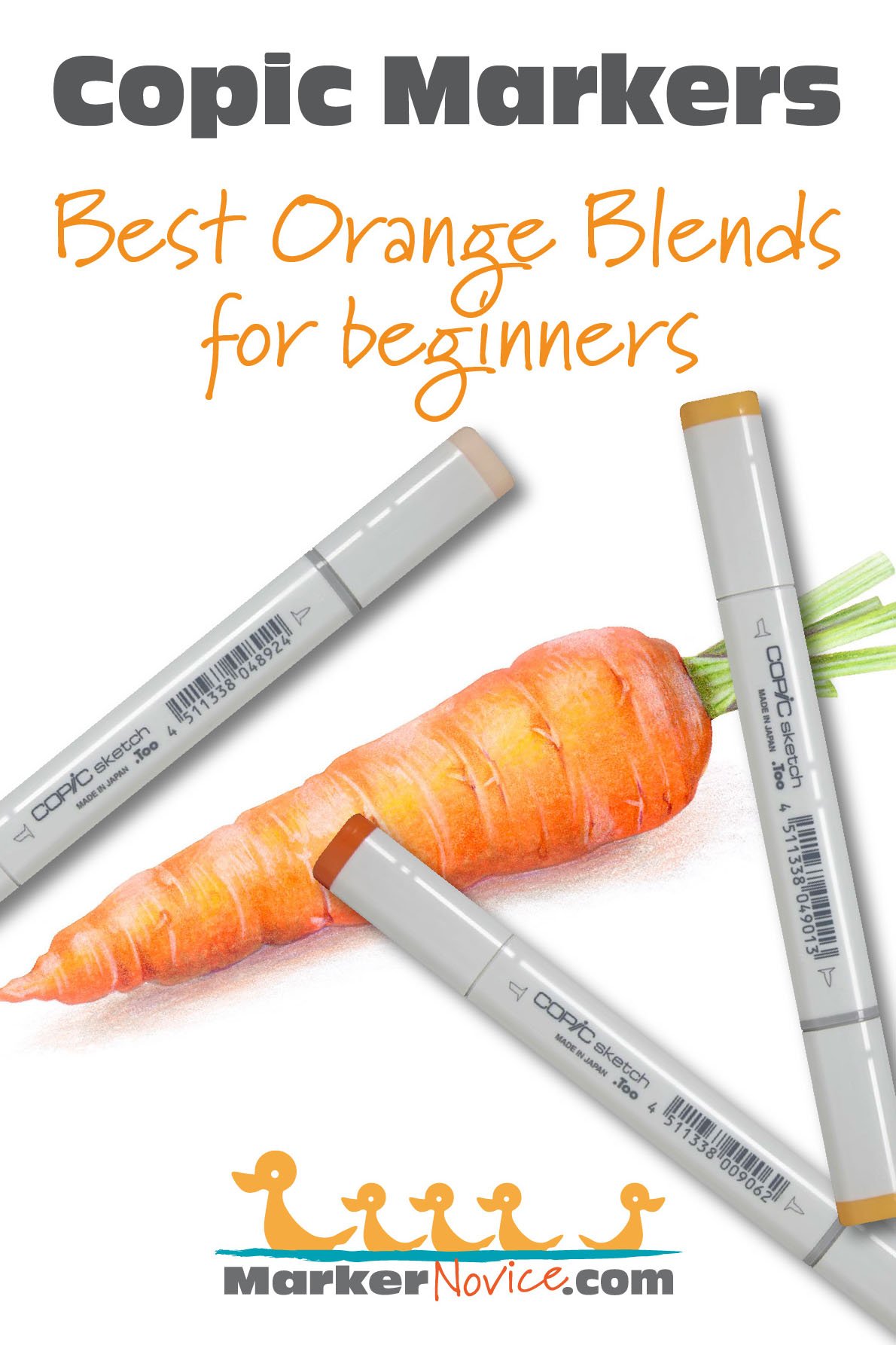
We highly recommend Copic’s YR-Zero series orange markers for beginners and anyone building a small, versatile alcohol marker collection. YR09, YR07, YR04 are easy blending oranges which can be used for food, flowers, and holiday images…
Are you purchasing Copic Markers for the first time?
While buying lots of pretty markers sounds like fun, this is real money we’re talking about.
Your money.
Sadly, we usually can’t buy all the colors at once. When I started, money was tight so I debated the worth of every color I purchased. Even with an art degree, I still made rookie mistakes. Many of the markers from my starter set are still gathering dust today!
If I could go back and change the past, I’d focus on useful individual blending combinations rather than grabbing any Copic in the clearance bin. It’s only a bargain if you actually use the marker!
In the spirit of helping you avoid my mistakes, I started to wonder:
What’s the best orange blending combination for Copic Marker beginners?
I asked three of my favorite marker instructors about which orange markers they recommend for first time colorers.
Which YR markers offer you the best value?
Which Copic Yellow-Reds are versatile enough to color many different orange items?
Which YRs do we teach with?
Which orange markers do we use in our own work?
Which Orange Copics are Best for Beginners?
We highly recommend Copic’s YR-Zero series orange markers for beginners and anyone building a small, versatile alcohol marker collection. YR09, YR07, YR04 are easy blending oranges which can be used for food, flowers, and holiday images.
YR18, YR16, YR14 would be our second choice for a more organic orange blending combination.
Let’s talk to four Copic instructors to find out why.

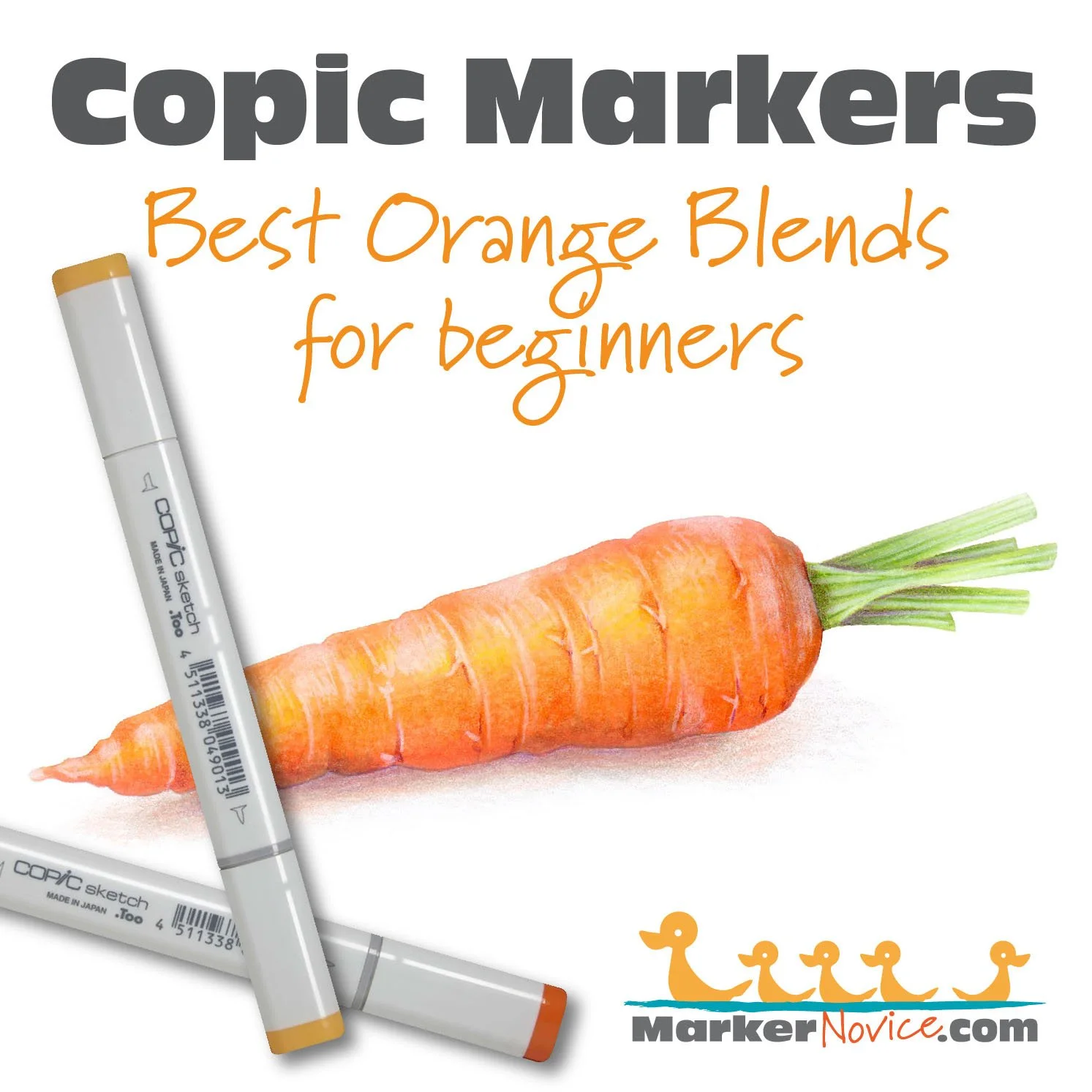
“Carrot” by the author, Amy Shulke. Copic Markers and Prismacolor Colored Pencils on X-Press It Blending Card paper. This project is Amy’s sample project for “Coloring Basics: Fences”, technique tips and talk from two Copic instructors. More info here.
Michelle Houghton’s Favorite Orange Copics
Find Michelle on her Copic in the Craftroom channel at YouTube and at Scrapweaver.com

Michelle recommends YR21-YR14-YR18 for beginners. She colors this combination light to dark.
Michelle says:
“There aren’t as many options with the YR family as we’d like but I use YR21 quite a bit. I basecoat with the YR21 and for this combination, I sometimes add Y25 under the YR14 if I want a brighter, more yellowy orange.
I also love the YR21, YR24, YR27 series but it’s very different. I use this golden combination on hair more than anything else.”
Michelle warns students who have purchased or inherited older markers about YR14. “It’s a great color but the plastic on the older caps does NOT match the color of the ink. The cap is darker and browner which can confuse many people. They changed the [plastic end] color on newer markers and it’s much more accurate now.”
Watch Michelle demonstrate this pretty blending combination in her “Finding Copic Color” video here:
Michelle is also hard at work on a video series which demonstrates every Copic Marker! You can see her blend the entire Yellow-Red family here:
Last, Michelle has a handy infographic comparing the various YR groups:
__________
Michelle is an elementary school teacher (BS Fine Arts, MA Education) with over 20 years of paper-crafting experience. She’s is a former Copic Certification Regional Instructor for Imagination International. Michelle runs the Copic in the Craftroom website and YouTube channel. Her Copic College events are favorites with Copic fans at all levels.. Visit her at Scrapweaver.com.
WE ASKED YOU!
In our survey of frequent Copic colorers, YR09-YR07-YR04 was voted favorite orange blending combination.
This isn’t a surprise. Many Copic fans favor bright, clean, vividly colored markers. You can’t get a brighter orange combination than the YR-Zero family!
Cordine van der Touw’s Favorite YR Blending Combination
Find Cordine’s latest projects on her Facebook page here. You can also find her at Copic Marker Europe and Cordine’s latest classes for Copics at Colourstock.
Cordine recommends YR09-YR16-Y17 as a beginner orange Copic blend.
Notice that’s two YR markers plus one Y?
Cordine says:
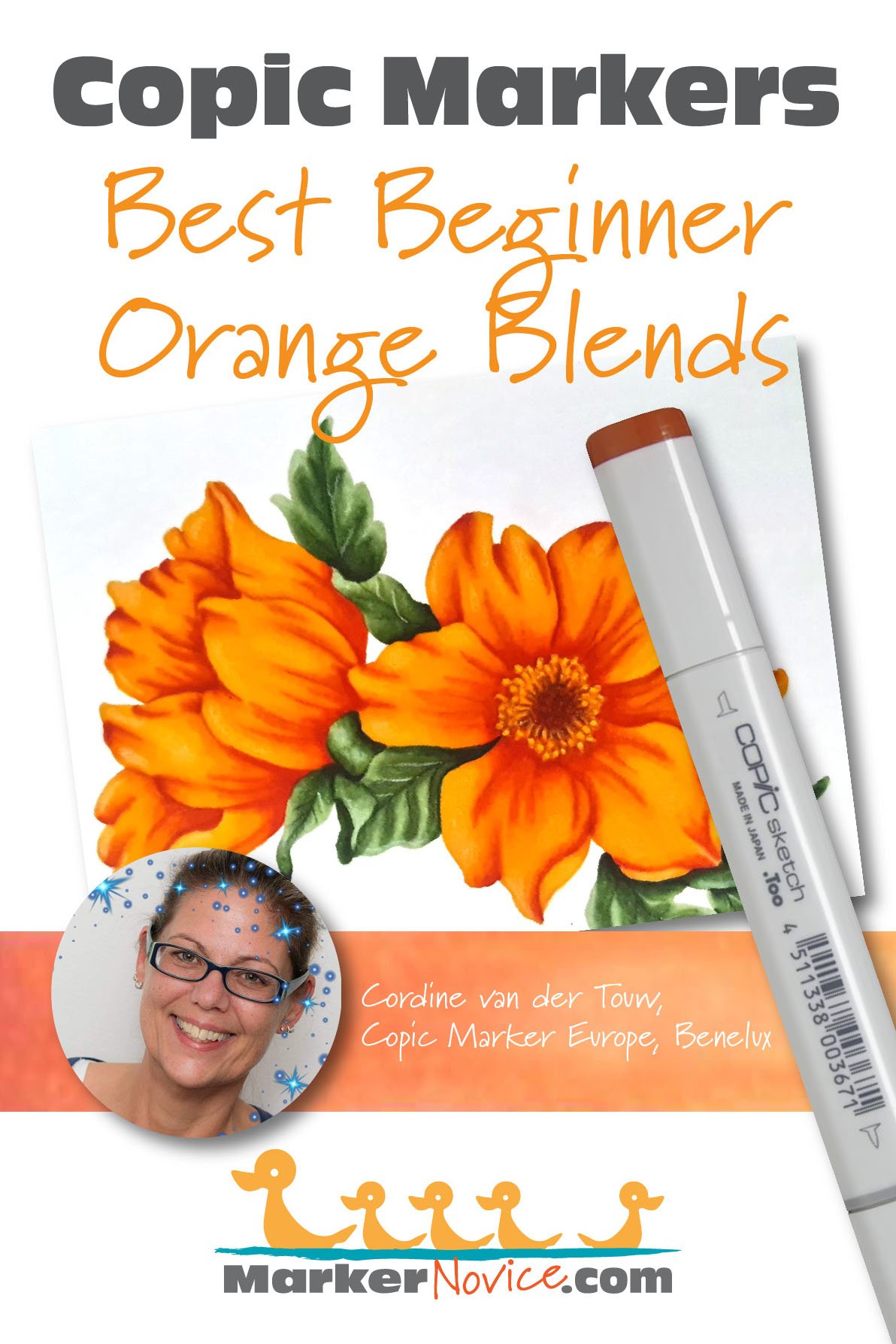
My to go to YR combination is YR09-YR16-Y17.
Sometimes I switch the YR09 to YR07 if I want a slightly softer orange.
I love this combination because it’s flexible! If I want a yellower project i would ad a Y15 after the Y17. If I want a darker looking orange, I can start with the red or the brown family plus these YRs.
I love Cordine’s approach to blending combinations.
Her goal is to color something orange but she’s actually not buying many orange markers.
Instead, she borrows yellows and either reds or browns to expand two YR markers into a larger blending combination.
This is a smart budget strategy!
__________
Cordine is an office manager in The Netherlands. She’s an avid paper crafter who loves card making, scrapbooking, and coloring stamps with Copic and colored pencils. She has taught Copic since 2013 for Colourstock as the Benelux region representative (Netherlands, Belgium, and Luxembourg). Contact Cordine here.
Elena Cazares’ Favorite Orange Copic Markers
Elena recommends YR07-YR04-YR02 for beginners. For advanced colorers, she recommends YR18-YR16-YR14.
Elena says:
YR can be a bit stubborn so I like the YR-Zero family for beginners because they’re easy to blend. YR07, YR04, and YR02 won’t give you any trouble.
But in my own work, I like orange to have a bit more sophistication. YR18, YR16 and YR14 are a bit desaturated and natural looking. They're organic colors, better for flowers and food.

I like that Elena acknowledges that there are beginner blends but also more challenging combinations which are best saved until you have some experience.
Beginners tend to focus on collecting colors— but there’s more to markers than just the appearance.
Some of the prettiest colors can be frustrating to blend!
By recommending an easy-blend orange combination to beginners, Elena helps her marker novices grow their skills before they tackle harder blends.
By the way, Elena always colors dark to light and she often underpaints orange with blue to create an interesting shady orange.
Amy Shulke’s Favorite Orange Markers
Hey, that’s me! You can find me here at MarkerNovice.com or at my artistic coloring site, VanillaArts.com.

My favorite orange blending combination is actually one orange and two yellows: YR07-Y38-Y35.
Fall is about the only time I teach with orange markers. Aside from the occasional accent, orange is just not a color I use much. Instead of asking my beginners to invest in a bunch of oranges, I borrowed two of yellows from our standard yellow combination.
Y38 and Y35 are chameleon colors. Paired with orange, they look orangish, paired with yellow, they look dark yellow.
I love it when I can save student’s money by using the same markers in completely different blending combinations!
Orange can be a slightly stubborn color but Y markers have lots of solvent in their formula. Adding a yellow marker to any orange combination increases the ease of blending.
I color dark to light and I always underpaint orange rather than using a darker YR or E marker to shade. My favorite underpaint for orange markers is usually V20 or V22 but the carrot shown here was underpainted with one of the YG markers borrowed from the stems. Using colors from other areas of the same image is how I keep my class supply lists short and budget-friendly.
And in case you’re wondering, I did not invent underpainting. Underpainting goes back several centuries to classical era oil painting. I’m simply one of first fine artists to promote underpainting as a technique specifically for Copic Markers. To be honest, when I started underpainting Copics, I didn’t realize that nobody else was doing it!
Do beginners need to underpaint orange?
No.
If you’ve never drawn, painted, or used Copics before, you don’t need to worry about underpainting.
Skip it.
Underpaint creates the look of realistic shade by creating a dirty, dingy orange. In art, we call this “desaturation”.
Real shade is not darker, it’s desaturated.
But for beginners, it’s much more important to learn how to color orange with confidence.
Once you’re blending without thinking too hard about the actual blending process, then try adding an easy underpaint as a challenge element.
You’ve got years to work on building skills. Master blending a variety of YR combinations before you branch into underpaint.
Should I purchase YR00 for skin tones?
Many beginners use YR00, YR000, or YR0000 to color caucasian skin.
Now I don’t know about you but I happen to be a pale caucasian.
If I hold a YR00 up to my arm, it’s not even close to my skin color. In fact, my skin doesn’t match any of the YR markers!
If you like to color cartoons, then you’ll probably enjoy using YR00 for skin but it’s a pretend skin color.
No human has YR colored skin. Copic Yellow-Red markers are all too pink, too orange, or too yellow for realistic skin tones.
For realistic caucasian skin, you’ll want to look closer at the Earth family (E). My skin is pretty close to E21 but I use E50 in a lot of classes too.
We also recommend this YR blending combination…
As I mentioned, I don’t use orange in very many beginner classes.
fall leaves
Halloween pumpkins
snowman noses
carrots for the Easter Bunny
I’m sure you can think of a few more orange objects but honestly, I simply don’t find orange to be an investment you need to make unless it’s October.
But there is a YR blending combination I use all the time. In fact, my classes call for this combination more than purple!
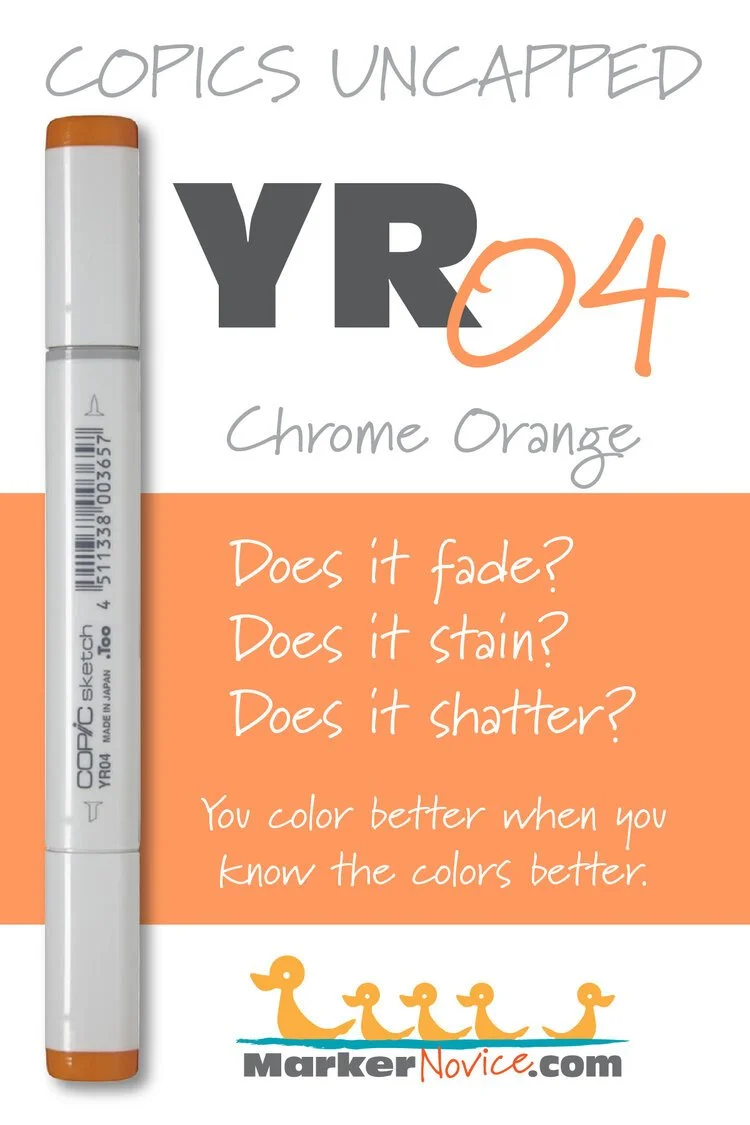
Copic YR27-YR24-YR21 is the perfect combination for gold, brass, and even golden blonde hair.
And this recommendation is unanimous. Michelle, Cordine, and Elena all mentioned the importance of the YR-Twenty family without me asking. We all teach with this combination.
When I first started teaching beginners, I developed a master Copic list. You can subscribe to my newsletter to get a copy of this same list from my FREE download library, subscribe here. Anyway, my intention was to teach all my beginner classes using only the markers on this list.
To make the list, I ran through the rainbow, creating a versatile blending combination for every Roy G. Biv color plus pink and also several browns for the various skin tones, hair colors, and natural stuff like wood and dirt.
But then month after month, we kept finding things in the rubber stamps which needed gold.
Sometimes it was little things like a belt buckle or a key. There were many animals, flowers, and food like bread or muffins which simply didn’t look real when colored bright yellow.
Then when the winter holiday season hit, almost every commercial stamp featured large items which were actually golden— Christmas ornaments, stars, jingle bells, sleigh runners, candlesticks, angel halos, trumpets, decorative filagree, and fizzy champagne in gold rimmed flutes.
Golden items look cheap when colored with Y markers!
Gold wasn’t even on my radar until I taught classes for card makers. I rarely used gold in my professional illustrations but paper-crafters color gold all the time!
Who’da thunk?
If you color stamps or coloring books, seriously consider adding the YR-Twenty family to your Copic shopping list!
So there you go,
The Best Orange Copic Marker Blending Combinations
If you’re new to Copic Markers, you can’t go wrong with the YR-Zero series. They’re a bright and cheerful classic orange without the stubborn blending tendencies you’ll find in some of the other YR groups.
For a more organic and natural looking orange, try YR18, YR16, YR14. It’s a bit harder to blend but better for realistic coloring.
Because orange isn’t a frequently used color, try Cordine’s advice about supplementing YRs with yellow, red, or earth markers.
And if you color stamps or coloring books, put the YR-Twenties towards the top of your shopping list. They really come in handy!
Amy Shulke is a professional illustrator who has used Copic Markers since 1990. She teaches artistic coloring classes online at VanillaArts.com and locally in mid-Michigan.
Marker Novice is Amy’s completely free resource devoted to beginner marker education. For intermediate/advanced artistic coloring articles, see her Studio Journal here.
Marker Testing: Colors mentioned above


Best Red Blending Combinations for Copic Marker Beginners: Tips from 4 Instructors
Which Red Copics are Best for Beginners?
We highly recommend Copic’s R-Twenty red series for beginners and anyone building a small, versatile alcohol marker collection. R29, R27, R24, R22, and R20 are traditional reds which can be used for food, flowers, and holiday images. The lighter reds in this series can be used for pink objects.

So, you’re new to Copic Markers and starting to build your collection?
A colorful spending spree sounds like fun until you’re confronted with 10 similar shades of red. This wasn’t supposed to be so stressful!
I remember those days. Money was tight, so I had to pick colors wisely. Even with an art degree, I still made rookie mistakes. My first major purchase was a 72-set and many of the markers from that original box are still gathering dust today!
If I had to do it again, I’d focus on useful individual blending combinations, buying just the colors I needed at the time. It’s only a bargain if you actually use the marker!
In the spirit of helping you avoid my mistakes, I started to wonder:
What’s the best red blending combination for Copic Marker beginners?
I asked three of my favorite marker instructors about which reds they recommend for first time colorers.
Which reds offer you the best value?
Which Copic reds are versatile enough to color many red items?
Which reds do we teach with?
Which red markers do we use in our own work?
Which Red Copics are Best for Beginners?
We highly recommend Copic’s R-Twenty red series for beginners and anyone building a small, versatile alcohol marker collection. R29, R27, R24, R22, and R20 are traditional reds which can be used for food, flowers, and holiday images. The lighter reds in this series can be used for pink objects.
Let’s talk to four Copic instructors to find out why.

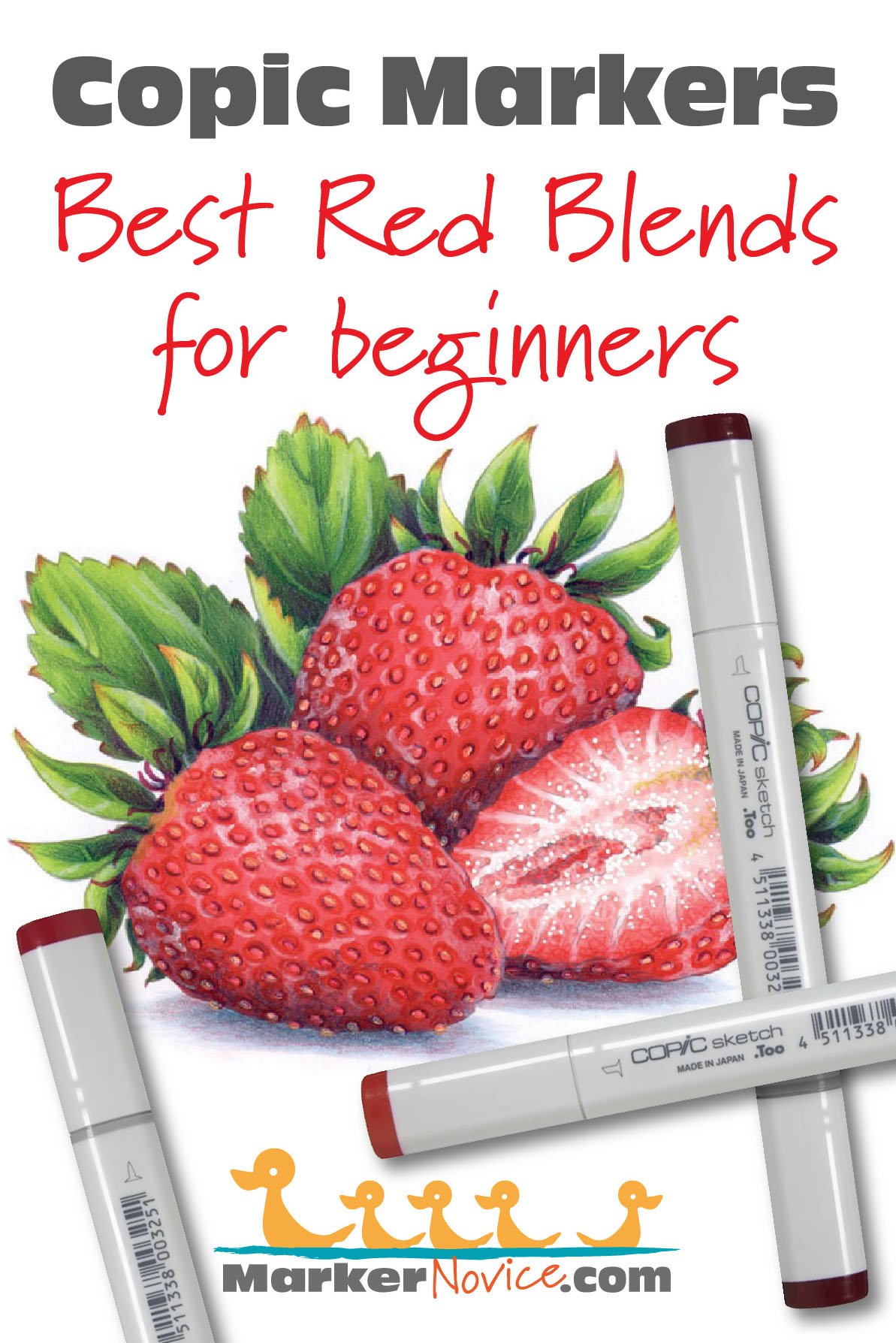
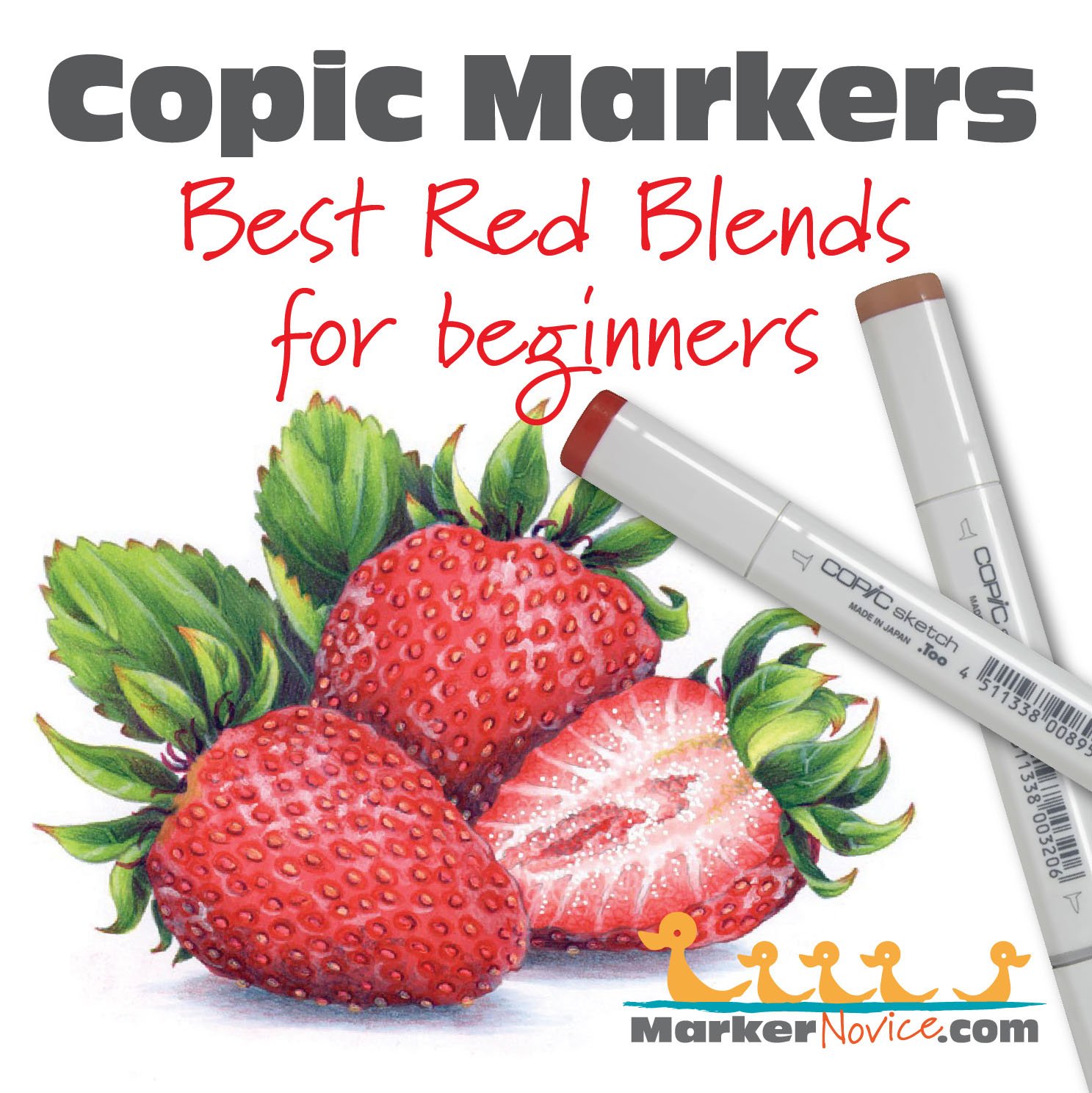
“Strawberry Trio” by the author, Amy Shulke. Copic Markers and Prismacolor Colored Pencils on X-Press It Blending Card paper. This project is the finale of Marker Painting Foundations, a 12 week course to improve your Copic Marker coloring. More info here.
Michelle Houghton’s Favorite Reds
Find Michelle on her Copic in the Craftroom channel at YouTube and at Scrapweaver.com
Michelle recommends R29-R24-R22 for Copic beginners. She frequently adds R59 if she needs a darker combination.

Michelle says:
The reds I most-often reach for are R22, R24, R29, R59. I also teach with them. This a very standard blending group but it’s one I have reliably used for a very long time.
However, I have shifted. Originally, I colored them from light to dark, now I tend to use them dark to light.
The R-Twenties are incredibly popular with colorers at all levels for a reason. R29 is a traditional fire-engine red, it’s not noticeably warm or cool, it’s just a beautifully balanced red.
Watch Michelle demonstrate her combination, offering tips for blending this combo both light to dark and dark to light.
In this next video, Michelle offers a more advanced combination, it’s beautiful!
__________
Michelle is an elementary school teacher (BS Fine Arts, MA Education) with over 20 years of paper-crafting experience. She’s is a former Copic Certification Regional Instructor for Imagination International. Michelle runs the Copic in the Craftroom website and YouTube channel. Her Copic College events are favorites with Copic fans at all levels.. Visit her at Scrapweaver.com.
WE ASKED YOU!
In our survey of frequent Copic colorers, R29-R27-R24 was by far their favorite red blending combination.
R59-R46-R24 was the next most popular with some very strong supporters.
I asked about other red combinations such as the R-Teens and R-Thirties but most felt these were for “special conditions” rather than all-purpose coloring.
Cordine van der Touw’s Favorite Reds
Find Cordine’s latest projects on her Facebook page here, also at Copic Marker Europe and her latest classes for Copics at Colourstock.
Cordine recommends R59-R46-R24 as a beautiful red for beginners. She adds R14 if she needs a lighter red in the combo.
Cordine says:

R46 is my base red. It’s gorgeous. R59 adds a lot of depth and I can add B34 underneath if I need even more darkness.
R24 is a very versatile red which works with my combination here plus many other red combinations. I recommend it for beginners.
What Cordine does here is very smart. She started with a base red which she loves (R46) and built her combination around it.
A good collection of markers must include your personal preferences because the markers you like are the markers you’ll use most. Start with a color you love to create a combination that’s perfect for you.
And a side note— Notice that Cordine’s combination jumps across several number groups. She’s combining a 59 with 46 and 24. Cordine proves that beautiful things can happen when you mix the numbers.
I also agree with Cordine, if you’re making your own combination, R24 is an extremely flexible color which works well with many reds.
__________
Cordine is an office manager in The Netherlands. She’s an avid paper crafter who loves card making, scrapbooking, and coloring stamps with Copic and colored pencils. She has taught Copic since 2013 for Colourstock as the Benelux region representative (Netherlands, Belgium, and Luxembourg). Contact Cordine here.
Elena Cazares’ Favorite Reds
Elena recommends R29-R27-R24 for beginners. For an added challenge, try underpainting the R29 with B32.
Elena says:
I love working with this combination because it’s a bright, true red. The R27 makes this an easy-blending combo for beginners. Be sure to completely cover the R29 with lots of R27 ink to make the smoothest blend possible.
In my own coloring, I always underpaint this combination with B32 but if I want a deeper red, I used B34. Beginners can skip the underpaint or try it when they feel brave.
Elena is correct. You’ll often see advanced Copic colorers use the R29-R24-R22 combination, as Michelle Houghton recommends.
I frequently do this myself, skipping more than the recommended 2 number values. Look at the last number on the cap, from R29 to R24 is a larger than average distance.
But R29 is a staining color. The jump from 29 to 24 is a big step for beginners, ESPECIALLY when you work at a larger scale as Elena does. It takes practice to blend big jumps seamlessly on 8 inch images. Elena recommends that beginners use R27 to fill the gap. This creates a gentle transition from R29 to R27 to R24.
Elena’s combination turns out slightly darker than Michelle’s but they’re both beautiful and extremely useful blends which you’ll use for a lifetime.
Amy Shulke’s Favorite Reds
Hey, that’s me! You can find me here at MarkerNovice.com or at my artistic coloring site, VanillaArts.com.

My favorite red combination is R29-R27-R14. This results in a warmer red with no traces of pink.
I’m torn about red Copics. R29 is my definition of a true red but the R-Twenty Copic group is weird. From R22 down, the colors get oddly cool and very bubble gum pink.
Pink is NOT light red!
Pink belongs in the magenta family.
I usually teach with R29-R27-R24 or R29-R24-R21.
But in my own work, to keep my reds warmer and truly red, I switch to R14. I sometimes continue downward to R12 and R11. R14 has a much warmer feel than R24.
As with all the instructors above, I underpaint my reds. I do not use R39, R59, or R89 as a standalone “dark” red. They’re not desaturated enough to look like realistically shaded red.
For beginners, I recommend underpainting R29 with B32. I teach beginners with B32 under R29 in most of my classes.
In my own work, I usually underpaint R29 with BV23. My strawberries in this article show BV23 at work to make the underside of the berries look shady and distant. Remember, the underpaint color only goes in the deepest, shadiest places. Leave room for R29 to shine by itself as a pure red because it’s gorgeous on its own.
And in case you’re wondering, I did not invent underpainting. Underpainting goes back several centuries to classical era oil painting. I’m simply one of first fine artists to promote underpainting as a technique specifically for Copic Markers. To be honest, when I started underpainting Copics, I didn’t realize that nobody else was doing it!
Do Beginners need to Underpaint Red?
No.
If you’re brand new to art and you’ve never drawn, painted, or used Copics before, you don’t need to worry about underpainting. Skip it.

Underpaint creates the look of realistic shade by creating a dirty, dingy red. In art, we call this “desaturation”.
Real shade is not darker, it’s desaturated.
But for beginners, it’s much more important to learn how to color reds with confidence.
This means mastering easy blends from one R marker to another.
Learn to blend your reds smoothly and stay inside the lines without over-inking the image before worrying about underpainting for realism.
Once you’re blending without thinking too hard about the process, then add underpaint as a challenge element.
B32 and B34 are excellent all-purpose underpaint colors which work under reds, greens, purples, magentas, and browns. Or try N2 and N4 which work under all the previous colors plus orange and blue too.
You’ve got years to work on building skills. Master blending red to red before you branch into underpaint.
And hey, when you’re ready, choose an instructor who actually understands underpainting. It’s a step up from hobby-level coloring so you’ll want to learn from someone skilled enough to explain the color selection process. Don’t get stuck with a trend-following instructor who simply feeds you underpaint recipes they found on the internet.
It’s Hard to Imagine a Copic Collection Without R29!
There are some colors you can delay buying for a while (even years) but a traditional red combination should be one of your first investments.
As you can tell from the four instructors in this article, we all prefer slightly different combinations but we’re consistent about liking the R-Twenty markers.
R-Twenties are great for value and versatility.
Copic’s R-Twenty series of reds is ideal for beginners. R29, R27, R24, R22, and R20 can be used together or as key parts of unique blending combinations.
I know it’s tempting to start with the lowest number family and many of the Copic sets will give you R-Zeros or R-Tens before the R-Twenties… but there’s a reason R29 is Copic’s top selling red.
R29 is popular because it’s beautiful but it’s also pretty darned handy!
Keep the R-Twenties in mind as you shop for your first red blending combination. They’re an excellent first-purchase.
And if you can’t find R29, I agree with Cordine— R46 is close in both color and value. It’s even a bit less staining than R29. Give it a try!
Amy Shulke is a professional illustrator who has used Copic Markers since 1990. She teaches artistic coloring classes online at VanillaArts.com and locally in mid-Michigan.
Marker Novice is Amy’s completely free resource devoted to beginner marker education. For intermediate/advanced artistic coloring articles, see her Studio Journal here.