
R080 Pale Cherry Pink: Testing Ohuhu Markers for Lightfastness and Quality
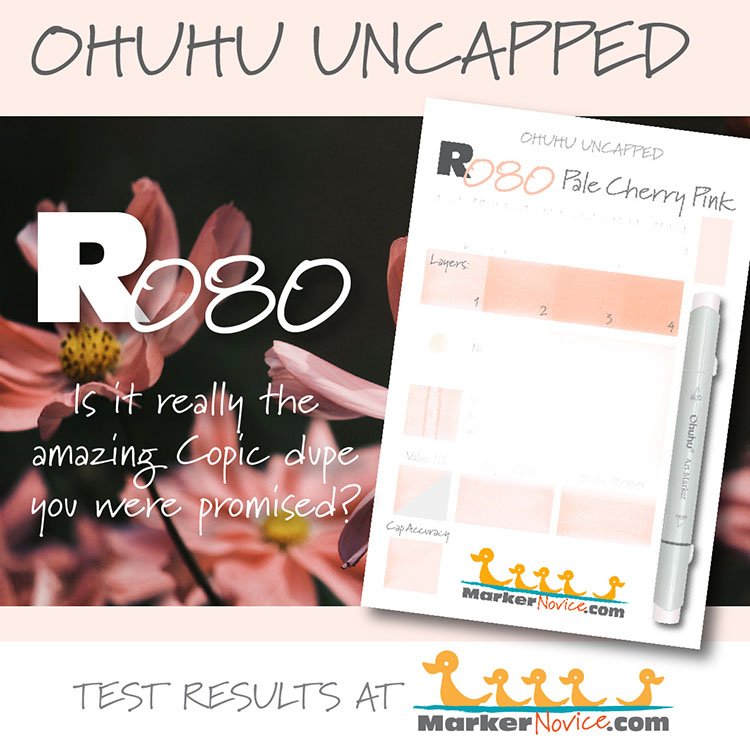
R080 Pale Cherry Pink
Let’s take a closer look at this Ohuhu Marker and its ink characteristics.
You were told “Ohuhu is the Copic slayer! They’re like Copic Markers but better!”
Is it true?
Every Ohuhu Marker has different characteristics based upon its unique ink formula. No matter how great they say the marker is, test results do not lie.
So are Ohuhu markers as great as you’ve heard?
Let’s look at Ohuhu R080 to find out.
WARNING: Ohuhu markers have numbers on the cap but not on the body of the marker. We do not recommend coloring with both caps off due to the risk of accidentally placing the wrong caps on a marker.
Test results: Ohuhu R080 Pale Cherry Pink
REFILL WARNING! At this time, Ohuhu does not sell refills for R080. To date, you must purchase a new marker when your current marker runs dry. Ohuhu is deceptive when they advertise that their markers are refillable. In reality, they only offer 50 refills in a line of 320+ markers. See Ohuhu’s current list of refills here.
Temperature: A highly diluted warm red
Resemblance: Vermilion watercolor
Name: “Pale Cherry Pink” isn’t a terrible name but it will bother any artist who knows this color is light red rather than pink. Pinks are part of the Magenta or “RV” family. Light reds are warmer and have almost a peachy vibe to them. Light red is not pink.
Actual Value: N2
Unlike Copic, Ohuhu does not measure value— this is a glaring deficiency which makes finding blending combinations harder than it has to be!
All Copics are measured on a Neutral Gray value scale. The last number on the Copic cap indicates the value. We’re using the Copic scale to measure Ohuhu until Ohuhu releases a reliable value scale.
Cap Accuracy: The plastic on an Ohuhu Honolulu R080 is a close match to one coat of R080. The colored plastic is a bit translucent though which can make the color indicator look greyish at times.
Copic Substitution: Ohuhu R080 is similar to Copic R00.
Note: similar colors rarely behave the same way. At the time of writing, I have not fully tested R00. I’m speaking from experience only. Most markers this pale are easy to work with, they blend and layer well because there’s just not a lot of colorant in the color. Ohuhu’s R080 makes me worry though. See the “Buildup” and “Overinking” categories below for more information on my concerns.

Buildup: R080 reaches a maximum value in the blotchy areas at only two coats. Now reflect on how many layers you typically use to apply a skin-colored blending combination and then blend it smooth. Can you color a face with only two layers of ink?
Overinking: We do not recommend using more than 2 coats of R080.
Let’s be honest, most people will use R080 for coloring skin and faces. The people who will use R080 for skin are usually beginners and weekend hobbyists because trained artists tend to use fewer literal skin colors for skin. Because of this, the people using this marker for skin are the least prepared to deal with the blotches and problems R080 creates with just a second layer.
The average skin blending session likely involves at least four layers of ink. Now look at the color above for four layers of R080. Have you ever met anyone with skin that color?
For both reasons, I do not recommend the use of R080.
Shattering: R080 did not shatter and is likely made with only one dye in the formula.
Chromatography testing shows this ink’s behavior when it comes in contact with #0 Colorless Blender (solvent). High shattering colors may leak unexpected color when you make corrections or attempt to blend with any color that has a high solvent to colorant ratio. Shattering is not bad, it’s just something to be aware of.
Staining: Most pale ink colors do not stain but of the palest colors, any red will stain more than the others. R080 is slightly staining but not any more so than similar markers in other brands.
With alcohol markers, a staining ink is generally a sign of a low quality ink. Staining inks bond to the paper fibers and are reluctant to release. Staining inks make blending harder than it has to be!
Lift: This is where R080 fails to work as well as Copic ink. First, we had the layering issues cited above. Now look at the dark trench sides created during the lift testing. Do you want to create stripes like this on a face?
See staining swatch. Sample was given 6 stripes of #0 Colorless Blender, drying between each stripe. Results indicate how much lifting you can expect.
Lightfast: R170 faded about 40% during the test period. This is excessive and the sign of low-quality ingredients.
Samples were swatched on X-Press It Blending Card. 1 layer of ink was exposed to windowsill sunlight for 21 days. Approximately 10 hours of sun per day based on weather conditions. Note: we do not recommend displaying original marker art under these conditions.
Ink Color Family: The “R” in R080 indicates that this marker is part of the R red family. In my opinion, this is a good placement for this color although I can easily see someone arguing that this color is better suited to the YR family.
Given that the use of two letters (YR) typically indicates a blended ink (yellow ink + red ink), and the fact that R080 seems to be a single source ink (see shattering test), I think this marker is solidly in the R family.
The Ohuhu numbering system is complete garbage and doesn’t always make sense. Some orange and magenta markers are hidden in the R family. Be warned, when it comes to other color families, you can not trust anything you read on an Ohuhu cap.
Cap Numbering: The R 0X0 group is just three markers:
R050 is a light salmon color which almost glows
R070 is a medium Carmine color
R080 is skintone-ish
These inks are NOT related to each other, not arranged chromatically, and not arranged according to value or temperature. They don’t even work as a blending group. Ohuhu dumped these colors together without thinking because they don’t care about their numbering system.
As stated above, the Ohuhu numbering system makes no sense. The markers are not arranged in chromatic order so you can not trust the numbers to tell you whether this marker is lighter or darker than other Ohuhu markers with similar numbers.
I’m still early in the Ohuhu testing process. I will add more info to this article as I learn more and when I spot behavioral patterns.
From what I’ve learned so far, I will not be working with Ohuhu markers and I will discourage students from using them in my classes. They’re simply not worth the frustration.







Testing Ohuhu: YG080 Yellow Grey 08 for Lightfastness and Quality
YG080 Red Grey 08
Let’s take a closer look at this Ohuhu Marker and its ink characteristics.
You were told “Ohuhu is the Copic slayer! They’re like Copic Markers but better!”
Is it true?
Every Ohuhu Marker has different characteristics based upon its unique ink formula. No matter how great they say the marker is, test results do not lie.
So are Ohuhu markers as great as you’ve heard?
Let’s look at Ohuhu RG030 to find out.
WARNING: Ohuhu markers have numbers on the cap but not on the body of the marker. We do not recommend coloring with both caps off due to the risk of accidentally placing the wrong caps on a marker.
Test results: Ohuhu YG080 Yellow Grey 08
REFILL WARNING! At this time, Ohuhu does not sell refills for YG080. To date, you must purchase a new marker when your current marker runs dry. Ohuhu is deceptive when they advertise that their markers are refillable. In reality, they only offer 50 refills in a line of 320+ markers. See Ohuhu’s current list of refills here.
Temperature: This is a warm… something… Yellow? Gray? Green? Brown?You decide.
Resemblance: to be honest, this is the color of old paint water, not a color of paint you’d ever need to purchase.
Name: “Yellow Grey 08” is an incredibly frustrating name. See the “Ink Color Family” info below for more information.
Actual Value: N5
Unlike Copic, Ohuhu does not measure value— this is a glaring deficiency which makes finding blending combinations harder than it has to be!
All Copics are measured on a Neutral Gray value scale. The last number on the Copic cap indicates the value. We’re using the Copic scale to measure Ohuhu until Ohuhu releases a reliable value scale.
Cap Accuracy: The plastic on an Ohuhu Honolulu YG080 marker closely matches 1 coat of YG080 ink.
I’ve seen numerous Ohuhu review videos where they complain about massive Ohuhu cap color inaccuracies. I’ve also read this mentioned in blogs and websites. To be honest, I’m simply not finding Ohuhu to be any worse than other marker brands. Yes, some caps are wrong but I don’t think cap accuracy is their biggest problem.
Copic Substitution: The closest color to Ohuu YG080 is Copic’s Y28. Y28 is a bit more golden but the highly desaturated yellow vibe is similar in both colors.
Note: similar colors rarely behave the same way. From experience I can tell you that Copic Y28 is an extremely easy color to blend and layer. Meanwhile YG080 is a color I’d warn against due to the oily blotches it develops on the second layer. See “Overinking” results below for more info. See the test results for Copic Y28 here.
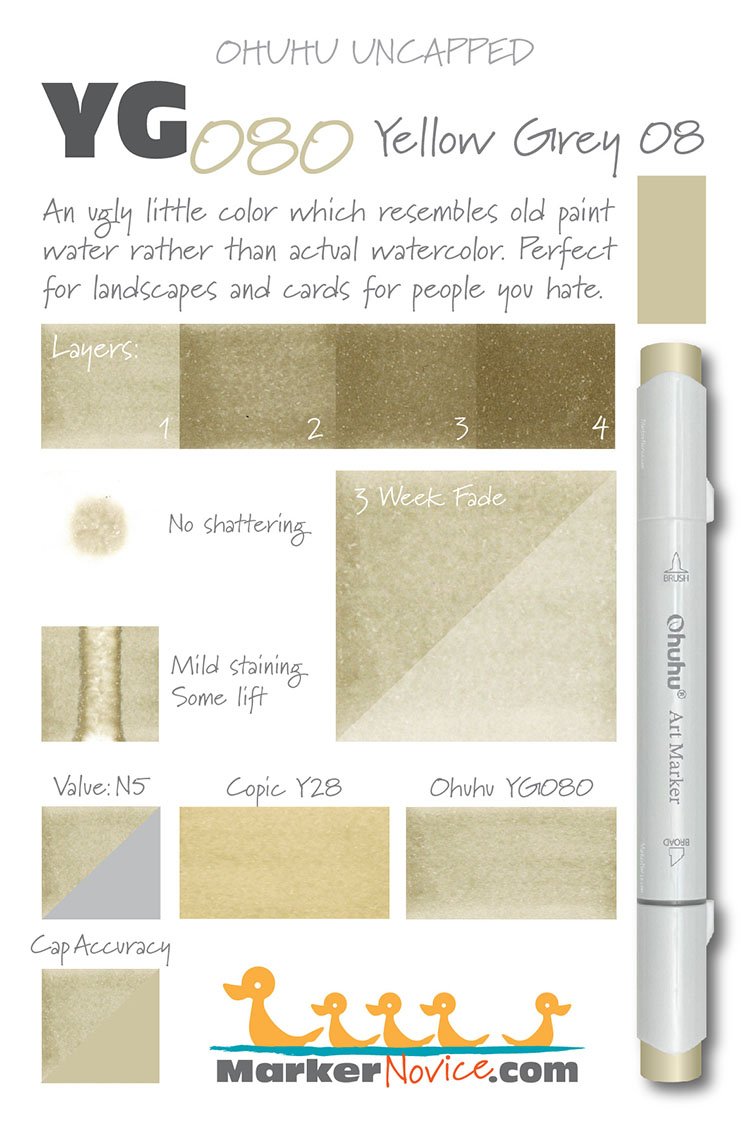
Buildup: YG080 reaches a maximum value at 4 coats.
Overinking: YG080 does not layer well. It develops oily blotches on the second layer which then turns to an overinked appearance at 3 layers. Exercise caution when using this marker in blending combinations— the act of blending may be enough to allow this marker to cast an oily sheen over the entire area.
Shattering: YG080 did not shatter and seems to be made from a single dye source.
Chromatography testing shows this ink’s behavior when it comes in contact with #0 Colorless Blender (solvent). High shattering colors may leak unexpected color when you make corrections or attempt to blend with any color that has a high solvent to colorant ratio. Shattering is not bad, it’s just something to be aware of.
Staining: YG080 mildly stains the paper.
With alcohol markers, a staining ink is generally a sign of a low quality ink. Staining inks bond to the paper fibers and are reluctant to release. Staining inks make blending harder than it has to be!
Lift: YG080 can be lifted somewhat but please look at the dark stripe on either side of the lifted area. This seems to be a common trait with Ohuhu markers, one that artist grade marker companies take care to avoid. What good is a marker if the colorant clumps this badly on contact with solvent? Would you want stripes like this appearing at the edges of your blends or even worse, after trying to make a correction?
See staining swatch. Sample was given 6 stripes of #0 Colorless Blender, drying between each stripe. Results indicate how much lifting you can expect.

Lightfast: YG080 faded about 40% during the test period. This is far more than the average Copic.
Samples were swatched on X-Press It Blending Card. 1 layer of ink was exposed to windowsill sunlight for 21 days. Approximately 10 hours of sun per day based on weather conditions. Note: we do not recommend displaying original marker art under these conditions.
Ink Color Family: In the real world YG universally stands for Yellow Green.
Not in Ohuhuland.
Ohuhu has chosen to confuse all of humanity by inventing a color they call “Yellow Grey” which is neither yellow nor gray.
Does Ohuhu make yellow green markers? Yes, they do. They make lots of yellow greens but because of this Yellow Grey stupidity, they were forced to call their yellow-green markers GY.
They did all of this for TWO markers.
Yes, that’s right folks— there are only two Yellow Gray markers.
And get this, one of the two Yellow Gray markers is actually a Neutral Gray.
Who invents a family for two unrelated markers and then gives them the name of an existing color family which happens to have the biggest color range and is the most popular selling family?
Ohuhu. It’s their way of flipping us the bird.
Cap Numbering: As mentioned above, there are only two piddly YG markers which can be divided evenly into your left hand and right hands for maximum portability.
YG080 is the color of vomit.
YG050 is a lovely Neutral Gray which has already filed for divorce.
I’m still early in the Ohuhu testing process. I will add more info to this article as I learn more and when I spot behavioral patterns.
From what I’ve learned so far, I will not be working with Ohuhu markers and I will discourage students from using them in my classes. They’re simply not worth the frustration.
Y070 Acid Yellow: Testing Ohuhu Markers for Lightfastness and Quality
Y070 Acid Yellow
Let’s take a closer look at this Ohuhu Marker and its ink characteristics.
You were told “Ohuhu is the Copic slayer! They’re like Copic Markers but better!”
Is it true?
Every Ohuhu Marker has different characteristics based upon its unique ink formula. No matter how great they say the marker is, test results do not lie.
So are Ohuhu markers as great as you’ve heard?
Let’s look at Ohuhu Y070 to find out.
WARNING: Ohuhu markers have numbers on the cap but not on the body of the marker. We do not recommend coloring with both caps off due to the risk of accidentally placing the wrong caps on a marker.
Test results: Ohuhu Y070 Acid Yellow
REFILL WARNING! At this time, Ohuhu does not sell refills for Y070. To date, you must purchase a new marker when your current marker runs dry. See Ohuhu’s current list of refills here.
Temperature: A warm medium yellow
Resemblance: Cadmium Yellow watercolor
Actual Value: N3.5
Unlike Copic, Ohuhu does not measure value— this is a glaring deficiency which makes finding blending combinations harder than it has to be!
All Copics are measured on a Neutral Gray value scale. The last number on the Copic cap indicates the value. We’re using the Copic scale to measure Ohuhu until Ohuhu releases a reliable value scale.
Cap Accuracy: The plastic on an Ohuhu Honolulu Y070 marker is close but noticeably lighter than 1 layer of Y070 ink.
Color Name: “Acid Yellow” is an inaccurate and misleading name for this marker. Acid Yellow is traditionally a green shift yellow (cool yellow). Some acid yellow paints are more green than yellow. This Ohuhu color is the opposite, an orange leaning (warm). There are hundreds of suitable names for this color, it’s ethically wrong to mislead customers this badly.
Many Ohuhu color names indicate a serious lack of English speaking staff at Ohuhu headquarters. It’s nice when one of their marker names actually makes sense.
Copic Substitution: Ohuhu Y070 is similar to Copic’s Y15. They are not the same ink due to the difference in test results but the color appearance is close.
See Copic Y15 test results here.
Note: similar colors rarely behave the same way. Yellow inks in general tend to be easy to blend. In this case, although Y070 an Y15 are different inks, I think they’re equally easy for beginners... but this is the first Ohuhu/Copic sub where I’ve said both markers are about equal. Normally, the Ohuhu version is significantly harder to work with. Keep this in mind for ALL art supplies, it’s not enough to match the color, two similar inks, pencils, or paints can behave radically different in usage.
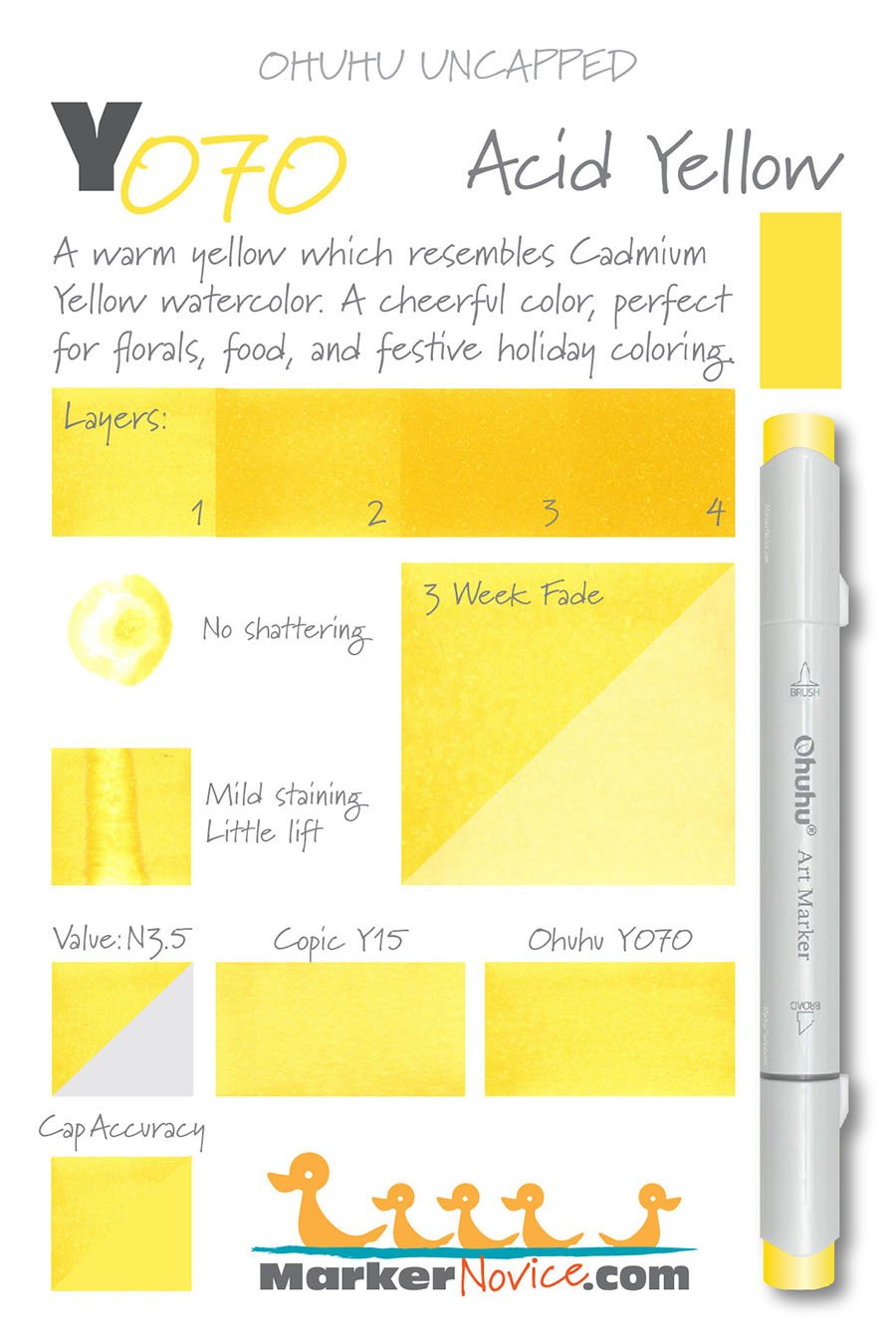
Buildup: Y070 reaches a maximum value at about 3 coats.
Overinking: I do not recommend using more than 3 coats of Y070. As with most Ohuhu markers, four layers looks exactly like three so why waste the ink.
Shattering: Y070 does not shatter. This is rare for Ohuhu this far in my testing.
Chromatography testing shows this ink’s behavior when it comes in contact with #0 Colorless Blender (solvent). High shattering colors may leak unexpected color when you make corrections or attempt to blend with any color that has a high solvent to colorant ratio. Shattering is not bad, it’s just something to be aware of.
Staining: Y070 is a mildly staining color. This is unusual for yellow but understandable given that it’s a medium color. Darker inks tend to be more staining.
With alcohol markers, a staining ink is generally a sign of a low quality ink. Staining inks bond to the paper fibers and are reluctant to release. Staining inks make blending harder than it has to be!
Lift: Y070 did not lift much from the paper. This is strange for a yellow ink, even a darker yellow. Please note the extreme striping on the sides of the test zone. This is very typical of Ohuhu inks and in my opinion, it’s a sign of poor quality. Be careful as you make corrections to this color as I’m sure you don’t want to accidentally create stripes near the area you were trying to correct.
See staining swatch. Sample was given 6 stripes of #0 Colorless Blender, drying between each stripe. Results indicate how much lifting you can expect.
Lightfast: Y070 faded by about 40% during the test period. This is extreme fading and in my opinion unacceptable, but it’s not unique to Ohuhu. Copic Y15 had a negligible fade during the same time period.
Samples were swatched on X-Press It Blending Card. 1 layer of ink was exposed to windowsill sunlight for 21 days. Approximately 10 hours of sun per day based on weather conditions. Note: we do not recommend displaying original marker art under these conditions.
Ink Color Family: Ohuhu has a small but interesting family of yellow markers. They offer more yellows than Copic and more desaturated yellows than Copic. I’m happy to see a marker company give us something more than 10 yellow highlighters.
The Ohuhu numbering system is complete garbage and doesn’t always make sense. While some may quibble with the inclusion of brownish or greenish colors in the Y family, I’m actually okay with it. Most yellow inks are pretty brown or green in their concentrated form. What I can’t excuse is Y5, a scarlet red marker which matches R17 and Y12 which is similar to E27!
Cap Numbering: Ohuhu Y markers are all over the place. Some have 1 or 2 digits (but are not releated at all), some follow the 0X0 pattern, some are 100s and some are 200s. There’s no rhyme or reason to it— I think the system is either complete carelessness or it’s designed to make it difficult to track marker colors.
The Y0X0 family consists of Y010, 030, 040, 050, 070, and 080.
This is a confused series of unrelated yellows. Two are cool yellows, the rest are warm. One is a highlighter and one is a dirty, desaturated yellow. The yellows are also not arranged by value as 080 is lighter than more all but two. As usual, Ohuhu has made a mess of their numbering system.
As stated above, the Ohuhu numbering system makes no sense. The markers are not arranged in chromatic order so you can not trust the numbers to tell you whether this marker is lighter or darker than other Ohuhu markers with similar numbers.
I’m still early in the Ohuhu testing process. I will add more info to this article as I learn more and when I spot behavioral patterns.
From what I’ve learned so far, I will not be working with Ohuhu markers and I will discourage students from using them in my classes. They’re simply not worth the frustration.
PB3 Cobalt Blue: Testing Ohuhu Markers for Lightfastness and Quality
PB3 Cobalt Blue
Let’s take a closer look at this Ohuhu Marker and its ink characteristics.
You were told “Ohuhu is the Copic slayer! They’re like Copic Markers but better!”
Is it true?
Every Ohuhu Marker has different characteristics based upon its unique ink formula. No matter how great they say the marker is, test results do not lie.
So are Ohuhu markers as great as you’ve heard?
Let’s look at Ohuhu PB3 to find out.
WARNING: Ohuhu markers have numbers on the cap but not on the body of the marker. We do not recommend coloring with both caps off due to the risk of accidentally placing the wrong caps on a marker.
Test results: Ohuhu PB3 Cobalt Blue
Refill: No
At this time, Ohuhu only sells refills for 50 colors (not exactly what they advertise, eh?). They do not sell refills for this marker so when it stops blending well, you’ll need to purchase a new marker. See Ohuhu’s current list of refills here.
Temperature: A red-shifted medium-dark blue.
Resemblance: Cobalt Deep watercolor
Actual Value: N10
Unlike Copic, Ohuhu does not measure value— this is a glaring deficiency which makes finding blending combinations harder than it has to be!
All Copics are measured on a Neutral Gray value scale. The last number on the Copic cap indicates the value. We’re using the Copic scale to measure Ohuhu until Ohuhu releases a reliable value scale.
Color Name: “Cobalt Blue” is an accurate name for this marker.
Many Ohuhu color names indicate a serious lack of English speaking staff at Ohuhu headquarters. It’s nice when one of their marker names actually makes sense.
Cap Accuracy: The plastic on an Ohuhu Honolulu PB3 is similar but slightly lighter than one layer of PB3 ink. This is a problem because almost nobody uses only one layer of marker ink. This is typical for Ohuhu and I suspect this is why so many people complain about Ohuhu cap accuracy. The plastic looks like one layer but the user applies 3 layers of ink.
A common complaint about Ohuhu is that the caps are not an accurate match to the ink inside the marker. I disagree. I have yet to find a marker that I’d classify as drastically wrong. The names may be odd and the numbering system is trash but for the. most part, the color of the plastic usually comes close to the ink.
Copic Substitution: Ohuhu B140 is slightly darker but similar to Copic’s B18. They are not the same ink due to the difference in test results.
Note: similar colors rarely behave the same way. From experience I can say Copic B18 is a moderatly easy blending marker which is typical for darker Copics. Meanwhile Ohuhu PB3 is a stubborn, staining color which is unusual for ANY blue marker. Blue is usually an easy ink to work with and yet PB3 is not. Keep this in mind for ALL art supplies, it’s not enough to match the color— two similar ink, pencil, or paint colors can behave radically different in usage. See Copic B18 test results here.
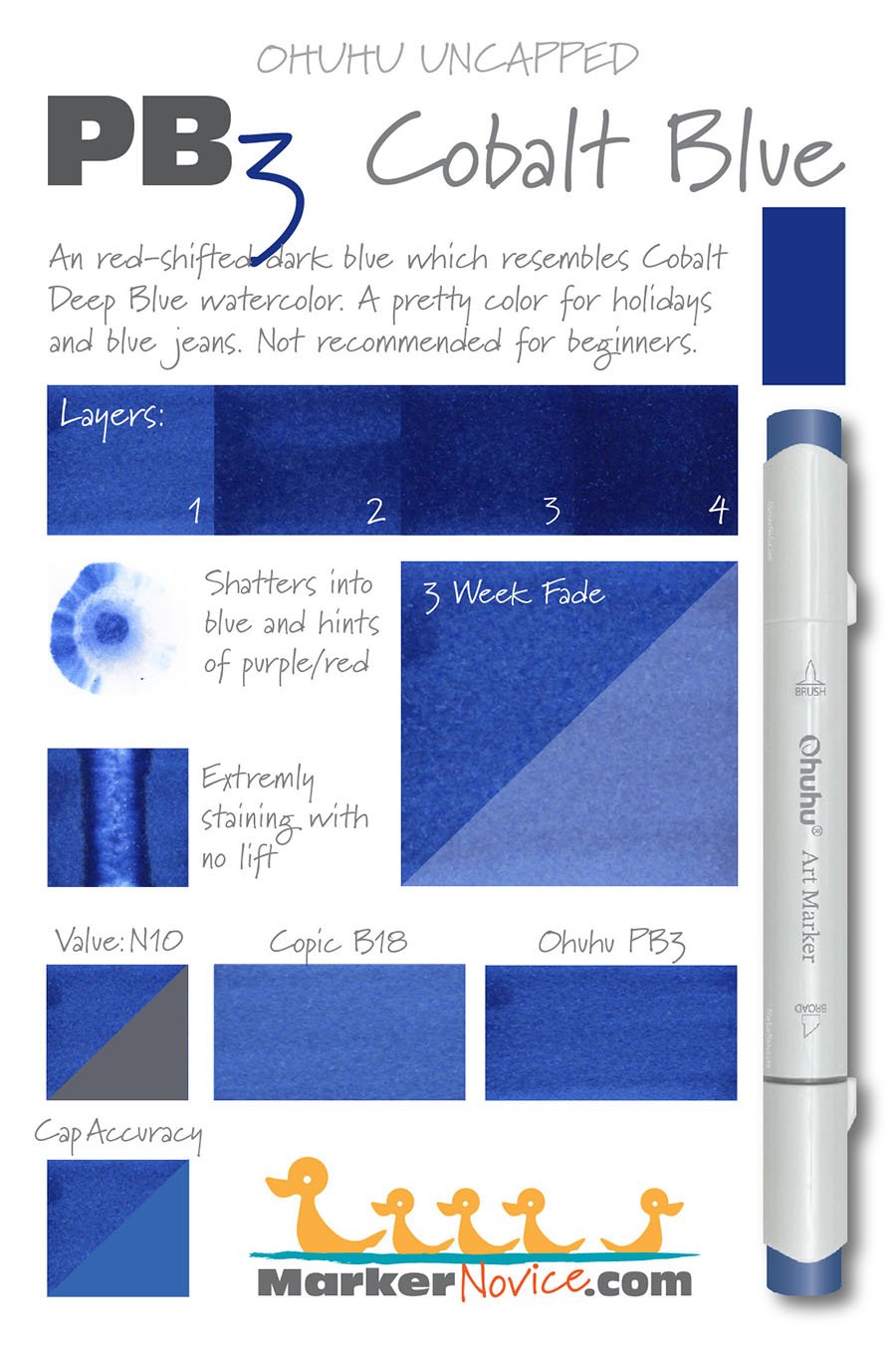
Buildup: PB3 reaches amost to maximum value at 2 coats. This makes the ink dangerous to work with. Most colorers use 3 layers for blending.
Overinking: As mentioned in above in “Buildup”, PB3 quickly reaches maximum value at 2 layers. 3-4 layers are what the average person uses in blending at which point PB3 will already be looking overinked and oily. This is why I will not recommend PB3 for beginners.
Shattering: PB3 shatters into two dyes on contact with colorless blender— blue with with a bit of purple or pink dye.
Chromatography testing shows this ink’s behavior when it comes in contact with #0 Colorless Blender (solvent). High shattering colors may leak unexpected color when you make corrections or attempt to blend with any color that has a high solvent to colorant ratio. Shattering is not bad, it’s just something to be aware of.
Staining: PB3 is an extremely staining color. Beware as you’re blending PB3 with a lighter color of ink as the solvent in the light ink may cause PB3 to separate. I saw hints of pink around the edges of several of my test swatches and I wasn’t even blending. PB3 almost shatters itself!
With alcohol markers, a staining ink is generally a sign of a low quality ink. Staining inks bond to the paper fibers and are reluctant to release. Staining inks make blending harder than it has to be!
Lift: PB3 is one of the worst lifting Ohuhu markers I’ve tried. Please look at the test sample above and note the extremely dark borders on the stripe where the colorless blender was applied. Would you want similar dark stripes to appear at the edges of your blend zones? Would you want these dark stripes where you’ve tried to make a correction?
See staining swatch. Sample was given 6 stripes of #0 Colorless Blender, drying between each stripe. Results indicate how much lifting you can expect.
Lightfast: PB3 faded by more than 50% during the test period. This is an unacceptable level of fade. For comparison, Copic B18 had a fade of about 10% during the same time frame..
Samples were swatched on X -Press It Blending Card. 1 layer of ink was exposed to windowsill sunlight for 21 days. Approximately 10 hours of sun per day based on weather conditions. Note: we do not recommend displaying original marker art under these conditions.
Ink Color Family: Okay, settle in because I’m going to rant.
What does PB mean?
Two possiblities spring to mind: Prussian Blue and Phthalo Blue.
This color family is definitely not Prussian. Prussian Blues tend to be green-shifted and PB3 here has actual red in the formula making it the OPPOSITE of Prussian.
Okay, so what about Phthalo Blue? This makes more sense. Actual Phthalo Blue comes in both green and red shift varieties. BUT there are no PB markers called Phthalo and PB5 is named “Prussian Blue”. If you name one of the PBs “Prussian” doesn’t that indicate you don’t mean Phthalo?
So how about if we look at the entire PB family: are most PB blues green shift (Prussian) or red shift (possible Phthalo)?
PB1, PB2, PB3, PB4, PB5, PB6 - red shift
PB7, PB8 - these aren’t blue, they’re cyan markers
PB9, PB10 - these aren’t blue, they’re greenish aqua
PB11 - green shift
Look, Ohuhu didn’t have to make this hard. Every single PB marker could have easily been called a B just like every other normal marker company in the world does. But no, Ohuhu purposefully goes out of their way to make things stupid. This is sheer, unadulterated stupidity.
The Ohuhu lettering system is complete garbage and doesn’t always make sense. Perhaps Ohuhu breaks the normal color family rules due to carelessness in the translation from Chinese to English. But actually, I suspect the confusion is to purposefully make it hard to track which colors are included in which sets and/or make it easy to change colors based on which ingredients are cheapest at the time.
Cap Numbering: The PB group includes 11 markers numbered from 1 to 11. The order of the PB numbers is not light to dark. The order is also not in groups of 3 (meaning 1,2,3 are one light medium, dark blending combination, then 4, 5, 6 and 7, 8,9 are other L-M-D combinations)
The PB markers aren’t even releated to each other (see the red/green shift breakdown above).
I see no reason why these markers are singled out as PBs and I suspect the numbers were assigned randomly.
Why do I feel like I’ve spent more time trying to figure out the Ohuhu numbering system than Ohuhu spent creating it?
Stupid. This is all so stupid.
As stated above, the Ohuhu numbering system generally makes no sense. The markers are not arranged in chromatic order so you can not trust the numbers to tell you whether this marker is lighter or darker than other Ohuhu markers with similar numbers.
I’m still early in the Ohuhu testing process. I will add more info to this article as I learn more and when I spot behavioral patterns.
From what I’ve learned so far, I will not be working with Ohuhu markers and I will discourage students from using them in my classes. They’re simply not worth the frustration.
MG100 Blue Grey 09: Testing Ohuhu Markers for Lightfastness and Quality
MG100 Blue Grey 09
Let’s take a closer look at this Ohuhu Marker and its ink characteristics.

You were told “Ohuhu is the Copic slayer! They’re like Copic Markers but better!”
Is it true?
Every Ohuhu Marker has different characteristics based upon its unique ink formula. No matter how great they say the marker is, test results do not lie.
So are Ohuhu markers as great as you’ve heard?
Let’s look at Ohuhu MG100 to find out.
WARNING: Ohuhu markers have numbers on the cap but not on the body of the marker. We do not recommend coloring with both caps off due to the risk of accidentally placing the wrong caps on a marker.
Test results: Ohuhu MG100 Blue Grey 09
IMPORTANT NOTE: To nobody’s suprise, Ohuhu has badly botched their lettering/number system. SEE THE “INK COLOR FAMILY” SECTION BELOW FOR AN IMPORTANT WARNING ABOUT OHUHU MG MARKERS.
REFILL WARNING! At this time, Ohuhu does not sell refills for MG100. To date, you must purchase a new marker when your current MG100 runs dry. See Ohuhu’s current list of refills here.
Temperature: A medium-dark grayed blue-green
Resemblance: this resembles a hand mixed color, possibly Payne’s Gray with a touch of Turquoise
Actual Value: N8
Unlike Copic, Ohuhu does not measure value— this is a glaring deficiency which makes finding blending combinations harder than it has to be!
All Copics are measured on a Neutral Gray value scale. The last number on the Copic cap indicates the value. We’re using the Copic scale to measure Ohuhu until Ohuhu releases a reliable value scale.
Cap Accuracy: The plastic on an Ohuhu Honolulu MG100 marker matches 1 coat of MG100 ink.
I’ve seen numerous Ohuhu review videos where they complain about massive Ohuhu cap color inaccuracies. I’ve also read this mentioned in blogs and websites. To be honest, I’m simply not finding Ohuhu to be any worse than other marker brands. Yes, some caps are wrong but I don’t think cap accuracy is their biggest problem.
Copic Substitution: Ohuhu BG050 does not have a match in the Copic Marker palette. The closest similarity is to Copic’s B97 but otherwise, they are a near match in hue and value. B97 is bluer, MG100 has a bit more gray and green to it. Copic C Greys are not bluish enough to substitute for MG100.
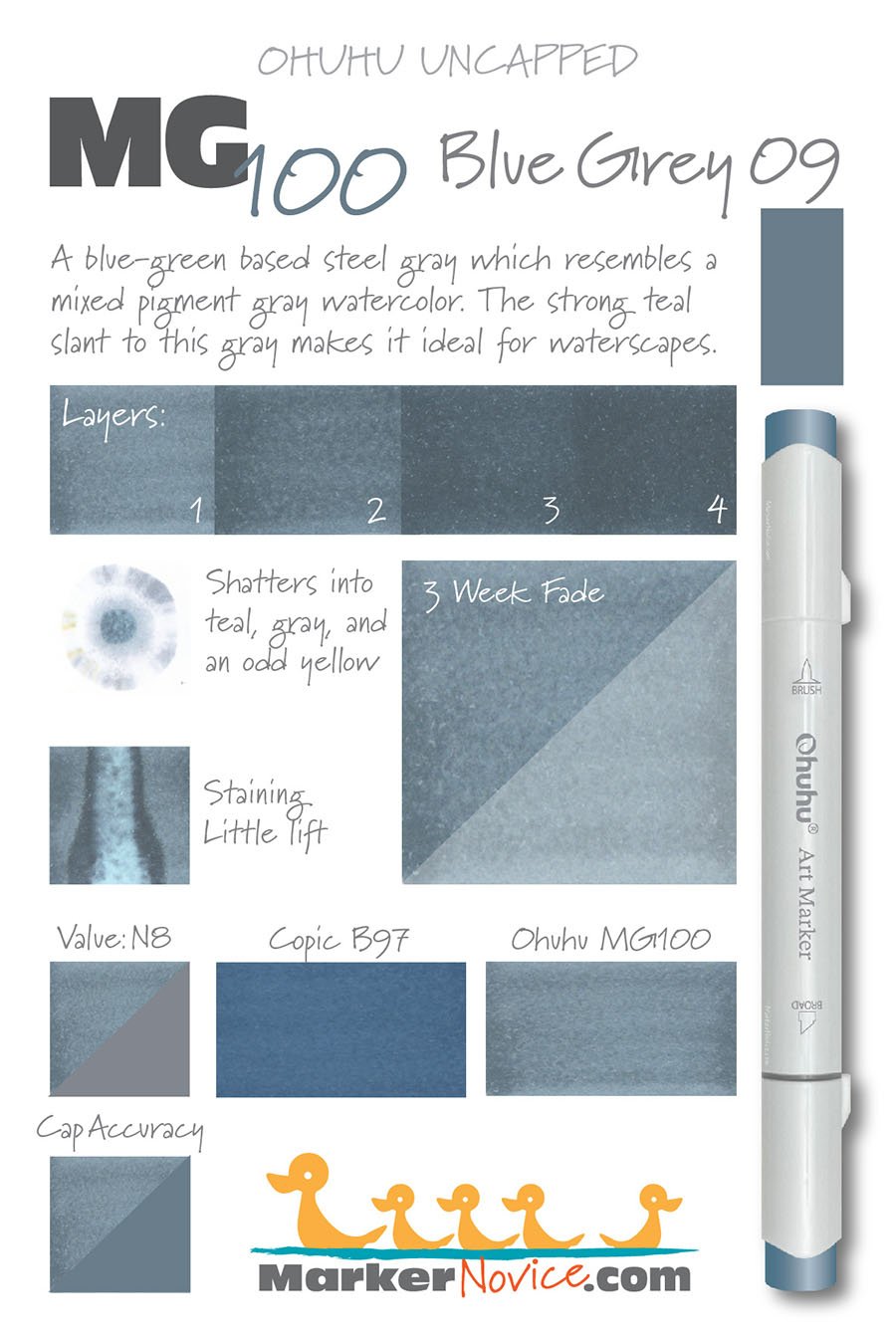
Buildup: MG100 reaches a maximum value at 3-4 coats. Exercise caution when using more than 3 layer of any Ohuhu ink.
Overinking: We do not recommend using more than 3 coats of MG100 and we do not recommend using this in three or four marker Ohuhu blending combinations.
Shattering: MG100 shattered into at least three colors of ink. We believe this ink is a blend of gray, teal, and a very strange lime green or yellowish color. A higher quality ink company would have chosen a greener teal instead of adding yellow to the mix, to keep their inks limited to only two components.
Chromatography testing shows this ink’s behavior when it comes in contact with #0 Colorless Blender (solvent). High shattering colors may leak unexpected color when you make corrections or attempt to blend with any color that has a high solvent to colorant ratio. Shattering is not bad, it’s just something to be aware of.
Staining: MG100 stains the paper considerably
With alcohol markers, a staining ink is generally a sign of a low quality ink. Staining inks bond to the paper fibers and are reluctant to release. Staining inks make blending harder than it has to be!
Lift: MG100 is not an easy lifting color, it also damages the paper quite badly (as do many of the Ohuhu inks we’ve tested. We expect colorless blender to snowplow a stripe of ink to either side of the test zone, but we find the extreme striping to be a big problem for anyone trying to soften the look of mistakes. Exercise caution when trying to correct this marker.
See staining swatch. Sample was given 6 stripes of #0 Colorless Blender, drying between each stripe. Results indicate how much lifting you can expect.

Lightfast: MG100 faded about 30% during the test period. This is more than the average Copic and at least twice the fade of Copic’s C8 which is a similar value gray (but not as blue).
Samples were swatched on X-Press It Blending Card. 1 layer of ink was exposed to windowsill sunlight for 21 days. Approximately 10 hours of sun per day based on weather conditions. Note: we do not recommend displaying original marker art under these conditions.
Ink Color Family: Sit down folks, this is gonna be a long one.
Ohuhu doesn’t care about their ink identification system and this means they really do not care about you!
“MG” in Ohuhu markers means “Blue-Gray”
The problem is that Ohuhu has already named their Cool Greys “BG” and they also named their Blue Greens “BG”. They really can’t lump a third group into their dumb BG group of markers.
I’ve been in art 30 years and I have no idea what the M in MG means. It’s nonsense.
There are many names they could have chosen for this color family other than MG. Steel gray? Slate gray?
Or here’s a crazy idea… call all the cool grays CG and give them a better numbering system.
Cap Numbering: There are 4 MG grays which honestly, look like blue markers next to the other grays. I have no idea why these markers were designated gray but now that they’ve done it, at least they could number them well?
Nope.
Folks, MG100 stands for Blue Gray #09. Not #10. They could have given this the name MG090 if they wanted to, the number isn’t being used.
But they didn’t. Because they don’t care about you.
As stated above, the Ohuhu numbering system makes no sense. The markers are not arranged in chromatic order so you can not trust the numbers to tell you whether this marker is lighter or darker than other Ohuhu markers with similar numbers.
I’m still early in the Ohuhu testing process. I will add more info to this article as I learn more and when I spot behavioral patterns.
From what I’ve learned so far, I will not be working with Ohuhu markers and I will discourage students from using them in my classes. They’re simply not worth the frustration.

G070 Lemon Green: Testing Ohuhu Markers for Lightfastness and Quality
G070 Lemon Green
Let’s take a closer look at this Ohuhu Marker and its ink characteristics.
You were told “Ohuhu is the Copic slayer! They’re like Copic Markers but better!”
Is it true?
Every Ohuhu Marker has different characteristics based upon its unique ink formula. No matter how great they say the marker is, test results do not lie.
So are Ohuhu markers as great as you’ve heard?
Let’s look at Ohuhu G070 to find out.
WARNING: Ohuhu markers have numbers on the cap but not on the body of the marker. We do not recommend coloring with both caps off due to the risk of accidentally placing the wrong caps on a marker.
Test results: Ohuhu G070 Lemon Green
REFILL WARNING! At this time, Ohuhu does not sell refills for G070. To date, you must purchase a new marker when your current marker runs dry. See Ohuhu’s current list of refills here.
Temperature: A warm greenish yellow
Resemblance: Green Gold watercolor
Name: “Lemon Green” is a confusing description of the color. To my American ears, it sounds weird describing a lemon as green but when painting lemons, I do see green undertones... but that’s a stretch. Ultimately, I do believe this is a mistake in translating from Chinese to English as many of Ohuhu color names are as bad or worse than this. See below in the Color Family and Cap Numbering sections for more confusion.
Actual Value: N4
Unlike Copic, Ohuhu does not measure value— this is a glaring deficiency which makes finding blending combinations harder than it has to be!
All Copics are measured on a Neutral Gray value scale. The last number on the Copic cap indicates the value. We’re using the Copic scale to measure Ohuhu until Ohuhu releases a reliable value scale.
Cap Accuracy: The color of the plastic on an Ohuhu Honolulu G070 marker matches one coat of ink.
The most common complaint I hear in Ohuhu review videos is about the cap colors not matching the ink color. Honestly folks, I don’t have a problem with their plastic colors! I think the complaints stem from the caps matching 1-2 coats of ink, meanwhile the user is laying down 3-4 heavy coats. As you can see in my layering tests, the ink color builds with more layers. No company can make a cap that reflects the look of the ink at your preferred level! From what I’ve seen so far, Ohuhu caps are actually more accurate than Copic Markers.
Copic Substitution: Ohuhu G070 is slightly darker than Copic’s YG21 but otherwise, they are close in hue and value.
Note: similar colors rarely behave the same way. Normally in this section, I list reasons why the Copic substitution is easier to work with but in this case, the Copic YG-Twenty family is also a temperamental color. The two colors are not related as Ohuhu G070 shatters while Copic YG21 is a single colorant ink. See the test results for Copic YG23 here.
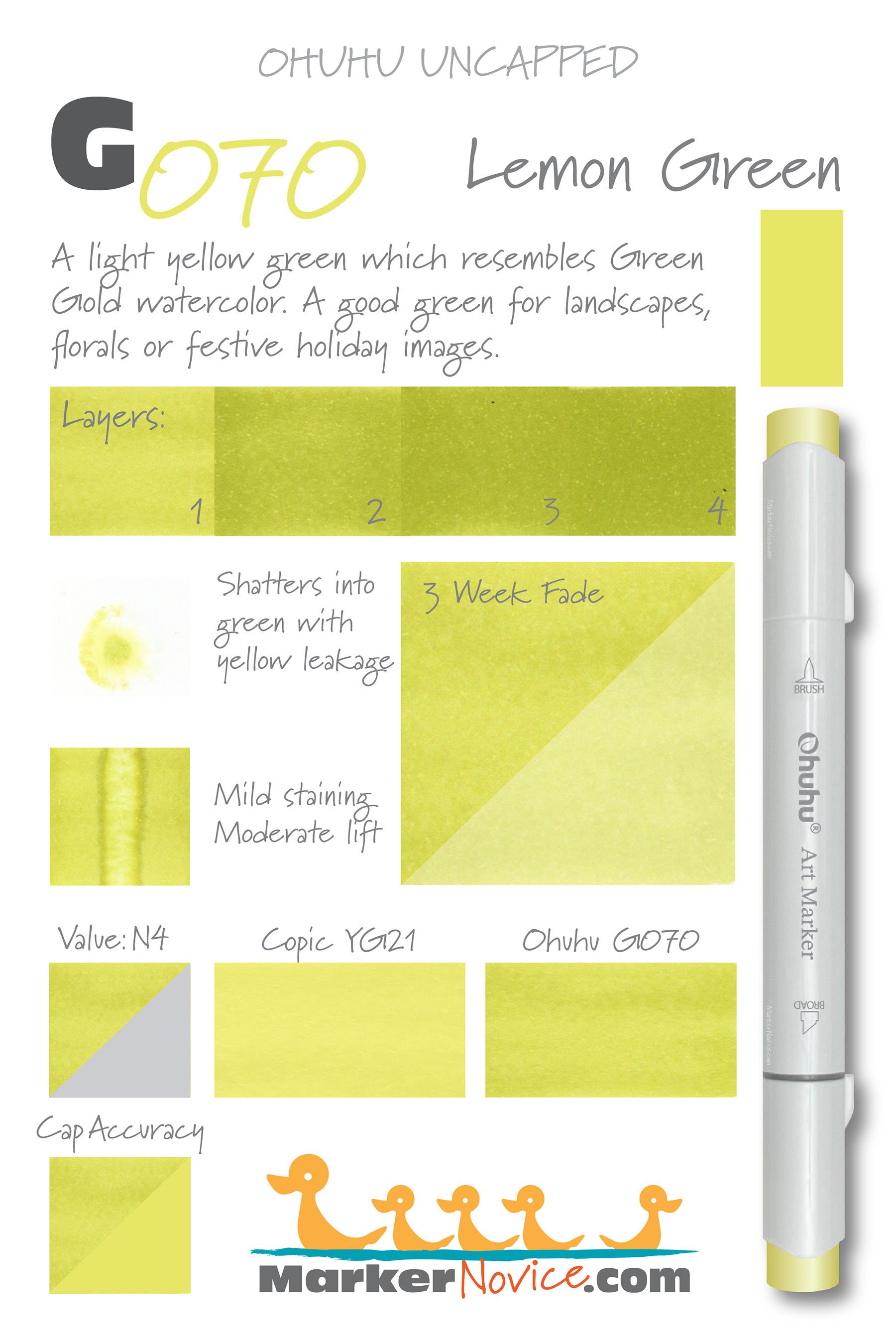
Buildup: G070 reaches a maximum value at 3 coats.
Overinking: We do not recommend using more than 3 coats of G070. As with most Ohuhu markers, four layers looks oversaturated and dull.
Shattering: This ink is a mixture of green and yellow inks. The green is stubborn and doesn’t move much during testing which indicates you’ll have some difficulty blending this color smoothly. Note, this is unusual in an ink containing this much yellow. Yellow inks tend to be easy to work with, G070 will be more of a challenge.
Chromatography testing shows this ink’s behavior when it comes in contact with #0 Colorless Blender (solvent). High shattering colors may leak unexpected color when you make corrections or attempt to blend with any color that has a high solvent to colorant ratio. Shattering is not bad, it’s just something to be aware of.
Staining: G070 stains the paper with a noticeable harsh yellow which we were unable to lighten.
With alcohol markers, a staining ink is generally a sign of a low quality ink. Staining inks bond to the paper fibers and are reluctant to release. Staining inks make blending harder than it has to be!
Lift: Normally, mistakes made with pale to medium alcohol inks are relatively easy to correct. Use caution when correcting G070. Notice the extremely dark dry-lines of ink on either side of the correction stripe. You’ll see similar effects when you try to lift G070 on your own project. Before attempting a correction, weigh the dangers versus the benefits.
See staining swatch. Sample was given 6 stripes of #0 Colorless Blender, drying between each stripe. Results indicate how much lifting you can expect.
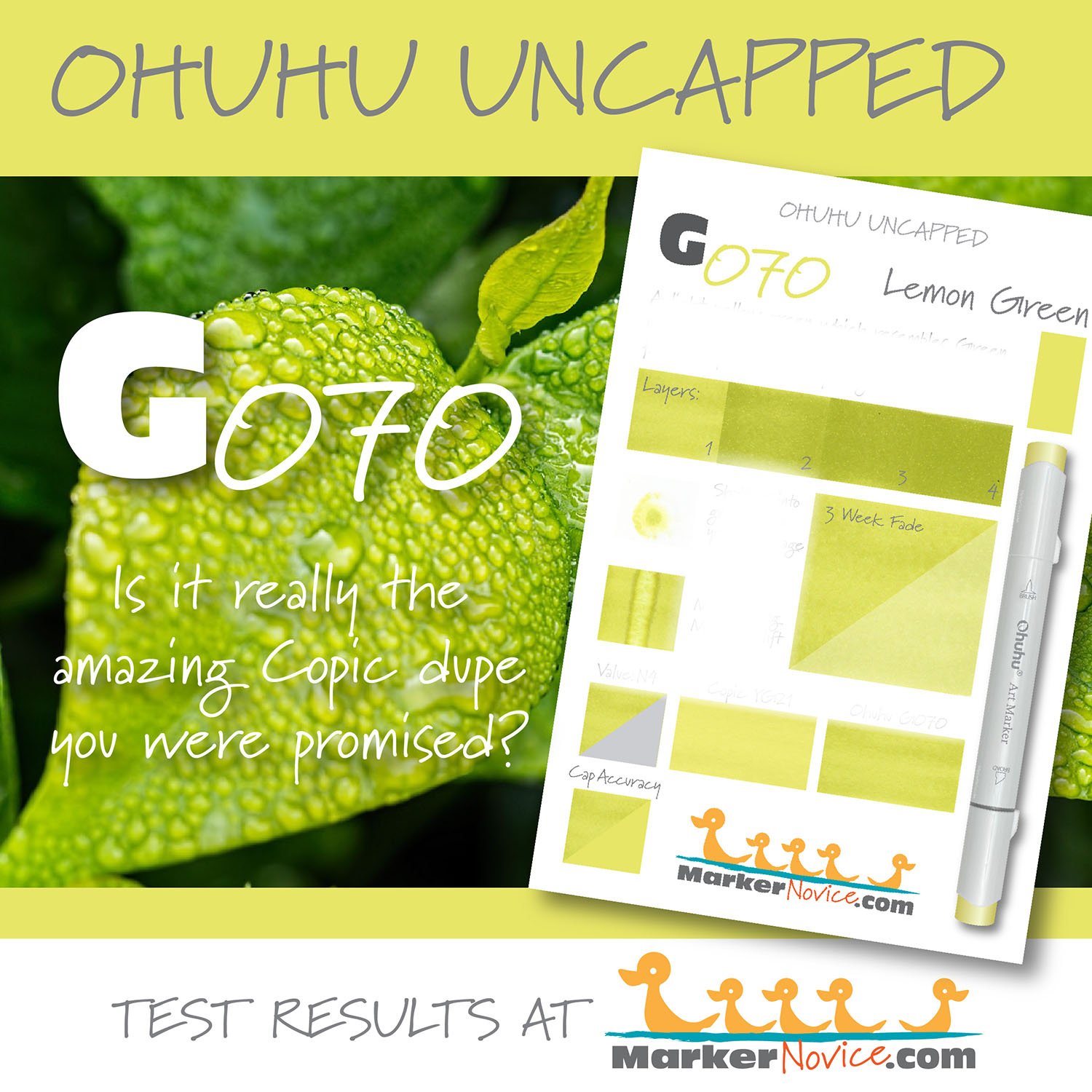
Lightfast: G070 faded about 40% during the test period. This is far more than the average Copic but on par with most Ohuhu markers. In general, you can expect most Ohuhu to fade twice as fast as Copic.
Samples were swatched on X-Press It Blending Card. 1 layer of ink was exposed to windowsill sunlight for 21 days. Approximately 10 hours of sun per day based on weather conditions. Note: we do not recommend displaying original marker art under these conditions.
Ink Color Family: The “G” in G070 indicates that this marker is part of the G Green family.
The G family includes greens ranging from warm yellow greens to cool blue greens. The G’s all have either 1 number or 3 numbers after the G. It’s not clear why this decision was made.
Here’s where it gets bad— G070 (and the entire number series have been placed into the wrong family! This is a YG or GY marker, not a G.
In alcohol markers, the greens are often divided into 2-3 families:
YG/GY for warm yellow greens
G for viridian based cooler greens
BG for greens which strongly lean towards blue
Ohuhu makes 12 GY markers, most of which contain less yellow than G070! Why was this marker called G when it’s more Y than all the GY’s? It’s a complete mystery.
The Ohuhu lettering and numbering numbering system is complete garbage and doesn’t always make sense. Be warned, you can not trust anything you read on an Ohuhu cap.
Cap Numbering: G070 is part of an unrelated series of greenish yellow markers all starting with 0. The G0xx markers are roughly arranged according to value but the temperatures fluctuate wildly.
G020 is a yellow highlighter
G030 is a cool yellow
G050 is a bright acid green, slightly cool
G060 is a yellow chartreuse, matching G070 in value
G070 is almost identical to G060, just a hint warmer but the same value
G080 is a warm pea green, the darkest of the group but still just a medium value
As stated above, the Ohuhu numbering system makes no sense. The markers are not arranged in chromatic order so you can not trust the numbers to tell you whether this marker is lighter or darker than other Ohuhu markers with similar numbers.
I’m still early in the Ohuhu testing process. I will add more info to this article as I learn more and when I spot behavioral patterns.
From what I’ve learned so far, I will not be working with Ohuhu markers and I will discourage students from using them in my classes. They’re simply not worth the frustration.

Learn more about G070 Lemon Green, a deep green Ohuhu Marker. We swatch and test Ohuhu colors- layering, staining, lift, value, lightfastness, saturation, and cap accuracy. | MarkerNovice.com | How to blend alcohol ink markers.
R170 Lipstick Red: Testing Ohuhu Markers for Lightfastness and Quality
R170 Lipstick Red
Let’s take a closer look at this Ohuhu Marker and its ink characteristics.
You were told “Ohuhu is the Copic slayer! They’re like Copic Markers but better!”
Is it true?
Every Ohuhu Marker has different characteristics based upon its unique ink formula. No matter how great they say the marker is, test results do not lie.
So are Ohuhu markers as great as you’ve heard?
Let’s look at Ohuhu R170 to find out.
WARNING: Ohuhu markers have numbers on the cap but not on the body of the marker. We do not recommend coloring with both caps off due to the risk of accidentally placing the wrong caps on a marker.
Test results: Ohuhu R170 Lipstick Red
Refill: You’re in luck! Ohuhu sells only 50 colors of refills leaving most of their markers un-refillable. R170 is one of the refills they do make. This makes R170 a smart purchase! See Ohuhu’s current list of refills here.
Temperature: A cool, dark wine red
Resemblance: Perylene Red watercolor
Name: “Lipstick Red” isn’t a terrible name because I’ve seen lipstick this color. But to an American audience, “Lipstick” indicates a fiery, Corvette, candy-apple kind of red. The name simply feels wrong for a red this cool, dark, and almost burgundy.
Actual Value: N9
Unlike Copic, Ohuhu does not measure value— this is a glaring deficiency which makes finding blending combinations harder than it has to be!
All Copics are measured on a Neutral Gray value scale. The last number on the Copic cap indicates the value. We’re using the Copic scale to measure Ohuhu until Ohuhu releases a reliable value scale.
Cap Accuracy: The plastic on an Ohuhu Honolulu R170 is a close match to one coat of R3. The plastic is a bit duller and less vibrant than the ink.
Copic Substitution: Ohuhu R170 sits inbetween Copic’s R37 and R39.
Note: similar colors rarely behave the same way. From experience I can tell you that Copic R37 and R39 are much easier to work with, especially for beginners! Look below at how fast Ohuhu R170 reaches maximum value and looks oily. This means you’ll see oilyness AS you blend, before you even consider re-blending! The Copic R-30’s allow easier blending and the oiliness doesn’t appear until four layers. For comparison, see Copic R37 test results here.
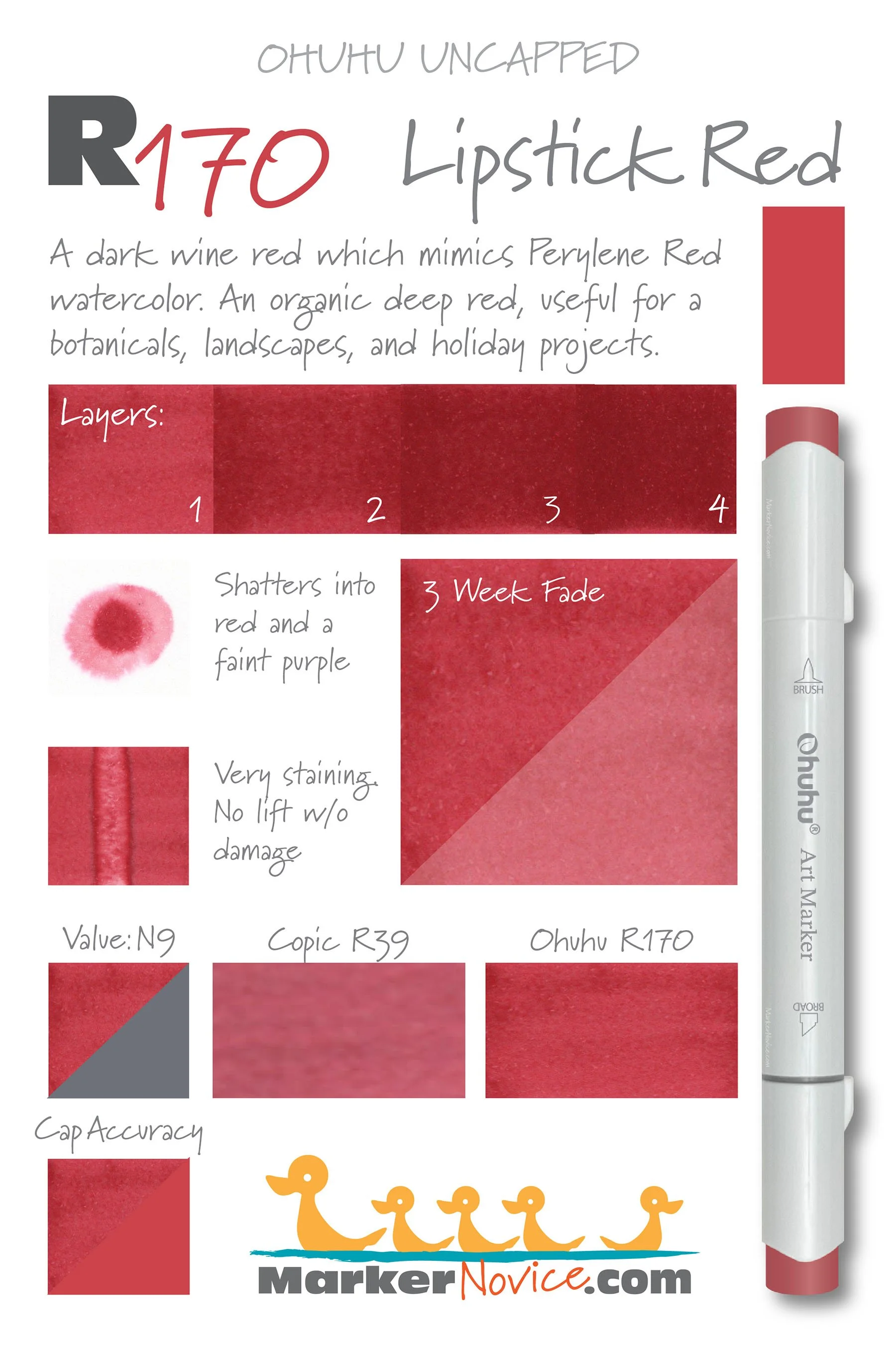
Buildup: R170 reaches a maximum value at 3 coats.
Overinking: We do not recommend using more than 2 coats of R170. As with most Ohuhu markers, 3-4 layers looks oversaturated and dull.
Shattering: R170 is extremely reactive to colorless blender indicating that there is a high ratio of colorant to solvent in this ink formula. In paint, we like high pigment ratios but in markers, it creates a temperamental and stubborn marker. I’ve seen worse in the Ohuhu line but this is higher than average and you will see blending issues because of it.
Chromatography testing shows this ink’s behavior when it comes in contact with #0 Colorless Blender (solvent). High shattering colors may leak unexpected color when you make corrections or attempt to blend with any color that has a high solvent to colorant ratio. Shattering is not bad, it’s just something to be aware of.
Staining: As with most red ink colors, R170 is extremely staining color. This is partially because it’s red but mostly because of the extreme amount of colorant in the formula.
With alcohol markers, a staining ink is generally a sign of a low quality ink. Staining inks bond to the paper fibers and are reluctant to release. Staining inks make blending harder than it has to be!
Lift: Forget about it. R170 is incredibly stubborn and stains the paper red. Exercise caution when trying to lift or move a mistake. Notice the dark edges to the correction area in the sample above. The ink in these dark stripes actually looks metallic and I can feel the stripe with my fingernail! Attempting to fix a mistake could damage your project more than the mistake did.
See staining swatch. Sample was given 6 stripes of #0 Colorless Blender, drying between each stripe. Results indicate how much lifting you can expect.
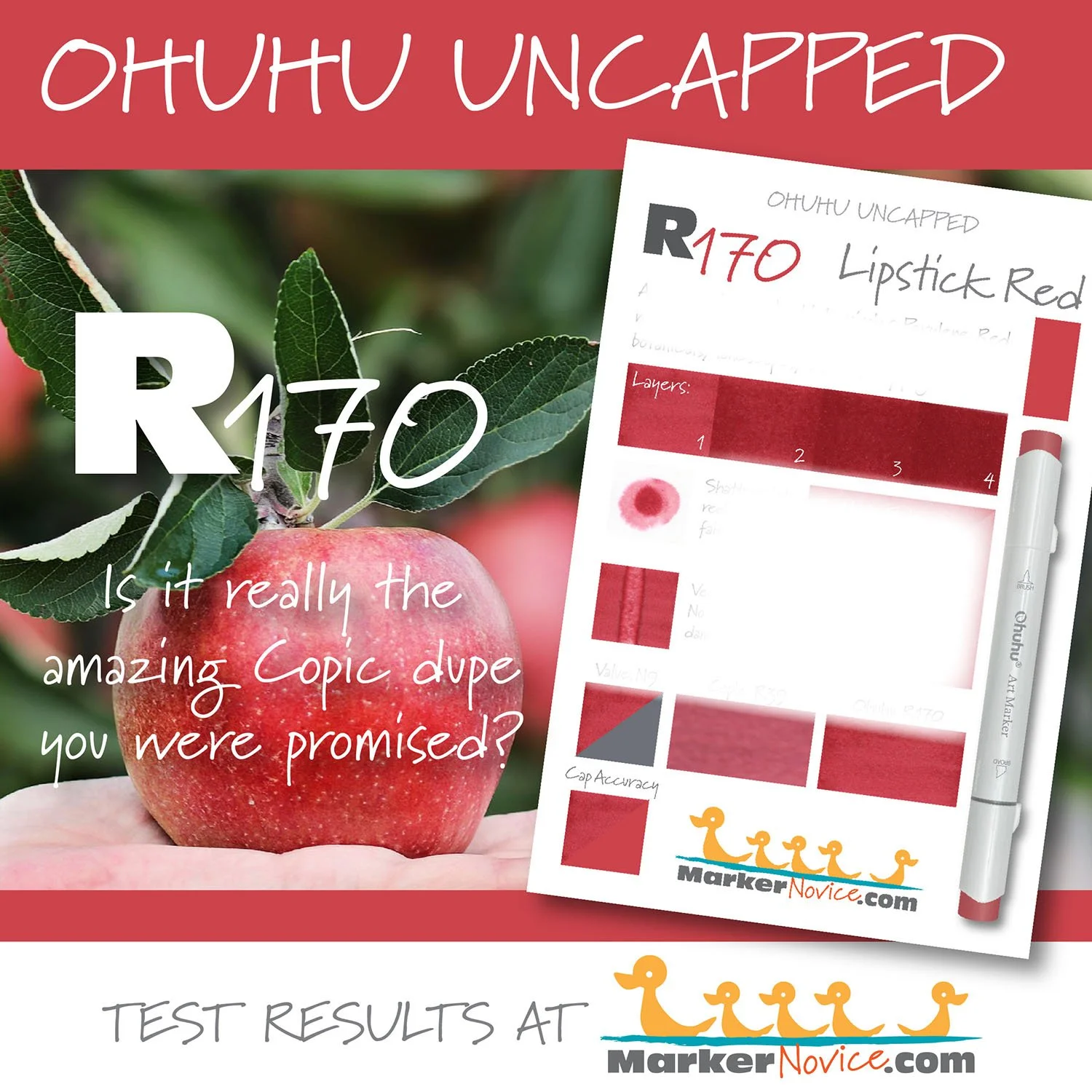
Lightfast: R170 faded about 20% during the test period.
Samples were swatched on X-Press It Blending Card. 1 layer of ink was exposed to windowsill sunlight for 21 days. Approximately 10 hours of sun per day based on weather conditions. Note: we do not recommend displaying original marker art under these conditions.
Ink Color Family: The “R” in R170 indicates that this marker is part of the R red family but Ohuhu classifies a lot of oranges, violets, and pinks also as R. Think of R and “probably red but maybe not.”
The Ohuhu numbering system is complete garbage and doesn’t always make sense. Some orange and magenta markers are hidden in the R family. Be warned, when it comes to other color families, you can not trust anything you read on an Ohuhu cap.
Cap Numbering: If the Ohuhu markering system made sense, we would assume that R170 is part of the R-One Hundred family which includes R110, R120, R150, R160, R170, R180, and R190.
In looking at that series, you’d think these red markers were similar colors arranged from light to dark, correct?
Nope.
R110 is a pale orange-red which is not related to anything else in the series.
R120 is a florescent pink highlighter.
R150 is a slightly neon medium salmon pink.
R160 is a carmine red.
R170 is a cool dark red.
R180 is a darker cool red than R170.
R190 is a light warm pink.
These inks are NOT related to each other, not arranged chromatically, and not arranged according to value. Ohuhu dumped these colors together without thinking because they don’t care about their numbering system.
As stated above, the Ohuhu numbering system makes no sense. The markers are not arranged in chromatic order so you can not trust the numbers to tell you whether this marker is lighter or darker than other Ohuhu markers with similar numbers.
I’m still early in the Ohuhu testing process. I will add more info to this article as I learn more and when I spot behavioral patterns.
From what I’ve learned so far, I will not be working with Ohuhu markers and I will discourage students from using them in my classes. They’re simply not worth the frustration.

Learn more about R170 Lipstick Red, a wine red Ohuhu Marker. We swatch and test Ohuhu colors- layering, staining, lift, value, lightfastness, saturation, and cap accuracy. | MarkerNovice.com | How to blend alcohol ink markers.
Testing Ohuhu: RG030 Red Grey 03 Lightfastness and Quality
RG030 Red Grey 03
Let’s take a closer look at this Ohuhu Marker and its ink characteristics.
You were told “Ohuhu is the Copic slayer! They’re like Copic Markers but better!”
Is it true?
Every Ohuhu Marker has different characteristics based upon its unique ink formula. No matter how great they say the marker is, test results do not lie.
So are Ohuhu markers as great as you’ve heard?
Let’s look at Ohuhu RG030 to find out.
WARNING: Ohuhu markers have numbers on the cap but not on the body of the marker. We do not recommend coloring with both caps off due to the risk of accidentally placing the wrong caps on a marker.
Test results: Ohuhu RG030 Red Grey 03
REFILL WARNING! At this time, Ohuhu does not sell refills for RG030. To date, you must purchase a new marker when your current RG030 runs dry. Ohuhu is deceptive when they advertise that their markers are refillable when they only offer 50 refills in a line of 320+ markers. See Ohuhu’s current list of refills here.
Temperature: A warm reddish gray
Resemblance: diluted French Gray watercolor
Actual Value: N4
Unlike Copic, Ohuhu does not measure value— this is a glaring deficiency which makes finding blending combinations harder than it has to be!
All Copics are measured on a Neutral Gray value scale. The last number on the Copic cap indicates the value. We’re using the Copic scale to measure Ohuhu until Ohuhu releases a reliable value scale.
Cap Accuracy: The plastic on an Ohuhu Honolulu RG030 marker is a bit darker and cooler than 1 coat of BG050 ink.
I’ve seen numerous Ohuhu review videos where they complain about massive Ohuhu cap color inaccuracies. I’ve also read this mentioned in blogs and websites. To be honest, I’m simply not finding Ohuhu to be any worse than other marker brands. Yes, some caps are wrong but I don’t think cap accuracy is their biggest problem.
Copic Substitution: Much to my disappointment, Copic does not make Red or French Gray markers. The closest color Copic makes to RG030 would be Copic’s W3. W3 is warm but a green-gray rather than this rosier “greige” color. Kudos to Ohuhu for giving us a group of beautiful French Grays.
Note: similar colors rarely behave the same way. From experience I can tell you that Copic C3 is an easier marker for layering. See “buildup” and “overinking” results below for why I think C3 is a much better marker for those with a heavy hand or who make many blend corrections. See the test results for Copic C3 here.
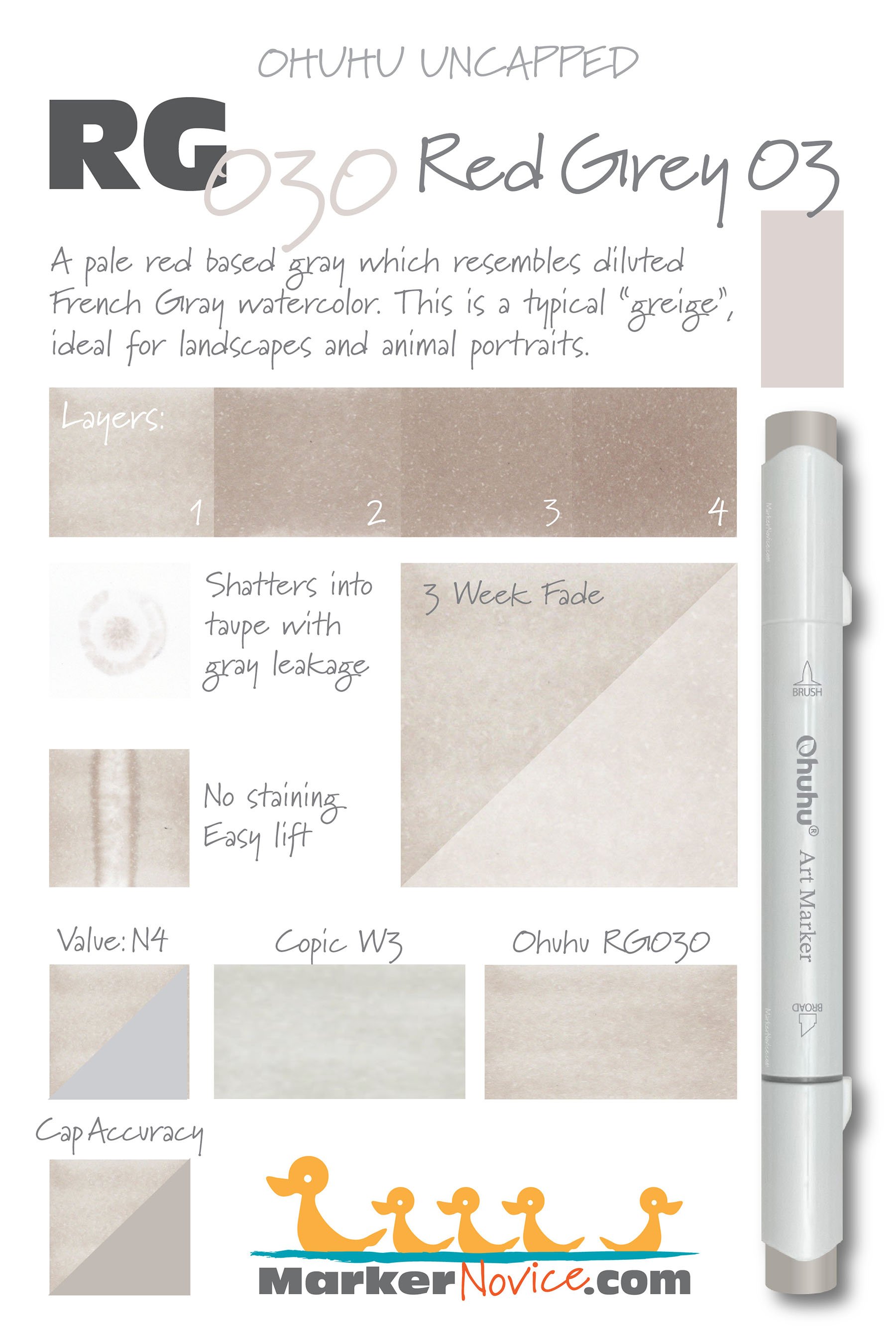
Buildup: RG030 reaches a maximum value at 4 coats.
Normally, I rant in this section about how Ohuhu colors reach maximum value at two layers which makes blending harder than it has to be. Ohuhu markers tend to look oily very fast which makes many of their colors unsuitable for underpainting or beginner blending.
However, Ohuhu’s RG030 acts more like a Copic Marker in its ability to layer several times before turning oily. I have yet to test the rest of the RG family but I have high hopes for this group.
For the first time in this series, I can see a place for adding Ohuhu RG markers as a supplement to my Copic collection. The only reason I won’t is because I don’t like the Ohuhu brush nib but also, because to date, Ohuhu does not sell any RG refills. I’m extremely disappointed because I really want a set of French Gray markers!
Overinking: RG030 layers beautifully and the color did not develop over-inked blotches until 5 layers (which is more than anyone should ever do).
Shattering: This is definitely an ink blend. RG030 shattered into a brownish color with gray leakage.
Chromatography testing shows this ink’s behavior when it comes in contact with #0 Colorless Blender (solvent). High shattering colors may leak unexpected color when you make corrections or attempt to blend with any color that has a high solvent to colorant ratio. Shattering is not bad, it’s just something to be aware of.
Staining: RG030 did not stain the paper.
With alcohol markers, a staining ink is generally a sign of a low quality ink. Staining inks bond to the paper fibers and are reluctant to release. Staining inks make blending harder than it has to be!
Lift: RG030 is an easy lifting color. As with most Ohuhu inks, you can make some corrections with colorless blender but use caution because the ink creates dark dry lines which often look worse than the original mistake.
See staining swatch. Sample was given 6 stripes of #0 Colorless Blender, drying between each stripe. Results indicate how much lifting you can expect.
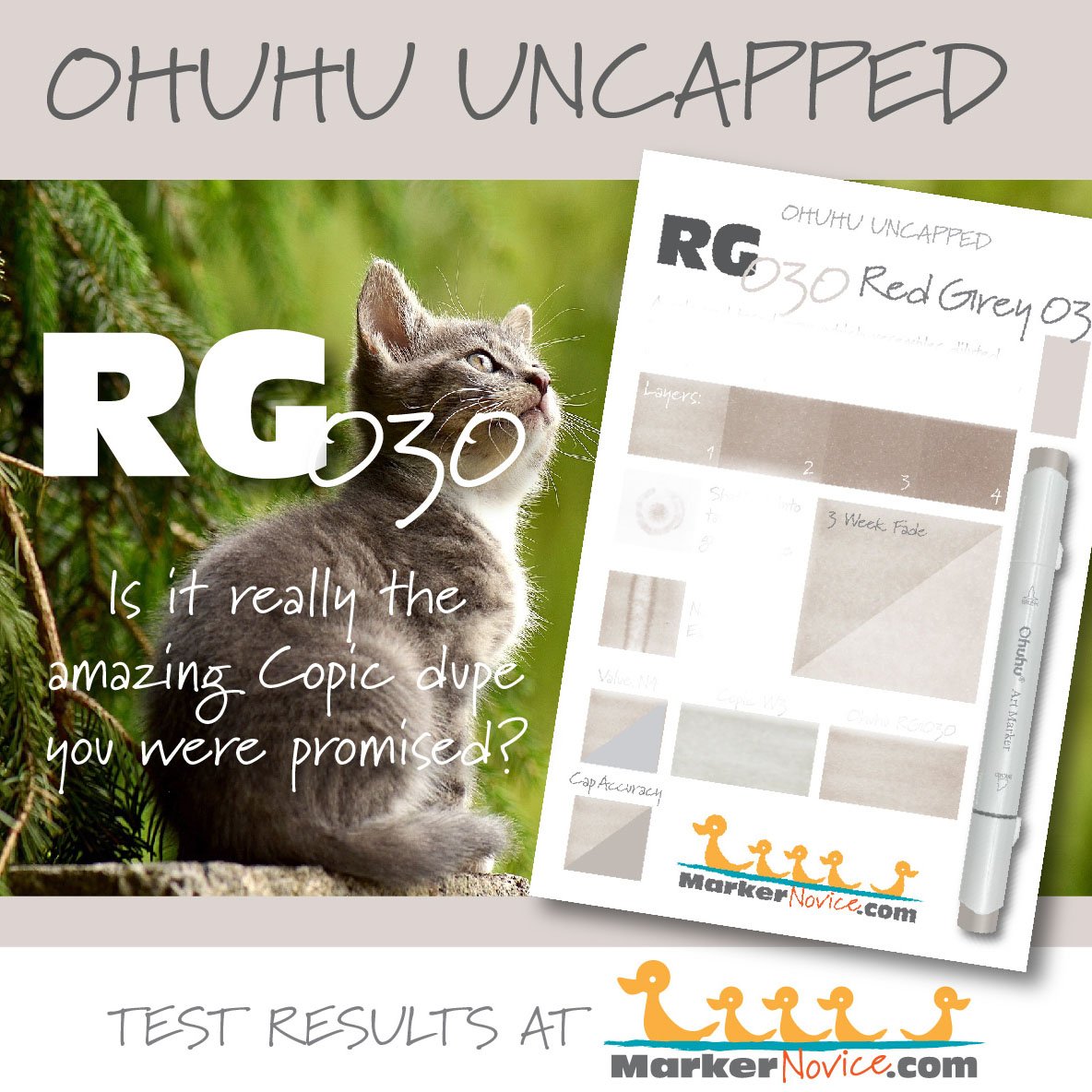
Lightfast: RG030 faded about 50% during the test period. This is far more than the average Copic. The closest Copic color is W3 which did not fade at all.
Samples were swatched on X-Press It Blending Card. 1 layer of ink was exposed to windowsill sunlight for 21 days. Approximately 10 hours of sun per day based on weather conditions. Note: we do not recommend displaying original marker art under these conditions.
Ink Color Family: RG stands for Red Grey which is usually called French Grey in other art supplies. French Greys tend to look brownish compared to other grays and for this reason, they’re excellent organic grays for landscapes, botanicals, and animal fur.
Ohuhu gives us six RG markers, three of which look like true Red Grays, hooray! The other three are Violet Grays which is disappointing.
Cap Numbering: As mentioned above, there are six RG markers which can be divided into two color groups, each with a light, medium, and dark version.
RG030 is the lightest member of the trio of true Red Greys. It can be blended with RG050 and RG080.
This is one of the few times when the numbering within an Ohuhu color family actually makes sense!
I’m still early in the Ohuhu testing process. I will add more info to this article as I learn more and when I spot behavioral patterns.
From what I’ve learned so far, I will not be working with Ohuhu markers and I will discourage students from using them in my classes. They’re simply not worth the frustration.

Learn more about RG030 Red Grey 03, a warm gray Ohuhu Marker. We swatch and test Ohuhu colors- layering, staining, lift, value, lightfastness, saturation, and cap accuracy. | MarkerNovice.com | How to blend alcohol ink markers.