

R080 Pale Cherry Pink: Testing Ohuhu Markers for Lightfastness and Quality
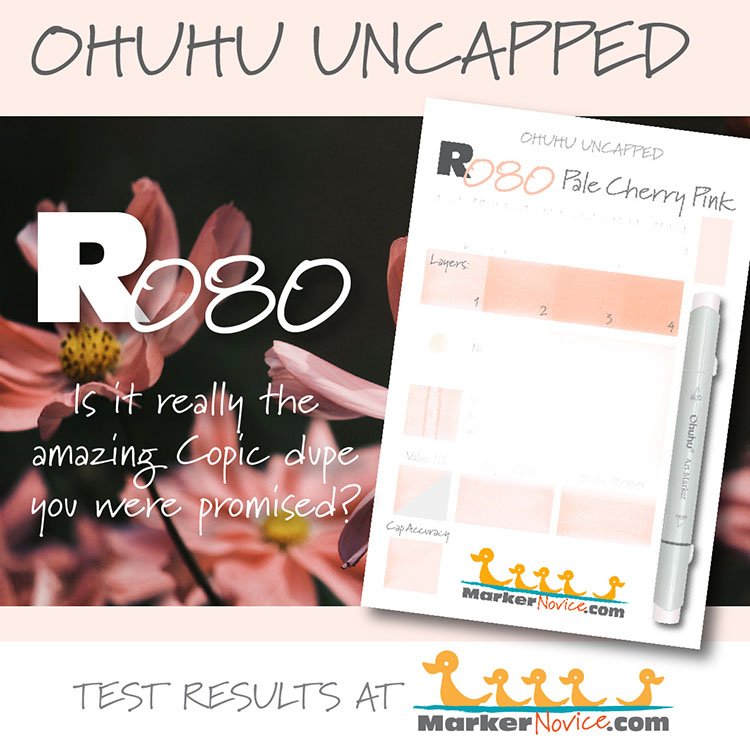
R080 Pale Cherry Pink
Let’s take a closer look at this Ohuhu Marker and its ink characteristics.
You were told “Ohuhu is the Copic slayer! They’re like Copic Markers but better!”
Is it true?
Every Ohuhu Marker has different characteristics based upon its unique ink formula. No matter how great they say the marker is, test results do not lie.
So are Ohuhu markers as great as you’ve heard?
Let’s look at Ohuhu R080 to find out.
WARNING: Ohuhu markers have numbers on the cap but not on the body of the marker. We do not recommend coloring with both caps off due to the risk of accidentally placing the wrong caps on a marker.
Test results: Ohuhu R080 Pale Cherry Pink
REFILL WARNING! At this time, Ohuhu does not sell refills for R080. To date, you must purchase a new marker when your current marker runs dry. Ohuhu is deceptive when they advertise that their markers are refillable. In reality, they only offer 50 refills in a line of 320+ markers. See Ohuhu’s current list of refills here.
Temperature: A highly diluted warm red
Resemblance: Vermilion watercolor
Name: “Pale Cherry Pink” isn’t a terrible name but it will bother any artist who knows this color is light red rather than pink. Pinks are part of the Magenta or “RV” family. Light reds are warmer and have almost a peachy vibe to them. Light red is not pink.
Actual Value: N2
Unlike Copic, Ohuhu does not measure value— this is a glaring deficiency which makes finding blending combinations harder than it has to be!
All Copics are measured on a Neutral Gray value scale. The last number on the Copic cap indicates the value. We’re using the Copic scale to measure Ohuhu until Ohuhu releases a reliable value scale.
Cap Accuracy: The plastic on an Ohuhu Honolulu R080 is a close match to one coat of R080. The colored plastic is a bit translucent though which can make the color indicator look greyish at times.
Copic Substitution: Ohuhu R080 is similar to Copic R00.
Note: similar colors rarely behave the same way. At the time of writing, I have not fully tested R00. I’m speaking from experience only. Most markers this pale are easy to work with, they blend and layer well because there’s just not a lot of colorant in the color. Ohuhu’s R080 makes me worry though. See the “Buildup” and “Overinking” categories below for more information on my concerns.

Buildup: R080 reaches a maximum value in the blotchy areas at only two coats. Now reflect on how many layers you typically use to apply a skin-colored blending combination and then blend it smooth. Can you color a face with only two layers of ink?
Overinking: We do not recommend using more than 2 coats of R080.
Let’s be honest, most people will use R080 for coloring skin and faces. The people who will use R080 for skin are usually beginners and weekend hobbyists because trained artists tend to use fewer literal skin colors for skin. Because of this, the people using this marker for skin are the least prepared to deal with the blotches and problems R080 creates with just a second layer.
The average skin blending session likely involves at least four layers of ink. Now look at the color above for four layers of R080. Have you ever met anyone with skin that color?
For both reasons, I do not recommend the use of R080.
Shattering: R080 did not shatter and is likely made with only one dye in the formula.
Chromatography testing shows this ink’s behavior when it comes in contact with #0 Colorless Blender (solvent). High shattering colors may leak unexpected color when you make corrections or attempt to blend with any color that has a high solvent to colorant ratio. Shattering is not bad, it’s just something to be aware of.
Staining: Most pale ink colors do not stain but of the palest colors, any red will stain more than the others. R080 is slightly staining but not any more so than similar markers in other brands.
With alcohol markers, a staining ink is generally a sign of a low quality ink. Staining inks bond to the paper fibers and are reluctant to release. Staining inks make blending harder than it has to be!
Lift: This is where R080 fails to work as well as Copic ink. First, we had the layering issues cited above. Now look at the dark trench sides created during the lift testing. Do you want to create stripes like this on a face?
See staining swatch. Sample was given 6 stripes of #0 Colorless Blender, drying between each stripe. Results indicate how much lifting you can expect.
Lightfast: R170 faded about 40% during the test period. This is excessive and the sign of low-quality ingredients.
Samples were swatched on X-Press It Blending Card. 1 layer of ink was exposed to windowsill sunlight for 21 days. Approximately 10 hours of sun per day based on weather conditions. Note: we do not recommend displaying original marker art under these conditions.
Ink Color Family: The “R” in R080 indicates that this marker is part of the R red family. In my opinion, this is a good placement for this color although I can easily see someone arguing that this color is better suited to the YR family.
Given that the use of two letters (YR) typically indicates a blended ink (yellow ink + red ink), and the fact that R080 seems to be a single source ink (see shattering test), I think this marker is solidly in the R family.
The Ohuhu numbering system is complete garbage and doesn’t always make sense. Some orange and magenta markers are hidden in the R family. Be warned, when it comes to other color families, you can not trust anything you read on an Ohuhu cap.
Cap Numbering: The R 0X0 group is just three markers:
R050 is a light salmon color which almost glows
R070 is a medium Carmine color
R080 is skintone-ish
These inks are NOT related to each other, not arranged chromatically, and not arranged according to value or temperature. They don’t even work as a blending group. Ohuhu dumped these colors together without thinking because they don’t care about their numbering system.
As stated above, the Ohuhu numbering system makes no sense. The markers are not arranged in chromatic order so you can not trust the numbers to tell you whether this marker is lighter or darker than other Ohuhu markers with similar numbers.
I’m still early in the Ohuhu testing process. I will add more info to this article as I learn more and when I spot behavioral patterns.
From what I’ve learned so far, I will not be working with Ohuhu markers and I will discourage students from using them in my classes. They’re simply not worth the frustration.







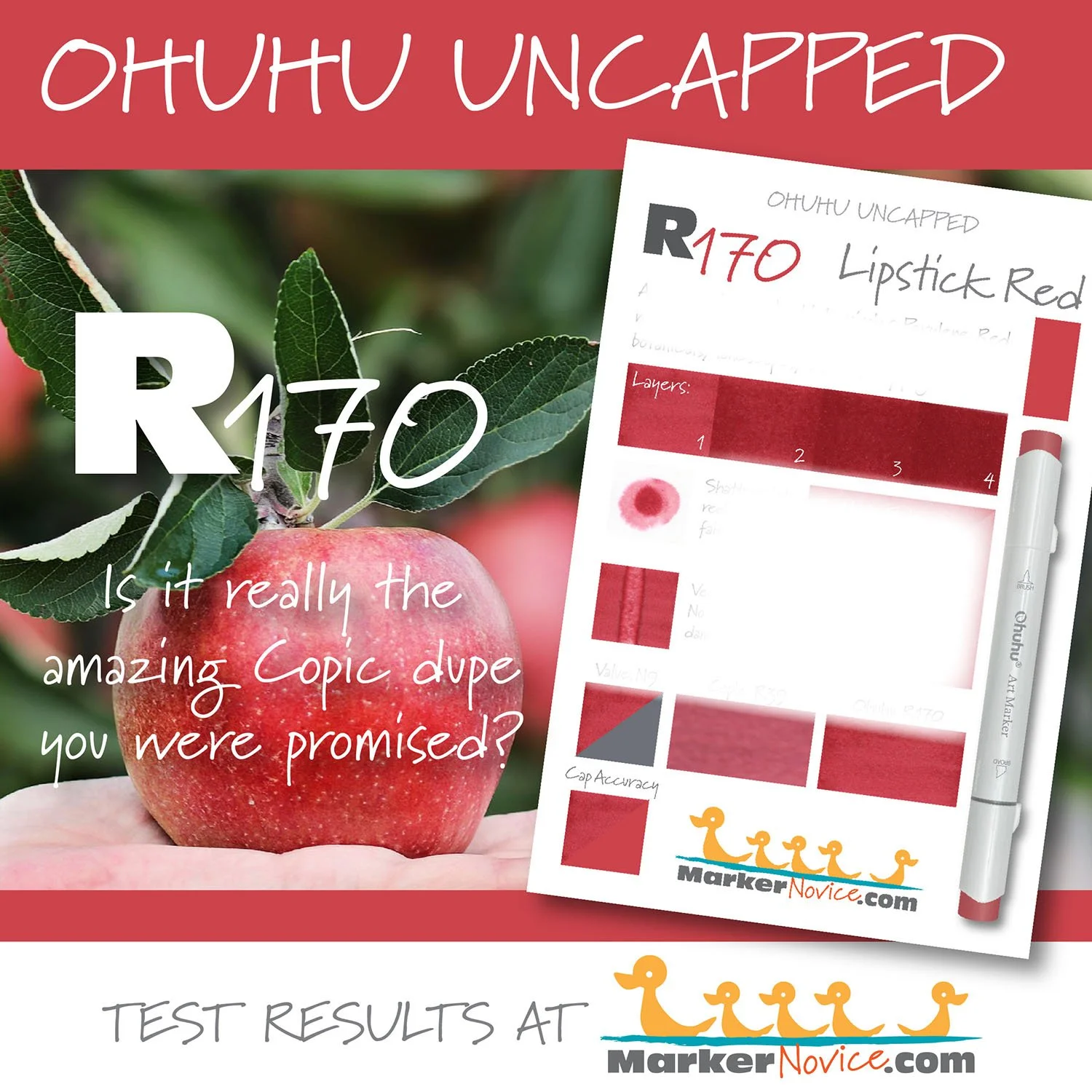
R170 Lipstick Red: Testing Ohuhu Markers for Lightfastness and Quality
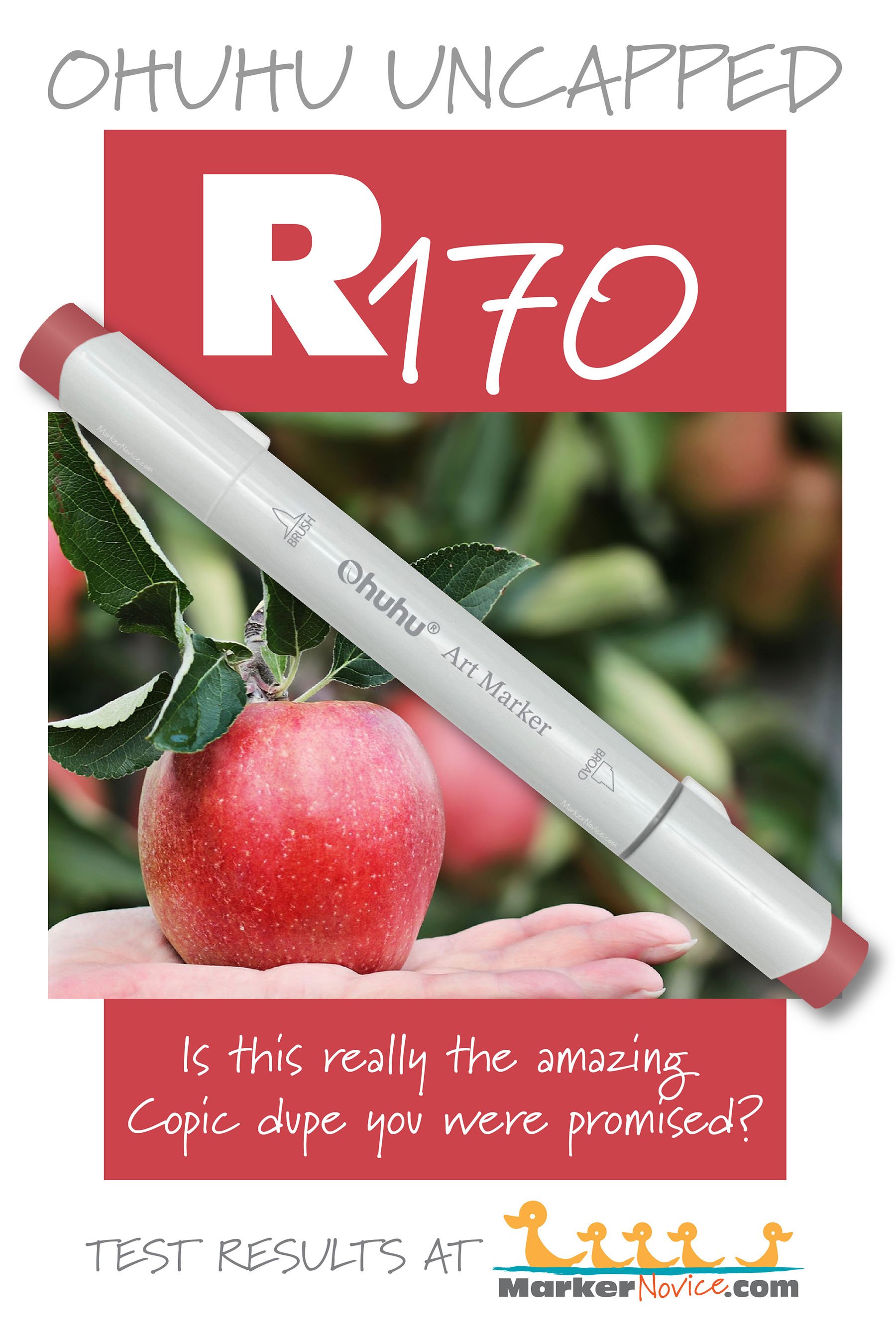
R170 Lipstick Red
Let’s take a closer look at this Ohuhu Marker and its ink characteristics.
You were told “Ohuhu is the Copic slayer! They’re like Copic Markers but better!”
Is it true?
Every Ohuhu Marker has different characteristics based upon its unique ink formula. No matter how great they say the marker is, test results do not lie.
So are Ohuhu markers as great as you’ve heard?
Let’s look at Ohuhu R170 to find out.
WARNING: Ohuhu markers have numbers on the cap but not on the body of the marker. We do not recommend coloring with both caps off due to the risk of accidentally placing the wrong caps on a marker.
Test results: Ohuhu R170 Lipstick Red
Refill: You’re in luck! Ohuhu sells only 50 colors of refills leaving most of their markers un-refillable. R170 is one of the refills they do make. This makes R170 a smart purchase! See Ohuhu’s current list of refills here.
Temperature: A cool, dark wine red
Resemblance: Perylene Red watercolor
Name: “Lipstick Red” isn’t a terrible name because I’ve seen lipstick this color. But to an American audience, “Lipstick” indicates a fiery, Corvette, candy-apple kind of red. The name simply feels wrong for a red this cool, dark, and almost burgundy.
Actual Value: N9
Unlike Copic, Ohuhu does not measure value— this is a glaring deficiency which makes finding blending combinations harder than it has to be!
All Copics are measured on a Neutral Gray value scale. The last number on the Copic cap indicates the value. We’re using the Copic scale to measure Ohuhu until Ohuhu releases a reliable value scale.
Cap Accuracy: The plastic on an Ohuhu Honolulu R170 is a close match to one coat of R3. The plastic is a bit duller and less vibrant than the ink.
Copic Substitution: Ohuhu R170 sits inbetween Copic’s R37 and R39.
Note: similar colors rarely behave the same way. From experience I can tell you that Copic R37 and R39 are much easier to work with, especially for beginners! Look below at how fast Ohuhu R170 reaches maximum value and looks oily. This means you’ll see oilyness AS you blend, before you even consider re-blending! The Copic R-30’s allow easier blending and the oiliness doesn’t appear until four layers. For comparison, see Copic R37 test results here.
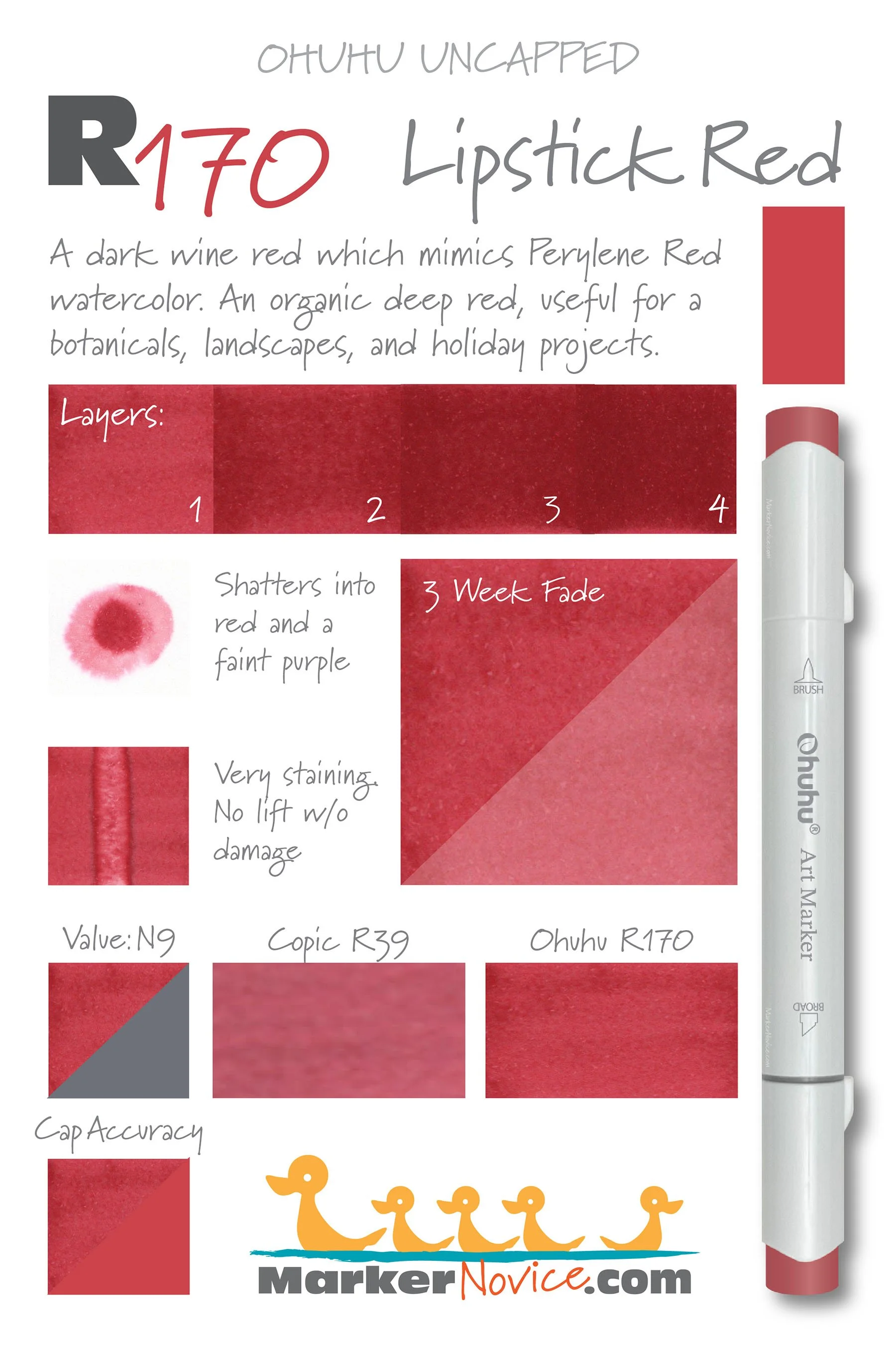
Buildup: R170 reaches a maximum value at 3 coats.
Overinking: We do not recommend using more than 2 coats of R170. As with most Ohuhu markers, 3-4 layers looks oversaturated and dull.
Shattering: R170 is extremely reactive to colorless blender indicating that there is a high ratio of colorant to solvent in this ink formula. In paint, we like high pigment ratios but in markers, it creates a temperamental and stubborn marker. I’ve seen worse in the Ohuhu line but this is higher than average and you will see blending issues because of it.
Chromatography testing shows this ink’s behavior when it comes in contact with #0 Colorless Blender (solvent). High shattering colors may leak unexpected color when you make corrections or attempt to blend with any color that has a high solvent to colorant ratio. Shattering is not bad, it’s just something to be aware of.
Staining: As with most red ink colors, R170 is extremely staining color. This is partially because it’s red but mostly because of the extreme amount of colorant in the formula.
With alcohol markers, a staining ink is generally a sign of a low quality ink. Staining inks bond to the paper fibers and are reluctant to release. Staining inks make blending harder than it has to be!
Lift: Forget about it. R170 is incredibly stubborn and stains the paper red. Exercise caution when trying to lift or move a mistake. Notice the dark edges to the correction area in the sample above. The ink in these dark stripes actually looks metallic and I can feel the stripe with my fingernail! Attempting to fix a mistake could damage your project more than the mistake did.
See staining swatch. Sample was given 6 stripes of #0 Colorless Blender, drying between each stripe. Results indicate how much lifting you can expect.
Lightfast: R170 faded about 20% during the test period.
Samples were swatched on X-Press It Blending Card. 1 layer of ink was exposed to windowsill sunlight for 21 days. Approximately 10 hours of sun per day based on weather conditions. Note: we do not recommend displaying original marker art under these conditions.
Ink Color Family: The “R” in R170 indicates that this marker is part of the R red family but Ohuhu classifies a lot of oranges, violets, and pinks also as R. Think of R and “probably red but maybe not.”
The Ohuhu numbering system is complete garbage and doesn’t always make sense. Some orange and magenta markers are hidden in the R family. Be warned, when it comes to other color families, you can not trust anything you read on an Ohuhu cap.
Cap Numbering: If the Ohuhu markering system made sense, we would assume that R170 is part of the R-One Hundred family which includes R110, R120, R150, R160, R170, R180, and R190.
In looking at that series, you’d think these red markers were similar colors arranged from light to dark, correct?
Nope.
R110 is a pale orange-red which is not related to anything else in the series.
R120 is a florescent pink highlighter.
R150 is a slightly neon medium salmon pink.
R160 is a carmine red.
R170 is a cool dark red.
R180 is a darker cool red than R170.
R190 is a light warm pink.
These inks are NOT related to each other, not arranged chromatically, and not arranged according to value. Ohuhu dumped these colors together without thinking because they don’t care about their numbering system.
As stated above, the Ohuhu numbering system makes no sense. The markers are not arranged in chromatic order so you can not trust the numbers to tell you whether this marker is lighter or darker than other Ohuhu markers with similar numbers.
I’m still early in the Ohuhu testing process. I will add more info to this article as I learn more and when I spot behavioral patterns.
From what I’ve learned so far, I will not be working with Ohuhu markers and I will discourage students from using them in my classes. They’re simply not worth the frustration.

Learn more about R170 Lipstick Red, a wine red Ohuhu Marker. We swatch and test Ohuhu colors- layering, staining, lift, value, lightfastness, saturation, and cap accuracy. | MarkerNovice.com | How to blend alcohol ink markers.
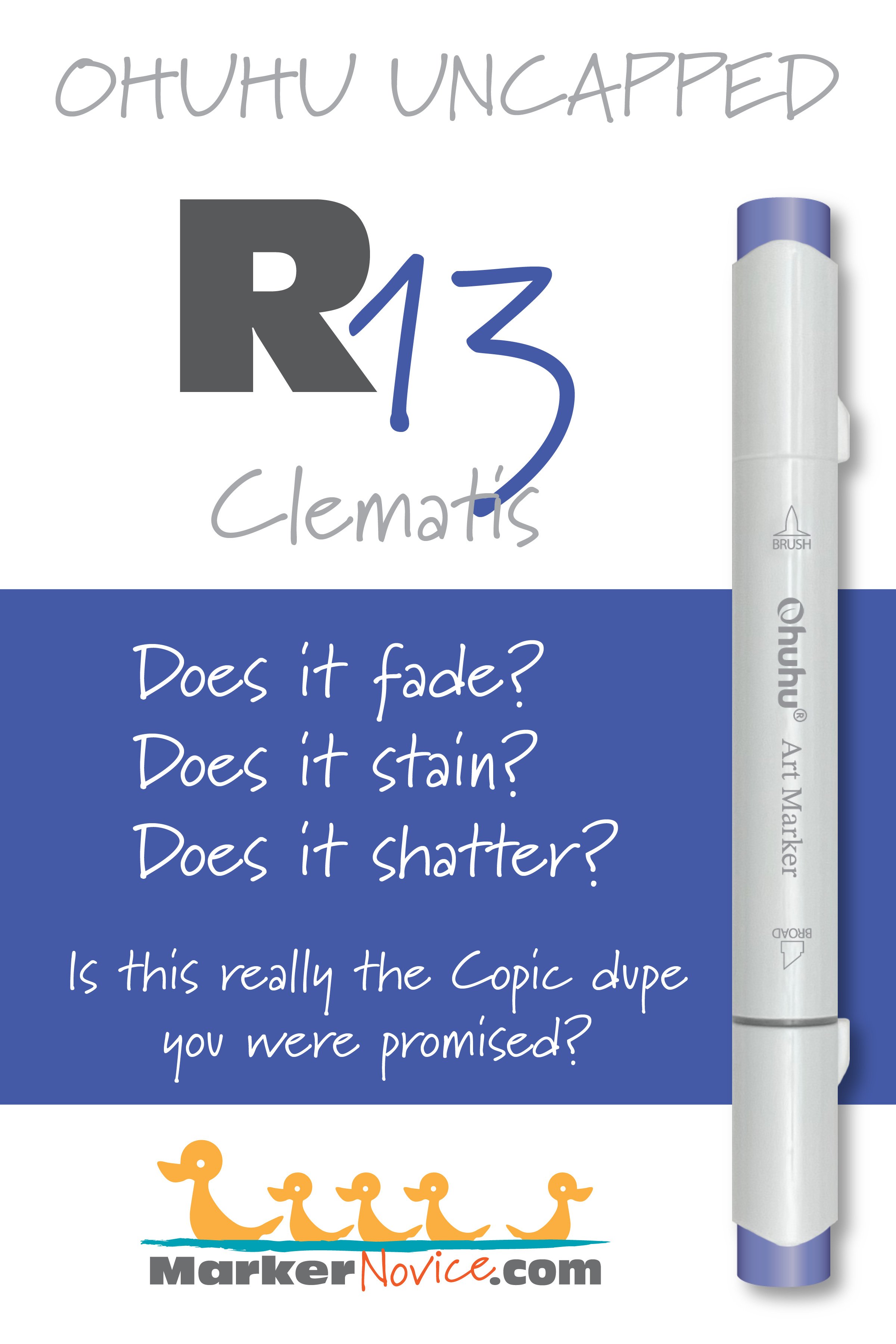
R13 Clematis: Testing Ohuhu Markers for Lightfastness and Quality
R13 Clematis
Let’s take a closer look at this Ohuhu Marker and its ink characteristics.
You were told “Ohuhu is the Copic slayer! They’re like Copic Markers but better!”
Is it true?
Every Ohuhu Marker has different characteristics based upon its unique ink formula. No matter how great they say the marker is, test results do not lie.
So are Ohuhu markers as great as you’ve heard?
Let’s look at Ohuhu R13 to find out.
WARNING: Ohuhu markers have numbers on the cap but not on the body of the marker. We do not recommend coloring with both caps off due to the risk of accidentally placing the wrong caps on a marker.
Test results: Ohuhu R13 Clematis
NUMBER SYSTEM WARNING: R13 is not a typo! As I warn below, the Ohuhu numbering system is nonsense! This marker proves how little they care about helping you use their product. They know this is not a red ink because Clematis flowers are never red. This also is not the only stupidly numbered marker in the Ohuhu collection.
REFILL WARNING! At this time, Ohuhu does not sell refills for R13. To date, you must purchase a new marker when your current marker runs dry. See Ohuhu’s current list of refills here.
Temperature: A cool violet with blue undertones
Resemblance: Cobalt Violet watercolor
Actual Value: N9
Unlike Copic, Ohuhu does not measure value— this is a glaring deficiency which makes finding blending combinations harder than it has to be!
All Copics are measured on a Neutral Gray value scale. The last number on the Copic cap indicates the value. We’re using the Copic scale to measure Ohuhu until Ohuhu releases a reliable value scale.
Cap Accuracy: The plastic on an Ohuhu Honolulu R13 marker both lighter and warmer than even one coat of R13. Beware when selecting Ohuhu markers based on cap colors.
Copic Substitution: Ohuhu R13 is a close match to Copic’s BV04.
Note: similar colors rarely behave the same way. From experience I can tell you that Copic BV04 is a marker I highly recommend for beginners— it’s on my Starter Marker List and I teach with it frequently because it’s an easy blending color. Ohuhu R13 is not an easy blending color and therefore, I would never recommend this color for beginners. See Copic BV04 test results here.
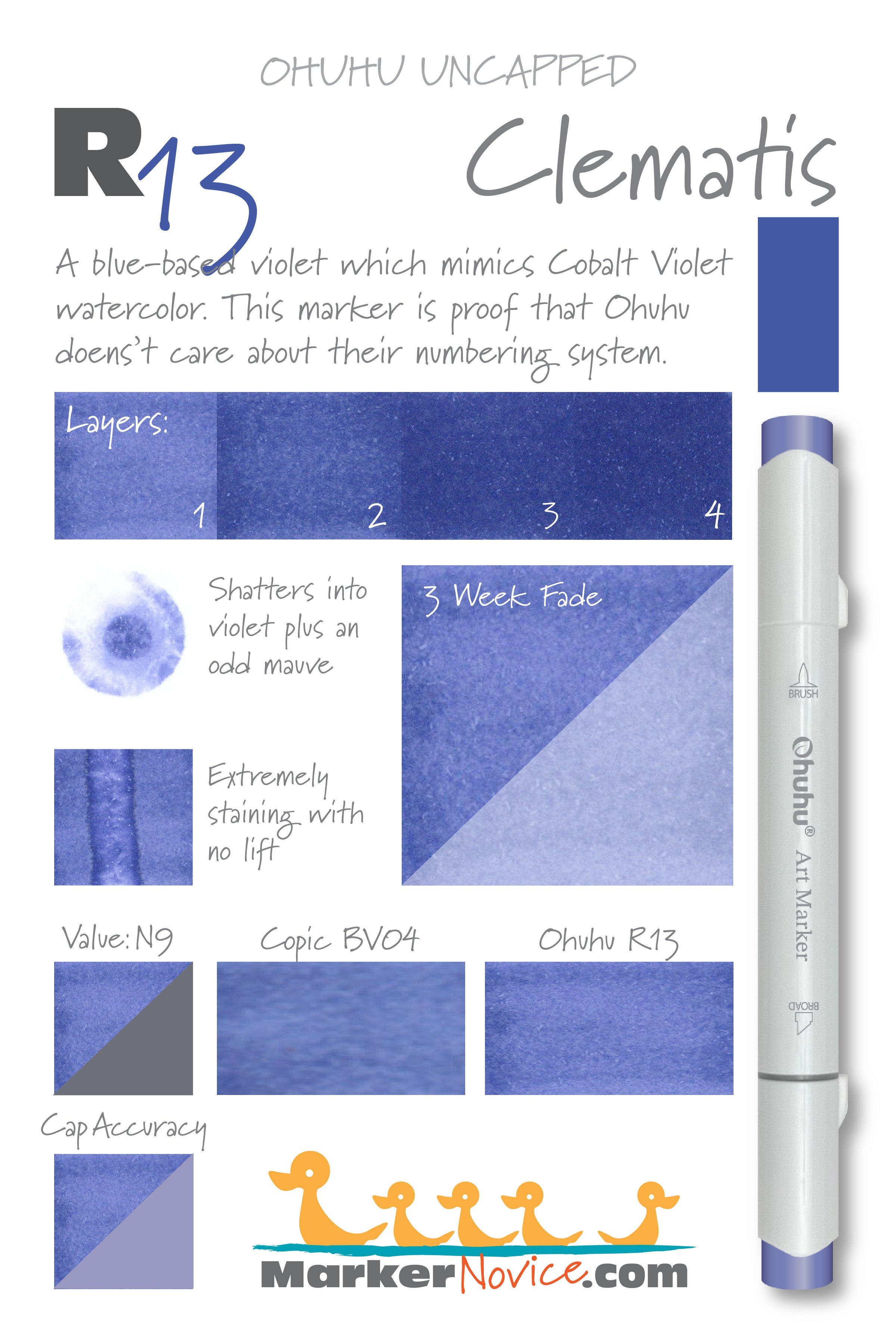
Buildup: R13 reaches a maximum value at about 3 coats.
Overinking: We do not recommend using more than 4 coats of R13. As with most Ohuhu markers, four layers looks oversaturated and oily.
Shattering: R13 seems to be a mixture of at least two inks, one violet and an odd mauve. The mauve color appears at the edge of the shattering test and may appear on your projects when you make corrections with colorless blender.
Chromatography testing shows this ink’s behavior when it comes in contact with #0 Colorless Blender (solvent). High shattering colors may leak unexpected color when you make corrections or attempt to blend with any color that has a high solvent to colorant ratio. Shattering is not bad, it’s just something to be aware of.
Staining: As with most red ink colors, R13 is extremely staining color.
With alcohol markers, a staining ink is generally a sign of a low quality ink. Staining inks bond to the paper fibers and are reluctant to release. Staining inks make blending harder than it has to be!
Lift: Forget about it. R13 is stubborn and stains the paper an odd pink. The ink itself moves very little, even on high quality paper.
See staining swatch. Sample was given 6 stripes of #0 Colorless Blender, drying between each stripe. Results indicate how much lifting you can expect.

Lightfast: R13 faded by about 40% during the test period.
Samples were swatched on X-Press It Blending Card. 1 layer of ink was exposed to windowsill sunlight for 21 days. Approximately 10 hours of sun per day based on weather conditions. Note: we do not recommend displaying original marker art under these conditions.
Ink Color Family: The “R” in R13 indicates that this marker is part of the R red family. Does this look like red ink to you? When you look at this number, do you feel like Ohuhu cares about helping you use their product? Do you think Ohuhu deserves your money?
The Ohuhu numbering system is complete garbage and doesn’t always make sense. Some orange, magenta, violet, and obviously blue-violet markers are hidden in the R family. Be warned, when it comes to other color families, you can not trust anything you read on an Ohuhu cap.
Cap Numbering: R13 is blue violet. R12 is a dirty orange-pink. R14 is neon pink. Good luck blending R13 with anything in the R family. This is ridiculous, how is a beginner supposed to form blending combinations when the caps are beyond stupid?
As stated above, the Ohuhu numbering system makes no sense. The markers are not arranged in chromatic order so you can not trust the numbers to tell you whether this marker is lighter or darker than other Ohuhu markers with similar numbers.
I’m still early in the Ohuhu testing process. I will add more info to this article as I learn more and when I spot behavioral patterns.
From what I’ve learned so far, I will not be working with Ohuhu markers and I will discourage students from using them in my classes. They’re simply not worth the frustration.


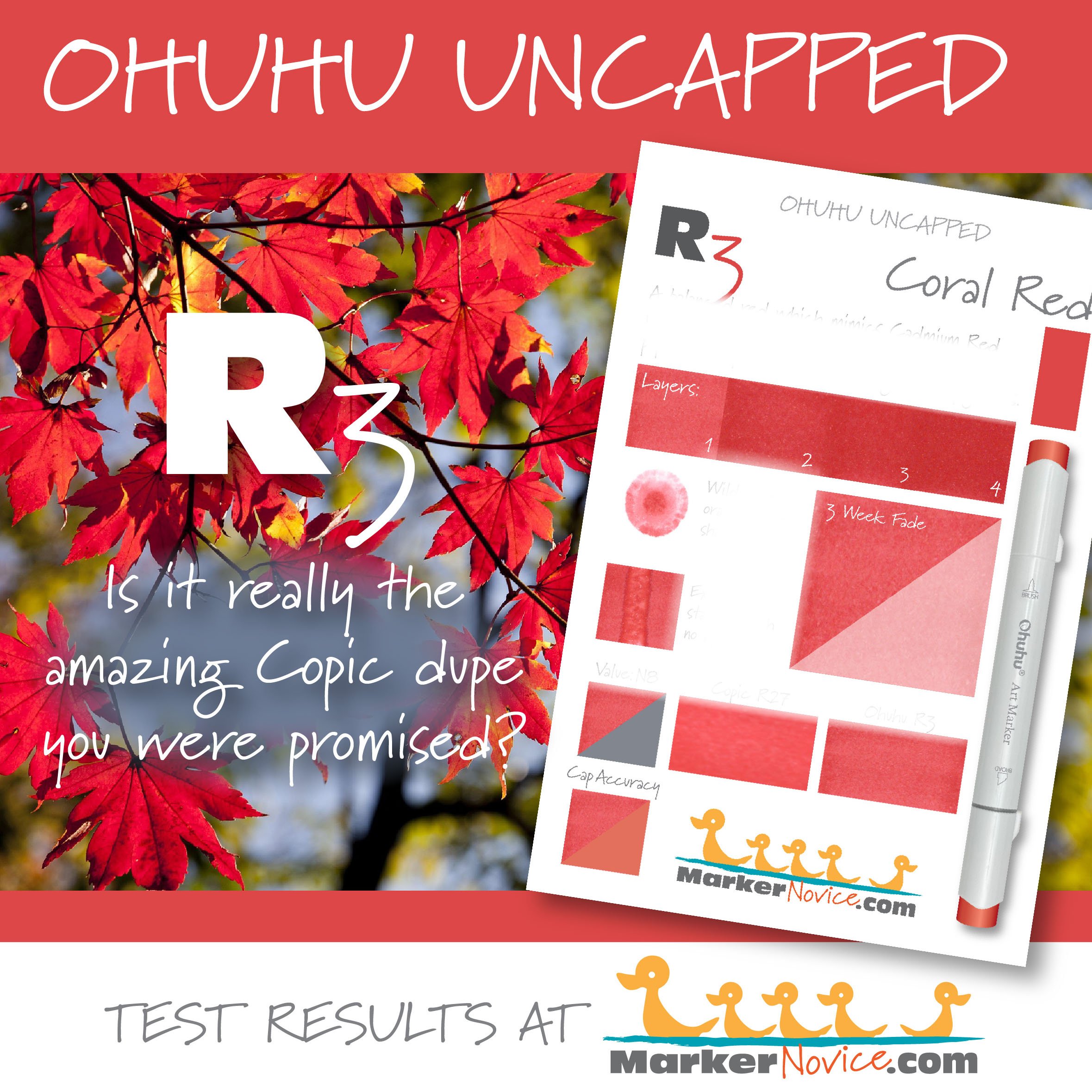
R3 Coral Red: Testing Ohuhu Markers for Lightfastness and Quality
R3 Coral Red
Let’s take a closer look at this Ohuhu Marker and its ink characteristics.
You were told “Ohuhu is the Copic slayer! They’re like Copic Markers but better!”
Is it true?
Every Ohuhu Marker has different characteristics based upon its unique ink formula. No matter how great they say the marker is, test results do not lie.
So are Ohuhu markers as great as you’ve heard?
Let’s look at Ohuhu R3 to find out.
WARNING: Ohuhu markers have numbers on the cap but not on the body of the marker. We do not recommend coloring with both caps off due to the risk of accidentally placing the wrong caps on a marker.
Test results: Ohuhu R3 Coral Red
COLORLESS BLENDER WARNING: R3 turns a violent neon orange when touched by colorless blender. As the ink dries again, the orange fades slightly but not completely. WE DO NOT RECOMMEND CORRECTING R3 MISTAKES WITH COLORLESS BLENDER. See the Shattering category below for more info.
REFILL WARNING! At this time, Ohuhu does not sell refills for R3. To date, you must purchase a new marker when your current marker runs dry. See Ohuhu’s current list of refills here.
Temperature: A warm red with subtle orange undertones
Resemblance: Cadmium Red watercolor
Actual Value: N8
Unlike Copic, Ohuhu does not measure value— this is a glaring deficiency which makes finding blending combinations harder than it has to be!
All Copics are measured on a Neutral Gray value scale. The last number on the Copic cap indicates the value. We’re using the Copic scale to measure Ohuhu until Ohuhu releases a reliable value scale.
Cap Accuracy: The plastic on an Ohuhu Honolulu R3 marker is a dull red, lighter than even one coat of R3. Ironically, the cap color is actually closer to the faded version of R3 after lightfast testing.
Copic Substitution: Ohuhu R3 is slightly cooler than Copic’s R27 but otherwise, they are a near match in hue and value.
Note: similar colors rarely behave the same way. From experience I can tell you that Copic R27 is much easier to blend with and as a result, I do not recommend R3 for blending beginners. For comparison, see Copic R27 test results here.
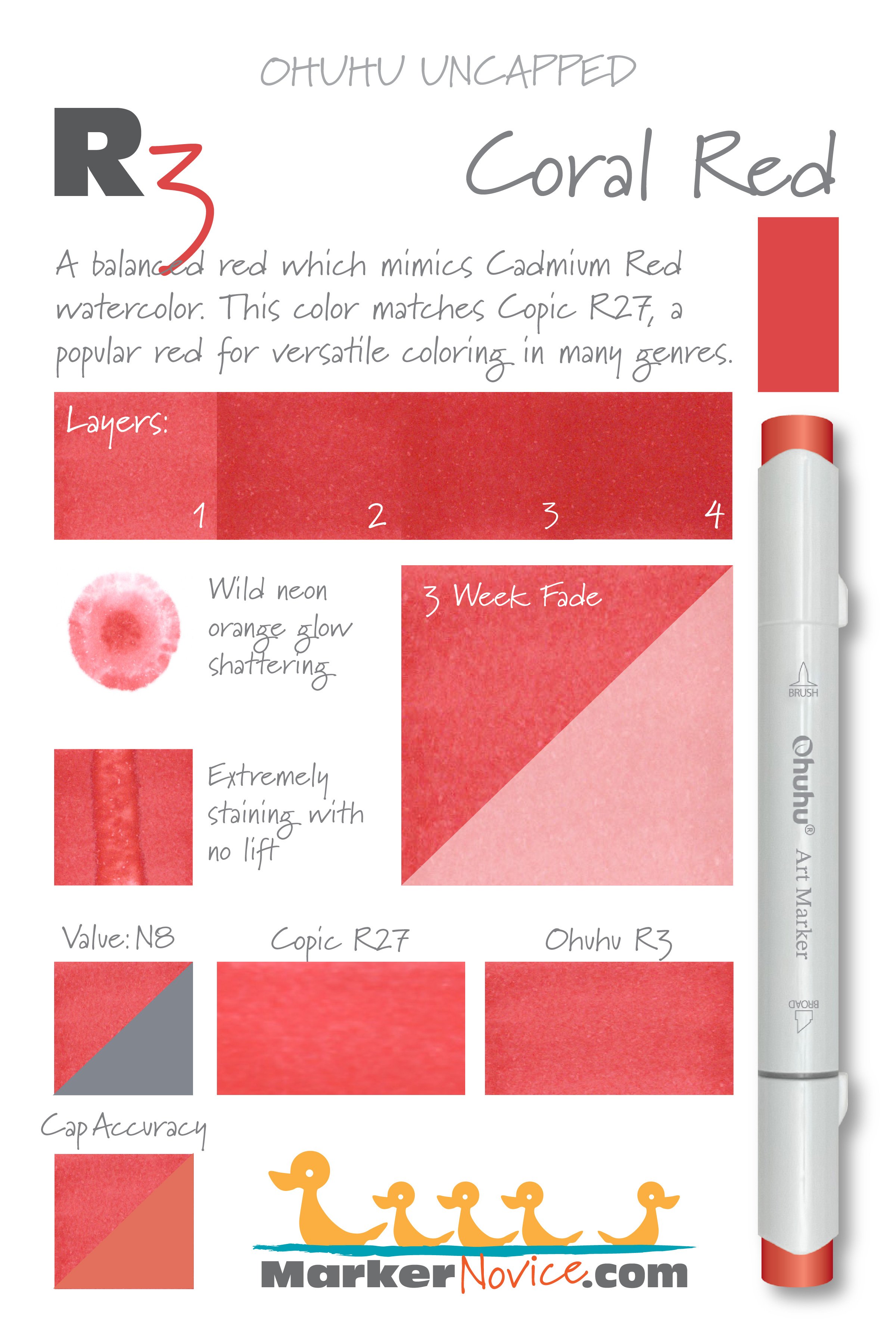
Buildup: R3 reaches a maximum value at 3 coats.
Overinking: We do not recommend using more than 4 coats of R3. As with most Ohuhu markers, four layers looks oversaturated and dull. Additionally, 4 layers of R3 feels slightly tacky to the touch indicating a high amount of dye in the ink blend.
Shattering: I’ve never seen a marker ink react to colorless blender the way R3 did! Normally when I drip colorless blender solution over an ink sample, the color fades slightly. R3 exploded into a bright neon orange color and the dye spread out everywhere!
Due to this extreme reaction, WE DO NOT RECOMMEND CORRECTING R3 MISTAKES WITH COLORLESS BLENDER. Fixing an R3 mistake will cause more damage than the original mistake.
Chromatography testing shows this ink’s behavior when it comes in contact with #0 Colorless Blender (solvent). High shattering colors may leak unexpected color when you make corrections or attempt to blend with any color that has a high solvent to colorant ratio. Shattering is not bad, it’s just something to be aware of.
Staining: As with most red ink colors, R3 is extremely staining color.
With alcohol markers, a staining ink is generally a sign of a low quality ink. Staining inks bond to the paper fibers and are reluctant to release. Staining inks make blending harder than it has to be!
Lift: Forget about it. R3 is incredibly stubborn and stains the paper orange. The ink itself moves very little. Trying to make a correction with colorless blender will cause more damage than the mistake itself. See staining above, this is a sign of a low quality ink.
See staining swatch. Sample was given 6 stripes of #0 Colorless Blender, drying between each stripe. Results indicate how much lifting you can expect.
Lightfast: R3 faded more than any other ink I’ve tested to date. The fade was well over 50% during the test period.
Samples were swatched on X-Press It Blending Card. 1 layer of ink was exposed to windowsill sunlight for 21 days. Approximately 10 hours of sun per day based on weather conditions. Note: we do not recommend displaying original marker art under these conditions.
Ink Color Family: The “R” in R3 indicates that this marker is part of the R red family but Ohuhu classifies a lot of oranges, violets, and pinks also as R. Think of R and “kinda red but maybe not.”
The Ohuhu numbering system is complete garbage and doesn’t always make sense. Some orange and magenta markers are hidden in the R family. Be warned, when it comes to other color families, you can not trust anything you read on an Ohuhu cap.
Cap Numbering: R3 is lighter than both R2 and R4. This is ridiculous, how is a beginner supposed to form blending combinations when the caps make no sense?
As stated above, the Ohuhu numbering system makes no sense. The markers are not arranged in chromatic order so you can not trust the numbers to tell you whether this marker is lighter or darker than other Ohuhu markers with similar numbers.
I’m still early in the Ohuhu testing process. I will add more info to this article as I learn more and when I spot behavioral patterns.
From what I’ve learned so far, I will not be working with Ohuhu markers and I will discourage students from using them in my classes. They’re simply not worth the frustration.

Learn more about R3 Coral Red, a warm red Ohuhu Marker. We swatch and test Ohuhu colors- layering, staining, lift, value, lightfastness, saturation, and cap accuracy. | MarkerNovice.com | How to blend alcohol ink markers.