
V050 Pearl Violet: Testing Ohuhu Markers for Lightfastness and Quality
V050 Pearl Violet
Let’s take a closer look at this Ohuhu Marker and its ink characteristics.
You were told “Ohuhu is the Copic slayer! They’re like Copic Markers but better!”
Is it true?
Every Ohuhu Marker has different characteristics based upon its unique ink formula. No matter how great they say the marker is, test results do not lie.
So are Ohuhu markers as great as you’ve heard?
Let’s look at Ohuhu V050 to find out.
WARNING: Ohuhu markers have numbers on the cap but not on the body of the marker. We do not recommend coloring with both caps off due to the risk of accidentally placing the wrong caps on a marker.
Test results: Ohuhu V050 Pearl Violet
REFILL WARNING! At this time, Ohuhu does not sell refills for V050. To date, you must purchase a new marker when your current marker runs dry. See Ohuhu’s current list of refills here.
Temperature: A medium, slightly warm violet
Resemblance: a warmer Ultramarine Violet watercolor
Actual Value: N6
Unlike Copic, Ohuhu does not measure value— this is a glaring deficiency which makes finding blending combinations harder than it has to be!
All Copics are measured on a Neutral Gray value scale. The last number on the Copic cap indicates the value. We’re using the Copic scale to measure Ohuhu until Ohuhu releases a reliable value scale.
Cap Accuracy: The plastic on an Ohuhu Honolulu V050 marker is fairly close to the color of one coat of this ink
Copic Substitution: Ohuhu V050 is slightly warmer but otherwise close to Copic’s V15
Note: similar colors rarely behave the same way. From experience I can tell you that Copic V15 is an easy blending marker. I recommend it for beginners, it’s on my Starter Marker List, and I teach with it frequently— all because it’s a very friendly blender. Ohuhu V050 feels very similar with one exception. I can tell this marker has a lot of colorless blender in the ink formula because this ink mottles slightly on just the second layer. Is this bad? Not necessarily but it does prove that it’s not enough to match the color, two similar inks can behave radically different in usage. See Copic V15 test result here.

Buildup: V050 reaches a maximum value at about 3 coats.
Overinking: We do not recommend using more than 4 coats of V050. As with most Ohuhu markers, four layers looks oversaturated. Four coats actually a pretty color but it does have an inky, almost oily look to it.
Shattering: WOW! V050 is a highly reactive ink. The color immediately spread out far when the sample received a single drop of colorless blender. I can’t say this is good or bad, it’s just extremely unusual. V050 does not shatter. It’s a good bet this is a single ink formula rather than a blend.
Chromatography testing shows this ink’s behavior when it comes in contact with #0 Colorless Blender (solvent). High shattering colors may leak unexpected color when you make corrections or attempt to blend with any color that has a high solvent to colorant ratio. Shattering is not bad, it’s just something to be aware of.
Staining: V050 is a staining color. This is normal for red, purple, and violet markers as these dyes are generally more stubborn than other colors. Expect blending issues with this color as staining colors are resistant to smooth blends.
With alcohol markers, a staining ink is generally a sign of a low quality ink. Staining inks bond to the paper fibers and are reluctant to release. Staining inks make blending harder than it has to be!
Lift: As described in the Shattering category, V050 is sensitive to colorless blender. In the staining sample, you can see how some of the ink was driven off to the sides but the effect was not complete. I recommend caution when trying to fix a V050 mistake as this blender-sensitivity could damage parts of your coloring near the mistake.
See staining swatch. Sample was given 6 stripes of #0 Colorless Blender, drying between each stripe. Results indicate how much lifting you can expect.

Lightfast: V050 faded by about 30% during the test period. Copic V15 had a similar fade rate.
Samples were swatched on X-Press It Blending Card. 1 layer of ink was exposed to windowsill sunlight for 21 days. Approximately 10 hours of sun per day based on weather conditions. Note: we do not recommend displaying original marker art under these conditions.
Ink Color Family: Ohuhu has violet and purple markers hidden in several marker families including R Red, RV Red Violet, RP Red Purple?, P Purple?, and B Blue. I’ve given up trying to understand why.
The Ohuhu numbering system is complete garbage and doesn’t always make sense. Some orange, magenta, violet, and obviously blue-violet markers are hidden in the R family. Be warned, when it comes to other color families, you can not trust anything you read on an Ohuhu cap.
Cap Numbering: V markers all have 3 digits rather than two. I have no idea why because they all end in zero… except for one stinkin’ marker which I’m convinced is only there to throw off any accidental logic. If you line up V020 - 030 - 050 - 060 - 070 - 080 they kinda look in order from light to dark BUT the color temperatures are all over the place. Moral of the story: don’t get too excited when you think you’ve cracked the code.
As stated above, the Ohuhu numbering system makes no sense. The markers are not arranged in chromatic order so you can not trust the numbers to tell you whether this marker is lighter or darker than other Ohuhu markers with similar numbers.
I’m still early in the Ohuhu testing process. I will add more info to this article as I learn more and when I spot behavioral patterns.
From what I’ve learned so far, I will not be working with Ohuhu markers and I will discourage students from using them in my classes. They’re simply not worth the frustration.








Learn about V050 Pearl Violet, a medium violet Ohuhu Marker. We swatch and test Ohuhu colors- layering, staining, lift, value, lightfastness, saturation, and cap accuracy. | MarkerNovice.com | How to color with alcohol markers
Ohuhu Markers: Dry and Under-weight Markers in a New Set?
I purchased a large set of Ohuhu markers for testing. How many markers were dry, dead, or under-weight?
Read more here.

Testing Ohuhu Markers
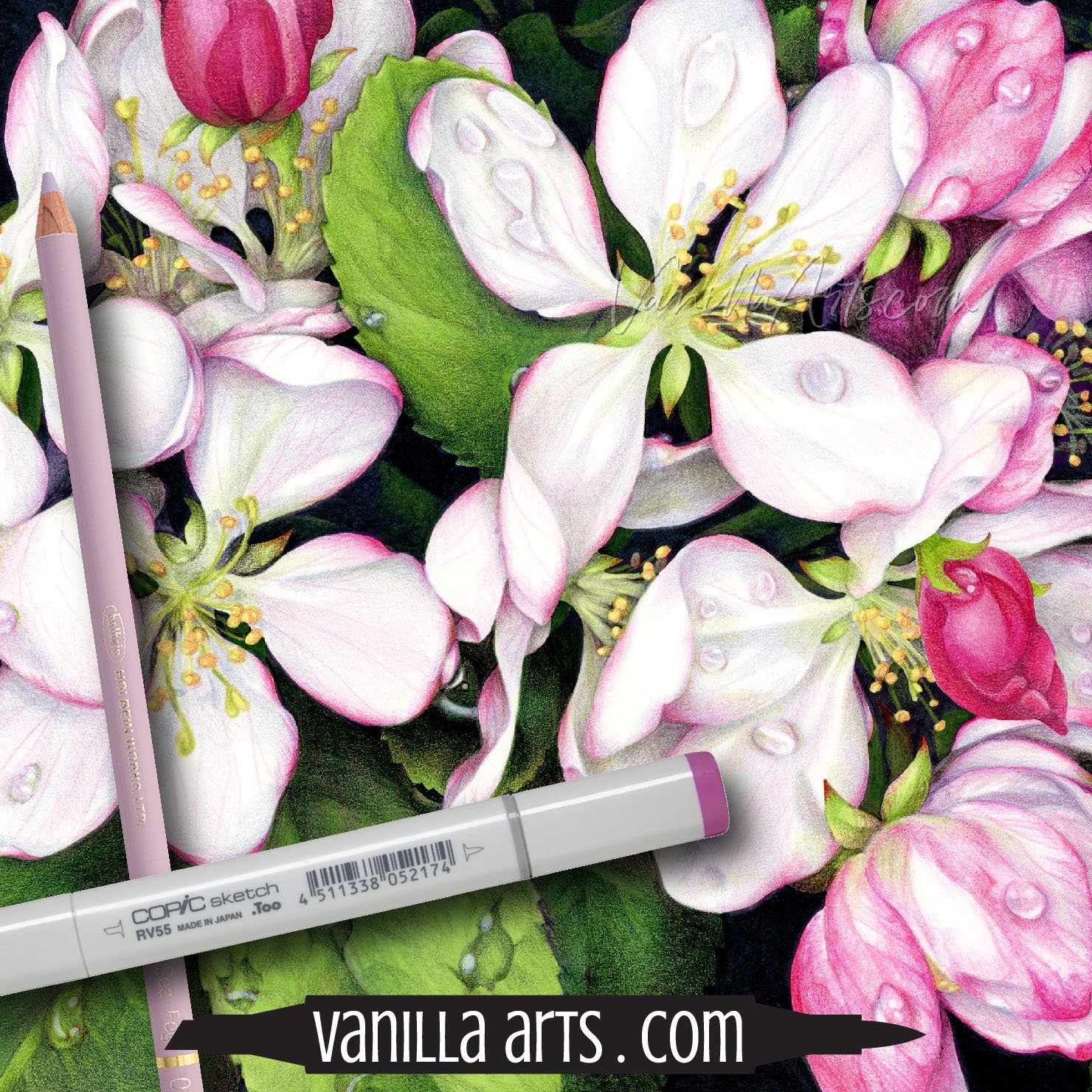
“Apple Blossom” a Copic Marker illustration by the author, Amy Shulke, 2023. 12x18 inches on Strathmore Bristol. Details with Holbein Colored Pencils. Advanced level Apple Blossom coloring kit available here.
Hey there, my name is Amy and I’m a technical illustrator and marker art instructor. I’ve worked professionally with artist grade markers since 1989. I specialize in Copic Markers.
After all the recent hype about Ohuhu Markers, I’m finally trying them.
Actually, I’m testing them. Are they really as good as Copic?
I mean real testing. I’m analyzing the Ohuhu marker body, the nibs, and testing the ink for lightfastness, color chemistry, staining, lift, and cap accuracy.
You know, the stuff marker artists should care about?
In this series of articles, I’m sharing the good, the bad, and the really, really ugly. Honest observations from a professional marker artist who isn’t paid to review Ohuhu and isn’t trying to sell you markers.
Today, let’s cover the dry and dying markers I received in my new set of Ohuhu Markers
DRY OHUHU MARKERS?
FULL DISCLOSURE: I didn’t open my Ohuhu package immediately when it arrived; then it took a couple of weeks of swatching for lightfast testing before I found the dry markers.
To be honest, I don’t weigh my markers on arrival. Who does?
In any case, I missed the 30 day exchange window so I can’t tell you how effective their customer service is. More on this subject below.
I am not sponsored by Ohuhu or any other art supply company. I do not accept free art supplies either. Every product shown on MarkerNovice.com and VanillaArts.com has been purchased by me with my own funds.
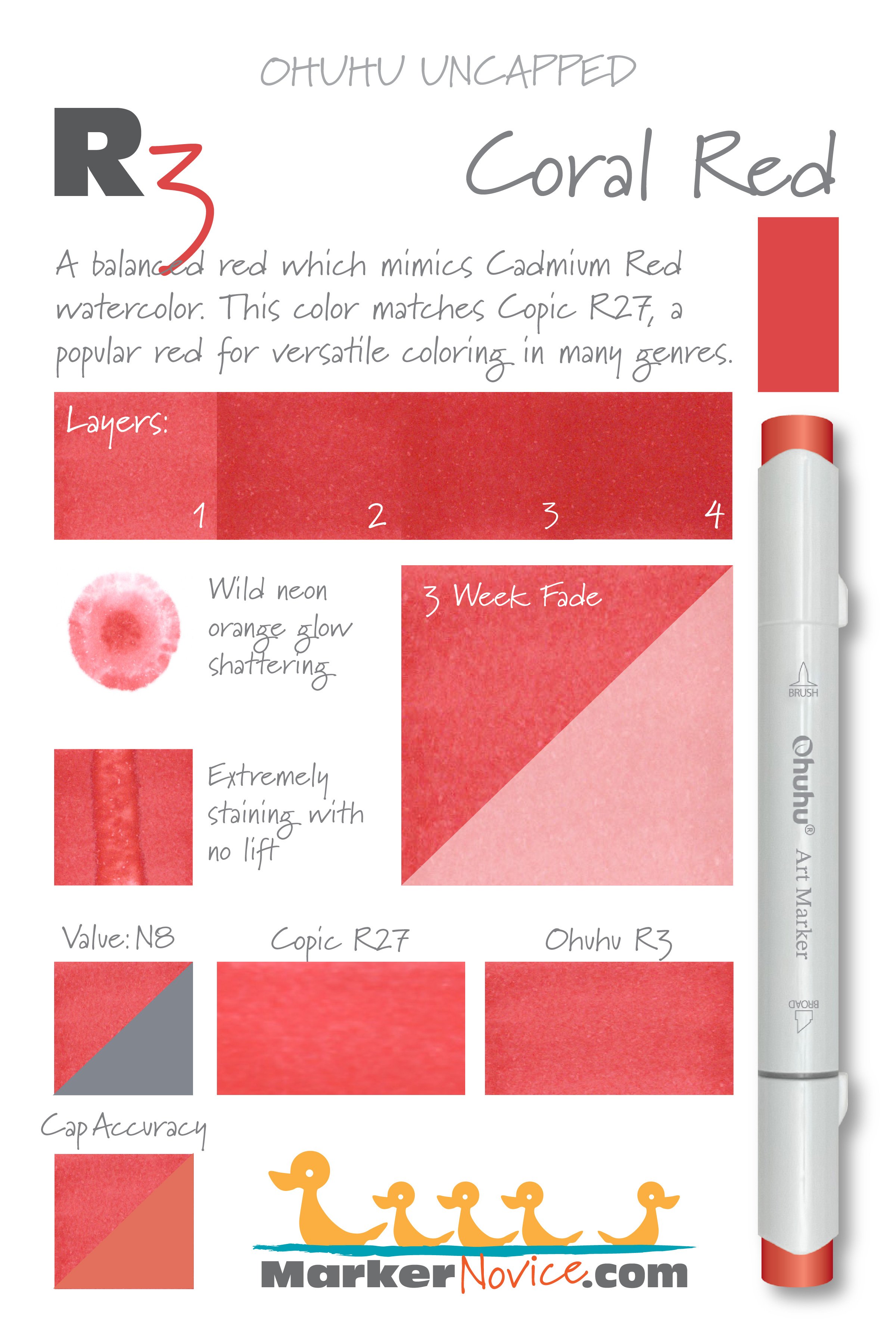
Are Ohuhu Markers a money saver or a budget buster?
Now that I have all 320 Honolulu colors, I’m testing every marker the same way I’ve been testing Copic Markers.
lightfastness
color chemistry
value
reactiveness
staining
lift
cap accuracy.
dry or Under-weight Ohuhu Markers in a brand new set?
I’ll be honest, I’m biased.
I expected Ohuhu to look and behave like a low-quality alcohol marker but I didn’t count on buying dead markers.
In my set of 320 Ohuhu Honolulu markers, seven markers arrived dead or dying.
I was about 2/3 of the way though swatching the entire set before I found the first dead marker. At that point, I started weighing each before swatching.
I still need to circle back to to the beginning to weigh the first two hundred markers. I won’t have an accurate under-weight marker count until I do.
How Low Are the Dying Ohuhu Markers?
The seven markers are all well under the average weight of a full Ohuhu marker. There are no visible cracks and all caps were secure when I discovered the dry markers.
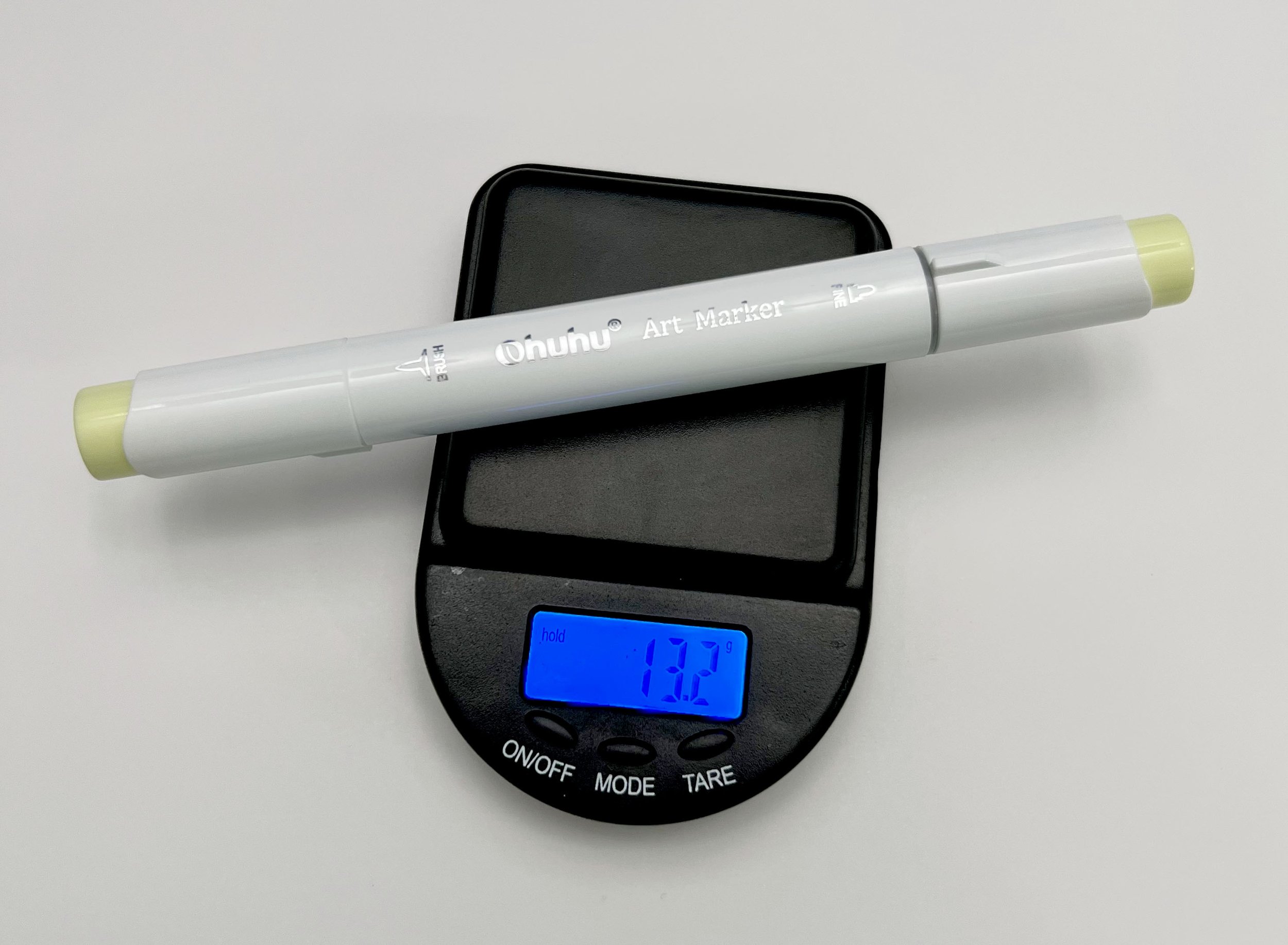
Ohuhu G030 Crescent Yellow on the scale. The full Ohuhu Markers in my new set average about 16.2 grams. This dead marker weighs 3 grams short and both nibs are pale and hard.
Full Honolulu “Brush/Fine” Markers (with both caps on) are averaging about 16.2 grams, give or take a tenth.
Note: I can’t confirm this average until I weigh all 320 markers.
In my new set:
2 dead Ohuhu weighed 12.9 and 13.2 grams
The under-weight Ohuhu weighed between 13.7 - 14.4 grams
For clarification, I consider a marker “dead” when the marker barely leaves a mark on the paper and when one or both nibs are hard and crunchy.
A dying marker is too low on ink to leave a consistent mark. The nibs may have whitened dry spots or even darkened sticky areas where the nib can’t draw enough ink from the marker core to stay fully moist.
One interesting point:
My dead/dying colors included only one dark marker (E080).
The remaining six are all light yellow, light yellow greens, and light greens. Two of them are numbered “030” which is an interesting coincidence.
Most art supply companies produce colors in batches— for instance, one month they make all blues, the next month they switch to red. It’s not a stretch to wonder if there was an issue at the factory during Ohuhu’s pale yellowish green batches.
Customer Service: Ohuhu’s return policy

Read Ohuhu’s return/exchange policy page very carefully. It seems designed to make returns difficult. This is one reason I decided to order through Amazon rather than directly from Ohuhu.
I live in a rural area. I can return to Amazon from several local businesses but the nearest Fed Ex or UPS is an hour away.
As I stated above, I missed the 30 day return window because my package sat unopened for a couple weeks and then it took a while to swatch the whole set. The bad markers were concentrated on the far right and I started swatching from the left.
But also, I was hesitant to contact Ohuhu. I’m testing their markers and was already seeing things I don’t like. I didn’t want obligate Ohuhu to send free replacements for an unfavorable review.
Why not purchase refills for the dying Ohuhu Markers?
I purchased seven new Ohuhu Markers to replace the seven dead/dying colors.
Why didn’t I just purchase refills and fix the markers?
It’s not as easy as you think.
First, Ohuhu claims their markers are refillable but that’s misleading.
Ohuhu makes 320+ colors but they only sell 50 refills.
Of the seven dead & dying, only one marker has a corresponding refill.
There’s also a nib issue. The nibs on both ends of all seven markers are damaged beyond repair.
Ohuhu only sells replacement brush nibs. Ohuhu does not sell replacement chisel or fine nibs.
So the best I can do is replace the brush ends but my fine ends are just dead forever? No thanks.
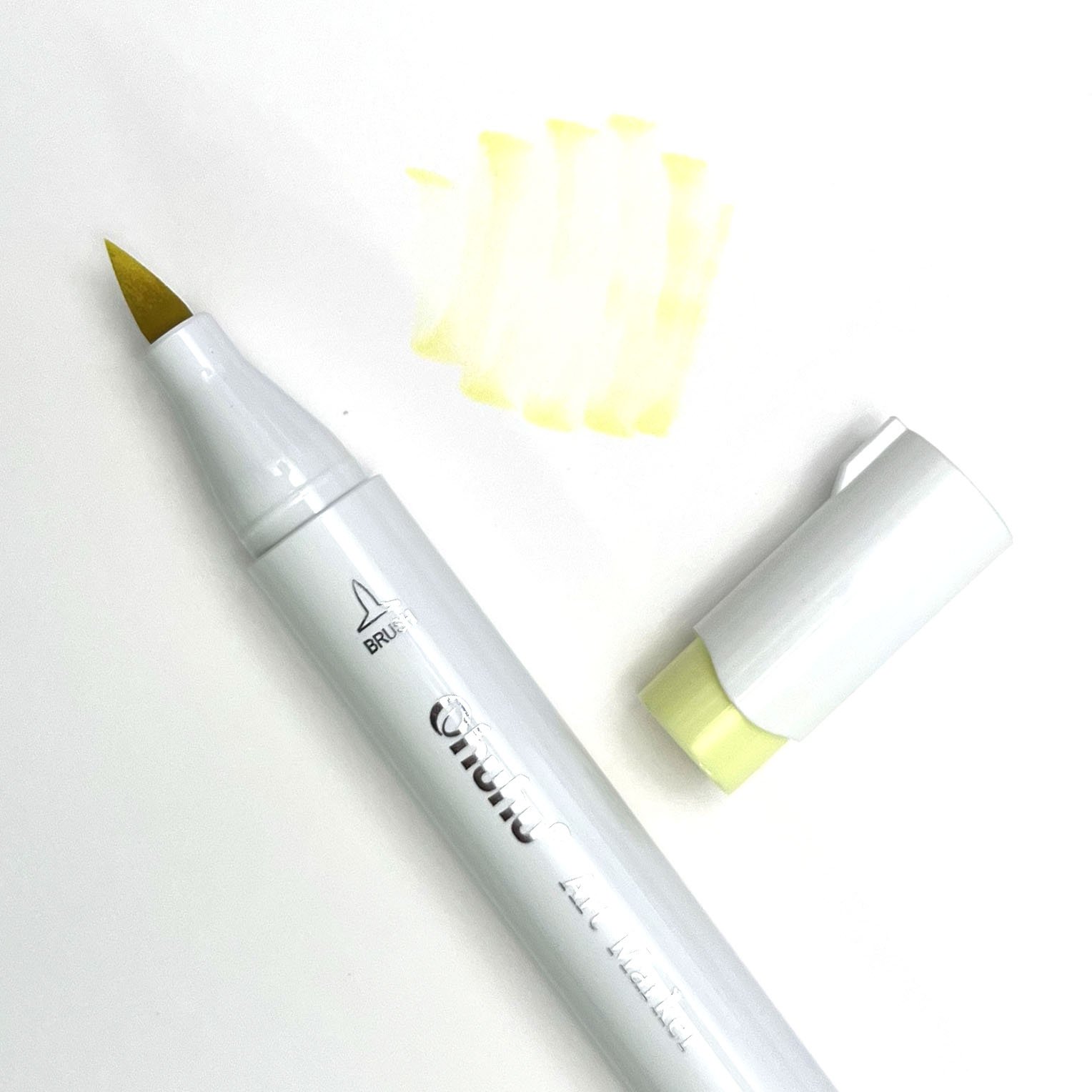
An under-weight, dying Ohuhu Y030 Lemon Chiffon. This dry marker is new, directly out of the package.
Here’s the last problem:
Contrary to popular myth, you can not fix a dead marker by simply refilling it.
Refills are for markers that running slightly low.
Refills can not raise the dead.
Most people think of a marker like a car with a gas tank. When it runs down to empty, just add more juice and you’re good to go.
But alcohol markers don’t work that way.
Inside every Ohuhu and Copic is a soft and spongey core. The core keeps the ink from sloshing around inside. The core also feeds ink to the nibs on both ends.
Ohuhu and Copic inks contain shellac. Shellac is a fixative; it hardens and cures as it dries, preventing color transfer or smearing after your coloring has dried.
When a marker dries-out below a minimum weight, in the absence of ink, the soft core cures and hardens. A crusty core can not hold ink.
Note: This is why ink sometimes pours out the other end as you refill a marker, the damaged core can’t absorb new ink.
My dead Ohuhu can not be saved. They’re toast.
My dying Ohuhu are close enough in weight to the dead markers that their cores are certainly toast too.
Besides, there’s a fatal flaw with the resurrection theory:
Even if you could revive a dead marker with refill ink, the color of the marker would be darker than normal.
The alcohol (solvent) in the marker evaporates, the dye doesn’t. Adding fresh ink adds more moisture AND more dye. To keep an R13 marker the true color of R13, you should add straight solvent, not more dye!
But it doesn’t work anyway. No sense wishing and wasting refill ink.
Refills won’t help my markers, even if Ohuhu did sell ink for them.
But Copic has issues too!
I hear ya!
I’m not making excuses for Copic— they’ve had problems with marker cracks and shipping dead markers for the last several years.
I hear about it from a lot of students.
But I’m not reviewing Copic markers today. We’re talkin’ Ohuhu here.
I’ve read a lot of dead Copic rants on Facebook, Quora, and Reddit. People are mad at Copic so they’re buying Ohuhu instead.
Which seems dumb. You’re mad at the good markers so you’re gonna suffer with the bad in protest?
My set of Ohuhu had similar quality issues to what I’m hearing from those buying Copics made in the last couple years. At least with a dried-out Copic, there’s usually a crack in the body or cap you can point to. With my Ohuhu I don’t see anything wrong with them, other than the fact that they feel comically lightweight.
I’m not saying it’s okay to sell people dry markers,
I’m pointing out that Ohuhu has similar problems to Copic.
Neither company is an angel here.
Oh, and by the way:
I’m missing one color from my Ohuhu set
In the swatching process, I found two WG3 markers.
But I’ve got 320 markers which means I’m missing a color.
And it’ll be a total PITA to figure out which one because Ohuhu’s numbers are a joke.

Ohuhu Honolulu Markers 320 Set purchased by the author in May 2023.
Unboxing Ohuhu Markers: Ordering and Packaging Review
I purchased a large set of Ohuhu markers for testing. How was he packaging? And how many dead markers did they send?
Read more here.
Ordering Ohuhu Markers From Amazon
Hi there, my name is Amy and I’m a technical illustrator and marker art instructor. I’ve worked professionally with artist grade markers since 1989. I specialize in Copic Markers.
After years of hearing about Ohuhu Markers, I’ve decided to try them.
Actually, I’m going to test them. Are they really as good as Copic?
I mean real testing. I’m analyzing the Ohuhu marker body, the nibs, and testing the ink for lightfastness, color chemistry, staining, lift, and cap accuracy.
You know, the stuff artists should actually care about?
In this series of articles, I’m sharing the good, the bad, and the really, really ugly…
Honest observations from a professional marker artist who isn’t trying to sell you markers.
Today, let’s cover the purchasing process and packaging.
I ordered Ohuhu Markers online
This wasn’t by choice.
I prefer to try my art supplies before I buy them. With markers, simply picking one up and feeling it tells me a lot. I’ve avoided a lot of badly made markers just by holding a sample.
But Ohuhu markers are not sold in stores, at least not near me.
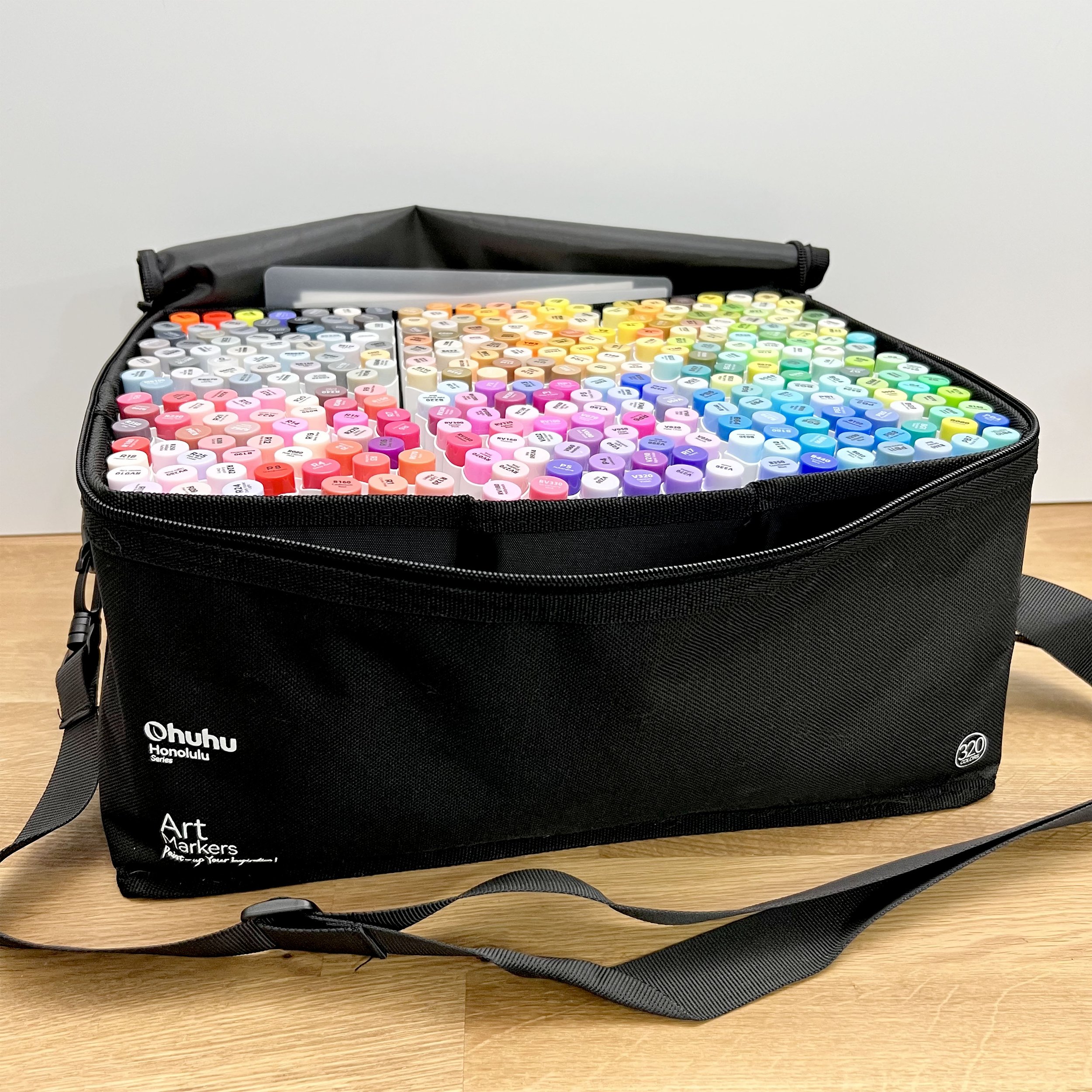
Ohuhu Honolulu Markers 320 Set purchased by the author in May 2023.
Granted, I live in the middle of nowhere but I travelled an hour to my favorite hole-in-the-wall independent art supply store. They carry lots of markers but not Ohuhu. The store owner knew about them but said they’d never been asked to stock them or sent a product catalog. He gets tons of catalogs but never one from Ohuhu. Weird.
Then I struck out at the chain stores:
No Ohuhu on the shelves at Dick Blick, Michaels, Joann’s, Hobby Lobby, or the college bookstore (which sells Copic).
I looked online and saw Walmart.com carries Ohuhu but there were none at my local Walmart.
So I ordered off Amazon.
Ohuhu also sells markers from their own website but given the size of my purchase and that I’ve never dealt with this company before, I wanted the customer service team at Amazon behind me if the box arrived damaged or (yikes!) not at all.
With the order placed, I spent several days worrying that I’d just spent $165 on really bad markers.
Are Ohuhu Markers a money saver or a budget buster?
Now that I have all 320 Honolulu colors, I’m testing every marker the same way I’ve been testing Copic Markers.
lightfastness
color chemistry
value
reactiveness
staining
lift
cap accuracy.
Ohuhu Packaging: securely padded in protective boxes
Despite my worry, the Ohuhu set arrived intact and pristine.
I ordered the 320 set of Honolulu markers in the Brush/Fine Tip version. They also come in sets of 104 and 216. Because I eventually want to test every color Ohuhu makes, I purchased the full set.
The markers come in a zippered canvas bag which was wrapped in a plastic bag, then double-boxed with plenty of cardboard protection.
Thumbs up for Ohuhu’s excellent mail packaging!
They also placed a foam piece on top of the markers inside the bag to keep them from jostling during transit. Nice!
Ohuhu markers are dumped into the bag in random order
Ohuhu Honolulu Markers 320 Set purchased by the author in May 2023.
Here’s where every artist dies a little inside…
When you unzip the canvas Ohuhu bag, you expect to see a rainbow of joy. Instead you’re confronted by mass color chaos.
The markers arrive in a jumbled mess of colors. You really can’t tell what you’re looking at because every color is jumbled with every other color. This photo was taken after I spent TWO HOURS rearranging the markers in kind’a chromatic order.
Am I being nit picky about this?
No!
Chromatically organized markers are a reasonable expectation and it’s easy to arrange this at the factory— if you care enough to make the effort.
NOTE: Even children’s art supplies take the time to arrange their products in chromatic or at least appealing order!
Color organization is important because we can’t get a feel for the color palette when the colors are scattered willy-nilly.
Once re-arranged you can see that Ohuhu is heavy on the pinks, purples, and grays with alarmingly few yellows and greens.
Floral and landscape artists beware! Yellow and green are important.
I can’t help but feel the scattered presentation is meant to obscure something more than the overall palette. I’ll talk more about this when I write an article about the Ohuhu numbering system.
Ohuhu provides a Complementary Vinyl Coloring Surface
I’ve purchased Ohuhu marker sketchbooks before and each sketchbook comes with a complementary vinyl sheet to place underneath your coloring page to protect the paper or the table from marker bleed though.
I’m iffy about Ohuhu marker journals but I’m madly in love with the sheet of vinyl!
In my classes, I teach students to color on non-porous surfaces like acrylic clipboards or glass desk tops. The non-absorbent surface improves the smoothness of your marker blends.
Ohuhu’s sheet of vinyl is perfect because it’s portable. I was thrilled to see they included a vinyl sheet in the marker bag. My only gripe is that the protector could have been cut larger, a full page size like A4 or 8.5x11” would have been better. Heck, I’d pay for a larger one!
But they didn’t have to put on in the bag at all, so I do really appreciate the gift-with-purchase.
Thanks, Ohuhu!
Ohuhu Swatch Cards are A Joke!
Ohuhu includes four swatch cards which sounds great until you touch one.
First, the paper is not identified— makes it easy for them to choose the cheapest paper and switch when another paper can be found cheaper, eh?
And they’re definitely switching and swapping because my cards do not match. One is printed on bright white, the rest are ivory-white.
But wait, it gets worse. The swatch cards are printed on an absorbent paper which is a big no-no with alcohol markers. The paper is also extremely toothy— toothy paper over time will wear-down your marker nibs. Whatever this awful paper is, it’s not a paper I’d recommend to students and a marker company should be ashamed for encouraging customers to use this kind of paper.
How hard can it be to call up a marker paper company and say “hey, we’re giving our customers free swatch cards. If you cut us a deal on the paper, we’ll print your logo in the corner and recommend your paper to our customers.”
Heck, Ohuhu SELLS marker sketchbooks!!! How much money are they missing out on by not promoting their own paper?
The printing on my cards is poorly done, as if the machine was running low on ink. One card has an ombre’ effect where the top third is dark and fades to light gray at the bottom.
The swatch squares are small and the text is uncomfortably hard to read. I’ve done a fair share of pamphlet and poster graphic design and these swatch cards were intended to be printed on cards 2-3 times this size. Ohuhu simply shrank the image to fit four to a page without scaling the text and strokes for readability. Doofus move, Ohuhu!
Now for the kicker which says a lot about Ohuhu: the swatches are not arranged in either numeric or chromatic order. Basically, the swatch cards are as badly organized as the markers arrive in the bag.
My recommendation: Burn the free swatch cards and purchase a download file online— find a swatch chart created by someone who cares about Ohuhu more than Ohuhu cares about Ohuhu.
Grading the Ohuhu ordering experience and packaging:
“Easy as Pie” a Copic Marker illustration by the author, Amy Shulke, 2023. 12x12 inches on Strathmore Bristol. Details with Prismacolor Premier Colored Pencils.
Ordering was quick and easy through Amazon and I felt a sense of security that I wouldn’t have had ordering through Ohuhu. Call me chicken but markers this inexpensive make me nervous. Amazon gets an A+
Ohuhu packages their marker sets securely and my order arrived without damage. There was enough cardboard and foam to keep the markers from shifting at all PLUS they bagged the canvas bag in plastic to prevent water damage. Ohuhu gets an A for packaging
I did not appreciate the jumbled mess of colors inside the canvas bag. Not only is it a let down to see markers out of order but it also hides the fact that the Ohuhu color palette is long on colors I rarely use and short on markers I need. I’ll discuss Ohuhu’s deceptive moves more in future articles. Ohuhu organization gets an D+
I love the Ohuhu vinyl page protector. I have one from an Ohuhu sketchbook and was thrilled to receive a spare in my set of markers. Ohuhu gets an B for the page protector because with a bag this size, the protector could have been a full 8.5x11”.
Ohuhu’s swatch cards are terrible! It’s the wrong kind of paper, the print is badly done, the writing is too small, and the swatches are not organized. Ohuhu gets an E for swatch cards. In fact, I’d rather they just give a link to print from home!
And to follow up:
Earlier in this article I mentioned that I can usually tell whether a marker is high quality by feeling the weight, shape, and plastic in my hand?
I was worried about buying Ohuhu markers sight-unseen, without feeling the the quality first.
Now that I’ve held an Ohuhu Marker in my hand, would I have purchased them based upon my decades of marker experience and my artistic Spidey Sense?
NO
Ohuhu Markers feel like a low-grade marker.
The kind of marker you buy for kids, not an adult hobby and really not for serious marker art.
After years of using artist-grade illustration markers from the major pioneering brands, Ohuhu markers feel like a waste of my time.
But now that I have them, I’ll test them anyway because maybe modern markers are meant to feel disposable? Maybe this is what today’s artist market wants?
I’m giving Ohuhu Markers the benefit of the doubt but there’s a cricket on my shoulder telling me this isn’t worth it.
And hey, guess what?
Some of my new Ohuhu markers were dead on arrival!
R18 Pastel Peach: Testing Ohuhu Markers for Lightfastness and Quality
R18 Pastel Peach
Let’s take a closer look at this Ohuhu Marker and its ink characteristics.
You were told “Ohuhu is the Copic slayer! They’re like Copic Markers but better!”
Is it true?
Every Ohuhu Marker has different characteristics based upon its unique ink formula. No matter how great they say the marker is, test results do not lie.
So are Ohuhu markers as great as you’ve heard?
Let’s look at Ohuhu R18 to find out.
WARNING: Ohuhu markers have numbers on the cap but not on the body of the marker. We do not recommend coloring with both caps off due to the risk of accidentally placing the wrong caps on a marker.
Test results: Ohuhu R18 Pastel Peach
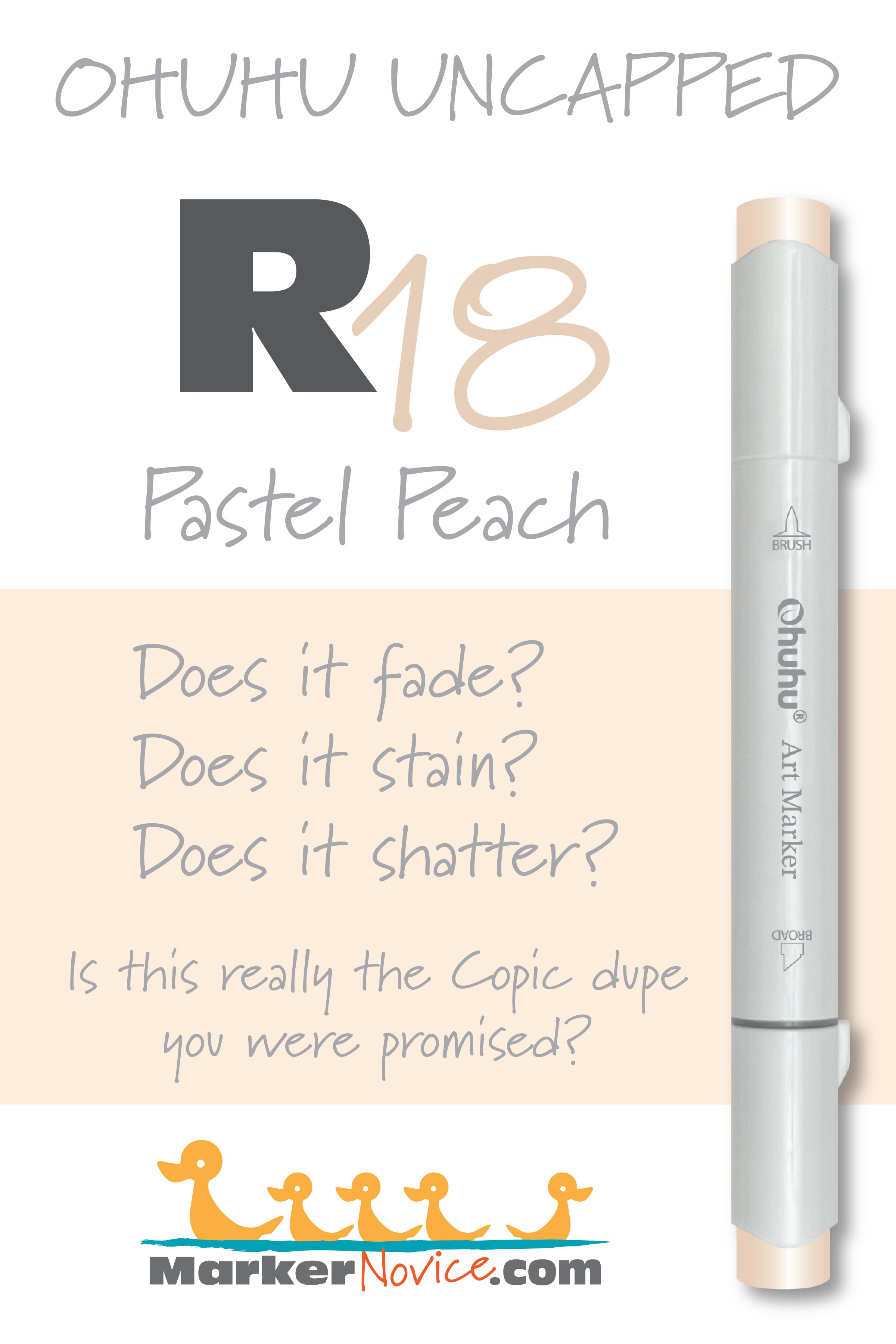
IS THIS ACTUALLY A RED MARKER? I’ve said repeatedly that the Ohuhu cap numbering system is nonsense but in this case, I can argue that R18 is correctly placed inside the R Red family. Most people think of pink as light red but pink is actually light magenta. When you dilute red watercolor or in this case, red dye, the result is a color that’s warmer than pink but not quite light orange— you basically get the peachy flesh color of R18.
Refill: R18 is one of the 50 refill colors Ohuhu currently sells. Contrary to what you’ll hear on YouTube, Ohuhu should not be considered a refillable marker until they offer refills for all their markers. They sell over 300 markers but only 50 refills. It’s not like they don’t make the ink, so why not offer it in bottles? Stupid, this is truly stupid. But hey, R18 is truly refillable. See Ohuhu’s current list of refills here.
Temperature: A pale warm red or red-brown
Resemblance: Highly diluted Raw Sienna watercolor
Actual Value: N2
Unlike Copic, Ohuhu does not measure value— this is a glaring deficiency which makes finding blending combinations harder than it has to be!
All Copics are measured on a Neutral Gray value scale. The last number on the Copic cap indicates the value. We’re using the Copic scale to measure Ohuhu until Ohuhu releases a reliable value scale.
Cap Accuracy: The plastic on an Ohuhu Honolulu R18 marker is pretty close to the ink color. It’s slightly duller and less warm than the ink but as far as Ohuhu caps go, they get points for being this close.
Copic Substitution: Ohuhu R18 is slightly more golden but otherwise close to Copic’s YR00
Note: similar colors rarely behave the same way. From experience I can tell you that Copic YR00 is an easy blending marker and mistakes are simple to lift. Most people will use Ohuhu R18 for skin tones but beware. Unlike Copic YR00, Ohuhu R18 is a staining color. Look at the staining test, I hit this marker with SIX coats of colorless blender. Look at the same test on YR00 where the color almost completely erases. This is what I mean when I say some markers are beginner friendly and some are not.
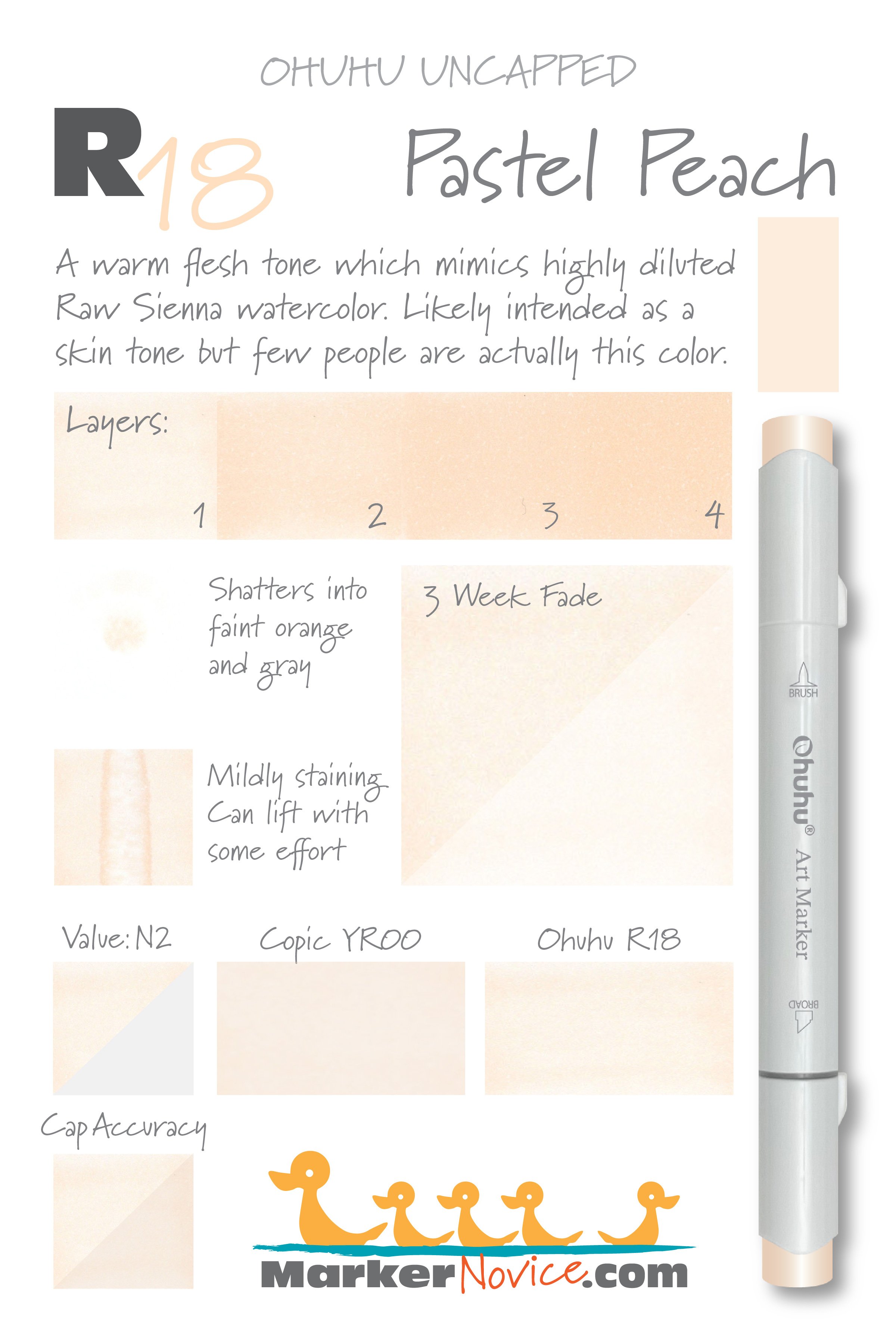
Buildup: R18 reaches a maximum value at about 3 coats.
Overinking: We do not recommend using more than 4 coats of R18. As with most Ohuhu markers, four layers looks oversaturated and oily.
Shattering: R18 seems to be a mixture of at two inks— one either orange or light red and the other a dull gray. The gray dried fairly pale in the shattering test but you can still see it in the erasure zone of the staining text and also along the dark lines to either side.
Chromatography testing shows this ink’s behavior when it comes in contact with #0 Colorless Blender (solvent). High shattering colors may leak unexpected color when you make corrections or attempt to blend with any color that has a high solvent to colorant ratio. Shattering is not bad, it’s just something to be aware of.
Staining: Unlike other inks this pale, it’s odd that R18 stains as much as it does.
With alcohol markers, a staining ink is generally a sign of a low quality ink. Staining inks bond to the paper fibers and are reluctant to release. Staining inks make blending harder than it has to be!
Lift: R18 is stubborn color. You can lift a mistake slightly but don’t expect to erase it fully.
See staining swatch. Sample was given 6 stripes of #0 Colorless Blender, drying between each stripe. Results indicate how much lifting you can expect.
Lightfast: R18 faded by about 10% during the test period. This is about average with similar Copic colors.
Samples were swatched on X-Press It Blending Card. 1 layer of ink was exposed to windowsill sunlight for 21 days. Approximately 10 hours of sun per day based on weather conditions. Note: we do not recommend displaying original marker art under these conditions.
Ink Color Family: R18 belongs to the red family. Many Ohuhu R’s are anything but red but this does look like a very diluted red or reddish brown.
The Ohuhu numbering system is complete garbage and doesn’t always make sense. Some orange, magenta, violet, and obviously blue-violet markers are hidden in the R family. Be warned, when it comes to other color families, you can not trust anything you read on an Ohuhu cap.
Cap Numbering: R18 and R19 blend fairly well together. I can see R18 as skin and R19 as the blush color. But as soon as something in the Ohuhu numbers make sense, they punch you in the face. Ohuhu’s R17 is not a flesh color, it’s actuall a darker violet than Copic BV08
As stated above, the Ohuhu numbering system makes no sense. The markers are not arranged in chromatic order so you can not trust the numbers to tell you whether this marker is lighter or darker than other Ohuhu markers with similar numbers.
I’m still early in the Ohuhu testing process. I will add more info to this article as I learn more and when I spot behavioral patterns.
From what I’ve learned so far, I will not be working with Ohuhu markers and I will discourage students from using them in my classes. They’re simply not worth the frustration.
Learn more about R18 Pastel Peach, a pale flesh toned Ohuhu Marker. We swatch and test Ohuhu colors- layering, staining, lift, value, lightfastness, saturation, and cap accuracy. | MarkerNovice.com | How to blend alcohol ink markers.
R13 Clematis: Testing Ohuhu Markers for Lightfastness and Quality
R13 Clematis
Let’s take a closer look at this Ohuhu Marker and its ink characteristics.
You were told “Ohuhu is the Copic slayer! They’re like Copic Markers but better!”
Is it true?
Every Ohuhu Marker has different characteristics based upon its unique ink formula. No matter how great they say the marker is, test results do not lie.
So are Ohuhu markers as great as you’ve heard?
Let’s look at Ohuhu R13 to find out.
WARNING: Ohuhu markers have numbers on the cap but not on the body of the marker. We do not recommend coloring with both caps off due to the risk of accidentally placing the wrong caps on a marker.
Test results: Ohuhu R13 Clematis
NUMBER SYSTEM WARNING: R13 is not a typo! As I warn below, the Ohuhu numbering system is nonsense! This marker proves how little they care about helping you use their product. They know this is not a red ink because Clematis flowers are never red. This also is not the only stupidly numbered marker in the Ohuhu collection.
REFILL WARNING! At this time, Ohuhu does not sell refills for R13. To date, you must purchase a new marker when your current marker runs dry. See Ohuhu’s current list of refills here.
Temperature: A cool violet with blue undertones
Resemblance: Cobalt Violet watercolor
Actual Value: N9
Unlike Copic, Ohuhu does not measure value— this is a glaring deficiency which makes finding blending combinations harder than it has to be!
All Copics are measured on a Neutral Gray value scale. The last number on the Copic cap indicates the value. We’re using the Copic scale to measure Ohuhu until Ohuhu releases a reliable value scale.
Cap Accuracy: The plastic on an Ohuhu Honolulu R13 marker both lighter and warmer than even one coat of R13. Beware when selecting Ohuhu markers based on cap colors.
Copic Substitution: Ohuhu R13 is a close match to Copic’s BV04.
Note: similar colors rarely behave the same way. From experience I can tell you that Copic BV04 is a marker I highly recommend for beginners— it’s on my Starter Marker List and I teach with it frequently because it’s an easy blending color. Ohuhu R13 is not an easy blending color and therefore, I would never recommend this color for beginners. See Copic BV04 test results here.
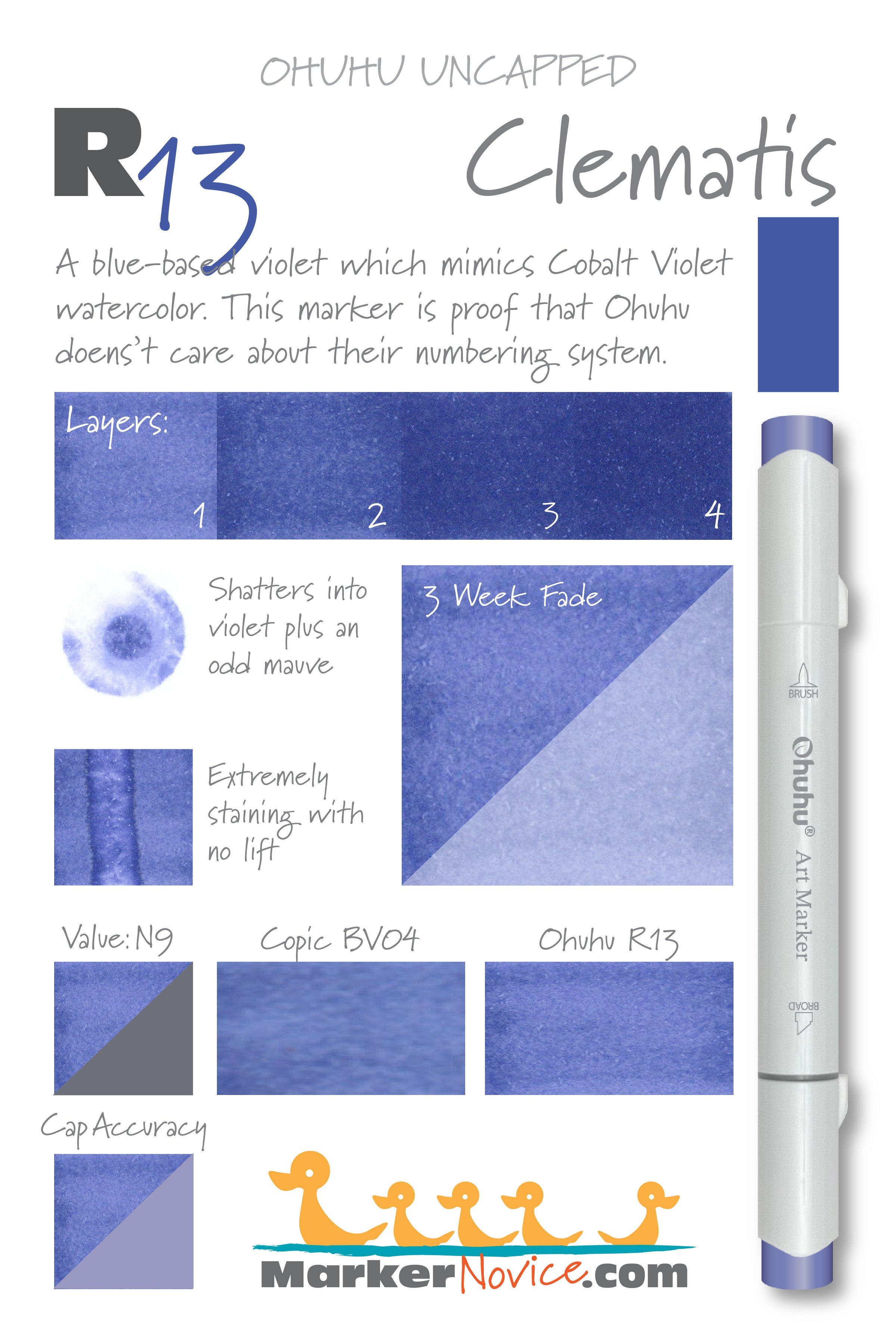
Buildup: R13 reaches a maximum value at about 3 coats.
Overinking: We do not recommend using more than 4 coats of R13. As with most Ohuhu markers, four layers looks oversaturated and oily.
Shattering: R13 seems to be a mixture of at least two inks, one violet and an odd mauve. The mauve color appears at the edge of the shattering test and may appear on your projects when you make corrections with colorless blender.
Chromatography testing shows this ink’s behavior when it comes in contact with #0 Colorless Blender (solvent). High shattering colors may leak unexpected color when you make corrections or attempt to blend with any color that has a high solvent to colorant ratio. Shattering is not bad, it’s just something to be aware of.
Staining: As with most red ink colors, R13 is extremely staining color.
With alcohol markers, a staining ink is generally a sign of a low quality ink. Staining inks bond to the paper fibers and are reluctant to release. Staining inks make blending harder than it has to be!
Lift: Forget about it. R13 is stubborn and stains the paper an odd pink. The ink itself moves very little, even on high quality paper.
See staining swatch. Sample was given 6 stripes of #0 Colorless Blender, drying between each stripe. Results indicate how much lifting you can expect.

Lightfast: R13 faded by about 40% during the test period.
Samples were swatched on X-Press It Blending Card. 1 layer of ink was exposed to windowsill sunlight for 21 days. Approximately 10 hours of sun per day based on weather conditions. Note: we do not recommend displaying original marker art under these conditions.
Ink Color Family: The “R” in R13 indicates that this marker is part of the R red family. Does this look like red ink to you? When you look at this number, do you feel like Ohuhu cares about helping you use their product? Do you think Ohuhu deserves your money?
The Ohuhu numbering system is complete garbage and doesn’t always make sense. Some orange, magenta, violet, and obviously blue-violet markers are hidden in the R family. Be warned, when it comes to other color families, you can not trust anything you read on an Ohuhu cap.
Cap Numbering: R13 is blue violet. R12 is a dirty orange-pink. R14 is neon pink. Good luck blending R13 with anything in the R family. This is ridiculous, how is a beginner supposed to form blending combinations when the caps are beyond stupid?
As stated above, the Ohuhu numbering system makes no sense. The markers are not arranged in chromatic order so you can not trust the numbers to tell you whether this marker is lighter or darker than other Ohuhu markers with similar numbers.
I’m still early in the Ohuhu testing process. I will add more info to this article as I learn more and when I spot behavioral patterns.
From what I’ve learned so far, I will not be working with Ohuhu markers and I will discourage students from using them in my classes. They’re simply not worth the frustration.


R3 Coral Red: Testing Ohuhu Markers for Lightfastness and Quality
R3 Coral Red
Let’s take a closer look at this Ohuhu Marker and its ink characteristics.
You were told “Ohuhu is the Copic slayer! They’re like Copic Markers but better!”
Is it true?
Every Ohuhu Marker has different characteristics based upon its unique ink formula. No matter how great they say the marker is, test results do not lie.
So are Ohuhu markers as great as you’ve heard?
Let’s look at Ohuhu R3 to find out.
WARNING: Ohuhu markers have numbers on the cap but not on the body of the marker. We do not recommend coloring with both caps off due to the risk of accidentally placing the wrong caps on a marker.
Test results: Ohuhu R3 Coral Red
COLORLESS BLENDER WARNING: R3 turns a violent neon orange when touched by colorless blender. As the ink dries again, the orange fades slightly but not completely. WE DO NOT RECOMMEND CORRECTING R3 MISTAKES WITH COLORLESS BLENDER. See the Shattering category below for more info.
REFILL WARNING! At this time, Ohuhu does not sell refills for R3. To date, you must purchase a new marker when your current marker runs dry. See Ohuhu’s current list of refills here.
Temperature: A warm red with subtle orange undertones
Resemblance: Cadmium Red watercolor
Actual Value: N8
Unlike Copic, Ohuhu does not measure value— this is a glaring deficiency which makes finding blending combinations harder than it has to be!
All Copics are measured on a Neutral Gray value scale. The last number on the Copic cap indicates the value. We’re using the Copic scale to measure Ohuhu until Ohuhu releases a reliable value scale.
Cap Accuracy: The plastic on an Ohuhu Honolulu R3 marker is a dull red, lighter than even one coat of R3. Ironically, the cap color is actually closer to the faded version of R3 after lightfast testing.
Copic Substitution: Ohuhu R3 is slightly cooler than Copic’s R27 but otherwise, they are a near match in hue and value.
Note: similar colors rarely behave the same way. From experience I can tell you that Copic R27 is much easier to blend with and as a result, I do not recommend R3 for blending beginners. For comparison, see Copic R27 test results here.
Buildup: R3 reaches a maximum value at 3 coats.
Overinking: We do not recommend using more than 4 coats of R3. As with most Ohuhu markers, four layers looks oversaturated and dull. Additionally, 4 layers of R3 feels slightly tacky to the touch indicating a high amount of dye in the ink blend.
Shattering: I’ve never seen a marker ink react to colorless blender the way R3 did! Normally when I drip colorless blender solution over an ink sample, the color fades slightly. R3 exploded into a bright neon orange color and the dye spread out everywhere!
Due to this extreme reaction, WE DO NOT RECOMMEND CORRECTING R3 MISTAKES WITH COLORLESS BLENDER. Fixing an R3 mistake will cause more damage than the original mistake.
Chromatography testing shows this ink’s behavior when it comes in contact with #0 Colorless Blender (solvent). High shattering colors may leak unexpected color when you make corrections or attempt to blend with any color that has a high solvent to colorant ratio. Shattering is not bad, it’s just something to be aware of.
Staining: As with most red ink colors, R3 is extremely staining color.
With alcohol markers, a staining ink is generally a sign of a low quality ink. Staining inks bond to the paper fibers and are reluctant to release. Staining inks make blending harder than it has to be!
Lift: Forget about it. R3 is incredibly stubborn and stains the paper orange. The ink itself moves very little. Trying to make a correction with colorless blender will cause more damage than the mistake itself. See staining above, this is a sign of a low quality ink.
See staining swatch. Sample was given 6 stripes of #0 Colorless Blender, drying between each stripe. Results indicate how much lifting you can expect.
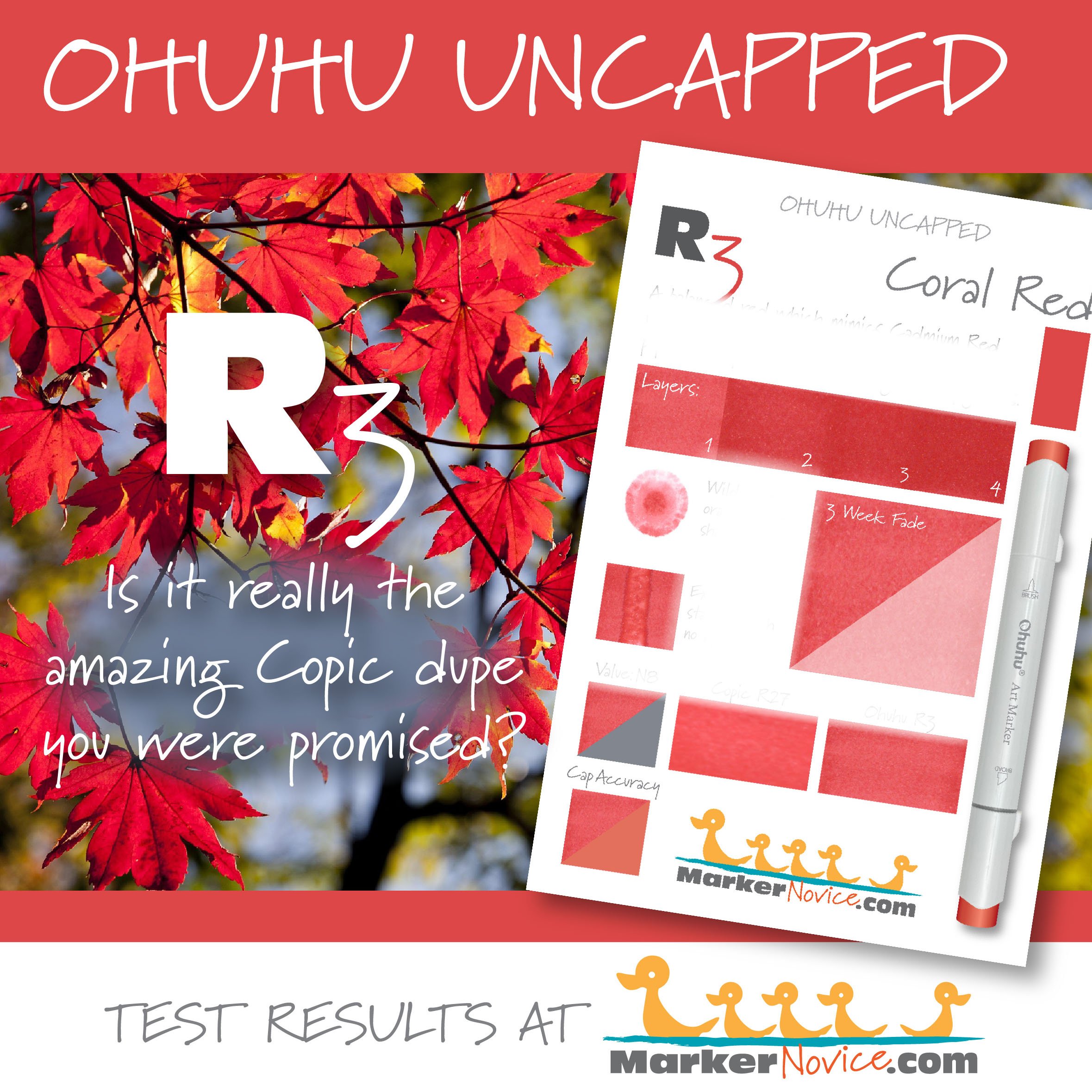
Lightfast: R3 faded more than any other ink I’ve tested to date. The fade was well over 50% during the test period.
Samples were swatched on X-Press It Blending Card. 1 layer of ink was exposed to windowsill sunlight for 21 days. Approximately 10 hours of sun per day based on weather conditions. Note: we do not recommend displaying original marker art under these conditions.
Ink Color Family: The “R” in R3 indicates that this marker is part of the R red family but Ohuhu classifies a lot of oranges, violets, and pinks also as R. Think of R and “kinda red but maybe not.”
The Ohuhu numbering system is complete garbage and doesn’t always make sense. Some orange and magenta markers are hidden in the R family. Be warned, when it comes to other color families, you can not trust anything you read on an Ohuhu cap.
Cap Numbering: R3 is lighter than both R2 and R4. This is ridiculous, how is a beginner supposed to form blending combinations when the caps make no sense?
As stated above, the Ohuhu numbering system makes no sense. The markers are not arranged in chromatic order so you can not trust the numbers to tell you whether this marker is lighter or darker than other Ohuhu markers with similar numbers.
I’m still early in the Ohuhu testing process. I will add more info to this article as I learn more and when I spot behavioral patterns.
From what I’ve learned so far, I will not be working with Ohuhu markers and I will discourage students from using them in my classes. They’re simply not worth the frustration.

Learn more about R3 Coral Red, a warm red Ohuhu Marker. We swatch and test Ohuhu colors- layering, staining, lift, value, lightfastness, saturation, and cap accuracy. | MarkerNovice.com | How to blend alcohol ink markers.
G7 Chromium Oxide Green: Testing Ohuhu Markers for Lightfastness and Quality
G7 Chromium Oxide Green
Let’s take a closer look at this Ohuhu Marker and its ink characteristics.
You were told “Ohuhu is the Copic slayer! They’re like Copic Markers but better!”
Is it true?
Every Ohuhu Marker has different characteristics based upon its unique ink formula. No matter how great they say the marker is, test results do not lie.
So are Ohuhu markers as great as you’ve heard?
Let’s look at Ohuhu G7 to find out.
WARNING: Ohuhu markers have numbers on the cap but not on the body of the marker. We do not recommend coloring with both caps off due to the risk of accidentally placing the wrong caps on a marker.
Test results: Ohuhu G7 Chromium Oxide Green
REFILL WARNING! At this time, Ohuhu does not sell refills for G7. To date, you must purchase a new marker when your current marker runs dry. See Ohuhu’s current list of refills here.
Temperature: A deep green with blue undertones
Resemblance: Hooker’s Green watercolor
Actual Value: N9
Unlike Copic, Ohuhu does not measure value— this is a glaring deficiency which makes finding blending combinations harder than it has to be!
All Copics are measured on a Neutral Gray value scale. The last number on the Copic cap indicates the value. We’re using the Copic scale to measure Ohuhu until Ohuhu releases a reliable value scale.
Cap Accuracy: The plastic on an Ohuhu Honolulu G7 marker matches 2 coats of ink.
Copic Substitution: Ohuhu G7 is slightly warmer than Copic’s G29 but otherwise, they are a near match in hue and value.
Note: similar colors rarely behave the same way. From experience I can tell you that Copic G29 is a less staining marker and thus easier to blend. See the test results for Copic G29 here.

Buildup: G7 reaches a maximum value at 3-4 coats.
Overinking: We do not recommend using more than 4 coats of G7. As with most Ohuhu markers, four layers looks oversaturated and dull.
Shattering: This ink is a mixture of green and brownish-green inks. Noticeable brown ink may appear along the edges of any area corrected with a colorless blender. Use caution when correcting mistakes.
Chromatography testing shows this ink’s behavior when it comes in contact with #0 Colorless Blender (solvent). High shattering colors may leak unexpected color when you make corrections or attempt to blend with any color that has a high solvent to colorant ratio. Shattering is not bad, it’s just something to be aware of.
Staining: As with most dark colors, G7 is a staining color but this ink felt particularly stubborn.
With alcohol markers, a staining ink is generally a sign of a low quality ink. Staining inks bond to the paper fibers and are reluctant to release. Staining inks make blending harder than it has to be!
Lift: Forget about it. G7 is stubborn and stains the paper light blue. The ink itself moves very little and I think trying to make a correction with colorless blender will cause more damage than the mistake itself. See staining above, this is a sign of a low quality ink.
See staining swatch. Sample was given 6 stripes of #0 Colorless Blender, drying between each stripe. Results indicate how much lifting you can expect.
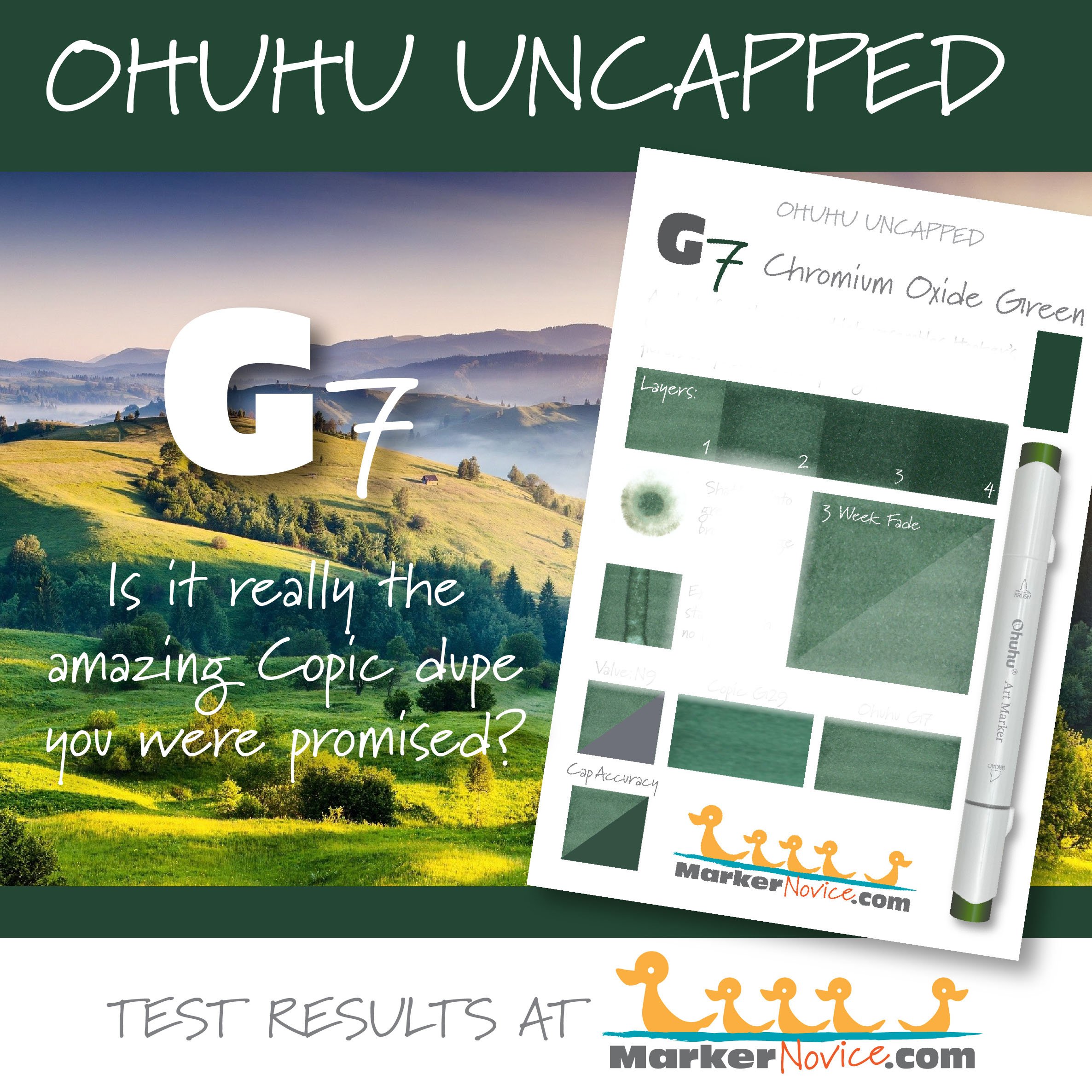
Lightfast: G7 faded about 15% during the test period. This is about average and comparable to most Copic markers.
Samples were swatched on X-Press It Blending Card. 1 layer of ink was exposed to windowsill sunlight for 21 days. Approximately 10 hours of sun per day based on weather conditions. Note: we do not recommend displaying original marker art under these conditions.
Ink Color Family: The “G” in G7 indicates that this marker is part of the G Green family.
The Ohuhu numbering system is complete garbage and doesn’t always make sense. Some blue green markers are hidden in the G family but for the most part, the G family makes sense. But be warned, when it comes to other color families, you can not trust anything you read on an Ohuhu cap.
Cap Numbering: G7 has no relation in tone or color to G6 and the two makers do not blend well together. The solvent in G6 actually damaged G7 quite badly.
As stated above, the Ohuhu numbering system makes no sense. The markers are not arranged in chromatic order so you can not trust the numbers to tell you whether this marker is lighter or darker than other Ohuhu markers with similar numbers.
I’m still early in the Ohuhu testing process. I will add more info to this article as I learn more and when I spot behavioral patterns.
From what I’ve learned so far, I will not be working with Ohuhu markers and I will discourage students from using them in my classes. They’re simply not worth the frustration.
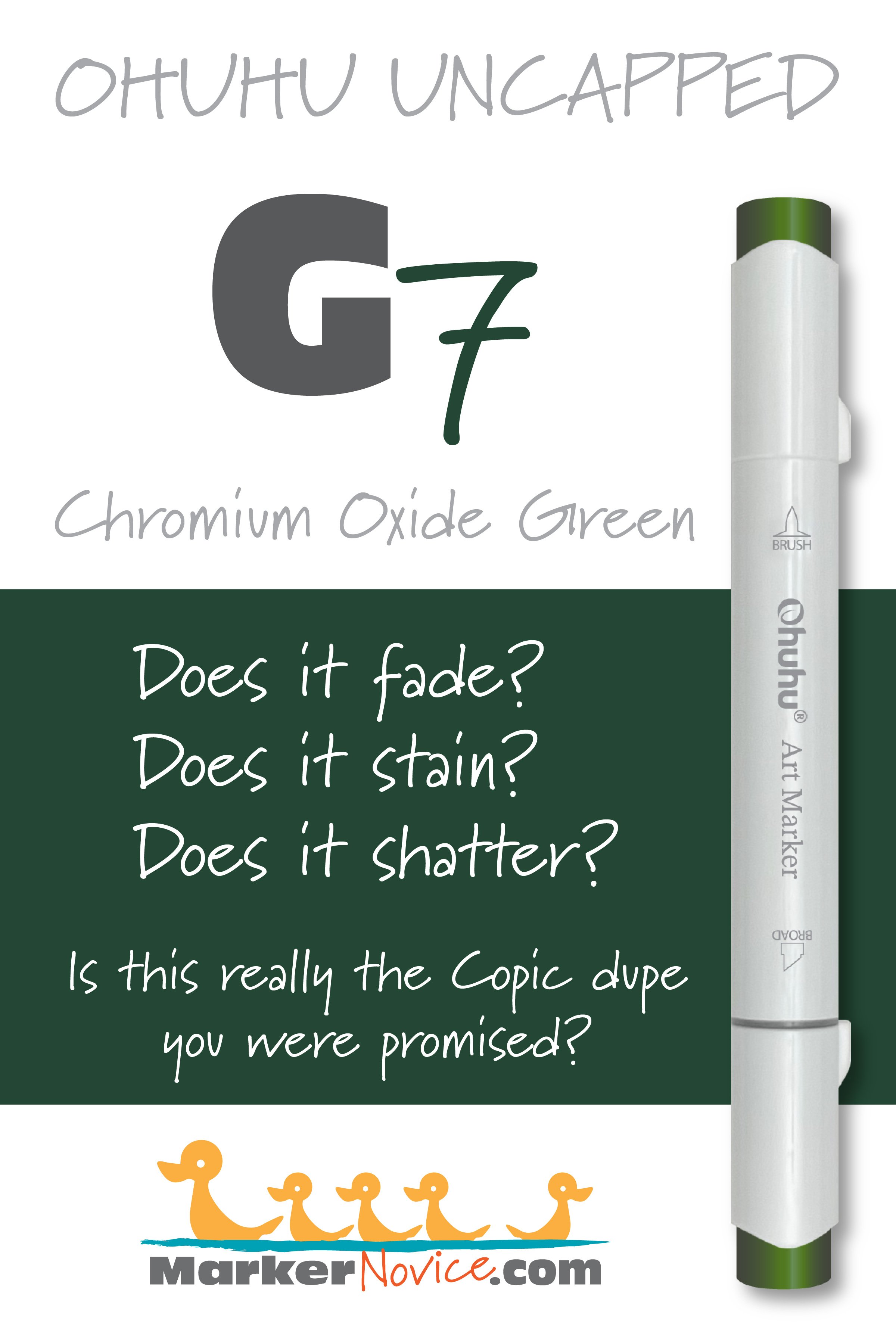
Learn more about G7 Chromium Oxide Green, a deep green Ohuhu Marker. We swatch and test Ohuhu colors- layering, staining, lift, value, lightfastness, saturation, and cap accuracy. | MarkerNovice.com | How to blend alcohol ink markers.

BG4 Mint Blue: Testing Ohuhu Markers for Lightfastness and Quality
BG4 Mint Blue
Let’s take a closer look at this Ohuhu Marker and its ink characteristics.
You were told “Ohuhu is the Copic slayer! They’re like Copic Markers but better!”
Is it true?
Every Ohuhu Marker has different characteristics based upon its unique ink formula. No matter how great they say the marker is, test results do not lie.
So are Ohuhu markers as great as you’ve heard?
Let’s look at Ohuhu BG4 to find out.
WARNING: Ohuhu markers have numbers on the cap but not on the body of the marker. We do not recommend coloring with both caps off due to the risk of accidentally placing the wrong caps on a marker.
Test results: Ohuhu BG4 Mint Blue
REFILL WARNING! At this time, Ohuhu does not sell refills for BG4. To date, you must purchase a new marker when your current BG4 runs dry. See Ohuhu’s current list of refills here.
Temperature: A light bluish green
Resemblance: Cobalt Turquoise watercolor
Actual Value: N2
Unlike Copic, Ohuhu does not measure value— this is a glaring deficiency which makes finding blending combinations harder than it has to be!
All Copics are measured on a Neutral Gray value scale. The last number on the Copic cap indicates the value. We’re using the Copic scale to measure Ohuhu until Ohuhu releases a reliable value scale.
Cap Accuracy: The plastic on an Ohuhu Honolulu BG4 marker matches 1-2 coats of ink.
Copic Substitution: Ohuhu BG4 is slightly bluer than Copic’s BG11 but otherwise, they are a near match in hue and value.
Note: similar colors rarely behave the same way. From experience I can tell you that Copic BG11 is an easier marker to use. See staining results below for more info on why I do not recommend BG4 for beginners. See the test results for Copic BG11 here.

Buildup: BG4 reaches a maximum value at 3 coats.
Overinking: We do not recommend using more than 3 coats of BG4. As with most Ohuhu markers, four layers looks oversaturated and dull.
Shattering: This ink is a mixture of blue and gray inks. Noticable gray ink may appear along the edges of any area corrected with a colorless blender. Use caution when correcting mistakes.
Chromatography testing shows this ink’s behavior when it comes in contact with #0 Colorless Blender (solvent). High shattering colors may leak unexpected color when you make corrections or attempt to blend with any color that has a high solvent to colorant ratio. Shattering is not bad, it’s just something to be aware of.
Staining: Despite being a very light color, BG4 is a staining color.
With alcohol markers, a staining ink is generally a sign of a low quality ink. Staining inks bond to the paper fibers and are reluctant to release. Staining inks make blending harder than it has to be!
Lift: BG4 can be lightened slightly but the paper remains light blue and the color moves but not enough to really make a good correction. This is extremely unusual for a light alcohol ink. See staining above, this is a sign of a low quality ink.
See staining swatch. Sample was given 6 stripes of #0 Colorless Blender, drying between each stripe. Results indicate how much lifting you can expect.
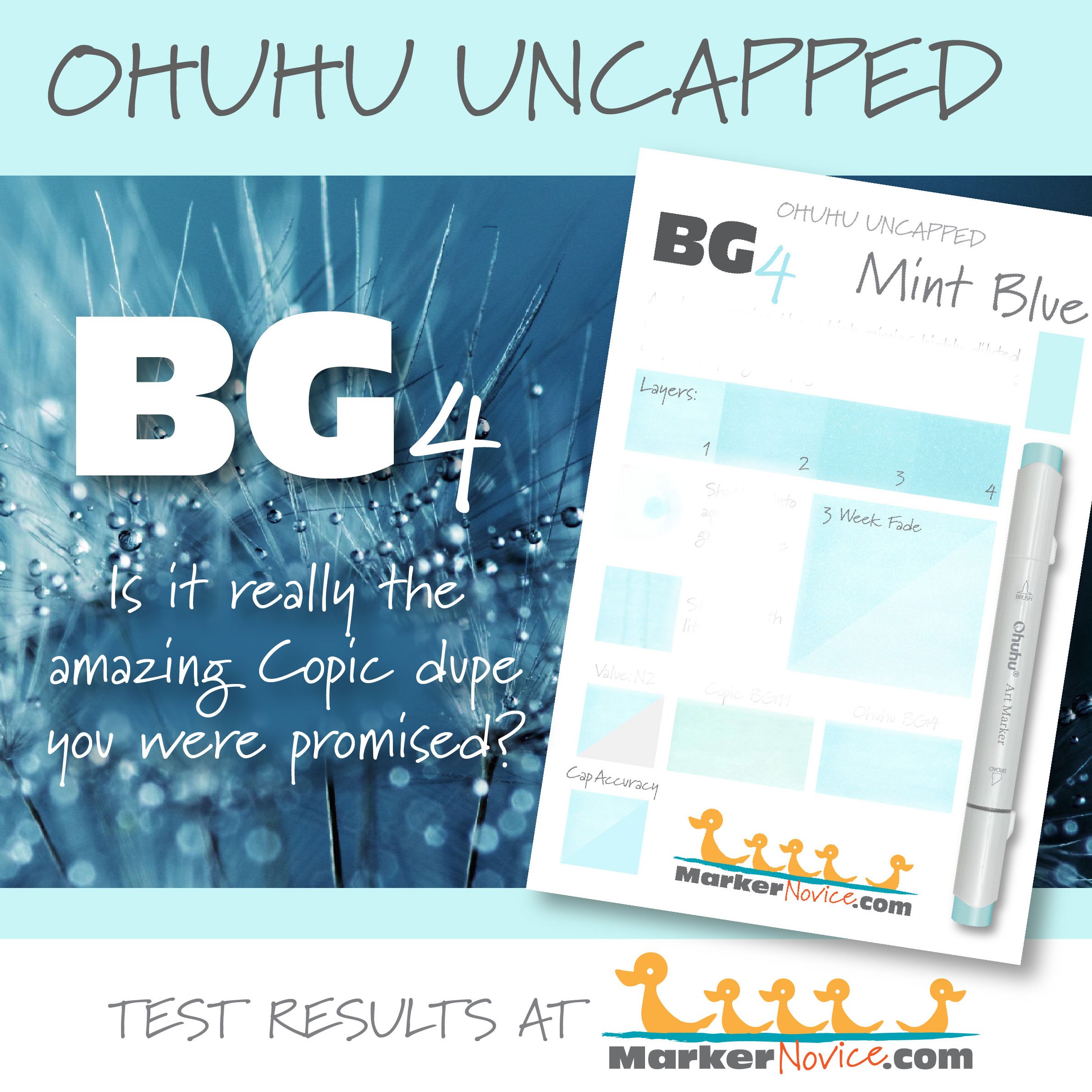
Lightfast: BG4 faded 50% during the test period. This is significantly more than the average Copic and more than twice the fade of Copic’s BG11 which is a similar color.
Samples were swatched on X-Press It Blending Card. 1 layer of ink was exposed to windowsill sunlight for 21 days. Approximately 10 hours of sun per day based on weather conditions. Note: we do not recommend displaying original marker art under these conditions.
Ink Color Family: I would love to say that the “BG” in BG4 indicates that this marker is part of the BG family.
I can’t say this with certainty because the Ohuhu numbering system is complete garbage. Some blueish-greenish markers say BG while others are marked B, PB, and even G. Why even bother? You simply can not trust anything you read on an Ohuhu cap.
Cap Numbering: BG4 has no relation in tone or color to BG3 (a blue gray) or BG5 which is much darker and the two do not blend well. This is completely unacceptable.
As stated above, the Ohuhu numbering system makes no sense. The markers are not arranged in chromatic order so you can not trust the numbers to tell you whether this marker is lighter or darker than other Ohuhu markers with similar numbers.
I’m still early in the Ohuhu testing process. I will add more info to this article as I learn more and when I spot behavioral patterns.
From what I’ve learned so far, I will not be working with Ohuhu markers and I will discourage students from using them in my classes. They’re simply not worth the frustration.
Learn more about BG4 Mint Blue, a blue-green Ohuhu Marker. We swatch and test Ohuhu colors- layering, staining, lift, value, lightfastness, saturation, and cap accuracy. | MarkerNovice.com | How to blend alcohol ink markers.