
120 Black: Testing Ohuhu Markers for Lightfastness and Quality
120 Black
Let’s take a closer look at this Ohuhu Marker and its ink characteristics.
You were told “Ohuhu is the Copic slayer! They’re like Copic Markers but better!”
Is this true?
Every Ohuhu Marker has different characteristics based upon its unique ink formula. No matter how great they say the marker is, test results do not lie.
So are Ohuhu markers as great as you’ve heard?
Let’s look at Ohuhu 120 Black to find out.
WARNING: Ohuhu markers have numbers on the cap but not on the body of the marker. We do not recommend coloring with both caps off due to the risk of accidentally placing the wrong caps on a marker.
Test results: Ohuhu 120 Black
Refill: At this time, Ohuhu only sells 50 refill colors. Luckily, they do sell black. Still, I’d like to point out that their marketing is extremely deceptive. With over 320 colors but only 50 refills, I think it’s stretching the truth to market themselves as “refillable”. See Ohuhu’s current list of refills here.
Temperature: A barely warm black.
Resemblance: Lamp Black watercolor.
Actual Value: N12
Unlike Copic, Ohuhu does not measure value— this is a glaring deficiency which makes finding blending combinations harder than it has to be!
All Copics are measured on a Neutral Gray value scale. The last number on the Copic cap indicates the value. We’re using the Copic scale to measure Ohuhu until Ohuhu releases a reliable value scale.
Cap Accuracy: The plastic on an Ohuhu Honolulu 120 marker matches 2 coats of 120 ink.
I’ve seen numerous Ohuhu review videos where they complain about massive Ohuhu cap color inaccuracies. I’ve also read this mentioned in blogs and websites. To be honest, I’m simply not finding Ohuhu to be any worse than other marker brands. Yes, some caps are wrong but I don’t think cap accuracy is their biggest problem.
Copic Substitution: Ohuhu 120 is a close match to Copic’s 110. Ohuhu’s black is more densely colored and a bit more neutral than the redder Copic Special Black, but otherwise, they are a match in value.
Note: similar colors rarely behave the same way. From experience I can tell you that both Copic 100 and 110 are easier to blend. Ohuhu clearly wanted a dense black so their ink formula has an extremely high ratio of colorant to solvent. Copic’s blacks are weaker. Is stronger better? I’d say no. With less black colorant, Copic’s blacks are easier to blend and you can layer them with no issues. Ohuhu Black on the other hand starts to look over-inked on the second coat and is nearly impossible to blend. With less black in their black, Ohuhu could have created an easier marker to work with. See the test results for Copic 110 here.
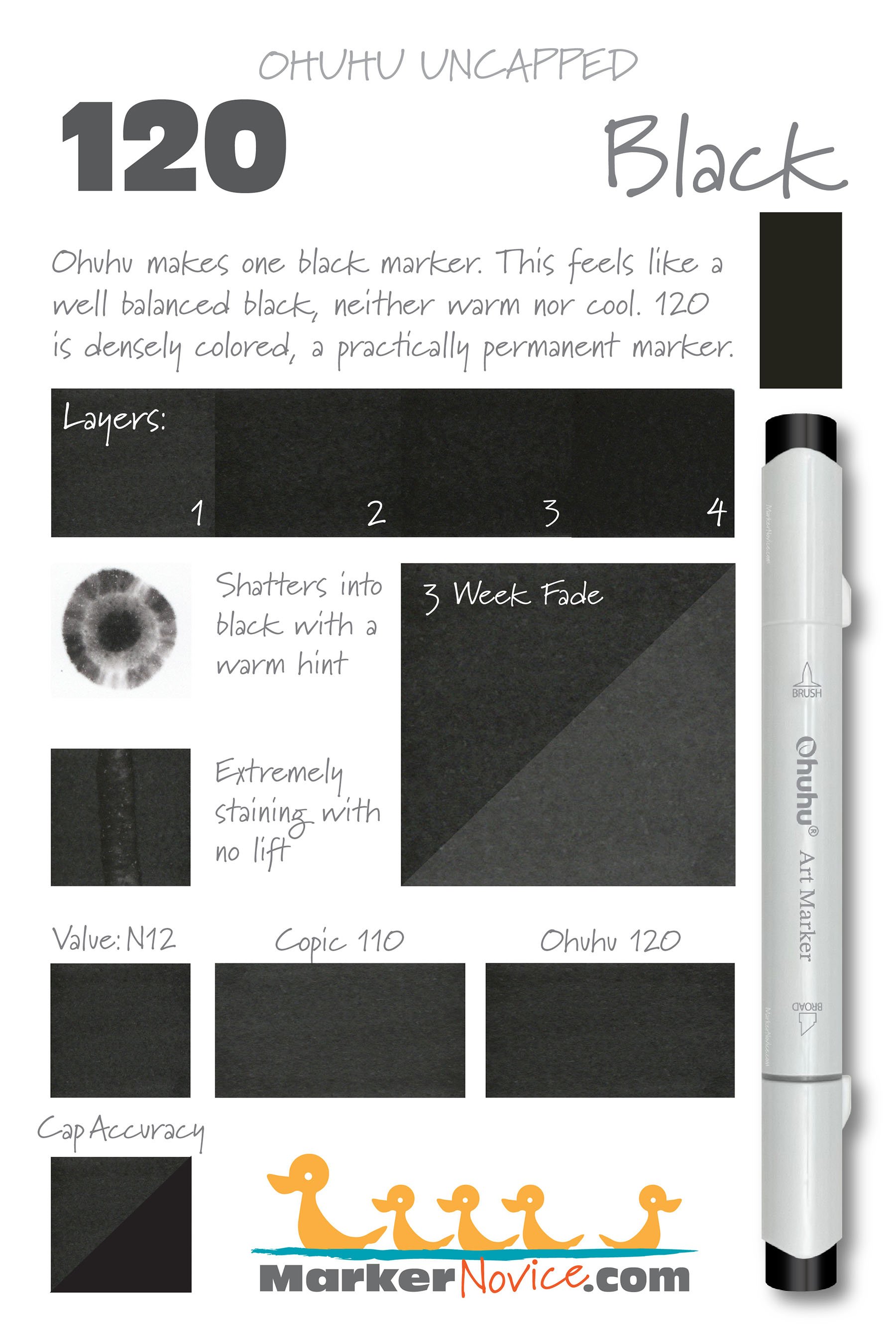
Buildup: 120 reaches a maximum value at 2 coats.
This is especially problematic for those who color with a lot of ink, who have a heavy hand (using a lot of pressure), or those who make many blending corrections. When an ink reaches maximum value, the paper begins to look oily and will eventually turn sticky. Sticky projects actually collect dust! For an ink to reach full value at only two coats is absolutely ridiculous.
If you wonder why this is a problem, consider that most people use THREE marker blending combinations, meanwhile this marker doesn’t want to be touched with more than two layers of any color.
This ink is not appropriate for coloring and especially not for blending. It may have other legimate uses but Ohuhu never should have released such a unsuitable ink for coloring purposes!
Overinking: We do not recommend using more than 2 coats of 120 and we do not recommend using this in three or four marker blending combinations.
Shattering: This ink is highly reactive to colorless blender due to the extremely high amount of colorant in the formula. There is a slight hint of pink/red leakage around the center stained area which indicates this black is a blend. Black blends are standard in art supplies and not a sign of low quality. Black is simply a hard color to make.
Chromatography testing shows this ink’s behavior when it comes in contact with #0 Colorless Blender (solvent). High shattering colors may leak unexpected color when you make corrections or attempt to blend with any color that has a high solvent to colorant ratio. Shattering is not bad, it’s just something to be aware of.
Staining: 120 is extremely staining.
With alcohol markers, a staining ink is generally a sign of a low quality ink. Staining inks bond to the paper fibers and are reluctant to release. Staining inks make blending harder than it has to be!
Lift: Consider 120 Black a permanent marker. In all my years of coloring, I’ve never seen a marker lift less than Ohuhu black.
See staining swatch. Sample was given 6 stripes of #0 Colorless Blender, drying between each stripe. Results indicate how much lifting you can expect.
Lightfast: 120 faded about 10% during the test period. This is the same amount of fade seen in Copic’s 100 and Copic's 110 despite the fact that Ohuhu has far more colorant in it’s formula. I’d expect an ink this dense to fade less.
Samples were swatched on X-Press It Blending Card. 1 layer of ink was exposed to windowsill sunlight for 21 days. Approximately 10 hours of sun per day based on weather conditions. Note: we do not recommend displaying original marker art under these conditions.
Ink Color Family: Black is basically treated as it’s own color family by most marker brands.
Cap Numbering: I don’t understand why this was given the number “120”. With a number like 120, I expected to find 2 or 3 more blacks in the set. Doesn’t the number 100 for an only black seem more logical to you?
Marker Name: Bonus points to Ohuhu for not messing this up.
I’m still early in the Ohuhu testing process. I will add more info to this article as I learn more and when I spot behavioral patterns.
From what I’ve learned so far, I will not be working with Ohuhu markers and I will discourage students from using them in my classes. They’re simply not worth the frustration.






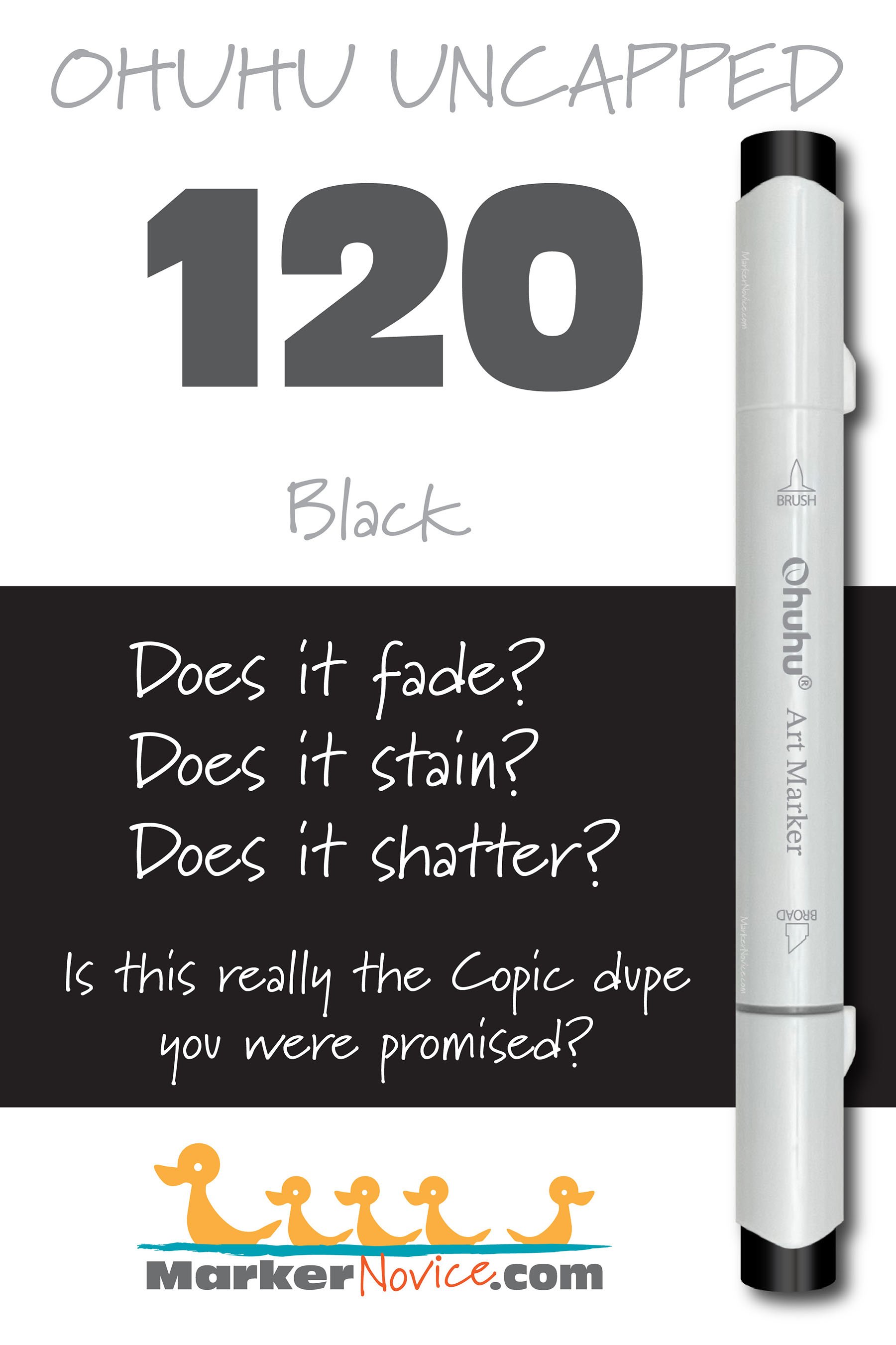
Learn more about 120 Black, a true black Ohuhu Marker. We swatch and test Ohuhu colors- layering, staining, lift, value, lightfastness, saturation, and cap accuracy. | MarkerNovice.com | How to blend alcohol ink markers.

BG050 Cool Grey 05: Testing Ohuhu Markers for Lightfastness and Quality
BG050 Cool Grey 05
Let’s take a closer look at this Ohuhu Marker and its ink characteristics.
You were told “Ohuhu is the Copic slayer! They’re like Copic Markers but better!”
Is it true?
Every Ohuhu Marker has different characteristics based upon its unique ink formula. No matter how great they say the marker is, test results do not lie.
So are Ohuhu markers as great as you’ve heard?
Let’s look at Ohuhu BG050 to find out.
WARNING: Ohuhu markers have numbers on the cap but not on the body of the marker. We do not recommend coloring with both caps off due to the risk of accidentally placing the wrong caps on a marker.
Test results: Ohuhu BG050 Cool Grey 05
IMPORTANT NOTE: To nobody’s suprise, Ohuhu has badly botched their lettering/number system. SEE THE “INK COLOR FAMILY” SECTION BELOW FOR AN IMPORTANT WARNING ABOUT OHUHU BG MARKERS.
REFILL WARNING! At this time, Ohuhu does not sell refills for BG050. To date, you must purchase a new marker when your current BG050 runs dry. See Ohuhu’s current list of refills here.
Temperature: A medium bluish gray
Resemblance: diluted Payne’s Gray watercolor
Actual Value: N3.5
Unlike Copic, Ohuhu does not measure value— this is a glaring deficiency which makes finding blending combinations harder than it has to be!
All Copics are measured on a Neutral Gray value scale. The last number on the Copic cap indicates the value. We’re using the Copic scale to measure Ohuhu until Ohuhu releases a reliable value scale.
Cap Accuracy: The plastic on an Ohuhu Honolulu BG050 marker matches 1 coat of BG050 ink.
I’ve seen numerous Ohuhu review videos where they complain about massive Ohuhu cap color inaccuracies. I’ve also read this mentioned in blogs and websites. To be honest, I’m simply not finding Ohuhu to be any worse than other marker brands. Yes, some caps are wrong but I don’t think cap accuracy is their biggest problem.
Copic Substitution: Ohuhu BG050 is a close match to Copic’s C3 but otherwise, they are a near match in hue and value.
Note: similar colors rarely behave the same way. From experience I can tell you that Copic C3 is an easier marker for layering. See “buildup” and “overinking” results below for why I think C3 is a much better marker for those with a heavy hand or who make many blend corrections. See the test results for Copic C3 here.
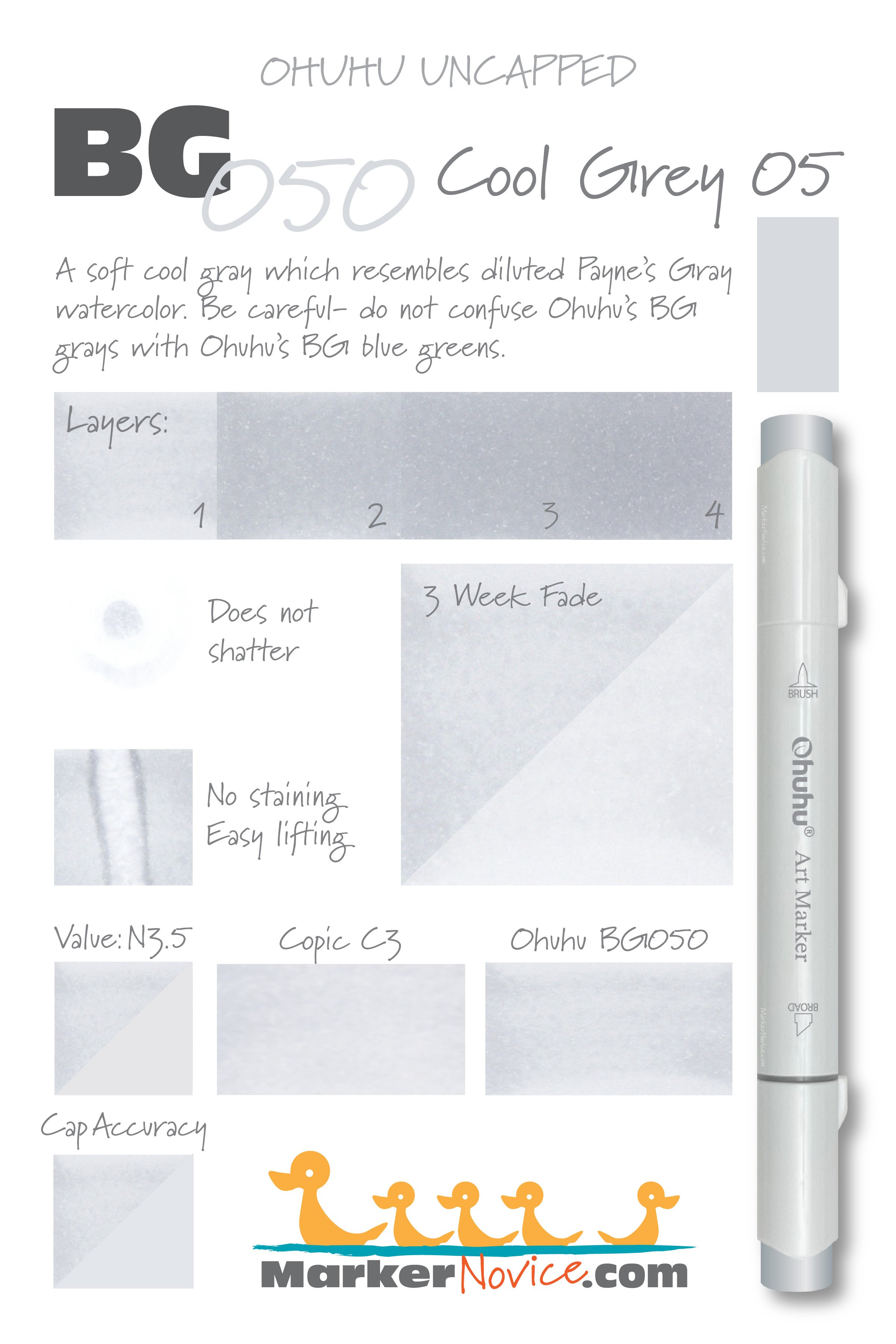
Buildup: BG050 reaches a maximum value at 2 coats.
This is especially problematic for those who color with a lot of ink, who have a heavy hand (using a lot of pressure), or those who make many blending corrections. When an ink reaches maximum value, the paper begins to look oily and will eventually turn sticky. Sticky projects actually collect dust! For an ink to reach full value at only two coats is absolutely ridiculous.
If you wonder why this is a problem, consider that most people use THREE marker blending combinations, meanwhile this marker doesn’t want to be touched with more than two layers of any color.
This ink is not appropriate for coloring and especially not for blending. It may have other legimate uses but Ohuhu never should have released such a unsuitable ink for coloring purposes!
Overinking: We do not recommend using more than 2 coats of BG050 and we do not recommend using this in three or four marker blending combinations.
Shattering: This ink did not noticeably shatter in testing but it’s such a light color that perhaps I’ve missed the presence of other colors in the formula. To my eye, this looks like a single color formula.
Chromatography testing shows this ink’s behavior when it comes in contact with #0 Colorless Blender (solvent). High shattering colors may leak unexpected color when you make corrections or attempt to blend with any color that has a high solvent to colorant ratio. Shattering is not bad, it’s just something to be aware of.
Staining: BG050 did not stain the paper.
With alcohol markers, a staining ink is generally a sign of a low quality ink. Staining inks bond to the paper fibers and are reluctant to release. Staining inks make blending harder than it has to be!
Lift: BG050 is an easy lifting color and should be considered “correctable”. No ink is erasable but you should be able to fade most mistakes made with this color.
See staining swatch. Sample was given 6 stripes of #0 Colorless Blender, drying between each stripe. Results indicate how much lifting you can expect.
Lightfast: BG050 faded about 30% during the test period. This is more than the average Copic and at least twice the fade of Copic’s C3 which is a similar color.
Samples were swatched on X-Press It Blending Card. 1 layer of ink was exposed to windowsill sunlight for 21 days. Approximately 10 hours of sun per day based on weather conditions. Note: we do not recommend displaying original marker art under these conditions.
Ink Color Family: Sit down folks, this is gonna be a long one.
Ohuhu doesn’t care about their ink identification system and this means they really do not care about you!
“BG” in Ohuhu markers may mean “Blue-Green”
But BG can also means “Blue-Gray”. Got that? Ohuhu couldn’t be bothered to give their aqua markers a different set of letters than their blue grays. They’re all BG. Thanks, Ohuhu.
From what I can tell, the BG markers with two numbers are blue green. If it has 3 numbers, it’s a cool gray.
But wait, it gets worse! BG050 is named “Cool Grey 05” which should not be confused with Ohuhu CG (Cool Grey) markers or CG II (Cool Grey Series 2) markers.
Hang on again, there’s more bad news. Ohuhu has grays marked MG. I have absolutely NO idea what the M might stand for. And hold on to your socks folks, because MG markers are all named “Blue Gray (something)”
As if this wasn’t all bad enough, none of the BG Gray inks are related to each other. Read on for more on this subject.
Cap Numbering: The BG grays (not to be confused with the BG blue-greens) is a group of 3 markers which have no relation to one another despite being consecutively numbered.
BG050 “Cool Grey 05” is a very bluish medium gray
BG060 “Deep Cool Grey” is darker but more violet-ish and noticeably warmer
BG070 “Cool Grey 07” isn’t much darker than 060. It’s a traditional slate gray, more neutral than 050 or 060.
They do not blend with each other particularly well.
As stated above, the Ohuhu numbering system makes no sense. The markers are not arranged in chromatic order so you can not trust the numbers to tell you whether this marker is lighter or darker than other Ohuhu markers with similar numbers.
Marker Name: Special note… notice above, the three BG grays are not consistently named. Ohuhu doesn’t even care enough to keep the name pattern consistent.
BG050 “Cool Grey 05”
BG060 “Deep Cool Grey”
BG070 “Cool Grey 07”
I’m still early in the Ohuhu testing process. I will add more info to this article as I learn more and when I spot behavioral patterns.
From what I’ve learned so far, I will not be working with Ohuhu markers and I will discourage students from using them in my classes. They’re simply not worth the frustration.
Learn more about BG050 Cool Grey 05, a blue-gray Ohuhu Marker. We swatch and test Ohuhu colors- layering, staining, lift, value, lightfastness, saturation, and cap accuracy. | MarkerNovice.com | How to blend alcohol ink markers.
RV070 Sakura Pink: Testing Ohuhu Markers for Lightfastness and Quality
RV070 Sakura Pink - Ohuhu
Let’s take a closer look at this Ohuhu Marker and its ink characteristics.
You were told “Ohuhu is the Copic slayer! They’re like Copic Markers but better!”
Is it true?
Every Ohuhu Marker has different characteristics based upon its unique ink formula. No matter how great they say the marker is, test results do not lie.
So are Ohuhu markers as great as you’ve heard?
Let’s look at Ohuhu RV070 to find out.
WARNING: Ohuhu markers have numbers on the cap but not on the body of the marker. We do not recommend coloring with both caps off due to the risk of accidentally placing the wrong caps on a marker.
Test results: Ohuhu RV070 Sakura Pink
REFILL WARNING! At this time, Ohuhu does not sell refills for RV070. In fact, they don’t currently sell any RV pink refills— a glaring problem given the popularity of RV markers in the papercrafting community! To date, you must purchase a new marker when your current marker runs dry. See Ohuhu’s current list of refills here.
Temperature: A cool shocking pink
Resemblance: Opera Rose watercolor with an added shot of something florescent.
Actual Value: N6
Unlike Copic, Ohuhu does not measure value— this is a glaring deficiency which makes finding blending combinations harder than it has to be!
All Copics are measured on a Neutral Gray value scale. The last number on the Copic cap indicates the value. We’re using the Copic scale to measure Ohuhu until Ohuhu releases a reliable value scale.
Cap Accuracy: The plastic on an Ohuhu Honolulu RV070 marker is lighter and less florescent than one layer of RV070 ink.
Copic Substitution: Ohuhu RV070 is more day-glow but otherwise fits inbetween Copic’s RV04 and RV06
Note: similar colors rarely behave the same way. From experience I can tell you that Copic’s RV-zero family is an easy blending marker group, as are most Copics that start with a zero. The big difference I see between RV070 and Copic RV04 or 06 is that the Ohuhu marker doesn’t have any natural partners to blend with. This leads to partnering it with a high-solvent pink which badly damages RV070 and turns it slightly orange. The same thing does not happen with Copic’s hot pinks. Proof that two similar inks can behave radically different in usage. See Copic RV04 test result here.
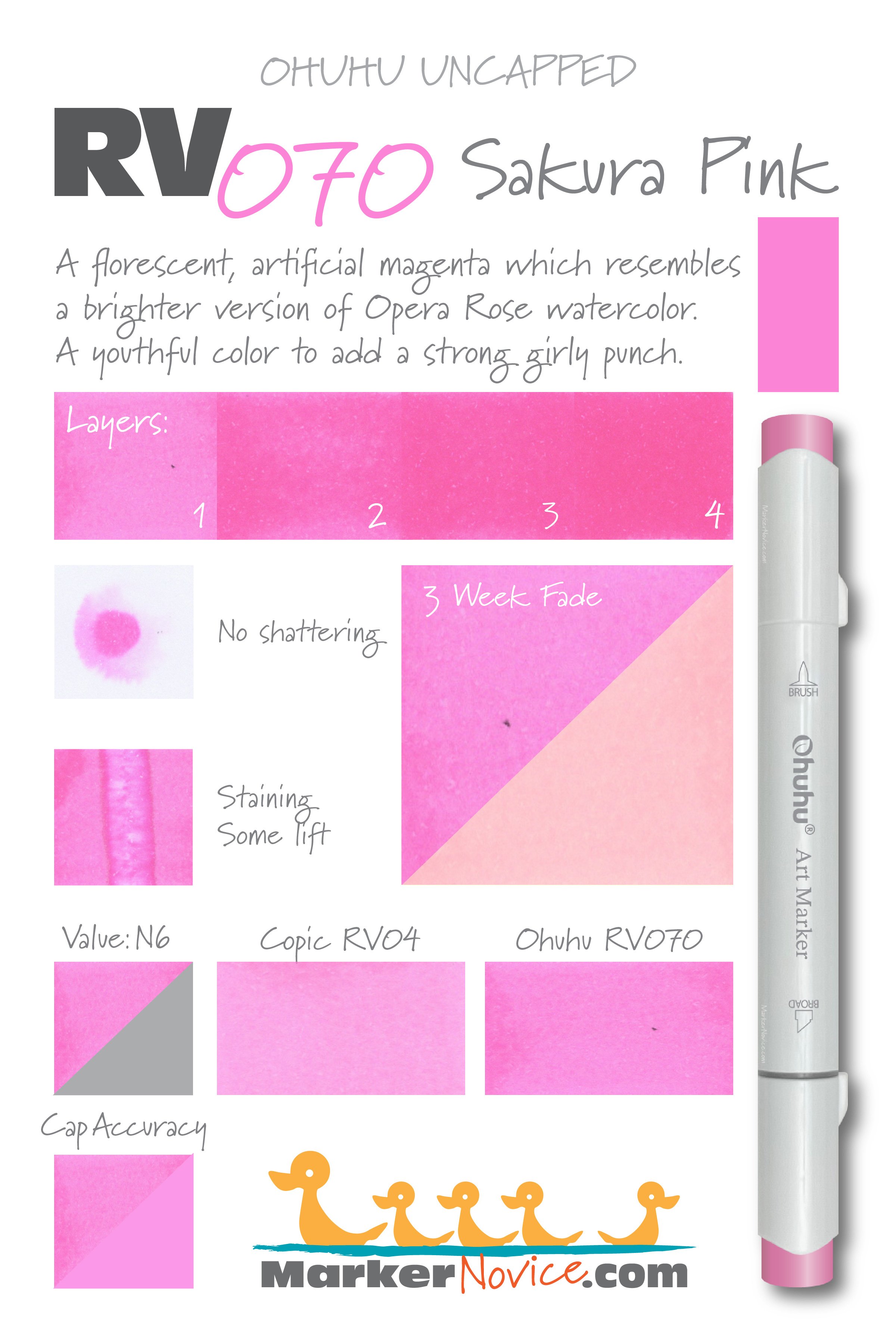
Buildup: RV070 reaches a maximum value at 3 coats.
Overinking: We do not recommend using more than 3 layers of RV070. As with many darker Ohuhu markers, four layers looks incredibly over-inked and oily.
Shattering: RV070 did not shatter in testing, indicating that this is likely a single color ink formula.
Chromatography testing shows this ink’s behavior when it comes in contact with #0 Colorless Blender (solvent). High shattering colors may leak unexpected color when you make corrections or attempt to blend with any color that has a high solvent to colorant ratio. Shattering is not bad, it’s just something to be aware of.
Staining: RV070 staining color which leaves the paper with a distinct pink glow.
With alcohol markers, a staining ink is generally a sign of a low quality ink. Staining inks bond to the paper fibers and are reluctant to release. Staining inks make blending harder than it has to be!
Lift: RV070 moved a bit but didn’t lift the way I expected. Compare the lift shown here with Copic’s RV06 here.
See staining swatch. Sample was given 6 stripes of #0 Colorless Blender, drying between each stripe. Results indicate how much lifting you can expect.
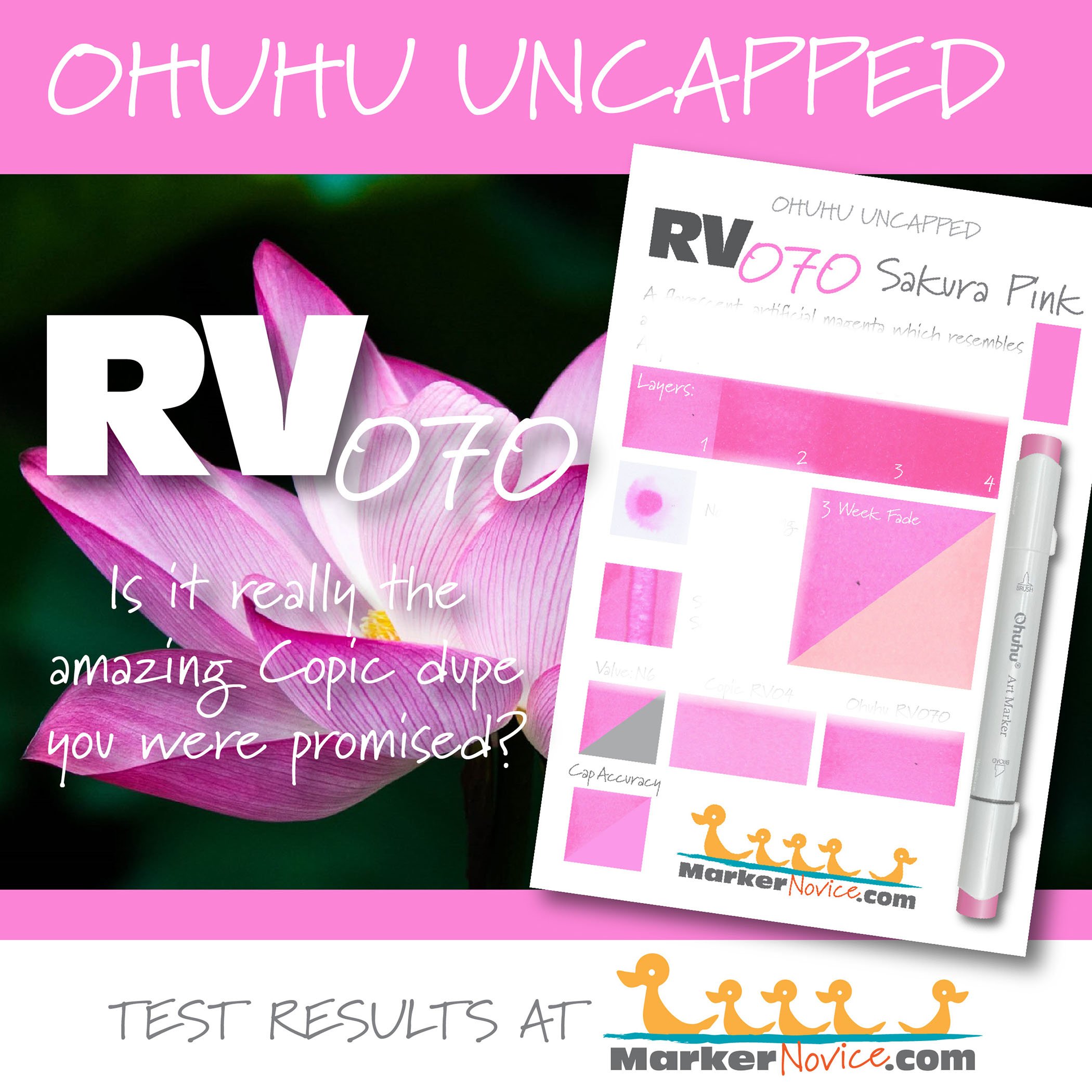
Lightfast: RV070 has an extreme and odd reaction to light. The sample faded by more than 50% and it also turned an odd peach color. Copic's RV06 also faded a lot but did not turn yellowish. See the results here.
Samples were swatched on X-Press It Blending Card. 1 layer of ink was exposed to windowsill sunlight for 21 days. Approximately 10 hours of sun per day based on weather conditions. Note: we do not recommend displaying original marker art under these conditions.
Ink Color Family: Ohuhu oddly places most of their magenta markers within the R family rather than the RV family. There are also a few stray pinks marked as RP, possibly “red-purple” although they look very magenta and not purple.
The Ohuhu letter-number system is complete garbage and doesn’t always make sense. I’ve tried to understand the pattern and have decided there is no pattern.
Cap Numbering: I suppose RV070 falls into a group we can call the RV000’s which are all florescent pinks. The group isn’t cohesive though becasue 010 and 080 are cool while 030 and 070 are warmer. The markers also don’t work well as a blending group because 070 and 080 are too close in value while the other two markers are far too light to blend with them. I feel like my analysis in this paragraph is more than Ohuhu bothered to do.
As stated above, the Ohuhu numbering system makes no sense. The markers are not arranged in chromatic order so you can not trust the numbers to tell you whether this marker is lighter or darker than other Ohuhu markers with similar numbers.
I’m still early in the Ohuhu testing process. I will add more info to this article as I learn more and when I spot behavioral patterns.
From what I’ve learned so far, I will not be working with Ohuhu markers and I will discourage students from using them in my classes. They’re simply not worth the frustration.

Learn about RV070 Sakura Pink, a magenta Ohuhu Marker. We swatch and test Ohuhu colors- layering, staining, lift, value, lightfastness, saturation, and cap accuracy. | MarkerNovice.com | How to color with alcohol markers
V340 Lavender Blue: Testing Ohuhu Markers for Lightfastness and Quality
V340 Lavender Blue
Let’s take a closer look at this Ohuhu Marker and its ink characteristics.
You were told “Ohuhu is the Copic slayer! They’re like Copic Markers but better!”
Is it true?
Every Ohuhu Marker has different characteristics based upon its unique ink formula. No matter how great they say the marker is, test results do not lie.
So are Ohuhu markers as great as you’ve heard?
Let’s look at Ohuhu V340 to find out.
WARNING: Ohuhu markers have numbers on the cap but not on the body of the marker. We do not recommend coloring with both caps off due to the risk of accidentally placing the wrong caps on a marker.
Test results: Ohuhu V050 Pearl Violet
REFILL WARNING! At this time, Ohuhu does not sell refills for V340. To date, you must purchase a new marker when your current marker runs dry. See Ohuhu’s current list of refills here.
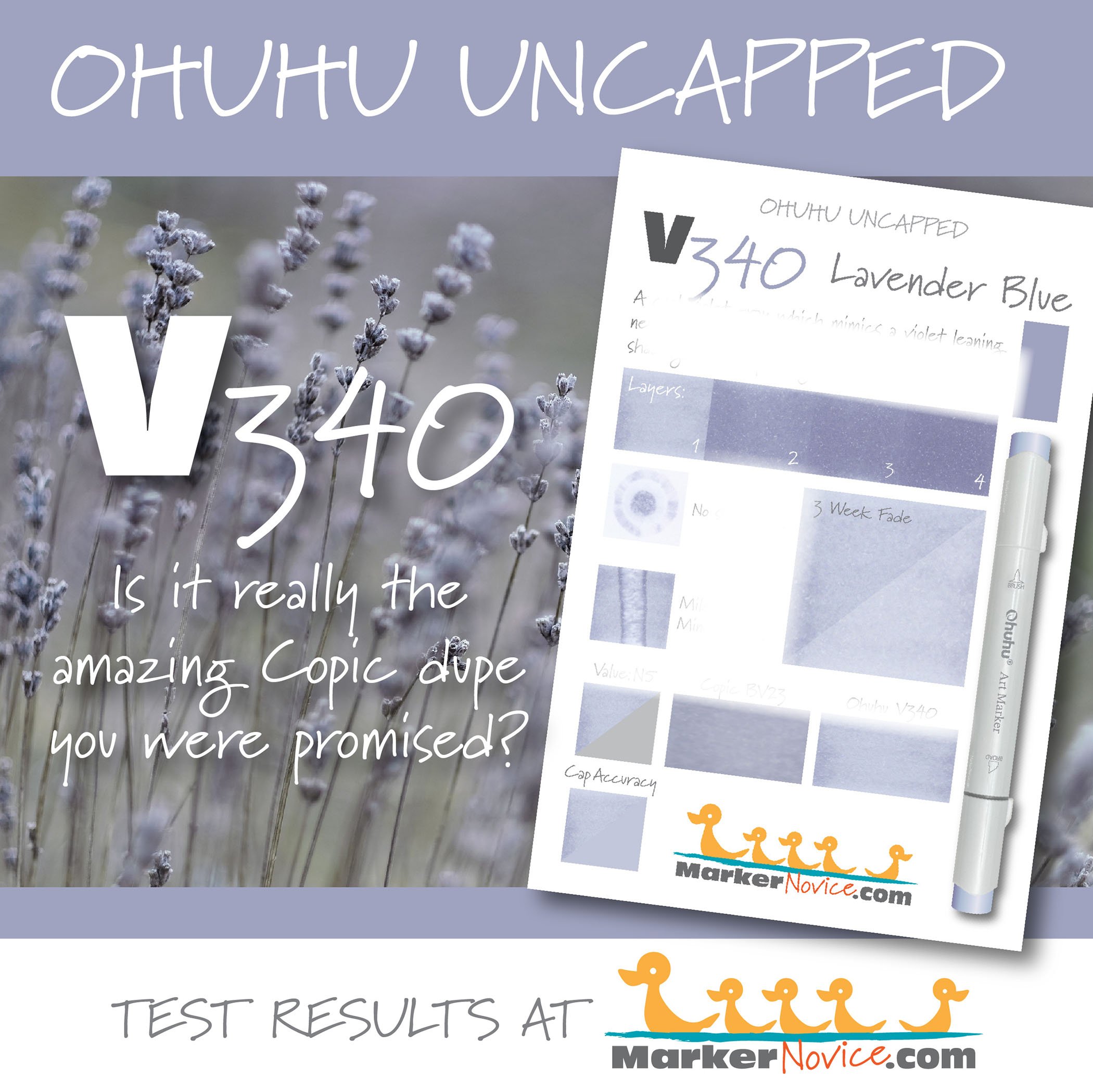
Temperature: A light cool gray-violet
Resemblance: a violet-leaning Neutral Tint watercolor
Actual Value: N5
Unlike Copic, Ohuhu does not measure value— this is a glaring deficiency which makes finding blending combinations harder than it has to be!
All Copics are measured on a Neutral Gray value scale. The last number on the Copic cap indicates the value. We’re using the Copic scale to measure Ohuhu until Ohuhu releases a reliable value scale.
Cap Accuracy: The plastic on an Ohuhu Honolulu V340 marker matches the color of one coat of this ink
Copic Substitution: Ohuhu V340 is slightly more violet but otherwise close to Copic’s BV23
Note: similar colors rarely behave the same way. From experience I can tell you that Copic BV23 is a relatively easy blending marker. I teach with BV23 frequently because it’s an extremely useful color for underpainting. On the otherhand, in my testing, I’ve noticed that Ohuhu V340 can not be used as a similar underpaint. When blended with lighter colors, this Ohuhu marker mottles. Since the entire premise of underpainting is to layer the color underneath lighter colors, I do not recommend Ohuhu V340 for underpainting. Proof that two similar inks can behave radically different in usage. See Copic BV23 test result here.
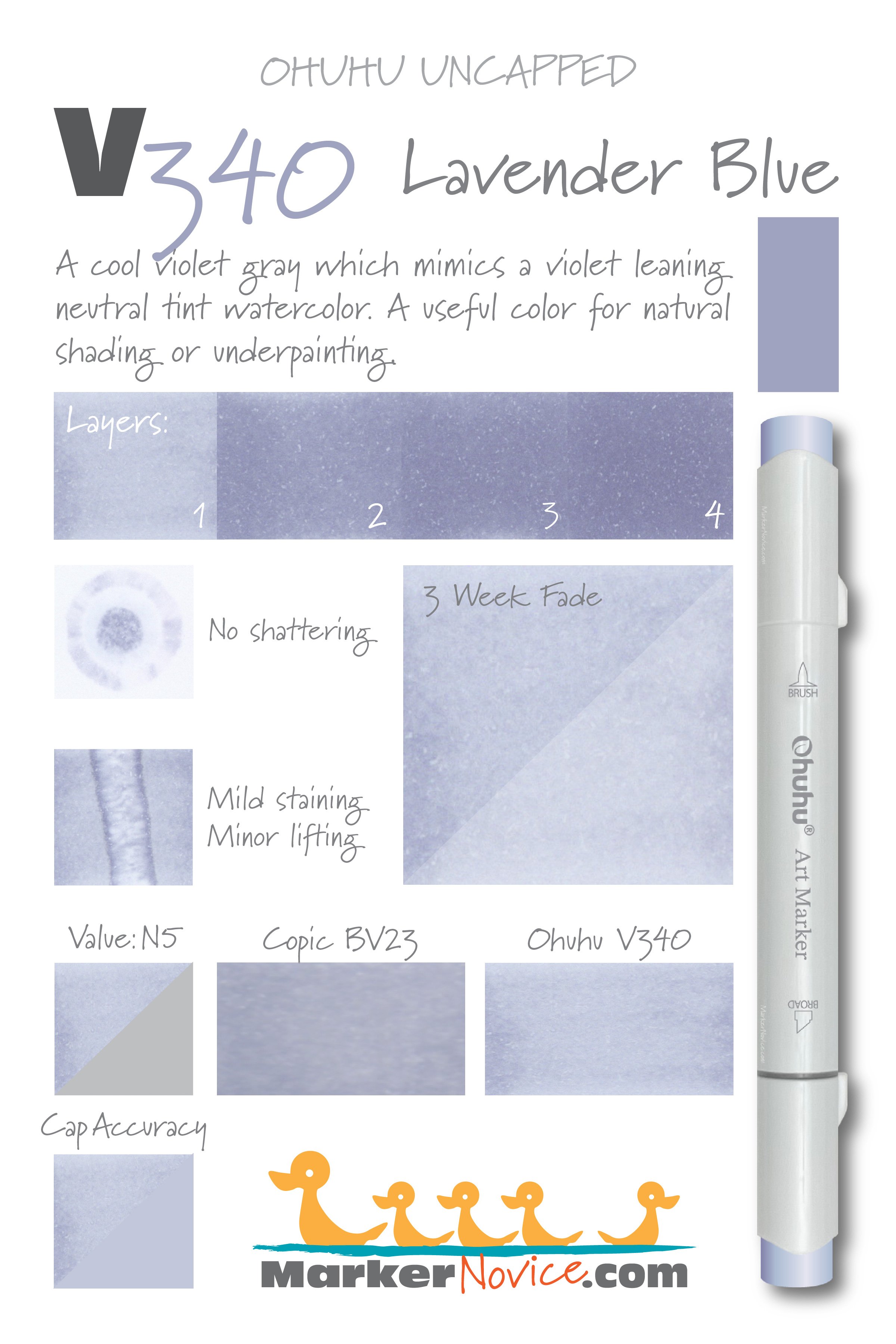
Buildup: V340 reaches a maximum value at about 2-3 coats.
Overinking: We do not recommend using more than 3 coats of V340. As with most Ohuhu markers, four layers seems to be a waste of ink since the color isn’t as buildable as Copic.
Shattering: V340 did not shatter in testing, indicating that this is likely a single color ink formula.
Chromatography testing shows this ink’s behavior when it comes in contact with #0 Colorless Blender (solvent). High shattering colors may leak unexpected color when you make corrections or attempt to blend with any color that has a high solvent to colorant ratio. Shattering is not bad, it’s just something to be aware of.
Staining: V340 a mildly staining color, an improvement over most Ohuhu colors tend to fall in the range from staining to extremely staining.
With alcohol markers, a staining ink is generally a sign of a low quality ink. Staining inks bond to the paper fibers and are reluctant to release. Staining inks make blending harder than it has to be!
Lift: V340 lifted pretty well during testing. As usual, Ohuhu markers really pile the ink along either side of the correction zone but with patience, I think mistakes with this color can be corrected.
See staining swatch. Sample was given 6 stripes of #0 Colorless Blender, drying between each stripe. Results indicate how much lifting you can expect.
Lightfast: V050 faded by about 20% during the test period. Copic BV23 faded slightly less. See BV23 results here.
Samples were swatched on X-Press It Blending Card. 1 layer of ink was exposed to windowsill sunlight for 21 days. Approximately 10 hours of sun per day based on weather conditions. Note: we do not recommend displaying original marker art under these conditions.
Ink Color Family: Ohuhu has violet and purple markers hidden in several marker families including R Red, RV Red Violet, RP Red Purple?, P Purple?, and B Blue. I’ve given up trying to understand why.
The Ohuhu numbering system is complete garbage and doesn’t always make sense. When it comes to color families, you can not trust anything you read on an Ohuhu cap.
Cap Numbering: V markers all have 3 digits rather than two. I have no idea why because they all end in zero… except for one stinkin’ marker (V322) which I’m convinced is only there to throw off any accidental logic.
It’s also hard to classify the V300’s as a number group. V320 is the darkest in the group but it’s also a warm purple rather than cool violet. V340 is an odd-ball in that it’s grayer than the others and 390 looks more like an Ultramarine Blue than violet.
As stated above, the Ohuhu numbering system makes no sense. The markers are not arranged in chromatic order so you can not trust the numbers to tell you whether this marker is lighter or darker than other Ohuhu markers with similar numbers.
I’m still early in the Ohuhu testing process. I will add more info to this article as I learn more and when I spot behavioral patterns.
From what I’ve learned so far, I will not be working with Ohuhu markers and I will discourage students from using them in my classes. They’re simply not worth the frustration.
Learn about V340 Lavender Blue, a light violet Ohuhu Marker. We swatch and test Ohuhu colors- layering, staining, lift, value, lightfastness, saturation, and cap accuracy. | MarkerNovice.com | How to color with alcohol markers
B140 Aquamarine: Testing Ohuhu Markers for Lightfastness and Quality
B140 Aquamarine
Let’s take a closer look at this Ohuhu Marker and its ink characteristics.
You were told “Ohuhu is the Copic slayer! They’re like Copic Markers but better!”
Is it true?
Every Ohuhu Marker has different characteristics based upon its unique ink formula. No matter how great they say the marker is, test results do not lie.
So are Ohuhu markers as great as you’ve heard?
Let’s look at Ohuhu B140 to find out.
WARNING: Ohuhu markers have numbers on the cap but not on the body of the marker. We do not recommend coloring with both caps off due to the risk of accidentally placing the wrong caps on a marker.
Test results: Ohuhu B140 Aquamarine
Refill: At this time, Ohuhu only sells refills for 50 colors (not exactly what they advertise though, eh?). Fortunately they do sell refill ink for B140, so when this marker stops blending well, you can easily refill it to restore its potential. See Ohuhu’s current list of refills here.
Temperature: A red-shifted medium blue.
Resemblance: diluted Ultramarine Blue watercolor
Actual Value: N5
Unlike Copic, Ohuhu does not measure value— this is a glaring deficiency which makes finding blending combinations harder than it has to be!
All Copics are measured on a Neutral Gray value scale. The last number on the Copic cap indicates the value. We’re using the Copic scale to measure Ohuhu until Ohuhu releases a reliable value scale.
Color Name: This marker is ridiculously named Aquamarine.
The name on this marker is clearly a sign that Ohuhu does not employ anyone on the color development team who both speaks English and understands common color nomenclature. This color is not even remotely close to “Aquamarine”. I suspect they meant to name this “Ultramarine” but even that would be wrong because we usually think of Ultramarine as the full strength darker version of this color.
Cap Accuracy: The plastic on an Ohuhu Honolulu B140 is fairly close to the color of one coat of B140 ink. The plastic is a little duller and grayer but not so off that I’d complain about being deceived by the plastic.
A common complaint about Ohuhu is that the caps are not an accurate match to the ink inside the marker. I disagree. I have yet to find a marker that I’d classify as drastically wrong. The names may be odd and the numbering system is trash but for the. most part, the color of the plastic usually comes close to the ink.
Copic Substitution: Ohuhu B140 is slightly lighter but similar to Copic’s B24. They are not the same ink due to the difference in test results.
Note: similar colors rarely behave the same way. From experience I can tell you that Copic B24 is a relatively easy blending marker. I frequently teach with B24 because it’s easy for beginners. Ohuhu B140 is a staining color and is more stubborn than the Copic equivalent. Blue markers tend to be easy to blend with, the fact that the Ohuhu version is a staining color is surprising. Keep this in mind for ALL art supplies, it’s not enough to match the color, two similar inks, pencils, or paints can behave radically different in usage. See Copic B24 test results here.
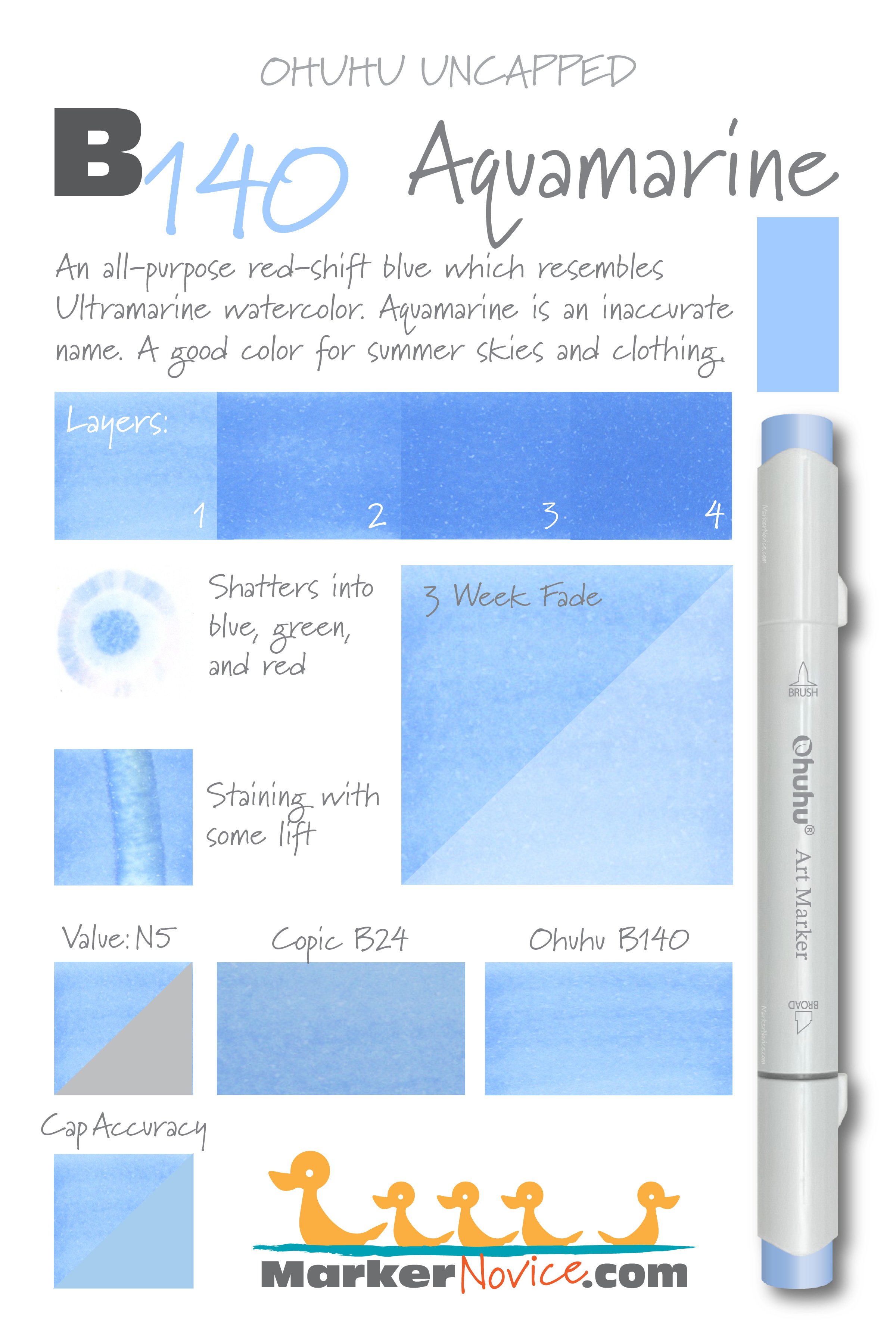
Buildup: B140 reaches a maximum value at 3 coats and looks smooth at 3 layers. Four layers does look oily.
Overinking: I do not recommend using more than 3 coats of B140. As with most Ohuhu markers, four layers looks exactly like three so why waste the ink?
Shattering: B140 shatters into three inks on contact with colorless blender— blue, green, and a soft red.
Chromatography testing shows this ink’s behavior when it comes in contact with #0 Colorless Blender (solvent). High shattering colors may leak unexpected color when you make corrections or attempt to blend with any color that has a high solvent to colorant ratio. Shattering is not bad, it’s just something to be aware of.
Staining: B140 is a staining color which is odd for a light blue ink. Beware as you’re blending B140 with a lighter color of ink as the solvent in the light ink may cause B140 to separate. I saw hints of green and red around the edges of several of my test swatches.
With alcohol markers, a staining ink is generally a sign of a low quality ink. Staining inks bond to the paper fibers and are reluctant to release. Staining inks make blending harder than it has to be!
Lift: The blue component of B140 ink lifted fairly well from the paper but the paper was left stained a noticeable light green.
See staining swatch. Sample was given 6 stripes of #0 Colorless Blender, drying between each stripe. Results indicate how much lifting you can expect.
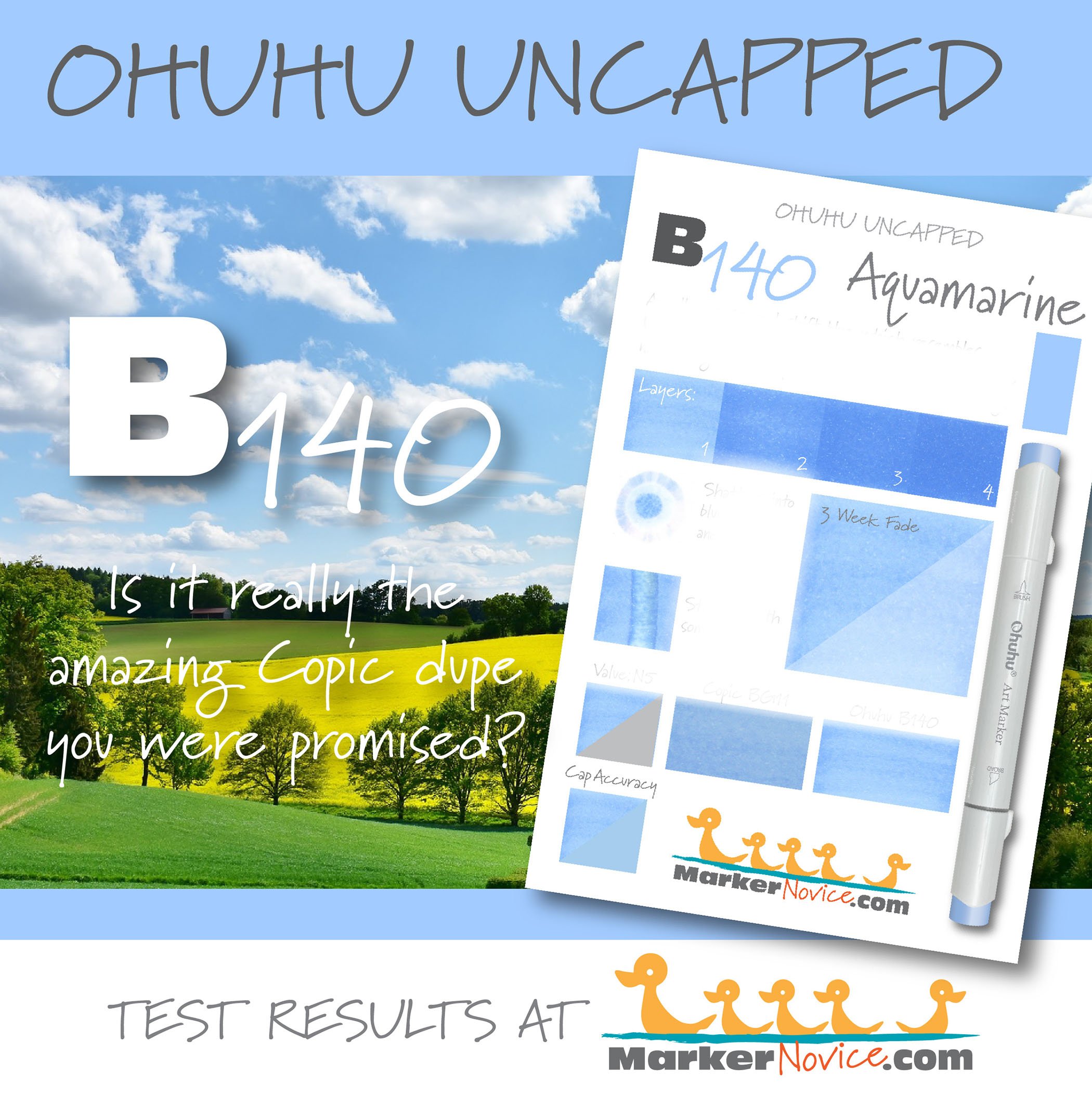
Lightfast: B140 faded by about 50% during the test period. This is average fading for Ohuhu. Copic B24 had a very mild fade rate of about 5%.
Samples were swatched on X -Press It Blending Card. 1 layer of ink was exposed to windowsill sunlight for 21 days. Approximately 10 hours of sun per day based on weather conditions. Note: we do not recommend displaying original marker art under these conditions.
Ink Color Family: Shockingly, Ohuhu does not include many blues in their 320 Honolulu sets. This is weird because blue inks are very common. Ohuhu classifies blues as B (blue) and PB. I have no idea what the P stands for. I first thought either “Prussian”, “Phthalo”, or “Pastel” but the PB marker colors do not look particularly Prussian or Phthalo, and they’re definitely not pastel.
The Ohuhu lettering system is complete garbage and doesn’t always make sense. Perhaps Ohuhu breaks the normal color family rules due to carelessness in the translation from Chinese to English. But actually, I suspect the confusion is to purposefully make it hard to track which colors are included in which sets and/or make it easy to change colors based on which ingredients are cheapest at the time.
Cap Numbering: There are only 20 Ohuhu B markers which all have 3 digit numbering. The markers do seem to make sense when divided by first number. If you’re trying to make blue blending combinations, try the B000’s, B100’s, B200’s, B300’s, or B400’s.
These groups are not related the way Copic number groups are*, so they will not blend as well, but at least the groups make a little bit of sense.
*B110 and B120 are not related, nor should B110 be in the same group as B180 or B190.
As stated above, the Ohuhu numbering system generally makes no sense. The markers are not arranged in chromatic order so you can not trust the numbers to tell you whether this marker is lighter or darker than other Ohuhu markers with similar numbers.
I’m still early in the Ohuhu testing process. I will add more info to this article as I learn more and when I spot behavioral patterns.
From what I’ve learned so far, I will not be working with Ohuhu markers and I will discourage students from using them in my classes. They’re simply not worth the frustration.
Learn about B140 “Aquamarine”, a blue Ohuhu Marker. We swatch and test Ohuhu colors- layering, staining, lift, value, lightfastness, saturation, and cap accuracy. | MarkerNovice.com | How to blend alcohol markers

YR190 Cadmium Orange: Testing Ohuhu Markers for Lightfastness and Quality
YR190
Let’s take a closer look at this Ohuhu Marker and its ink characteristics.
You were told “Ohuhu is the Copic slayer! They’re like Copic Markers but better!”
Is it true?
Every Ohuhu Marker has different characteristics based upon its unique ink formula. No matter how great they say the marker is, test results do not lie.
So are Ohuhu markers as great as you’ve heard?
Let’s look at Ohuhu YR190 to find out.
WARNING: Ohuhu markers have numbers on the cap but not on the body of the marker. We do not recommend coloring with both caps off due to the risk of accidentally placing the wrong caps on a marker.
Test results: Ohuhu YR190 Cadmium Orange
REFILL WARNING! At this time, Ohuhu does not sell refills for YR190. To date, you must purchase a new marker when your current marker runs dry. See Ohuhu’s current list of refills here.
Temperature: A warm medium orange
Resemblance: Chrome Orange watercolor
Actual Value: N6
Unlike Copic, Ohuhu does not measure value— this is a glaring deficiency which makes finding blending combinations harder than it has to be!
All Copics are measured on a Neutral Gray value scale. The last number on the Copic cap indicates the value. We’re using the Copic scale to measure Ohuhu until Ohuhu releases a reliable value scale.
Cap Accuracy: The plastic on an Ohuhu Honolulu YR190 is both lighter and more golden than the color of one coat of YR190 ink
Copic Substitution: Ohuhu YR190 is slightly lighter but similar to Copic’s YR07. They are not the same ink due to the difference in test results but the similarity between one layer of YR07 and two layers of YR190 is strikingly close.
Note: similar colors rarely behave the same way. From experience I can tell you that Copic YR07 is a relatively easy blending marker for an orange. I recommend YR07 for beginners, it’s on my Starter Marker List, and I teach with it frequently— all because it’s easy for beginners. Ohuhu YR190 is a staining color and is more stubborn than the Copic equivalent. Keep this in mind for ALL art supplies, it’s not enough to match the color, two similar inks, pencils, or paints can behave radically different in usage. See Copic YR07 test results here.

Buildup: YR190 reaches a maximum value at 3 coats but the difference between two and three layers is hardly worth the extra ink.
Overinking: I do not recommend using more than 3 coats of YR190. As with most Ohuhu markers, four layers looks exactly like three so why waste the ink?
Shattering: YR190 shatters into two inks on contact with colorless blender— orange and a bright yellow. This ink is also startling as the sample swatch turned a brilliant florescent orange while wet and even after drying retains a strange glow because the yellow is now obvious.
Chromatography testing shows this ink’s behavior when it comes in contact with #0 Colorless Blender (solvent). High shattering colors may leak unexpected color when you make corrections or attempt to blend with any color that has a high solvent to colorant ratio. Shattering is not bad, it’s just something to be aware of.
Staining: YR190 is a stubborn staining color which is to be expected because red and orange inks tend to be more staining than average. What is unusual is the glowing reaction of this ink. Beware as you’re blending YR190 with a lighter color of ink as the solvent in the light ink may turn this ink florescent or at least yellowish.
With alcohol markers, a staining ink is generally a sign of a low quality ink. Staining inks bond to the paper fibers and are reluctant to release. Staining inks make blending harder than it has to be!
Lift: YR190 barely lifted enough from the paper and where it did move, it left the paper noticeably yellow. The odds of making a correction to a mistake made with this orange ink are slim and it may be better not to make the attempt. Notice the very dark stripe to either side of the lifting area, YR190 really piles up along the edge of the colorless blender wet zone which could damage your project.
See staining swatch. Sample was given 6 stripes of #0 Colorless Blender, drying between each stripe. Results indicate how much lifting you can expect.
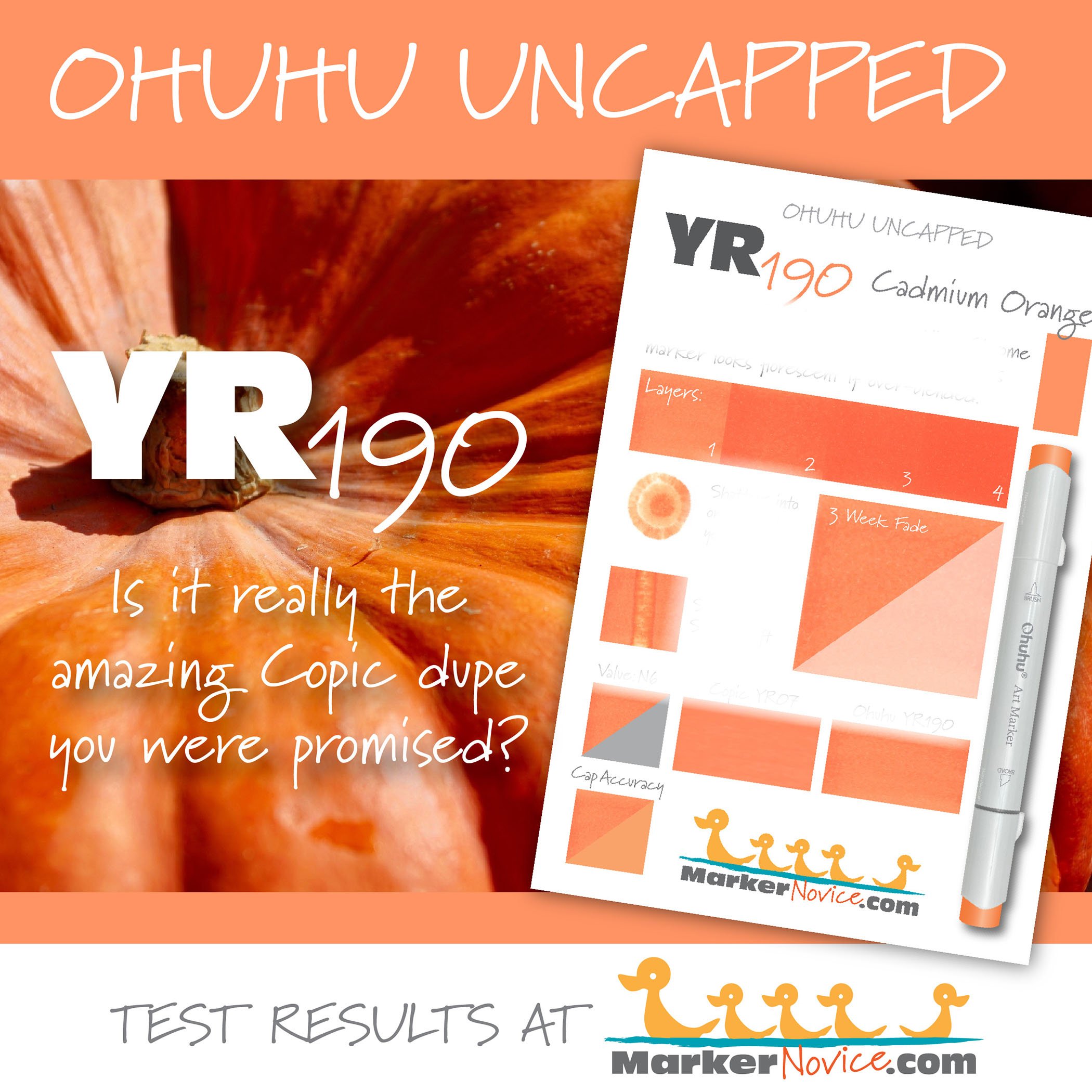
Lightfast: YR190 faded by about 60% during the test period. This is extreme fading but it’s not unique to Ohuhu. Copic YR07, a similar had a minimal fade rate of less than 10%.
Samples were swatched on X-Press It Blending Card. 1 layer of ink was exposed to windowsill sunlight for 21 days. Approximately 10 hours of sun per day based on weather conditions. Note: we do not recommend displaying original marker art under these conditions.
Ink Color Family: Ohuhu hides their orange markers in several color families including R reds, YR yellow-reds, and a few Y yellows.
The Ohuhu numbering system is complete garbage and doesn’t always make sense. In an artist grade marker system, a YR family would be ink blends while R and Y families would be single color formulas. Ohuhu breaks these rules because they don’t care about maintaining an accurate numbering system.
Cap Numbering: There are only about 18 YR markers with 1, 2, and 3 digit codes and are not organized by value. I suspect this confusing system is designed to make it difficult to track marker colors.
As stated above, the Ohuhu numbering system makes no sense. The markers are not arranged in chromatic order so you can not trust the numbers to tell you whether this marker is lighter or darker than other Ohuhu markers with similar numbers.
I’m still early in the Ohuhu testing process. I will add more info to this article as I learn more and when I spot behavioral patterns.
From what I’ve learned so far, I will not be working with Ohuhu markers and I will discourage students from using them in my classes. They’re simply not worth the frustration.
Learn about YR190, a medium orange Ohuhu Marker. We swatch and test Ohuhu colors- layering, staining, lift, value, lightfastness, saturation, and cap accuracy. | MarkerNovice.com | How to color with alcohol markers
E080 Praline: Testing Ohuhu Markers for Lightfastness and Quality
E080 Praline
Let’s take a closer look at this Ohuhu Marker and its ink characteristics.
You were told “Ohuhu is the Copic slayer! They’re like Copic Markers but better!”
Is it true?
Every Ohuhu Marker has different characteristics based upon its unique ink formula. No matter how great they say the marker is, test results do not lie.
So are Ohuhu markers as great as you’ve heard?
Let’s look at Ohuhu E080 to find out.
WARNING: Ohuhu markers have numbers on the cap but not on the body of the marker. We do not recommend coloring with both caps off due to the risk of accidentally placing the wrong caps on a marker.
Test results: Ohuhu E080 Praline
Note: The E080 marker which arrived in my new 320 set of Honolulu markers was underweight and pale. I had to borrow a second marker to perform these tests. Read more about the large number of dead, dying, and underweight markers I received in a full set of brand new markers here.
REFILL WARNING! At this time, Ohuhu does not sell refills for E080. To date, you must purchase a new marker when your current marker runs dry. See Ohuhu’s current list of refills here.
Temperature: A warm reddish brown
Resemblance: Burnt Sienna watercolor
Actual Value: N8
Unlike Copic, Ohuhu does not measure value— this is a glaring deficiency which makes finding blending combinations harder than it has to be!
All Copics are measured on a Neutral Gray value scale. The last number on the Copic cap indicates the value. We’re using the Copic scale to measure Ohuhu until Ohuhu releases a reliable value scale.
Cap Accuracy: The plastic on an Ohuhu Honolulu E080 marker is close to the color of one coat of this ink
Copic Substitution: Ohuhu E080 is a close match to Copic’s E09. Copic E09 has a noticeable pinkness where E080 is more brown but the difference is subtle. They are not the same ink, as demonstrated by the fact that Copic E09 did not fade at all during testing.
Note: similar colors rarely behave the same way. From experience I can tell you that E09 layers really well with no sign of oiliness while Ohuhu E080 looks wet and over-inked with the second layer. See Copic E09 test results here.
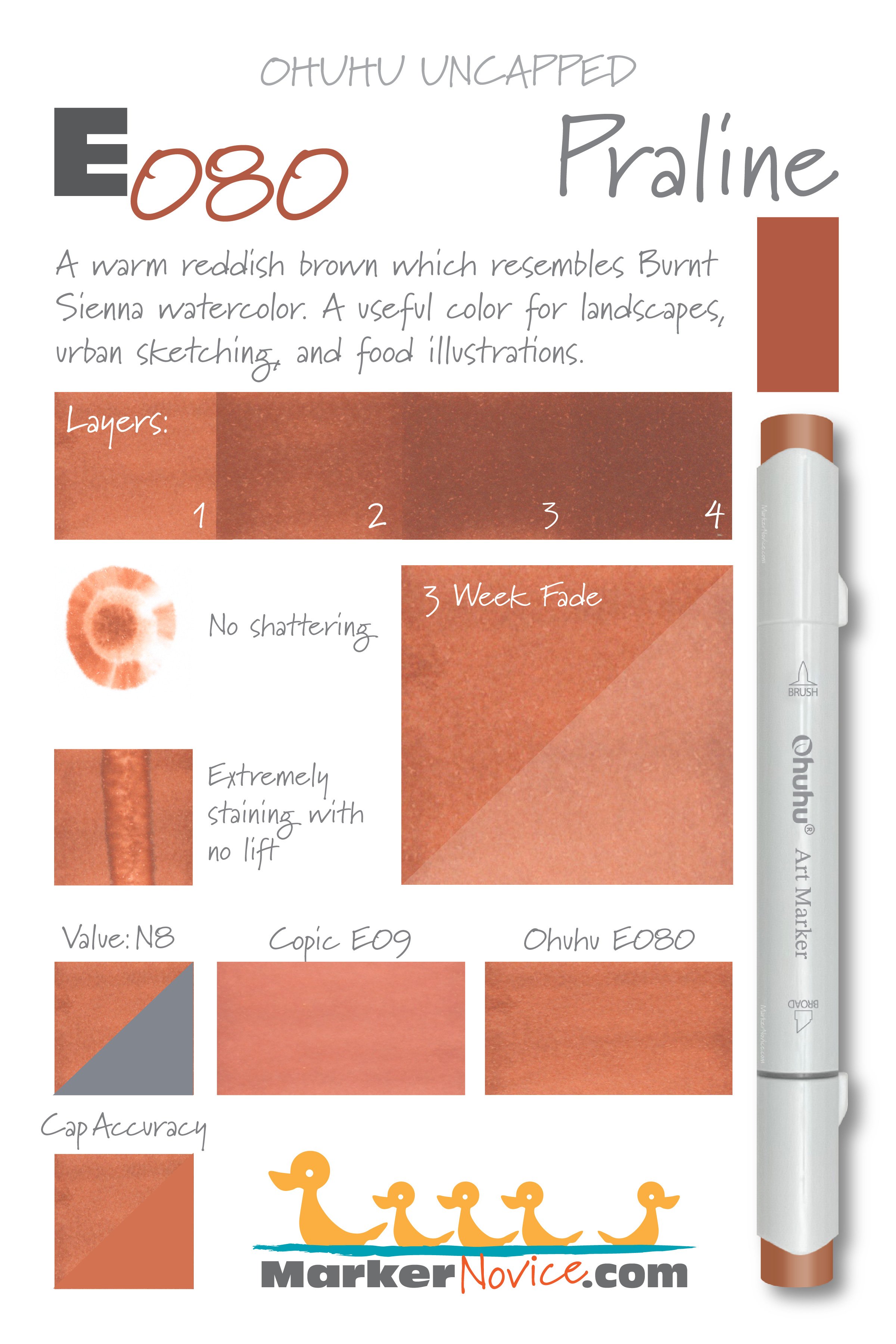
Buildup: E080 reaches a maximum value at about 2 coats.
Overinking: I do not recommend using more than 2 coats of E080. Most Ohuhu markers layer better than this color which quickly looks oily.
Shattering: E080 did not shatter meaning that it’s a single ink recipe.
Chromatography testing shows this ink’s behavior when it comes in contact with #0 Colorless Blender (solvent). High shattering colors may leak unexpected color when you make corrections or attempt to blend with any color that has a high solvent to colorant ratio. Shattering is not bad, it’s just something to be aware of.
Staining: E080 is an intensely staining color. Many dark markers and many brown markers are staining but I can tell from the staining test here that this marker will be a challenge to blend since the ink doesn’t want to budge from the paper.
With alcohol markers, a staining ink is generally a sign of a low quality ink. Staining inks bond to the paper fibers and are reluctant to release. Staining inks make blending harder than it has to be!
Lift: E080 barely lifted from the paper. I do not expect this marker will be easy to correct with colorless blender. My advice is to camouflage mistakes rather than trying to lift them with colorless blender.
See staining swatch. Sample was given 6 stripes of #0 Colorless Blender, drying between each stripe. Results indicate how much lifting you can expect.

Lightfast: E080 faded by about 20 during the test period. This is is about the average fade for Copic Markers too. Note that Copic E09, a similar color did not fade at all. If you have a mixed collection, I would recommend using E09 rather than E080.
Samples were swatched on X-Press It Blending Card. 1 layer of ink was exposed to windowsill sunlight for 21 days. Approximately 10 hours of sun per day based on weather conditions. Note: we do not recommend displaying original marker art under these conditions.
Ink Color Family: Ohuhu brown markers are spread through E, BR, Y, YR, and R families. There doesn’t seem to be any reason why this brown is an E and not any other letters and I don’t see a pattern or shared characteristics in the Es.
The Ohuhu numbering system is complete garbage and doesn’t make sense. This is one reason why I’m concerned about beginners learning to color with Ohuhu markers. Logical marker numbers make learning easier, Ohuhu seems determined to make learning harder.
Cap Numbering: E markers have 3 digit numbers staring with 0, 1, 2, 3, and 4. I don’t see relationships with everything starting with 2 etc.
As stated above, the Ohuhu numbering system makes no sense. The markers are not arranged in chromatic order so you can not trust the numbers to tell you whether this marker is lighter or darker than other Ohuhu markers with similar numbers.
I’m still early in the Ohuhu testing process. I will add more info to this article as I learn more and when I spot behavioral patterns.
From what I’ve learned so far, I will not be working with Ohuhu markers and I will discourage students from using them in my classes. They’re simply not worth the frustration.
Learn about E080 Praline, a red brown Ohuhu Marker. We swatch and test Ohuhu colors- layering, staining, lift, value, lightfastness, saturation, and cap accuracy. | MarkerNovice.com | How to color with alcohol markers
Y030 Lemon Chiffon: Testing Ohuhu Markers for Lightfastness and Quality
Y030 Lemon Chiffon
Let’s take a closer look at this Ohuhu Marker and its ink characteristics.
You were told “Ohuhu is the Copic slayer! They’re like Copic Markers but better!”
Is it true?
Every Ohuhu Marker has different characteristics based upon its unique ink formula. No matter how great they say the marker is, test results do not lie.
So are Ohuhu markers as great as you’ve heard?
Let’s look at Ohuhu Y030 to find out.
WARNING: Ohuhu markers have numbers on the cap but not on the body of the marker. We do not recommend coloring with both caps off due to the risk of accidentally placing the wrong caps on a marker.
Test results: Ohuhu Y030 Lemon Chiffon
Note: The Y030 marker which arrived in my new 320 set of Honolulu markers was dried-out and dead. I had to purchase a second marker to perform these tests. Read more about the large number of dead, dying, and underweight markers I received in a full set of brand new markers here.
REFILL WARNING! At this time, Ohuhu does not sell refills for Y030. To date, you must purchase a new marker when your current marker runs dry. See Ohuhu’s current list of refills here.
Temperature: A slightly greenish pale yellow
Resemblance: highly diluted Hansa Yellow watercolor
Actual Value: N1.5
Unlike Copic, Ohuhu does not measure value— this is a glaring deficiency which makes finding blending combinations harder than it has to be!
All Copics are measured on a Neutral Gray value scale. The last number on the Copic cap indicates the value. We’re using the Copic scale to measure Ohuhu until Ohuhu releases a reliable value scale.
Cap Accuracy: The plastic on an Ohuhu Honolulu Y030 marker is close to the color of one coat of this ink
Copic Substitution: Ohuhu Y030 is a match to Copic’s Y11. I don’t think they’re the same ink due to the difference in test results but the color appearance is strikingly close.
Note: similar colors rarely behave the same way. From experience I can tell you that Copic Y11 is an easy blending marker. I recommend it for beginners, it’s on my Starter Marker List, and I teach with it frequently— all because it’s a very friendly blender for beginners. Ohuhu Y030 is a staining color which is unusual in markers this light. Keep this in mind for ALL art supplies, it’s not enough to match the color, two similar inks, pencils, or paints can behave radically different in usage. See Copic Y11 test results here.
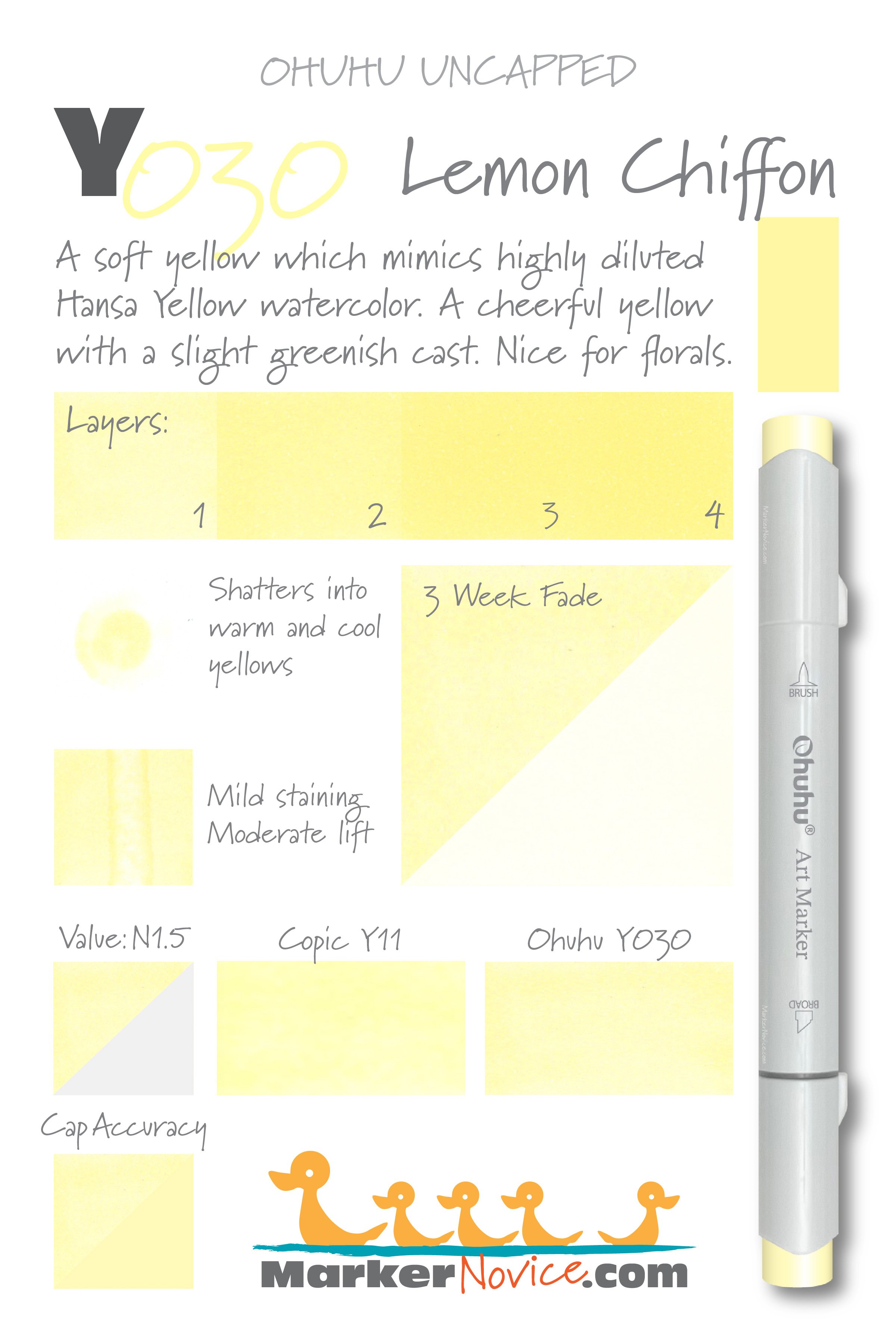
Buildup: Y030 reaches a maximum value at about 3 coats.
Overinking: I do not recommend using more than 3 coats of Y030. As with most Ohuhu markers, four layers looks exactly like three so why waste the ink.
Shattering: Y030 shatters into two inks… I think. This is such a light color that it’s hard to tell but the center dot in the shattering test looks stained with a more golden color than the pale ink leakage around the outer wet-zone. I didn’t expect this color to shatter at all, so the fact I’m seeing two yellows is interesting.
Chromatography testing shows this ink’s behavior when it comes in contact with #0 Colorless Blender (solvent). High shattering colors may leak unexpected color when you make corrections or attempt to blend with any color that has a high solvent to colorant ratio. Shattering is not bad, it’s just something to be aware of.
Staining: Y030 is a mildly staining color. Not only is this unusual for a pale color, it’s also unusual for yellow. As you can see in the staining test, the center stripe doesn’t return back to white paper and retains blobs of yellow where the solvent was heaviest. It’s a light color but it behaves like something darker.
With alcohol markers, a staining ink is generally a sign of a low quality ink. Staining inks bond to the paper fibers and are reluctant to release. Staining inks make blending harder than it has to be!
Lift: Y030 lifted enough from the paper that I think this ink is correctable when you accidentally color outside the lines. Just take note of the dark stripes of yellow to either side of my staining test. That’s where the colorless blender pushed the ink particles into a pile. You don’t want this to happen when you’re making a correction, so work slowly using light amounts of colorless blender over several passes. You can do it, just be patient.
See staining swatch. Sample was given 6 stripes of #0 Colorless Blender, drying between each stripe. Results indicate how much lifting you can expect.
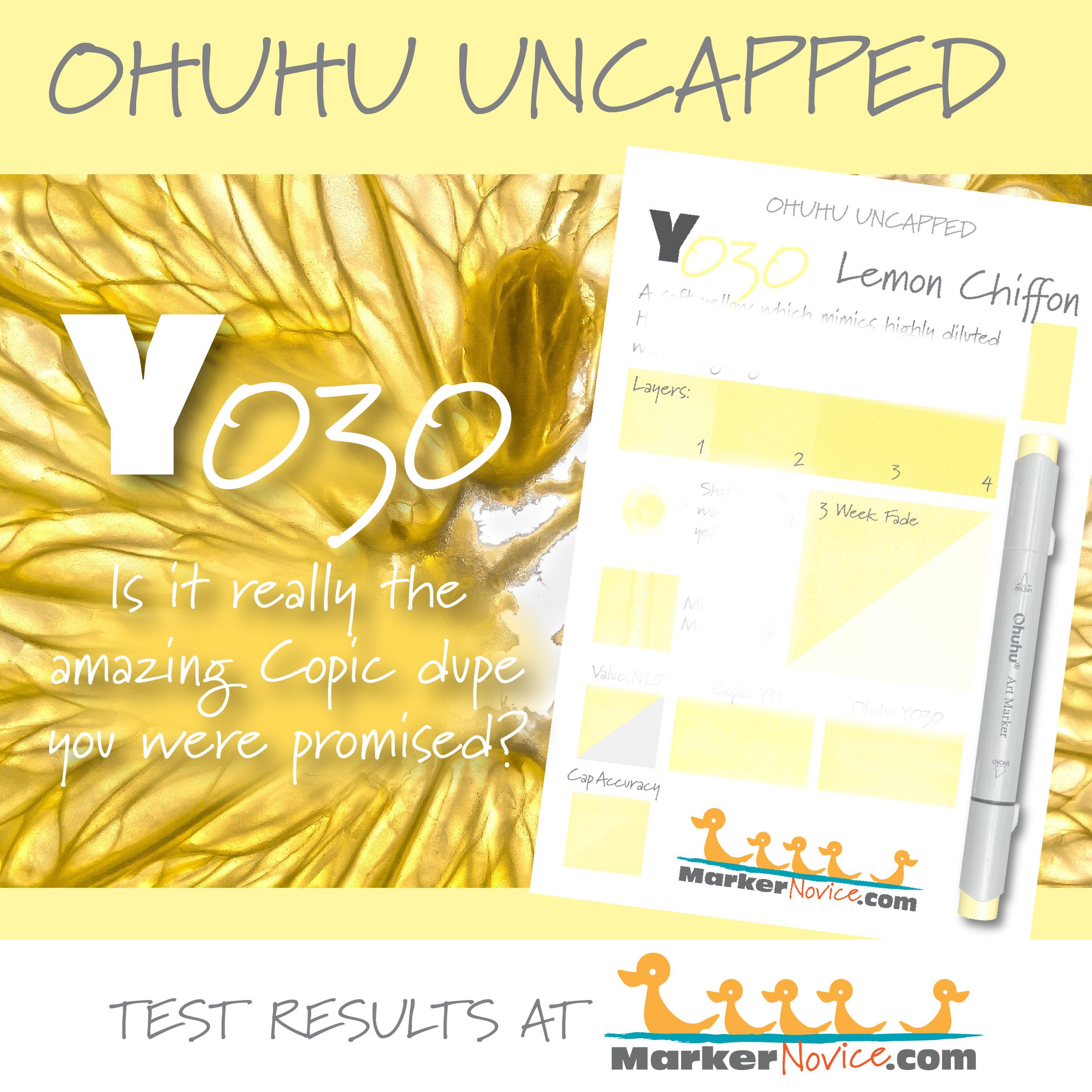
Lightfast: Y030 faded by about 80% during the test period. This is extreme fading but it’s not unique to Ohuhu. Copic Y11 had a similar fade rate.
Samples were swatched on X-Press It Blending Card. 1 layer of ink was exposed to windowsill sunlight for 21 days. Approximately 10 hours of sun per day based on weather conditions. Note: we do not recommend displaying original marker art under these conditions.
Ink Color Family: Ohuhu has a small but interesting family of yellow markers. They offer more yellows than Copic and more desaturated yellows than Copic. I’m happy to see a marker company give us something more than 10 yellow highlighters.
The Ohuhu numbering system is complete garbage and doesn’t always make sense. While some may quibble with the inclusion of brownish or greenish colors in the Y family, I’m actually okay with it. Most yellow inks are pretty brown or green in their concentrated form. What I can’t excuse is Y5, a scarlet red marker which matches R17 and Y12 which is similar to E27!
Cap Numbering: Y markers are all over the place. Some have 1 or 2 digits (but are not releated at all), some follow the 0X0 pattern, some are 100s and some are 200s. There’s no rhyme or reason to it— I think the system is either complete carelessness or it’s designed to make it difficult to track marker colors.
As stated above, the Ohuhu numbering system makes no sense. The markers are not arranged in chromatic order so you can not trust the numbers to tell you whether this marker is lighter or darker than other Ohuhu markers with similar numbers.
I’m still early in the Ohuhu testing process. I will add more info to this article as I learn more and when I spot behavioral patterns.
From what I’ve learned so far, I will not be working with Ohuhu markers and I will discourage students from using them in my classes. They’re simply not worth the frustration.

Learn about Y030, a pale yellow Ohuhu Marker. We swatch and test Ohuhu colors- layering, staining, lift, value, lightfastness, saturation, and cap accuracy. | MarkerNovice.com | How to color with alcohol markers