Copic G19 Bright Parrot Green: Swatch, Blend, Value, and Lightfast testing
G19 Bright Parrot Green
Let’s take a closer look at this Copic Marker and its ink characteristics.

Every Copic Marker has different characteristics based upon its unique ink formula.
Knowing how a color behaves will help you blend effectively and make art with confidence.
G19 Bright Parrot Green
Let’s take a closer look at this Copic Marker and its ink characteristics.
Temperature: A warm medium-dark green
Resemblance: Phthalo Green
Name: “Parrot Green” is a standard paint name but the name usually refers to a lighter color with stronger yellow tones. Copic often misses the mark on their color names which I blame on the language barrier from Japanese to English. In my opinion, this name is inaccurate and misleading.
Copic Styles: G19 is only available in Sketch and Classic style Copic markers.
Actual Value: N7 (this is significantly lighter than the number code indicates)
All Copics are measured on a Neutral Gray value scale. The last number on the cap is supposed to indicate value but we’ve found discrepancies where the actual ink value is different than cap designation.
Cap Accuracy: The colored plastic on the Sketch cap is darker than 4 layers of G19 ink. This combined with the inaccurate cap number is startling when you first use G19 as the color is lighter than expected.

Buildup: G19 reaches maximum color value at 3-4 layers. This color also looks blotchy at one layer but at two layers looks noticeably oily. There really isn’t a sweet spot between blotches and oil which makes this a hard color to work with and thus, I do not recommend G19 for beginners.
Shattering: Shatters into green with strong yellow color seeping out at the margins.
Chromatography testing shows this ink’s behavior when it comes in contact with #0 Colorless Blender (solvent). High shattering colors may leak unexpected color when you make corrections or attempt to blend with any color that has a high solvent to colorant ratio. Shattering is not bad, it’s just something to be aware of.
Staining: G19 stains the paper blue.
Lift: G19 can be lightened a bit but the paper will be permanently stained. The best you can hope for is to lighten mistakes enough to then camouflage them with another color.
See staining swatch. Sample was given 6 stripes of #0 Colorless Blender, drying between each stripe. Results indicate how much lifting you can expect.

Lightfast: G19, like several other G markers has an extremely odd fade. The color did not lighten but the swatch turned noticeably bluish. This is a blended ink (see shattering sample) and the yellow ink component faded entirely while the blue ink remained lightfast.
Samples were swatched on X-Press It Blending Card. 1 layer of ink was exposed to windowsill sunlight for 21 days. Approximately 10 hours of sun per day based on weather conditions. Note: we do not recommend displaying original Copic art under these conditions.
Natural Ink Family: G19 is the darkest marker in the G-Teen family. I stronly suspect G12 and G14 were shifted into this group and they’re not chemically related to G16, G17, or G19.
Family Members: G12, G14, G16, G17, G19
We include this information because many Copic users never think deeper than the letter groupings (R, BV, G, etc.). Every ink has its own temperature variations and underlying flavors. Understanding what an ink looks like in its different dilutions helps when creating your own blending combinations.
Complement: A medium deep red violet like RV66
Underpaint: We suggest BV23
This is simply one suggestion. Many possible colors exist. Test to find a color that pleases you.
Pushing Pencil: Prismacolor 931 Dark Purple is an excellent choice
VanillaArts.com (our sister site) teaches a Push & Pull technique for dimensional coloring. This is simply one suggestion. Many possible colors exist. Test to find a color that pleases you.
GREEN WORKSHOP

GREEN COLORING KIT

COPIC TEST ARCHIVE

MAKE GREEN BEAUTIFUL

UNDERPAINT BLENDING COMBINATIONS

Looking for beautiful color palettes?
We absolutely love The Color Catalog 1 & 2 from Sarah Renae Clark. It puts hundreds of Copic friendly color palettes at your fingertips.
(note: affiliate link)





G09 Veronese Green: Copics Uncapped (Alcohol Marker Swatch, Ink Testing)
G09 Veronese Green
Let’s take a closer look at this Copic Marker and its ink characteristics.
Every Copic Marker has different characteristics based upon its unique ink formula.
Knowing how a color behaves will help you blend effectively and make art with confidence.
G09 Veronese Green
Let’s take a closer look at this Copic Marker and its ink characteristics.
Temperature: A warm medium green
Resemblance: Phthalo Green
Name: “Veronese Green” is a standard paint name. I tend to think of Veronese as bluer than this green but it’s close enough.
Copic Styles: G09 is only available in Sketch and Classic style Copic markers.
Actual Value: N6 (this is significantly lighter than the number code indicates)
All Copics are measured on a Neutral Gray value scale. The last number on the cap is supposed to indicate value but we’ve found discrepancies where the actual ink value is different than cap designation.
Cap Accuracy: The colored plastic on the Sketch cap is darker than 4 layers of G09 ink. This combined with the inaccurate cap number is startling when you first use G09 as the color is lighter than expected.

Buildup: G09 reaches maximum color value at 4 layers.
Shattering: Shatters into green with yellow and a minty blue-green color seeping out at the margins.
Chromatography testing shows this ink’s behavior when it comes in contact with #0 Colorless Blender (solvent). High shattering colors may leak unexpected color when you make corrections or attempt to blend with any color that has a high solvent to colorant ratio. Shattering is not bad, it’s just something to be aware of.
Staining: G09 stains the paper green. Despite being a staining color, G09 actually blends fairly well with other G-Zero markers.
Lift: G09 can be lifted a bit but the paper will be permanently stained green. The best you can hope for is to lighten mistakes enough to then camouflage them with another color.
See staining swatch. Sample was given 6 stripes of #0 Colorless Blender, drying between each stripe. Results indicate how much lifting you can expect.

Lightfast: G09 has an odd fade. The color only lightened about 15% but the swatch turned noticeably bluish. Further proof that G09 is a composite ink recipe— the yellowish green ink faded, leaving behind only the bluer green ink.
Samples were swatched on X-Press It Blending Card. 1 layer of ink was exposed to windowsill sunlight for 21 days. Approximately 10 hours of sun per day based on weather conditions. Note: we do not recommend displaying original Copic art under these conditions.
Natural Ink Family: G09 is at the dark of the G-Zero
Family Members: G0000, G000, G00, G02, G03, G05, G07, G09
We include this information because many Copic users never think deeper than the letter groupings (R, BV, G, etc.). Every ink has its own temperature variations and underlying flavors. Understanding what an ink looks like in its different dilutions helps when creating your own blending combinations.
Complement: A cool, medium violet like V25
Underpaint: We suggest BV23
This is simply one suggestion. Many possible colors exist. Test to find a color that pleases you.
Pushing Pencil: Prismacolor PC932 Violet is an excellent choice
VanillaArts.com (our sister site) teaches a Push & Pull technique for dimensional coloring. This is simply one suggestion. Many possible colors exist. Test to find a color that pleases you.
GREEN WORKSHOP
GREEN COLORING KIT
COPIC TEST ARCHIVE

MAKE GREEN BEAUTIFUL
UNDERPAINT BLENDING COMBINATIONS
Looking for beautiful color palettes?
We absolutely love The Color Catalog 1 & 2 from Sarah Renae Clark. It puts hundreds of Copic friendly color palettes at your fingertips.
(note: affiliate link)

G85 Verdigris: Copics Uncapped (Marker Swatch, Ink Testing)
G85 Verdigris
Let’s take a closer look at this Copic Marker and it’s ink characteristics.

G85 is a slightly warm green Copic Marker which resembles Chromium Oxide Green watercolor. This is a natural green for landscapes and floral images. G85 is available in Copic Ciao, Sketch, and Classic marker styles.
Every Copic Marker has unique characteristics based on its unique ink formula.
Knowing how a color behaves will help you blend effectively and make art with confidence.
G85 Verdigris
Let’s take a closer look at this Copic Marker and its ink characteristics.
Temperature: A slightly warm, slightly grayed green.
Resemblance: Chromium Oxide Green watercolor.
Actual Value: N5
All Copics are measured on a Neutral Gray value scale. The last number on the cap is supposed to indicate value but we’ve found discrepancies where the actual ink value is different than cap designation.
Cap Accuracy: Holy cow, no, no NO! The colored plastic on the Sketch cap incredibly dark and very bluish green. To say this cap is inaccurate would grossly understate the reality of this error. This is the most-wrong cap in the whole entire Copic collection. Wow. Just wow.
Buildup: G28 doesn’t get oily the way some colors do— it’s really only at four layers that we start to see the blotchy look.
Layering: G85 is slow to get to maximum value. Note how similar the color is from the second layer onward. It’s odd that you can’t build more color from this marker.
Shattering: Shatters into a warmer green with faint gray leakage.
Chromatography testing shows this ink’s behavior when it comes in contact with #0 Colorless Blender (solvent). High shattering colors may leak unexpected color when you make corrections or attempt to blend with any color that has a high solvent to colorant ratio. Shattering is not bad, it’s just something to be aware of.
Staining: G85 is mildly staining color and left the paper with a moderate green tint.

Lift: This color isn’t dark enough to be truly stubborn. You can get some lift but not as much as we expected.
See staining swatch. Sample was given 6 stripes of #0 Colorless Blender, drying between each stripe. Results indicate how much lifting you can expect.
Lightfast: G85 is not a durable color. The swatch faded very early in testing and by the end had turned extremely yellowish.
Samples were swatched on X-Press It Blending Card. 1 layer of ink was exposed to windowsill sunlight for 21 days. Approximately 10 hours of sun per day based on weather conditions. Note: we do not recommend displaying original Copic art under these conditions.
Natural Ink Family: G85 sits at the dark end of the G-Eighty family. There are only two markers in this family and because it’s such an organic green, we wish there were more available. We’re wishing for a G87 and G89 someday.
Family Members: G85, G82
We include this information because many Copic users never think deeper than the letter groupings (R, BV, G, etc.). Every ink has its own temperature variations and underlying flavors. Understanding what an ink looks like in its different dilutions helps when creating your own blending combinations.
Complement: A cool temperature pink like RV63
Underpaint: We suggest BV13
This is simply one suggestion. Many possible colors exist. Test to find a color that pleases you.
Pushing Pencil: Prismacolor 931 Dark Purple works very well.
VanillaArts.com (our sister site) teaches a Push & Pull technique for dimensional coloring. This is simply one suggestion. Many possible colors exist. Test to find a color that pleases you.
Vanilla Arts Classes using G85:
Vanilla Arts Digi Stamps using G85:
We continue to create new content and stamps and we will update here as more become available.
Visit the stamp shop page at our sister site VanillaArts.com for a wide variety of digi stamps.
Color palettes and swatches using G85:
We are building our palette and swatch collection a little more each week and will update here as more become available.
Visit the color resource page at our sister site VanillaArts.com for a wide variety of Copic palettes and swatches.
Looking for beautiful color palettes?
We absolutely love The Color Catalog 1 & 2 from Sarah Renae Clark. It puts hundreds of Copic friendly color palettes at your fingertips.
(note: affiliate link)


G29 Pine Tree Green: Copics Uncapped (Marker Swatch, Ink Testing)
G29 Pine Tree Green
Let’s take a closer look at this Copic Marker and it’s ink characteristics.

G29 Pine Tree Green is an organic, balanced green Copic Marker which closely resembles Hooker’s Green watercolor. This is a lovely green for trees, leaves, landscapes, and holiday images. G29 is available in Copic Ciao, Sketch, and Classic marker styles.
Every Copic Marker has unique characteristics based on its unique ink formula.
Knowing how a color behaves will help you blend effectively and make art with confidence.
G29 Pine Tree Green
Let’s take a closer look at this Copic Marker and its ink characteristics.
Temperature: A slightly blueish but otherwise balanced green.
Resemblance: Hooker’s Green watercolor.
Actual Value: N8
All Copics are measured on a Neutral Gray value scale. The last number on the cap is supposed to indicate value but we’ve found discrepancies where the actual ink value is different than cap designation.
Cap Accuracy: No. The colored plastic on the Sketch cap is closer to four coats of G29 and the plastic is more vibrant and saturated than G29 ink.
Buildup: Exercise caution! G29 looks patchy and oily with just one coat. It reaches maximum value at 5 layers.
Shattering: Shatters into green with strong golden yellow ink at the margins.
Chromatography testing shows this ink’s behavior when it comes in contact with #0 Colorless Blender (solvent). High shattering colors may leak unexpected color when you make corrections or attempt to blend with any color that has a high solvent to colorant ratio. Shattering is not bad, it’s just something to be aware of.

Staining: G29 is a staining color and left the paper with a definite blue tint.
Lift: This color is stubborn and does not lift well.
See staining swatch. Sample was given 6 stripes of #0 Colorless Blender, drying between each stripe. Results indicate how much lifting you can expect.
Lightfast: G29 was surprisingly lightfast. We saw just a faint amount of fading during the 3 week test.
Samples were swatched on X-Press It Blending Card. 1 layer of ink was exposed to windowsill sunlight for 21 days. Approximately 10 hours of sun per day based on weather conditions. Note: we do not recommend displaying original Copic art under these conditions.
Natural Ink Family: G29 sits at the dark end of the G-Twenty family. The markers in this family are all quite pretty but each one has odd characteristics and idiosyncrasies.
Family Members: G29, G28, G24, G21, G20
We include this information because many Copic users never think deeper than the letter groupings (R, BV, G, etc.). Every ink has its own temperature variations and underlying flavors. Understanding what an ink looks like in its different dilutions helps when creating your own blending combinations.
Complement: Magenta pinks like RV17
Underpaint: We suggest V06
This is simply one suggestion. Many possible colors exist. Test to find a color that pleases you.
Pushing Pencil: Prismacolor 931 Dark Purple works very well.
VanillaArts.com (our sister site) teaches a Push & Pull technique for dimensional coloring. This is simply one suggestion. Many possible colors exist. Test to find a color that pleases you.
Vanilla Arts Classes using G29:

Gray Matter: Amy explores underpainting, a technique that increases the realism in colored images. Find more info here.
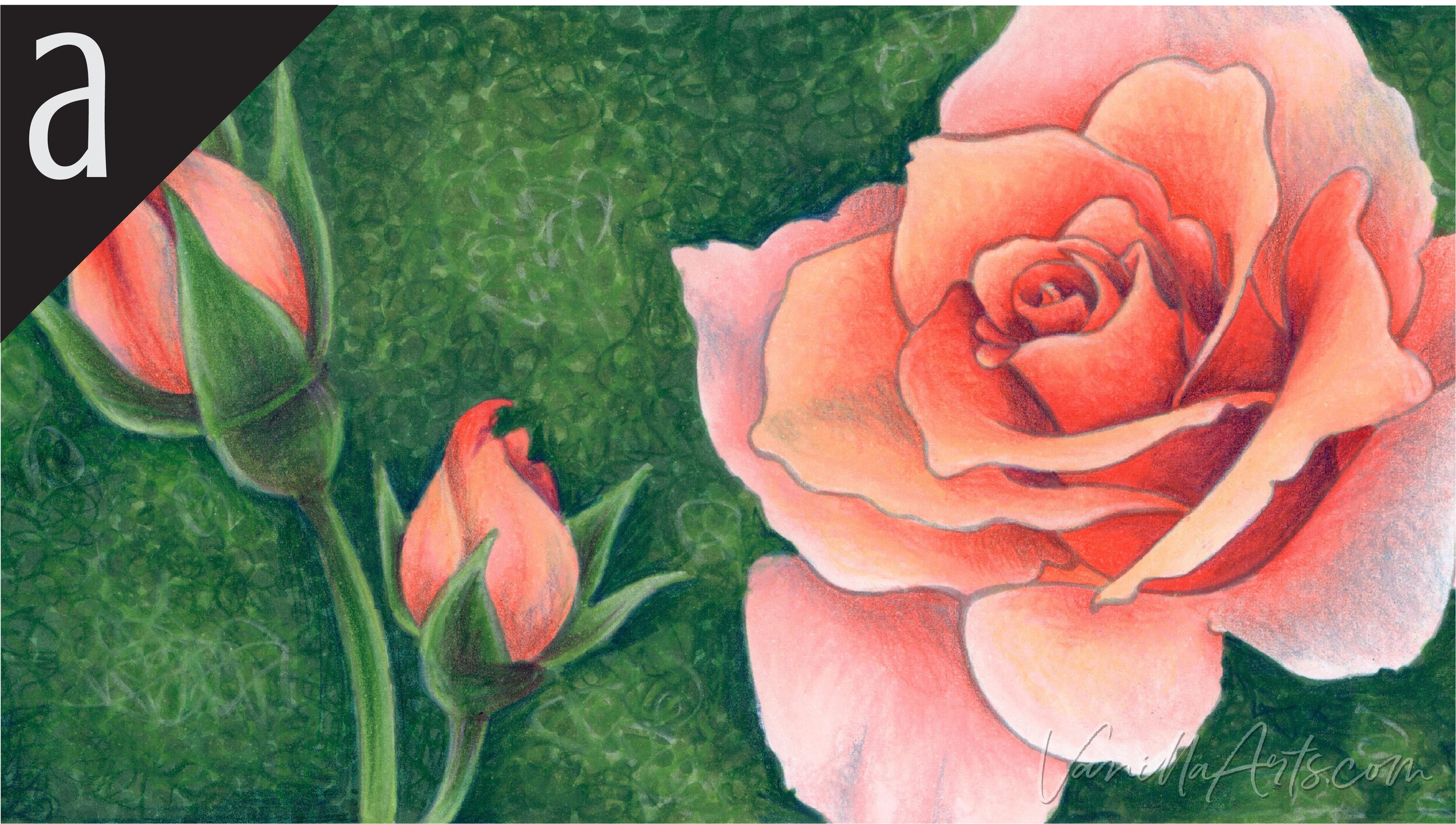
Peach Rose: A lesson on drawing greater inspiration from photo references. Learn how to better see what's in the photograph and to translate that into marker and pencil coloring. Find more info here.

Ink & Hydrangea: Amy shows you the theory behind color shifting for depth and the use of temperature to indicate distance. Find more info here.
Vanilla Arts Digi Stamps using G29:
We continue to create new content and stamps and we will update here as more become available.
Visit the stamp shop page at our sister site VanillaArts.com for a wide variety of digi stamps.
Color palettes and swatches using G29:

Looking for beautiful color palettes?
We absolutely love The Color Catalog 1 & 2 from Sarah Renae Clark. It puts hundreds of Copic friendly color palettes at your fingertips.
(note: affiliate link)


G14 Apple Green: Copics Uncapped (Marker Swatch, Ink Testing)
G14 Apple Green
Let’s take a closer look at this Copic Marker and it’s ink characteristics.

G14 Apple Green is a warmish green Copic Marker which mimics Phthalo Green Yellow-Shade watercolor. A happy green, ideal for cards and playful cartoon images, not a natural green. G14 is available in Copic Sketch, Ciao, and Classic marker styles.
Every Copic Marker has unique characteristics based on its unique ink formula.
Knowing how a color behaves will help you blend effectively and make art with confidence.
G14 Apple Green
Let’s take a closer look at this Copic Marker and its ink characteristics.
Temperature: A warmish green
Resemblance: Phthalo Green Yellow-Shade watercolor.
Actual Value: N4
All Copics are measured on a Neutral Gray value scale. The last number on the cap is supposed to indicate value but we’ve found discrepancies where the actual ink value is different than cap designation.
Cap Accuracy: Yes. The colored plastic on the Sketch cap matches 1 layer of G14 ink.
Buildup: Layers well but looks oily at 2 coats. The oily sheen looks smoother by 4 layers. Reaches maximum color by 3-4 coats.
Shattering: Easily shatters into green with bright yellow leakage.
Chromatography testing shows this ink’s behavior when it comes in contact with #0 Colorless Blender (solvent). High shattering colors may leak unexpected color when you make corrections or attempt to blend with any color that has a high solvent to colorant ratio. Shattering is not bad, it’s just something to be aware of.

Staining: G14 mildly stains the paper.
Lift: G14 is a stubborn lifter, we barely budged the sample in testing.
See staining swatch. Sample was given 6 stripes of #0 Colorless Blender, drying between each stripe. Results indicate how much lifting you can expect.
Lightfast: G14 had an odd fade during testing. The color didn’t change value, it weirdly turned bluish. We think the yellow ink component in the G14 mixture faded while the blue dye remained strong.
Samples were swatched on X-Press It Blending Card. 1 layer of ink was exposed to windowsill sunlight for 21 days. Approximately 10 hours of sun per day based on weather conditions. Note: we do not recommend displaying original Copic art under these conditions.
Natural Ink Family: G14 sits at the light end of the G-Teen family. The markers in this family all look to be related to Viridian
Family Members: G12, G14, G16, G17, G19
We include this information because many Copic users never think deeper than the letter groupings (R, BV, G, etc.). Every ink has its own temperature variations and underlying flavors. Understanding what an ink looks like in its different dilutions helps when creating your own blending combinations.
Complement: A red-violet like RV04
Underpaint: We suggest C3
This is simply one suggestion. Many possible colors exist. Test to find a color that pleases you.
Pushing Pencil: Prismacolor 1008 Parma Violet with very light pressure works well.
VanillaArts.com (our sister site) teaches a Push & Pull technique for dimensional coloring. This is simply one suggestion. Many possible colors exist. Test to find a color that pleases you.
Vanilla Arts Technique Classes using G14:
Box of Colors (Marker Painting Foundations 2) is a four episode Copic + Colored Pencil challenge for graduates of MPF. Covers color theory and form sculpting with group feedback. For more information: Box of Colors.
Vanilla Arts Digi Stamps using G14:
We continue to create new content and stamps and we will update here as more become available.
Visit the Stamp Shop resource page at our sister site VanillaArts.com for a wide variety of Vanilla Arts stamps.
Color palettes and swatches using G14:
We are building our palette and swatch collection a little more each week and will update here as more become available.
Visit the color resource page at our sister site VanillaArts.com for a wide variety of Copic palettes and swatches.
Looking for beautiful color palettes?
We absolutely love The Color Catalog 1 & 2 from Sarah Renae Clark. It puts hundreds of Copic friendly color palettes at your fingertips.
(note: affiliate link)


G12 Sea Green: Copics Uncapped (Marker Swatch, Ink Testing)
G12 Sea Green
Let’s take a closer look at this Copic Marker and it’s ink characteristics.

G12 Sea Green is a cool green Copic Marker which resembles highly diluted Phthalo Green Blue-Shade watercolor. A highly unstable ink mixture, G12 can damage itself during layering. G12 is only available in Copic Sketch and Classic marker styles.
Every Copic Marker has unique characteristics based on its unique ink formula.
Knowing how a color behaves will help you blend effectively and make art with confidence.
G12 Sea Green
Let’s take a closer look at this Copic Marker and its ink characteristics.
Temperature: A cool green
Resemblance: highly diluted Phthalo Green Blue-Shade watercolor.
Actual Value: N2
All Copics are measured on a Neutral Gray value scale. The last number on the cap is supposed to indicate value but we’ve found discrepancies where the actual ink value is different than cap designation.
Cap Accuracy: Yes. The colored plastic on the Sketch cap matches 1 layer of G12 ink.
Buildup: Layers well but looks oily at 2 coats. The oily sheen looks smoother by 4 layers.
Shattering: Shatters into green with gray and yellow leakage.
Chromatography testing shows this ink’s behavior when it comes in contact with #0 Colorless Blender (solvent). High shattering colors may leak unexpected color when you make corrections or attempt to blend with any color that has a high solvent to colorant ratio. Shattering is not bad, it’s just something to be aware of.
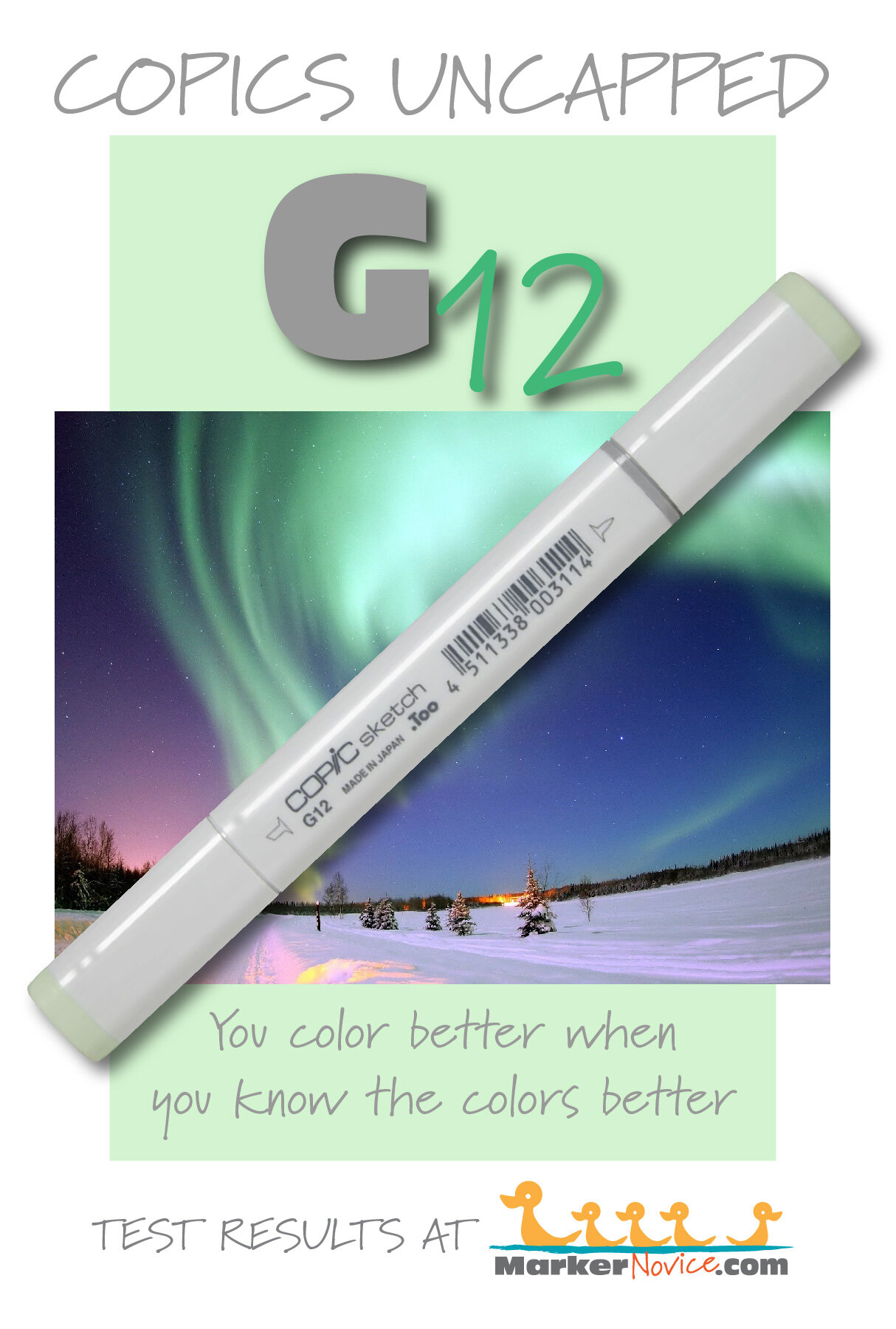
Staining: G12 mildly stains the paper.
Lift: G12 lifts moderately well, leaving behind slightly blue paper.
See staining swatch. Sample was given 6 stripes of #0 Colorless Blender, drying between each stripe. Results indicate how much lifting you can expect.
Lightfast: G12 faded slightly during testing, about 5%. We would expect this to continue under extended testing.
Samples were swatched on X-Press It Blending Card. 1 layer of ink was exposed to windowsill sunlight for 21 days. Approximately 10 hours of sun per day based on weather conditions. Note: we do not recommend displaying original Copic art under these conditions.
Natural Ink Family: G12 sits at the light end of the G-Teen family. The markers in this family all look to be related to Viridian
Family Members: G12, G14, G16, G17, G19
We include this information because many Copic users never think deeper than the letter groupings (R, BV, G, etc.). Every ink has its own temperature variations and underlying flavors. Understanding what an ink looks like in its different dilutions helps when creating your own blending combinations.
Complement: A pale red-violet like RV11
Underpaint: We suggest BV0000
This is simply one suggestion. Many possible colors exist. Test to find a color that pleases you.
Pushing Pencil: Prismacolor 1026 Greyed Lavender with very light pressure works well.
VanillaArts.com (our sister site) teaches a Push & Pull technique for dimensional coloring. This is simply one suggestion. Many possible colors exist. Test to find a color that pleases you.
Vanilla Arts Technique Classes using G12:
We continue to create new content and classes and we will update here as more become available.
Visit the workshop resource page at our sister site VanillaArts.com for a wide variety of Copic & colored pencil classes.
Vanilla Arts Digi Stamps using G12:
We continue to create new content and stamps and we will update here as more become available.
Visit the Stamp Shop resource page at our sister site VanillaArts.com for a wide variety of Vanilla Arts stamps.
Color palettes and swatches using G12:
We are building our palette and swatch collection a little more each week and will update here as more become available.
Visit the color resource page at our sister site VanillaArts.com for a wide variety of Copic palettes and swatches.
Looking for beautiful color palettes?
We absolutely love The Color Catalog 1 & 2 from Sarah Renae Clark. It puts hundreds of Copic friendly color palettes at your fingertips.
(note: affiliate link)


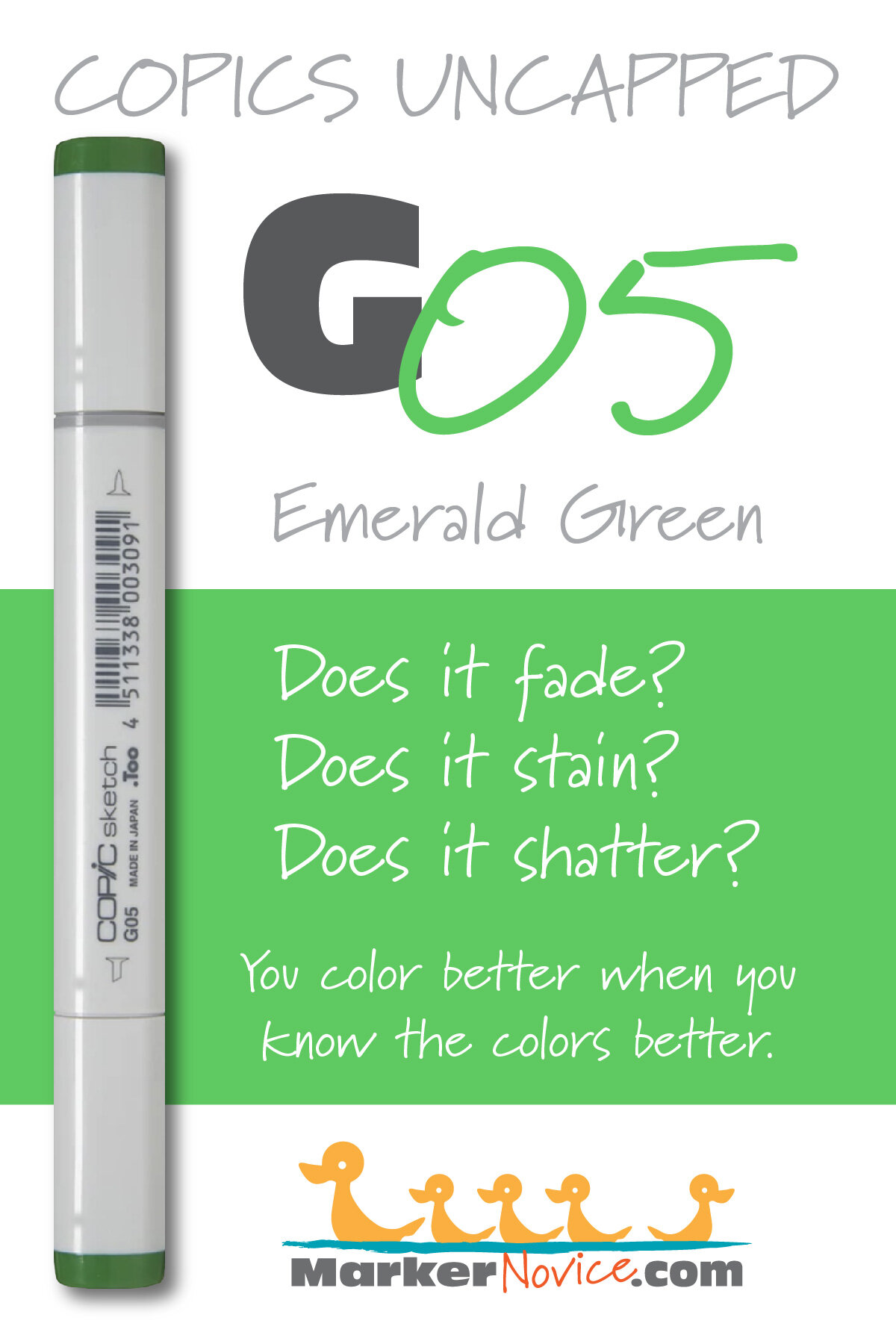
G05 Emerald Green: Copics Uncapped (Marker Swatch, Ink Testing)
G05 Emerald Green
Let’s take a closer look at this Copic Marker and it’s ink characteristics.

G05 Emerald Green is a warm green Copic Marker which resembles diluted Phthalo Green watercolor. This is a stereotypical green which is harder to find in nature than you’d expect. G05 is available in Copic Ciao, Sketch, and Classic marker styles.
Every Copic Marker has unique characteristics based on its unique ink formula.
Knowing how a color behaves will help you blend effectively and make art with confidence.
G05 Emerald Green
Let’s take a closer look at this Copic Marker and its ink characteristics.
Temperature: A slightly warm green
Resemblance: Phthalo Green watercolor.
Actual Value: N5
All Copics are measured on a Neutral Gray value scale. The last number on the cap is supposed to indicate value but we’ve found discrepancies where the actual ink value is different than cap designation.
Cap Accuracy: No. The colored plastic on the Sketch cap is closer to 5 layers of G05 ink. The cap is darker than the ink.
Buildup: Layers well but looks oily at 2 coats. The oily sheen looks smoother by 4 layers.
Shattering: Shatters into green with bright yellow leakage.
Chromatography testing shows this ink’s behavior when it comes in contact with #0 Colorless Blender (solvent). High shattering colors may leak unexpected color when you make corrections or attempt to blend with any color that has a high solvent to colorant ratio. Shattering is not bad, it’s just something to be aware of.

Staining: G05 mildly stains the paper.
Lift: G05 lifts moderately well, leaving behind slightly blue paper.
See staining swatch. Sample was given 6 stripes of #0 Colorless Blender, drying between each stripe. Results indicate how much lifting you can expect.
Lightfast: G05 has an odd fade. After the 3 week test, our sample didn’t appear to have lightened but was noticeably blue. This means the yellow ink in this green mixture faded but the blue ink was more lightfast.
Samples were swatched on X-Press It Blending Card. 1 layer of ink was exposed to windowsill sunlight for 21 days. Approximately 10 hours of sun per day based on weather conditions. Note: we do not recommend displaying original Copic art under these conditions.
Natural Ink Family: G05 sits in the middle of the G-Zero family. The markers in this family are all artificial looking, it’s hard to find them in nature.
Family Members: G0000, G000, G00, G02, G03, G05 G07, G09
We include this information because many Copic users never think deeper than the letter groupings (R, BV, G, etc.). Every ink has its own temperature variations and underlying flavors. Understanding what an ink looks like in its different dilutions helps when creating your own blending combinations.
Complement: Pale violets like V22 or BV02
Underpaint: We suggest BV31
This is simply one suggestion. Many possible colors exist. Test to find a color that pleases you.
Pushing Pencil: We suggest Prismacolor 1008 Parma Violet with very light pressure works well.
VanillaArts.com (our sister site) teaches a Push & Pull technique for dimensional coloring. This is simply one suggestion. Many possible colors exist. Test to find a color that pleases you.
Vanilla Arts Technique Classes using G05:
We continue to create new content and classes and we will update here as more become available.
Visit the workshop resource page at our sister site VanillaArts.com for a wide variety of Copic classes.
Vanilla Arts Digi Stamps using G05:
We continue to create new content and digital stamps and we will update here as more become available.
Visit the Vanilla Arts Stamp Shop at our sister site VanillaArts.com for a wide variety of digital stamps.
Color palettes and swatches using G05:
We are building our palette and swatch collection a little more each week and will update here as more become available.
Visit the color resource page at our sister site VanillaArts.com for a wide variety of Copic palettes and swatches.
Looking for beautiful color palettes?
We absolutely love The Color Catalog 1 & 2 from Sarah Renae Clark. It puts hundreds of Copic friendly color palettes at your fingertips.
(note: affiliate link)

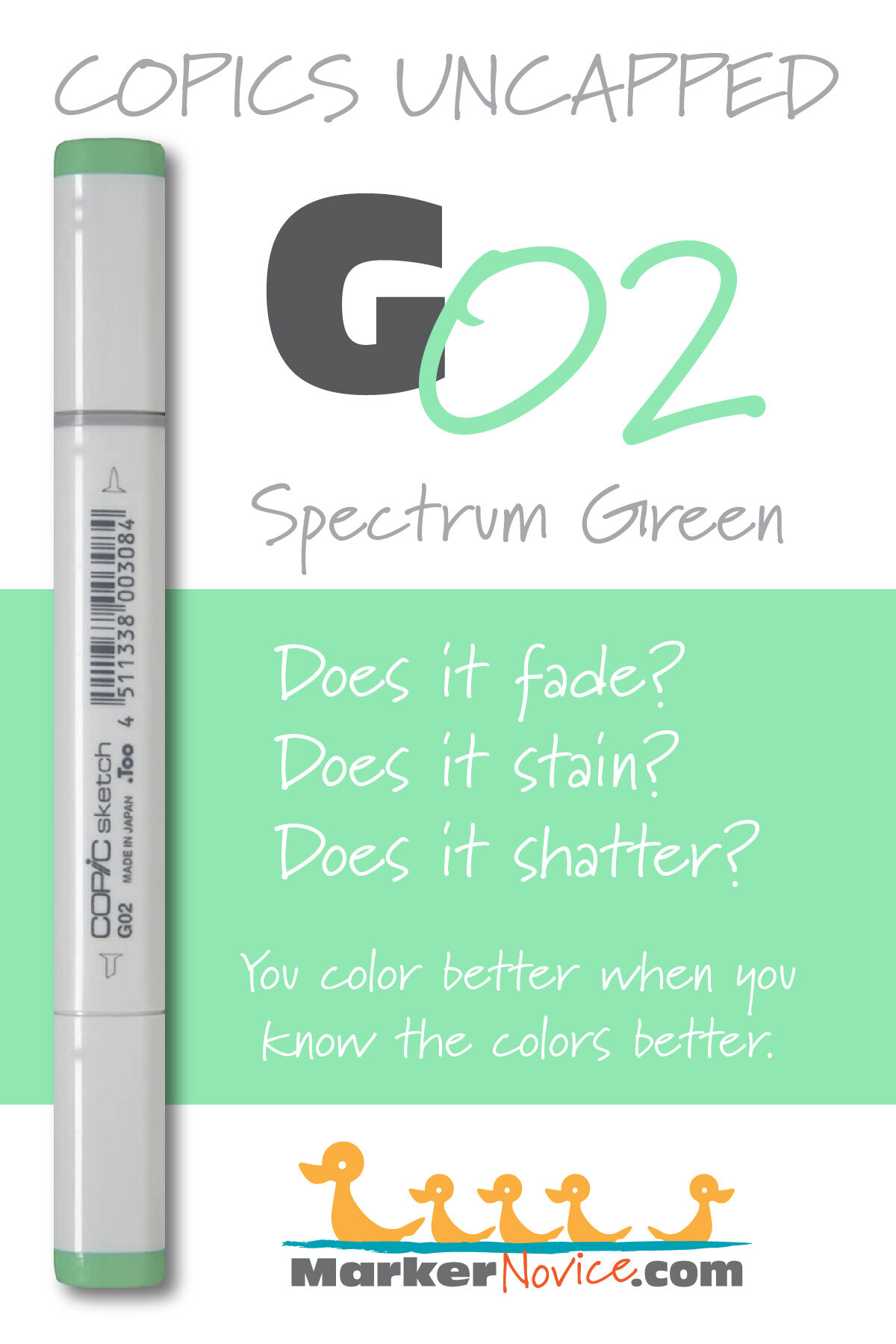
G02 Spectrum Green: Copics Uncapped (Marker Swatch, Ink Testing)
G02 Spectrum Green
Let’s take a closer look at this Copic Marker and it’s ink characteristics.
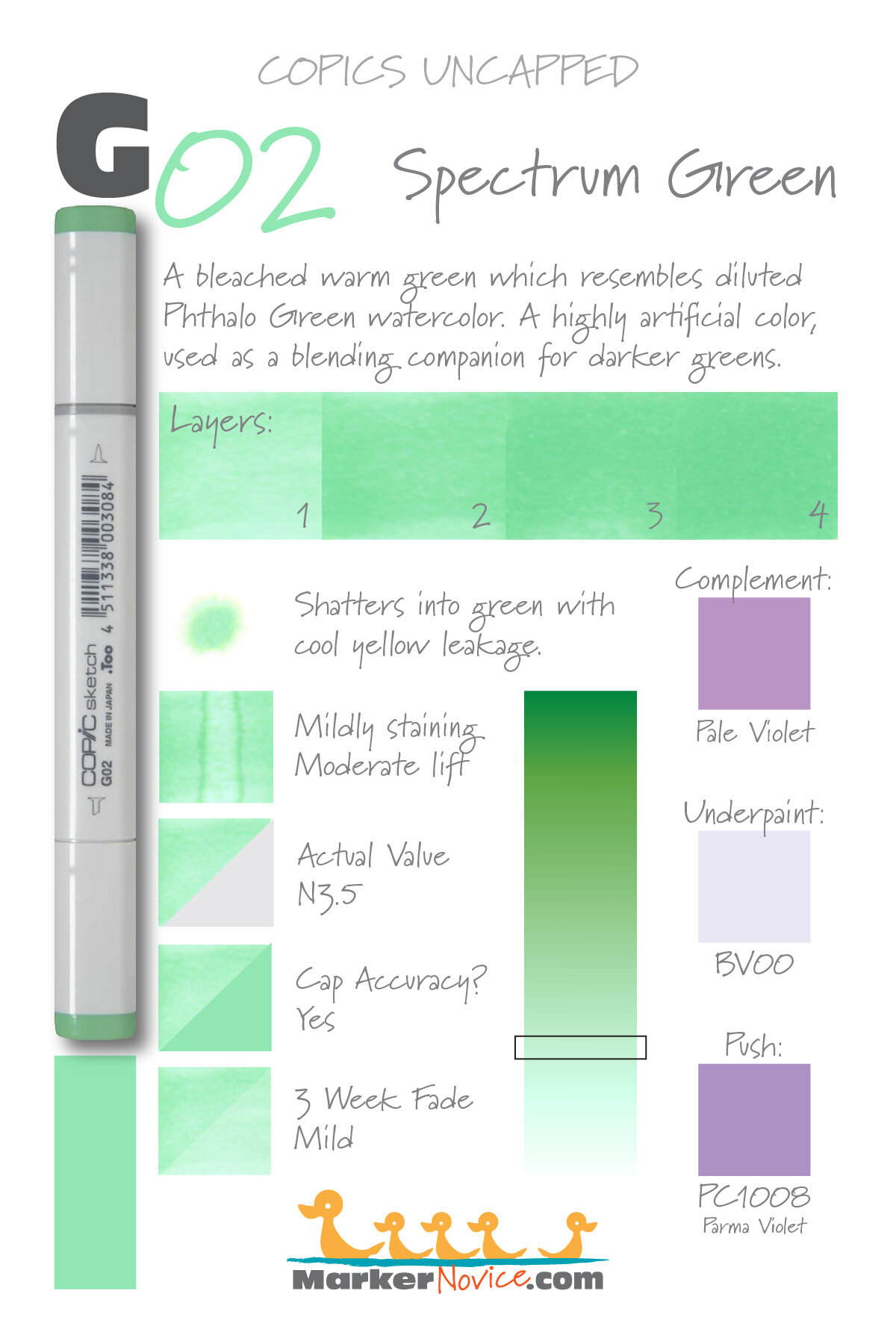
G02 Spectrum Green is a bleached warm green Copic Marker which resembles diluted Phthalo Green watercolor. This is a highly artificial green, most often used as s blending companion for darker greens. G02 is available in Copic Ciao, Sketch, and Classic marker styles.
Every Copic Marker has unique characteristics based on its unique ink formula.
Knowing how a color behaves will help you blend effectively and make art with confidence.
G02 Spectrum Green
Let’s take a closer look at this Copic Marker and its ink characteristics.
Temperature: A slightly warm green but strange things happen to inks when they’re overloaded with solvent. G02 has a bleached look and can create an oddly cool blend in some situations.
Resemblance: Diluted Phthalo Green watercolor.
Actual Value: N3.5
All Copics are measured on a Neutral Gray value scale. The last number on the cap is supposed to indicate value but we’ve found discrepancies where the actual ink value is different than cap designation.
Cap Accuracy: Yes. The colored plastic on the Sketch cap is close to the color of one layer of G02 ink.
Buildup: Layers well but reaches maximum value at only 3 coats.
Shattering: Shatters into green with canary yellow ink at the margins.
Chromatography testing shows this ink’s behavior when it comes in contact with #0 Colorless Blender (solvent). High shattering colors may leak unexpected color when you make corrections or attempt to blend with any color that has a high solvent to colorant ratio. Shattering is not bad, it’s just something to be aware of.

Staining: G02 mildly stains the paper.
Lift: G02 lifts moderately, leaving behind slightly cool bluish paper.
See staining swatch. Sample was given 6 stripes of #0 Colorless Blender, drying between each stripe. Results indicate how much lifting you can expect.
Lightfast: G02 was surprisingly lightfast. We saw only mild fading during the 3 week test.
Samples were swatched on X-Press It Blending Card. 1 layer of ink was exposed to windowsill sunlight for 21 days. Approximately 10 hours of sun per day based on weather conditions. Note: we do not recommend displaying original Copic art under these conditions.
Natural Ink Family: G02 sits at the light end of the G-Zero family. The markers in this family are all artificial looking, it’s hard to find them in nature.
Family Members: G0000, G000, G00, G02, G03, G05 G07, G09
We include this information because many Copic users never think deeper than the letter groupings (R, BV, G, etc.). Every ink has its own temperature variations and underlying flavors. Understanding what an ink looks like in its different dilutions helps when creating your own blending combinations.
Complement: Pale violets like V22
Underpaint: We suggest BV00
This is simply one suggestion. Many possible colors exist. Test to find a color that pleases you.
Pushing Pencil: Prismacolor 1008 Parma Violet with very light pressure works well.
VanillaArts.com (our sister site) teaches a Push & Pull technique for dimensional coloring. This is simply one suggestion. Many possible colors exist. Test to find a color that pleases you.
Vanilla Arts Technique Classes using G02:
Vanilla Arts Digi Stamps using G02:
We continue to create new content and classes and we will update here as more become available.
Visit the workshop resource page at our sister site VanillaArts.com for a wide variety of Vanilla Arts stamps.
Color palettes and swatches using G02:
We are building our palette and swatch collection a little more each week and will update here as more become available.
Visit the color resource page at our sister site VanillaArts.com for a wide variety of Copic palettes and swatches.
Looking for beautiful color palettes?
We absolutely love The Color Catalog 1 & 2 from Sarah Renae Clark. It puts hundreds of Copic friendly color palettes at your fingertips.
(note: affiliate link)