
Copic Markers: What's the Purpose of a Broad Chisel Nib?
What is the point of a Copic Broad Chisel Nib?
The chisel nib is the most misunderstood and under-appreciated of all the marker nibs. And yet illustrators and professional artists all use them? Why?
Let’s look at what hobby colorers are missing when it comes to broad nibs…


I’ve used several brands of illustration markers since 1989. Prior to Copic, the only dual-nib markers I’d seen were novelty markers for kids. Two nibs are still a major selling point; it shows up in all the Copic literature.
“Two markers in one!” sounds like a great value.
Psssttttt, wanna know a secret?
Most Copic colorers only use the brush nib. They avoid the chisel nib because it doesn’t work the way they expect.
Yep, Copic’s Broad Nib (commonly called a chisel nib) is unloved, unappreciated, and rather mysterious to even the most experienced hobby colorer.
Today, let’s look at why Copics come with broad nibs and how to start using your chisel for amazing marker art.
Copic Sketch, Ciao, and Classic Markers come standard with a broad chisel nib. Few people use the chisel because they often leave streaks. Sadly, you’re missing out on a great drawing nib. This article covers how to condition a chisel plus tips for pro artist results from the broad chisel nib.
Note: this article contains affiliate links to products mentioned. We only link to products we endorse and we source them to retailers we use and trust.
Why do Copic Markers Have Chisel Nibs?
“I do not like the chisel nib!”
I’ve taught Copic Marker classes for years and I’ve heard this complaint a lot.
Most people think of the broad nib as “the side I never use” or “the refill end”. It’s kinda sad because if you never use it, you’ll never learn to use it well.
The chisel a great nib; it’s just misunderstood.
The chisel is so unappreciated that for a brief time around 2016-17, many Copic colorers spent goo-gobs of money replacing all their chisels with the newly introduced bullet nib upgrade. That’s $2 x 358 for markers which already set you back $7 each? OUCH!!!
It would have been cheaper to learn how to use the chisel.
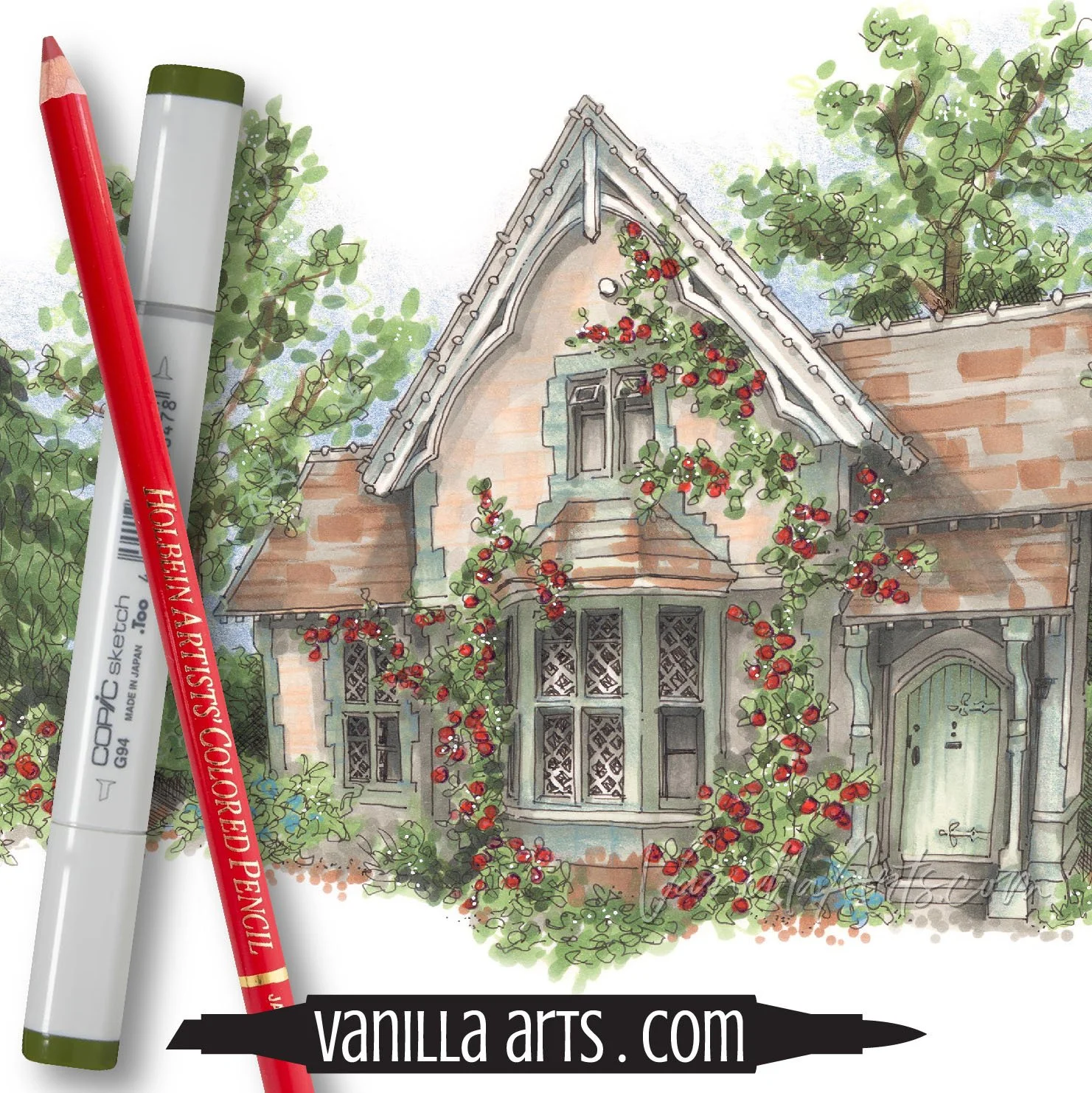
“Irish Cottage” colored by the author, Amy Shulke. Copic Markers plus Copic Drawing Pen and Holbein Colored Pencil details on Cryogen Curious White Cardstock. 12x18 inches. Online class here. Artistic coloring kit available here in Aug 2022.
Why do Sketch and Ciao markers come with chisel nibs?
Because they’re illustration markers and illustrators illustrate.
Look, I know it sounds weird but that’s because you’re a colorer.
You make cards or you color stamps and coloring books. If you do draw, you use a pencil or pen, then use Copic to fill the shapes with blending combinations.
You blend for a hobby, right?
But Copics were not invented for blending. They weren’t even invented for coloring.
Illustration markers go back to the 1950s and graphic artists have been drawing with art markers from the beginning.
Meanwhile the blending technique isn’t even old enough to buy itself a beer.
Copic Markers are a drawing tool— you just happen to blend with them.
FYI: Chisel is the generic term for a flat angled marker nib or paintbrush.
Copic chooses to call their chisel nib a “broad nib” but several other brands call it a chisel nib.
Copic’s Medium Broad Nib comes standard on the Sketch and Ciao marker styles.
Copic’s Standard Broad Nib comes standard on the Classic style.
The Medium and Standard Broad Nibs look and act the same once installed. The difference is the width of the insertion “stalk” end.
Because I’m a dinosaur— in this article, I’ll use the terms “chisel” and “broad” interchangeably.
Drawing with Markers - Old School Style
My Irish Cottage illustration here was drawn and filled using Copic Sketch Broad nibs.
No brush nibs. Nothing is blended.

This style is called Marker Indication and it’s used by architects, interior and landcape designers, fashion, jewelry, and product designers, typographers, art directors, storyboard artists, comic artists, and illustrators.
It’s called Marker Indication because these drawings are used to convey rough ideas. “Indication” means a hint or a symbol. It’s not a fully finished, framable drawing.
Marker indications use fast, loose, and expressive strokes.
The colors are layered, not blended.
Chisel nibs are perfect for marker indications and sketching.
If you’ve always admired the look of art journals, practice sketchbooks, or urban sketching, perhaps indication is a good style for you to explore.
Remember, just because everyone else blends, doesn’t mean you have to blend.

But they say blending creates depth & dimension!
They say a lot of things. Does my cottage here look flat to you?
The dimensional effect you want has nothing to do with blending.
Depth and dimension are the result of using correct values and desaturated color to simulate realistic shape.
It’s about how you use color— the right amount and the right flavor in the right spot. Blending is simply an application method. Blending doesn’t create the shape.
Here, I’ve layered marker strokes to create dimensional shapes. Look at the roof. Can you see the chisel nib stripes? If you zoom in, you can see swishes, blobs, and stripes of color everywhere without a blend in sight.
The color does the work. The chisel nib adds style.
You can do this too!
But first, we need to condition your chisel nibs so that they work properly. Chisel nibs do not work well, straight off the shelf.

What Makes Broad Nibs Ideal for Drawing?
Have you ever tried to draw a straight line with a brush nib? It looks sloppy, doesn’t it? Brush nibs are floppy and leak extra ink when you press hard. It’s difficult to draw lines without bulges, bends, or wandering thick and thin.
The chisel nib is designed for control.
Chisel nibs are made from hardened felt, carved into precision angles. The angles are tailored to keep the nib aligned to the paper with every stroke.
Because the felt is firm, the bevels stay true. The consistent shape of the nib does not warp as you stroke. You will not see variations in line weight (width) when your pressure waivers or your grip changes.
Chisel nibs are dryer than brush nibs, another control feature. A chisel feeds the same amount of ink onto the paper at every stage of the stroke and they rarely leak.
Chisel nibs will never be as juicy as brush nibs, but that’s okay. You don’t need two juicy nibs. The brush nib and the chisel nib are opposites. They complement each other.
Different nibs for different jobs. That’s a good thing!
Why do chisel nibs leave streaks and uneven color?
You tried to color with a chisel nib once… and that was it. The nib left a streaky line with stutters, gaps, or railroad tracks. It wasn’t just one nib either. Every color you’ve tried gives you the same janky line.
So you gave up— because chisel nibs are dumb.
Uhmm, hello?
Fresh chisel nibs do not work properly until you break them in.
And because you gave up so quickly, you’ve never conditioned a chisel nib to the stage where it works buttery smooth.
Dude, you’re missing out!
The inset photo here shows two lines made by Sketch Medium Broad (chisel) nibs.
The light green line on the left (G94) is a properly conditioned nib. See the even color and consistent width?
The darker green line on the right (G99) is from a new but unconditioned nib. See how the nib skidded, skipped, and left bare patches?

Copic doesn’t tell you how to prepare chisel nibs for use.
Sadly, Too (the parent company of Copic) takes a hands-off approach to customer support and education— at least for English speaking customers.
So it’s no wonder you think the chisel nib stinks. Very few hobby colorers know anything about their broad nibs.
Chisel nibs are made from hardened felt. This firmness provides support and consistency of line as you draw.
But because it’s so firm, the long bevelled edge can’t conform to the surface of the paper as you draw. Anywhere the fibers don’t meet the paper, the nib leaves pale streaks or skips.
To get a fully inked line, you must break the edge and soften it.
Once the nib has a bit of give along the edge, more fibers will touch the paper with each stroke.
It’s kinda like running a dried-out sponge over a counter, the whole sponge won’t make contact with the countertop. If you soften it, the sponge can hug the surface better.
But the firm edge is likely not your only problem.
Most people have very thirsty Copics.
Let’s face it, people don’t refill their markers often enough. Even when they do, they use the stupid drip method which underfills your marker by a lot.
Dry markers don’t work well and dry chisels really, really don’t work well.
Do your chisel nibs leave pale streaks or skippy lines? It’s because you’ve set them up to fail.
Condition Chisel Nibs for Beautiful Ink Flow
Breaking-in a broad nib is very easy and man, it makes such a difference!
How to condition a chisel nib:
First, inspect your chisel nib! Many colorers have never touched their chisel nibs. Look closely at every nib to insure it’s not crusty or sticky with old dried-out ink. Chisels can go bad if you don’t use them, even with the caps on.
A chisel in good condition will be dark and almost shiny. The color appears consistent across the whole nib with no white spots, pale fibers, sparkly crystals, hardened zones, or gooey patches.
Run the nib across some scrap paper. Does it glide smoothly or do you feel gummy resistance? Does it leave streaks that are several shades darker than the ink color? Does it barely make a mark or does it shed powdery residue? These are all signs of dead or dying chisel nibs.
If your nib doesn’t look fully wet and ready, you’ll need to replace the nib. Cleaning a dead nib is a waste of time and money with an extremely low success rate.
Purchase a small digital scale and refill your marker to near-factory weight. Copics always perform best when they’re full. They’re not like a car which you can run until the gas tank hits E. You’ll see a noticeable decrease in your blend quality before you’ve used just one gram of ink.
Brush nibs are more forgiving when ink is low because you can press harder to squeeze more ink from the nib. This is NOT true with chisel nibs.
The broad nib is the first nib to show signs of low ink; it will turn matte and pale. Because it’s firm, you can’t push to release extra ink. Broad nib strokes look pale and dry long before brush strokes do.
Juicy lines come from juicy markers. Refill your marker and keep your markers full for every use to insure your chisel nibs are primed and ready.
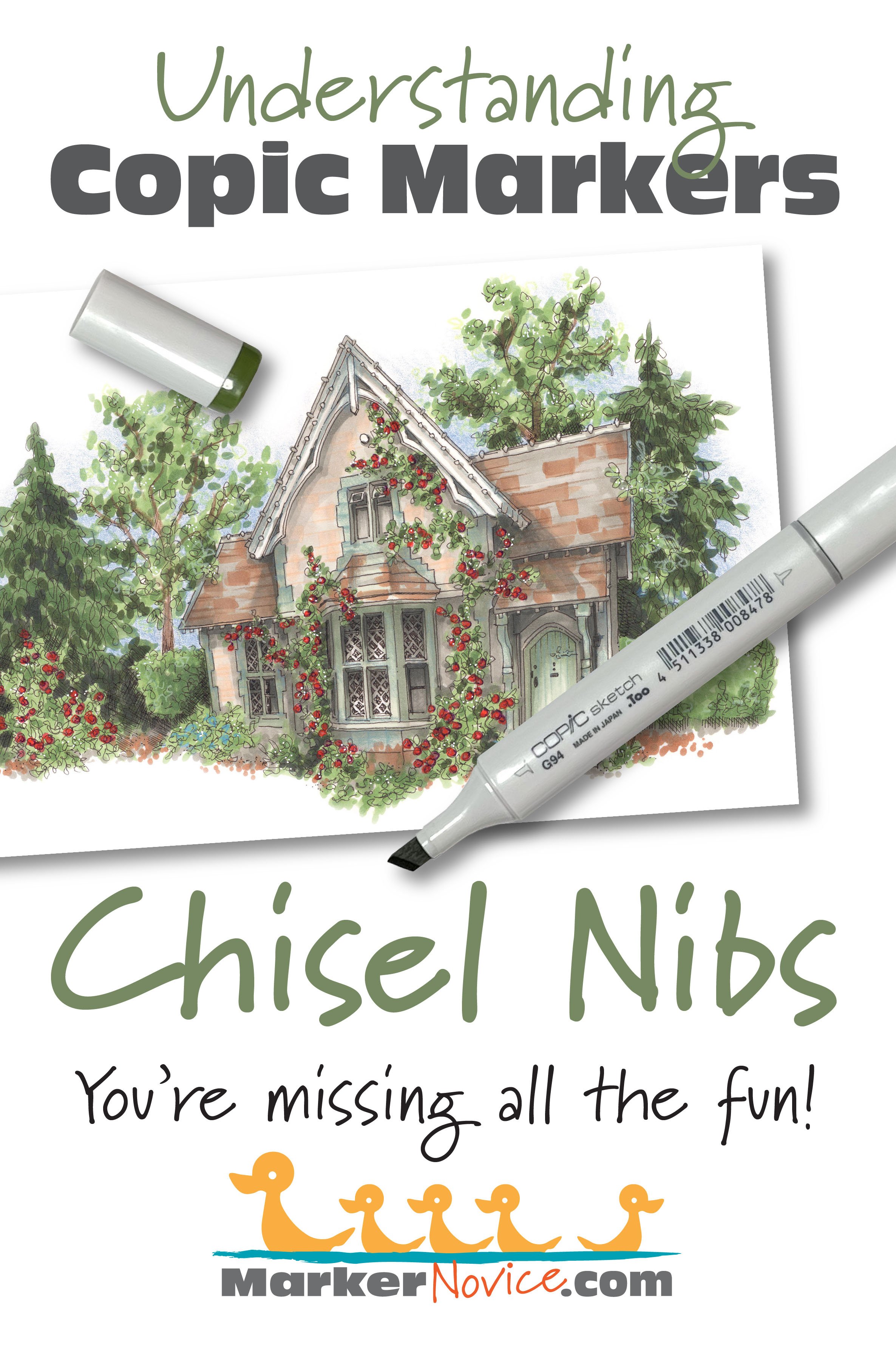
3. Fresh chisel nibs skip and leave gaps because the bevelled surface isn’t making full contact with the paper. Soften the WIDE bevel edge by making lots of practice strokes on scrap cardstock. I prefer using scraps of cheap cold press mixed media paper because it’s more abrasive. The goal is to soften the felt fibers slightly so that the edge conforms to the surface of the paper.
Don’t go overboard with the softening process. Using moderate pressure (more than we use for drawing), make thirty to forty 2” strokes. Hard felt skids across the paper; the softer the edge gets, the more friction you’ll feel with every stroke. When the strokes start to look consistently full and juicy, the edge is now “broken” enough for drawing.
Warning: a conditioned chisel nib doesn’t look much different than a fresh nib— the visual change is very subtle. You will feel the difference rather than see it.
4. Do not soften the point! We want a firmer point on the corner of the nib for drawing thin lines. The point will gradually soften and become rounded over time. Actually, a soft and spongey point is how you’ll know it’s time to replace your conditioned chisel nib.
Now a few warnings:
Stop coloring with both caps off!
A few decades ago, someone started the silly rumor that removing both caps relieves built-up pressure inside the marker. Now every colorer in the world thinks that they can avoid random ink leaks by taking both caps off when they color.
This is completely false! Copics can not hold pressure! Read my article here for the full story.
Please keep your chisel capped unless you’re using it. Remember when I said the broad nib is the first to dry out when your marker runs low on ink? Think about how removing the cap increases the air flow around your chisel nib. You’re encouraging evaporation.
Coloring with both caps off is the fast way to kill a chisel nib.
It’s also not good for your ink.
Removing both caps slowly darkens your markers over time. One of my very experienced card-making students always colored with both caps off. She’d been doing it for over a decade. We noticed during class that her B34 was darker than my B34, it looked more like a B35 or B36. At first, we thought she had mistakenly refilled B34 with B37 ink but then marker after marker, we noted that ALL of her Copics were darker than they should be.
Leaving a cap off allows solvent to evaporate but here’s the danger: the colorant in the ink does not evaporate. Colorant sticks around after evaporation and it forms the hard crust when a nib dries out. Slowly over time, my student had made her inks thicker and darker by releasing solvent from the open chisel end. Yes she refilled her markers frequently but her ratio of solvent to colorant was always off and it got worse with every refill. Her markers slowly turned darker over time.
There’s no benefit to coloring with both caps off. It damages your chisel nibs and it throws off the color.
Stop doing it.
2. Chisel nibs eventually wear out!
We conditioned your chisel nib by “breaking” the edge and softening the fibers just enough to help it hug the paper better.
But the softening doesn’t stop just because the nib is conditioned. Every stroke breaks the fibers a little more. There’s a definite sweet spot where the edge is soft enough to make a juicy line but firm enough for control. Beyond the sweet spot, the nib gets spongier, you’ll feel more friction, and your strokes will get juicier and darker.
As I said in step #4 above, I watch the longer corner, the “point” of the chisel. When the point gets rounded, squishy, or if the edge starts to look splayed or fuzzy, it’s time to break-in a new nib.
Copic sells replacement nibs because all nibs have a finite life.
Nibs don’t last forever. They all wear out.

Chisel Nibs: Better Than Bullet Nibs!
Earlier I mentioned that a few years back, Copic introduced a bullet nib replacement for Sketch and Ciao markers. They did this because hobby colorers thought the chisel was useless and begged for a bullet nib.
Replacing all the chisels with bullets wasn’t cheap.
And it was also kinda silly.
One of the reasons why I love drawing and coloring with a well conditioned chisel nib is that the chisel already is a bullet nib!
Chisel nibs are three nibs in one: a fine, medium, and broad point.
Your bullet nib can’t do that, can it?
For a broad line that’s almost .25” wide, use the wide edge. Everyone knows about this edge and most people think it’s the only way to use a broad nib.
Hey, there’s a point too. Turn the marker 90 degrees and use the point for a thinner stroke which is basically the same size as the Copic bullet nib.
But wait… there’s more! Turn the marker another 90 degrees to use the corner of the point for a thin stroke.
THIS is ultimately why Copic gives you a Broad nib instead of a bullet.
The bullet makes one kind of line. Just one.
Meanwhile with a chisel and a brush nib, Copic gives you FOUR distinct strokes.
Sketches and Ciao markers are not dual-ended,
They’re Quadra-ended!


In Summary:
Broad chisel marker nibs are not well understood, but once you get to know your nib, you’ll love it dearly.
The Copic chisel nib is not an after-thought. It’s an important part of your marker because it’s an excellent illustration tool.
Condition your nibs, keep the markers full, and learn to use the various edges to color like a true professional.

“Irish Cottage” colored by the author, Amy Shulke. Copic Markers plus Copic Drawing Pen and Holbein Colored Pencil details on Cryogen Curious White Cardstock. 12x18 inches. Online class here. Artistic coloring kit available here in Aug 2022.
Amy Shulke is a professional illustrator who has used Copic Markers since 1990. She teaches artistic coloring classes online at VanillaArts.com and locally in Michigan.
Marker Novice is Amy’s completely free resource devoted to beginner marker education. For intermediate/advanced artistic coloring articles, see her Studio Journal here.
Further reading on related topics:



Urban sketching
Have you admired Copic sketch journals but didn’t understand how artists get marker sketches on the road?
Irish Cottage: Intro to Line & Wash Technique for Markers
Artistic Coloring Kits are everything you need to challenge yourself with intermediate to advanced level images.
Learn to use loose and expressive strokes to create stylish scenes
Let your skill and creativity be the star of the image, not the stamp. Ideal for large-scale projects using Copic Marker, colored pencil, watercolor, or your unique mixed media.
This project is part of The Underpainters, an advanced coloring challenge group.
Kit includes: digital stamp, suggested supply list, references, color map, and process tips

Supplies for a Copic Refill & Nib Replacement Kit



Copic Markers: Should beginners start with Ciao or Sketch markers?
I teach Copic Marker classes and work with a lot of beginners. A common question I hear from brand new students is:
“I’m new to Copic Markers. Is it okay to start with Ciao style markers or should I purchase the Copic Sketch?”
Many people say Ciao and Sketch markers are interchangeable. But as an art instructor, I disagree.
Let’s look at why.

If you’re just starting out with Copic Markers, the choices can be overwhelming! At first, you focus on which colors to purchase first, until you realize…
“Uh oh… there’s more than one kind of Copic to choose from!”
I teach artistic Copic Marker classes and work with a lot of beginners. A common question I hear from new students is:
“I’m new to Copic Markers. Is it okay to start with Ciao style markers or should I purchase the Copic Sketch?”
Many people say Ciao and Sketch markers are interchangeable. But as an art instructor, I disagree.
Let’s look at why.
Copic Ciao Markers are often described as an inexpensive version of the Copic Sketch but the two markers are very different. If your budget allows, purchase Sketch style only. Sketch are more economical to maintain, ergonomically designed, and it’s easier to learn good technique with Sketch Copics.
Let’s look at why Sketch Markers are a better investment for beginners.
Note: this article contains affiliate links to products mentioned. We only link to products we endorse and we source them to retailers we use and trust.
Copic Ciao vs. Copic Sketch: What’s the difference?
Copic Ciao Markers and Copic Sketch Markers look totally different. One is thin and one is fat. One is round with large colorful caps and the other is flat and mostly gray.

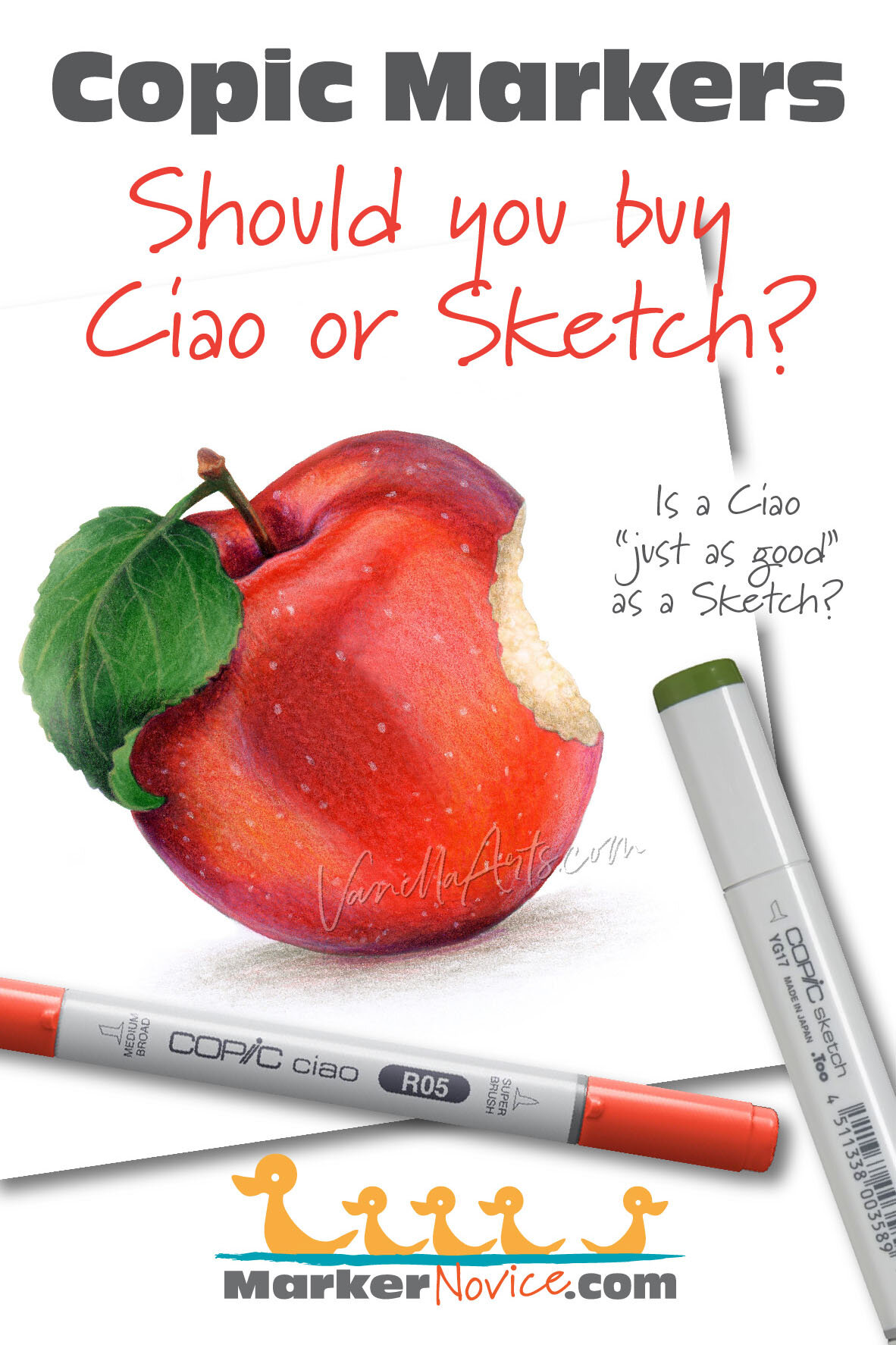
“Basic Apple” colored by the author, Amy Shulke. Copic Markers plus Prismacolor Premier Pencil details.
But when you take the caps off, you’ll see Sketch and Ciao have the same marker nibs: the medium broad chisel and the Copic Super Brush nib.
They have the same nibs, so it’s no surprise when you ask a room full of Copic fans:
“Which style of Copic is best for beginners”
… most of them say it doesn’t matter because the only difference is the price.
I totally disagree.
The ”all the same” myth seems to be reinforced by Copic coloring videos on YouTube where it’s common to see mixed collections of Ciao and Sketch being used together.
But just because people do it, doesn’t make it smart.
I’ve drawn and colored both professionally and for fun with illustration markers since 1989. I bought my first Copic in 1992. I know Copic Markers very well and that’s why I teach with them.
As an experienced art instructor, I highly recommend Sketch style Copic Markers for beginners
Actually, I recommend Sketch markers for everyone— beginners, intermediates, advanced colorers, and professional artists too.
This runs completely counter to what the online world says, so let me explain why.
Ciao Markers are not as budget-friendly as you assume
The first thing shoppers notice when comparing Copic Ciao markers to Copic Sketch markers is the price tag.
Ciao markers are about $2 cheaper than a Sketch.
I understand why many beginners choose Ciao markers over Sketches. Colorers want to create blending effects and to do so, you need several related colors. If money is tight or you’re frugal, Ciao seem to be a better deal— it’s hard to say no to a 25% savings!
Ahhhh grasshopper, but that’s just the initial cost.
Over the long term, you’ll spend more money maintaining Ciao markers. There are Ciao performance issues as well. You’ll also end up buying more than a few Sketch markers anyway, so you’re only saving on some colors, not all colors.
Let me emphasize this one more time because it’s really hard to convince people who are already reeling from Copic Marker sticker shock:
Copic Ciao Markers cost more in the long run.
Ciao Markers will save you a few dollars in the beginning but you’ll pay far more than $2 in extra maintenance costs and upgrades over the next decade.
Truly budget-conscious people will skip the Ciao and purchase Copic Sketch Markers.
What are the hidden costs of Copic Ciao Markers? Let’s look closer.
Copic Ciao Caps have serious design flaws
Copic Ciao Markers look like fun.
They’re pretty darned cute, with big bright colorful caps. You can even buy special editions printed with Mickey Mouse or characters from The Little Mermaid. They also sell a sparkle version of Ciao.
Copic Ciao were designed for children and can be purchased in bulk for schools and art programs. They’re even child-safe. The caps are designed with soft plastic and air holes so as not to block a child’s airway if swallowed.

But child friendliness and budget pricing make for a less durable cap.
The plastic cap stretches over time making for a marker which no longer seals properly. Copic talks about this problem here (though they offer no solution other than to buy a new marker, grrr).
Frequent forceful capping and uncapping can lead to stress cracks called “crazing” along the sides.
There’s also some of Murphy’s Law at play: If you drop your cap it will roll away. If someone steps on it, the cap will crack. Don’t laugh, this has happened 3 times in my classes.
Speaking of rolling caps, the only people who have mysteriously lost a cap in one of my classes have been Ciao users. The roll is a problem. Copic knows this so they added a small nub to the side of the cap. It doesn’t really help.
And honestly, for all the cap problems, I’ve never seen replacement Copic caps for sale. If you lose your cap or if it stops clicking tightly, you’re forced to purchase a new marker.
There’s another hidden problem with Ciao caps, one you’ll only notice after it’s too late:
If you look deep inside a Ciao cap, you’ll see a secondary cap inside the main cap. The nib fits into this smaller cap when you recap the marker.
But woe to those who fail to line the marker up correctly.
That interior cap has a sharp edge. I’ve personally hacked pieces off the edge of a chisel nib when I didn’t have the cap exactly centered. If you’re off center, just a wee bit to the left or right, the inner cap slices into your nib. I’ve cut a vicious notch into the center of a chisel nib; the marker now draws 2 stripes instead of one. I’ve also bent the heck out of a Super Brush nib; the nib was beyond repair.
Compare that to the inside a Sketch cap where you’ll see a gentle, rounded, can’t-screw-it-up sanctuary for nibs. The Sketch’s cap is designed to safely guide your nib into the center of the cap; you’d have to work pretty darned hard to damage your nib with a Sketch cap.
I’ve also seen far fewer seal failures, cracks, and accidentally dried-out nibs with Sketch markers— both with students and in my own marker collection where I have several markers over 20 years old.
Ciao caps are vicious to your nibs and they wear out faster than Sketch caps.
If economy and longevity are your goal, stick with Copic Sketch Markers.
Copic Ciao have a limited color range which forces you into a mixed collection
Copic Ciao come in 180 colors but Copic makes 358 colors. That’s 178 colors you’ll have to purchase in Sketch style.
You can’t build a full Copic collection with only Ciao markers.
I do not think it is possible to do artistic coloring with only Ciao style markers. There are too many important gaps in the Ciao color palette.
If you’re doing casual card making or coloring books, you might get by with just a Ciao collection. I’m skeptical but okay, maybe. But as soon as you take a class or try to color with realism, you’ll need colors not available in the Ciao style.
I tried to create a series of beginner classes which used nothing but Ciao. I couldn’t do it. Ciao is missing many important colors. You can see the full Ciao palette at the official Copic website here. It looks pretty good at first glance, but experienced Copic users soon start to notice missing colors and holes:

Ciao has no grays darker than a level 7 (I typically teach with 8 and 9)
No neutral N grays (which I recommend as a beginner’s first gray purchase)
Most of the pale Ciao markers come in the form of 00 or 000 (as opposed to colors with only one 0, like E30 or G40). Sub-zero markers often blow-out a blending combination because there’s a lot of solvent in the ink formula.
The Ciao palette focuses heavily on colors which start with 0. The “zero” families are unnaturally bright. Many look like highlighters with noticeable florescence.
Ciao markers all lean towards the lighter end of a color family with very few markers which end in 7, 8, or 9. This makes it hard to shade with realism.
Several Ciao have no natural blending partners
Ciao is missing my most used cast-shadow marker (BV20)
The purples selection is just weird, they either lean pink or look dusty.
Ciao is heavy on pinks yet missing any organic looking blending combinations
No Ciao R24 which is essential to the natural blending combination for Copic’s top selling red, R29
Ciao has only one organic yellow (Y21) but gives you nothing to blend it with
WE ASKED! 100% of Vanilla Arts students who prefer Ciao markers also own several Sketch markers.
But also, Ciao is simply missing many of the colors I see instructors calling for on a regular basis.
So as I said above, purchasing Ciao dooms you to a mixed collection of some Ciao and some Sketch markers. I’m not saying an assorted collection is fatal, you see people using mixed collections with great skill on YouTube all the time.
As an instructor, here are the issues I see with mixed collections:
There are no organized storage containers for a mixed collection. If you want to keep your markers in numeric order, you’ll always be tucking Ciaos lopsidedly into holes meant for Sketches.
The best storage systems for a mixed collection work on the bucket system where you chuck 10 to 20 similar markers into large divided areas. This lack of numeric order storage is bad for beginners. It encourages duplicate purchases and doesn’t alert you to lost markers or improperly capped markers.
My mixed collection students take longer to find their markers because they have to remember “is that color a Ciao or a Sketch?”
The ID number on a Ciao is on the side of the marker and poorly marked. It’s a kinda-dark mid-tone gray number printed on a kinda-light mid-tone gray body. It’s hard enough to grab the right marker when you’re working fast. Ciao encourage mistakes.
Ciao markers run out of ink faster than Sketches. When I see students with dead markers, it’s usually a mixed collection and it’s the Ciao which ran out of ink because they expected it to last as long as the Sketch.
Students with mixed collections often have issues learning good marker technique. More on that below.
Students with Ciao markers tend to replace the Super Brush Nib more frequently. More on that below, too.
Now let’s talk money.
People who start with Ciao markers frequently spend more money on their ideal marker collection than those who start with Sketch.
And I don’t mean the cost of maintaining the markers.
I mean spending more on actual markers.
Starting with Ciao makes superficial sense if you’re not sure about markers. If you’re just testing the waters or if you’re one of those people who has ninety other hobbies and no intention of coloring more than once in a while.
WE ASKED! 80% of Vanilla Arts students prefer the Sketch over other Copic styles.
But what I see with students who get serious about artistic marker coloring is they sell off their Ciao and replace them with Sketch. In your hand, there’s a world of difference between the two styles of markers.
Nobody sells off their Sketches to buy Ciao markers. The upgrade is always from Ciao to Sketch.
When you resell a marker, you don’t sell it at cost. You sell them deeply discounted. Maybe $3 per Ciao?
Add that loss to the cost of the replacement Sketch and you just spent far too much to end up with a Sketch anyway.
Copic Sketch Markers encourage good coloring technique
I’ve had several students tell me they like Ciao markers because they’re thinner. They feel more like a pencil or a regular marker.
And that’s precisely the problem.
The way to hold a pencil is very different than how to properly hold a marker!
Writing position is not the same as coloring position.
Read part one of my article on the difference between writing and coloring here. The article focuses on coloring position for colored pencil but it’s even more important for marker coloring.
In writing position, you choke up on the marker. In writing position, you have lots of control over little tiny micro-movements— the whole act of writing is a series of micro-movements using the muscles in your fingers and wrist.
Coloring on the other hand requires broader, more sweeping motions. We color from the elbow and shoulder— bigger joints for bigger movements. If you’re all choked up on a marker, you’re blocking your ability to blend and color smoothly.
Here’s the other problem, remember how I said choking up on a marker puts you up on the point?
The Copic brush nib was not designed to be used on the point.
Brush nibs are springy and soft. If you’re choke up on the marker, it puts a lot of downward pressure on the least stable part of the marker.
Beginner colorers have difficulty controlling brush nibs when they try to color on the point. If you’re up on the point, the brush nib flops around and releases ink in unpredictable spurts.
Come down onto the side of the nib by moving your hand into coloring position. Now you can control the brush nib and it’ll release a controlled level of ink.
Bad hand position causes a several other problems beyond control:
First, if you’re up on the point of the brush nib, you’re using the wrong muscle group— finger and wrist instead of elbow and shoulder. Little muscles have little ranges of motion, With just your fingers and a little wrist, you can’t cover the paper well.
Second, you can’t blend properly from the point of a marker. The point is the smallest and driest part of the nib.
Last, coloring from writing position exerts excessive downward pressure on the nib. You’re bending the nib in a way it doesn’t want to go. This wears out your brush nib extremely fast!
Worn brush nibs lose their point which makes precision coloring harder.
Worn brush nibs lose their springiness making for sloppy lines and inconsistent ink flow.
The larger, flattened barrel of a Sketch marker encourages a better coloring grip. You have to work hard to hold a Sketch from writing position for very long.
Sketch Markers encourage good coloring technique by forcing your hand into a proper grip.
What I notice with beginners is that the people using Sketch markers learn pretty quickly. It’s a little harder on the Ciao users but they eventually catch on and move their hands into coloring position.
But after all these years and tons of students, I strongly suspect that my slowest students are the people with a mixed Copic collection.
They use their Sketches from coloring position, they use their Ciao from writing position— that’s what feels natural with each marker.
So they’re constantly bouncing between good technique and bad technique. While everyone else is practicing and developing great automatic instinct, the poor mixed-collection people confuse their brains and muscles.
You can’t build good technique into a habit if your hand can’t feel the difference between good technique and bad technique.
I honestly think it’s harder to learn to color well with Ciao markers and it’s even worse when you add random Sketch markers to the mix.
Ciao markers have a high fatality rate due to user error
If there’s one thing that drives me nuts, it’s watching students try to color with dry markers.
Many people buy Copic Markers because they’re refillable but then stubbornly refuse to refill them.
Blending can’t happen with a marker that’s low on ink. Read more about how to instantly improve your blends by simply refilling your marker in my article here.
It doesn’t help that there are hundreds of people online bragging about how they’ve never, ever, no-never had to refill their Copics.
I call shenanigans on that! If we weighed their markers right now, I guarantee they’re all on the low side and silently causing this person blending issues.
What I notice is that the Ciao bargain price attracts people who can afford the marker but not the refill. Because the Ciao doesn’t hold much ink, they blow through their meager ink supply really fast. Then they’re online asking about why their nib is suddenly hard, dark, sticky, or all three.
High performance alcohol markers simply do not last as long as beginners expect.
It feels like an expensive marker should last forever.
Dry and dry-ish markers are a universal problem for Copic beginners and even intermediates. They simply don’t have the experience to pick up on the silent signs of a marker which needs to be refilled.
The warning signs come faster and with less grace time with Ciao.
I run a refill service for local students, refilling and replacing nibs before class. I get more Ciao markers than Sketch and it’s rare for the Ciao not to be dangerously low.
THE HARD TRUTH: If you let your Copic Markers get too dry, you can’t rescue them. I don’t care what you’ve heard online about soaking nibs in alcohol, soaking a nib will not help the core inside the marker. Copics contain resin which will not rehydrate after it cures. When a Copic core starts to harden, there’s no amount of refilling or solvent soaking that’ll bring back a crunch core.
In my decades of classes, I’ve seen hundreds of dead Ciao markers and only a handful of dead Sketch.
Ciao owners neglect their markers more than Sketch owners.
Copic Sketch Markers are easier for people with arthritis and/or dexterity issues
Last thing and I’ll be quick.
I mentioned a minute ago that Copic Sketch Markers are ergonomically designed. They simply feel good in the hand.
The fatter, flat barrel has a nice side effect, one that I appreciate more after celebrating my 50th birthday.
I can’t use my colored pencils all day and all night, doing marathon art sessions like I used to. After a while, my hand simply protests. My fingers get sore and I develop the oopsies, so much that I had to move a carpet under my desk because I drop my pencils frequently at the end of a long day.
But I can color with a Sketch marker for a long, long time with no issues.
If you’re an older colorer, and I say this delicately because “older” is different for everyone…
If you have arthritis or dexterity issues with your hands, switch from Ciao to Sketch markers.
Your hands will thank you.
Who Can benefit from buying Ciao Markers?
Ciao markers are excellent for children— smaller hands need smaller barrels.
If you want to test five or six Copics to see if you like coloring with markers, buy some Ciao. But keep in mind, Ciao are not a true indication of how Sketch Markers feel. If you like the few Ciao, start buying Sketch.
If you’re a hobby colorer, coloring mainly stamps for cards or coloring in coloring books, especially if you only color a few times a month, a Ciao collection might work fine for you.
If you sketch in journals or you travel with markers, like urban sketching, en plein air drawing, if you travel a lot, or if you’re headed out on vacation, a secondary set of Ciao is definitely more portable.
If you’re taking a class and the only way to get the right color is to choose Ciao. I’d rather students have the right color Ciao than to try to substitute a different color Sketch.
Notice I didn’t recommend Ciao to people strapped for cash?
That’s because Ciao are not really a bargain. You’ll pay more over the long run, spending more on refills, replacement nibs, replacement markers, and marker upgrades.
Instead, save your money and invest in Sketch. It’ll take longer to build a large collection but for artists and serious colorers, Sketch markers are totally worth the wait.
Pssstttt… This is exactly what I did! I ate a lot of ramen noodles and budgeted like crazy to afford quality art supplies. I don’t regret it.
In summary:
Copic Sketch markers are cheaper to maintain for a lifetime
This is why I recommend Copic Sketch Markers over Ciao style Copics.
To be clear, a Ciao Copic is better than no Copic…
But I really do think if you’re serious about making coloring your only hobby or if you’re interested in artistic level coloring, you ought to be using Sketch markers.
The primary reason most people choose Ciao markers is financial, but that’s a poor excuse when you look at the cost of a Ciao over its lifetime of use.
Ciao Markers are not as budget-friendly as the price tag indicates
Ciao caps have a higher failure rate, forcing you to buy a completely new replacement marker.
Ciao caps damage nibs more frequently forcing extra nib replacements.
Ciao need to be refilled more often and easily dry-out beyond repair.
Ciao have a limited color range which means you’ll end up buying at least a few Sketch markers.
Mixed collections are hard to store efficiently leading to the purchase of duplicates or losing markers without knowing it. You also can’t easily spot when a marker cap has been left slightly off leading to nib damage or totally dried-out markers.
Ciao markers encourage writing position grips which wear down nibs faster but also lead to difficulty learning and practicing good blending and precise coloring.
Ultimately many people end up selling their Ciao markers, replacing them with Sketch— the upgrade process destroys the initial cost benefit of a Ciao.
If you are torn between starting a collection of Ciao or Sketch Copics, I recommend Sketch markers. They’re a much better bargain in the long run.
Amy Shulke is a professional illustrator who has used Copic Markers since 1990. She teaches artistic coloring classes online at VanillaArts.com and locally in south-eastern Michigan.
Marker Novice is Amy’s completely free resource devoted to beginner marker education. For intermediate/advanced artistic coloring articles, see her Studio Journal here.

Further reading on related topics:
Copic Markers: How Many Colors Does Copic Make? (Beware!)
“Why is it impossible to find some Copic Marker colors?” a student asked recently. She’s been waiting for years on some colors. Years? That’s weird. Shelves are pretty flush right now; what can’t she find?
Then it hit me— her Copic chart doesn’t match her favorite marker style.
She’s looking for Copics which do not exist.
So let’s clear this up, before you get confused too…


“Why is it impossible to find some Copic Marker colors?”
A student asked me this recently. She’s been waiting for years on some colors.
Years?
It’s an odd question because while Copic stock varies from store to store, in general, shelves are pretty flush right now. And if you shop online, you can easily buy them all. So what colors can’t she find?
Then it hit me— her Copic chart doesn’t match her Ciao style markers.
She’s been looking for markers Copic doesn’t make.
So let’s clear this up, before you get confused too.
How many colors does Copic make?
In the Classic, Ciao, or Wide style? It may be less than you think.
Copic Makes 358 colors
Copic Inks come in 358 different colors BUT not every color is available in every style of Copic Marker. Copic offers a limited color range in their less popular marker types:
Refills: 358 colors (available in every color)
Sketch: 358 colors (available in every color)
Classic: only 214 colors
Ciao: only 180 colors
Wide: zero colors
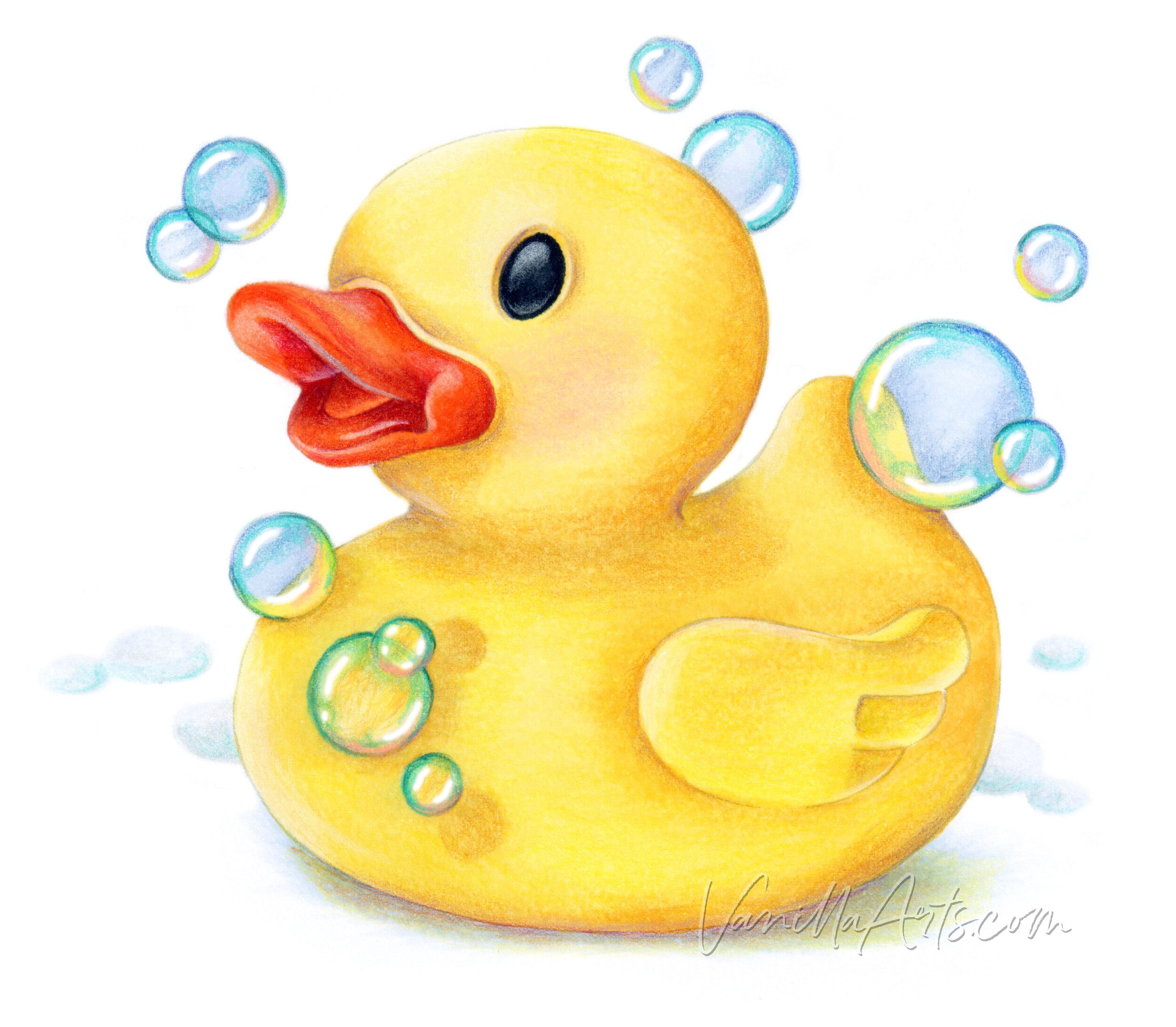
“Rubber Duckie” an original illustration by the author, Amy Shulke. Copic Marker + Prismacolor Premier colored pencils. 8x8” on Cryogen Curious Metallic White Cardstock.
Let’s look at the specifics of each Copic Marker style to help you find the colors you want.

Copic Refills
If Copic makes the color, then it’s available as a refill.
Copic makes refill inks for all 358 colors.
You will never get stuck with a marker that can not be refilled.
See the entire 358 color palette chart for Copic Refills at Copic’s official website here.
While we’re on the subject of refills, I want to warn you about one thing…
Copic used to make a square-ish bottle which they called “Various Ink”. These bottles held 25ml of ink. In late 2019, Copic switched their refills to a 12ml bottle…
Yes, the new bottles are half the size.
(Updated bottles are cylinders with a long needle nose dispenser.)
On some websites and auction sites, you can still find the older 25ml bottles.
BEWARE: Copic Various Ink 25ml bottles contain EXPIRED INK!
Square bottle ink has not been produced since early 2019. Copic ink has a shelf life of 3 years. Therefore all square bottles are long past the expiration date!
Now to be honest, I’m writing this in 2024 and I’m still using the last of my square bottle refills. I can tell you that Copic ink does not go rancid, it does not separate, and even though my Various Inks are 3+ years beyond the expiration date, they work just fine.
But Copic Ink is not lightfast and I keep my inks in a dark storage box inside a dark cupboard. I can guarantee this because they’re my inks.
If you’re purchasing someone else’s old stash of ink, you don’t know if they’ve taken similar care.
I’ve seen bottles of pale yellowish refill ink that were once hot pink, so this is a real concern. Even if the inks are not noticeably pale in the seller’s photographs, they could be only slightly faded— for instance, a B99 ink might look closer to B95. And once the fading process starts, it degrades quickly.
Buyer beware!
What about Colorless Blender?
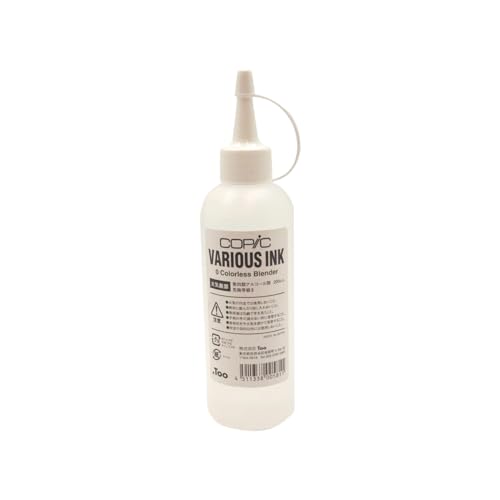
Colorless Blender solution is available in 2 different sized refill bottles. The economy sized 200ml/6/7oz bottle has not changed but the 25ml Various Ink refill size is now a smaller 12ml bottle.
I recommend owning both the large bottle and a small bottle. The larger bottle is more cost effective BUT it’s very awkward to pour from.
To limit how often I open the large bottle, I use my small bottle to refill my #0 markers. Then when necessary, I refill the small bottle with the large bottle.
Colorless Blender does not go bad and the bottles are fairly airtight. I know the large bottle seems overkill to a hobby level colorer but I think the cost savings is worth it. I go through one large bottler per year. Even if it takes you 2-3 years to use your bottle, do not worry. Copic Colorless Blender will not expire or lose it’s effectiveness.

Copic Sketch Markers come in 358 colors
It seems like everyone owns at least a couple of Sketch markers. It’s hard to avoid them.
Copic Sketch are the top-selling style. They come in all 358 colors.
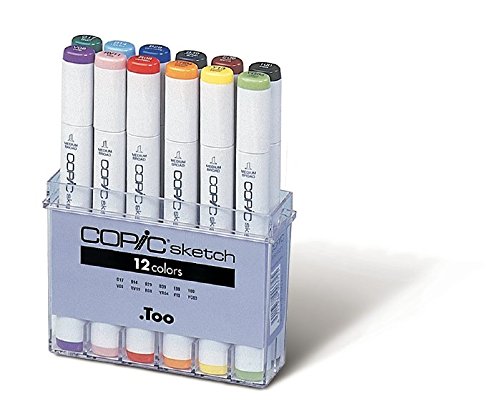
That’s 358 including the colorless blender.
The last new colors were introduced in 2012.
If you’re listening Copic, it’s been over a decade since you’ve introduced new colors. I’d kill for a B61 and more complete range of yellows.
See the full Sketch color palette at Copic’s official website here.
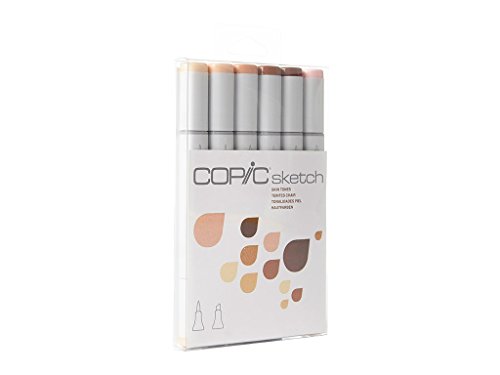
Sketch markers with their distinct oval shaped barrel were developed for professional artists. Many hobbyists also choose Sketches, knowing that they can continue to build an entire collection without mixing marker styles.
Read more about Copic Sketch markers in our article here:
(Link leads to the recommended supply page on our main site, VanillaArts.com. We keep one list for both sites to insure the links and buying tips are current.)

Copic Classic Markers come in 214 colors
Do you have the original square barrel Copics with a fine nib (bullet) and a broad chisel nib? If so, you’re working with a smaller color palette.
Classic Copics come in the original range of 214 colors.
This includes the Colorless Blender.
See the full Classic color palette at Copic’s official website here.

I started with Classics in the 1990s and honestly, I never felt at a loss for colors. Overall, 214 is a very workable collection. There’s a good selection from every color family plus all the grays from all four groups.
But remember, Classic Copics were not designed for blending.
I know this sounds strange to beginners who think Copic was, is, and always will be a blending marker; but Classics were developed long before blending became popular. Back in the dinosaur days, we did not blend. The paper we used at the time would never tolerate modern blending.
Copic Classic Markers are for drawing, not coloring.
This is why you’ll find some Classic markers with no easy blending partners.
Copic Classic have a good selection of colors but if you like blending, avoid Classic markers.
Read more about the Copic Classic Marker in our article here:
Subscribe to our weekly newsletter at VanillaArts.com for access to our FREE DOWNLOAD LIBRARY. The starter list is in the library — follow the newsletter instructions to download your copy.

Copic Ciao Markers
Most Copic beginners have Ciao Markers.

Ciao Copics are value priced, so you get more Ciao markers for your money. But economy has a hidden inconvenience.
Ciao Copics come in a very limited range of 180 colors.
That’s 180 including the Colorless Blender.
See the entire Ciao color palette at Copic’s official website here.
I could never work with Ciao markers alone. There are too many gaps in the color palette.
I actually tried this a few years back— I taught at a store which only carried Ciao. It was incredibly frustrating; The store finally started carrying Sketch markers because it was too hard to run classes with only Ciao colors.
Favorite colors which are not available in Ciao style: R24, R89, YR24, YR27, Y13, YG01, G24, G40, G43, BG11, BG53, BG57, B21, B34, BV01, BV20… and that’s just off the top of my head.

Even worse, there are no neutral gray Ciaos (ack!). Of the grays they do have? I don’t understand why there are no 4s, 6s, or double-zeros which I use regularly. And they don’t go darker than a 7 which is problematic for me since I don’t use black in my artwork.
As an entry-point for beginners, I recommend Ciao Copics.
BUT I always warn students that you will not be able to stay inside the Ciao ecosystem very long.
Ciao limits you to half a collection. The 180 colors are all useful colors. I don’t see any dead weight in the Ciao palette, but I also can’t un-see the big gaping holes.
Read more about Copic Ciao Markers in our article here:

Copic Wide Markers
Copic Wide was once 35 colors plus a Colorless Blender.
Not anymore.
Copic Wide comes in ZERO colors! Today’s Wides are do-it-yourself markers.
If you spot colored wides in a store, it’s been sitting around on the shelf for a long time. It may be expired.
If you want a Copic Wide now, you must buy the empty marker (called a “blank”) and fill it yourself with a Copic Ink Refill bottle.
Do-it-yourself isn’t a bad thing! I never liked the available color selection for Wides, so I’ve been buying blanks for years, creating the colors I need instead of settling for the colors they made.
The downside to DIYing a Wide is that you’ll never have a color coordinated cap. I’ve had to label the side of the marker with a nasty piece of tape which feels terrible as I use the marker.
Grrrr. I really wish they would come up with a better way to indicate DIY colors. They’re not cheap but the tape-on-the-side method sure makes them look cheap!

Black Edition?
Ever seen a black body Copic? They’re rare but they do exist.
Black 25th Anniversary Sets were a limited edition release 2017.
Limited Edition Copics came in 36 total colors released as one box or in smaller sets of 12.
The Black Anniversary series looks like a Sketch marker but the nibs are different. Normal Sketches carry a Super Brush nib on one end and the Broad chisel nib on the other. The Black Anniversary style is a Super Brush plus a Fine Nib bullet.
The Black Anniversary did not contain any new colors.
You can see a photo of the Anniversary 36 on Debbie Olson’s site here.
I sold my Classic style markers to get away from the bullet nib so I never bought the Black Anniversary.
Wait, what’s a C30?
Don’t be silly! There’s no such thing as a Cool Gray 30!
Ahhh, grasshopper. Yes, there is.
30th Anniversary Classic Sets were a PRIVATE gift release in 2017. Most people don’t realize they exist!
Here’s a photo at Copic in the Craftroom on Facebook. Michelle Houghton who runs the Copic in the Craftroom channel at YouTube (and blogs at Scrapweaver.com) was one of the lucky ducks to receive a 30th set when she attended the anniversary event in Japan.
As you can see in the photo, most of these colors are just figments of your imagination. There are no refills for them, so they’re the exception to the every-marker-has-a-refill rule. The 30s are beautiful little one-offs.
And that Y30? Oh Copic, pretty, pretty please!!!
Discontinued Colors?
Nope.
Copic has never discontinued an ink color.
Have they discontinued products? Yes.
But not inks.
You can see the full discontinued product list on their official website here. It’s mostly paper and marker storage but please pause for a solemn moment of silence when you get to my beloved SP Color Multiliners.
Oh dear, (sigh). They were truly beautiful.
Many Stores do not stock all 358 colors

Yes, Copic makes 358 colors but I’ve personally never seen all 358 colors on the shelf in a local store.
First off, to carry the entire Copic line is expensive for stores. Most small shops prefer to special-order a rare color for you instead of buying 6 and letting them rot on the shelf.
But also, there’s always something on backorder from the factory. Always.
Even if your shop is great at stocking shelves with just the right products, sometimes they can’t get the colors they want because the supplier doesn’t have any.
Here’s the other issue you may not realize when you begin buying Copics:
Many chain stores will NEVER carry all 358 Copic colors.
Big-box retailers (Jo-Michael’s Lobby Mart) create their own “exclusive” palette based on tiny shelf displays. Several chains do not carry the extra colors on their website either. If you’re using the 50% off coupon method to collect markers, you’ll run out of markers to buy long before you have a medium sized collection.
How many colors does Copic make?
It depends upon what you’re buying.
Copic Ink comes in 358 different colors BUT not every color is available in every style.
And that’s the catch!
Before you beat your head against the wall looking for a BG11 Ciao or a Classic V01, do some checking. The color may be listed on your handy-dandy color chart but it might not be available in your preferred style or at your favorite retailer.
Happy hunting!
Amy Shulke is a professional illustrator who has used Copic Markers since 1990. She teaches artistic coloring classes online at VanillaArts.com and locally in south-eastern Michigan.
Marker Novice is Amy’s completely free resource devoted to beginner marker education. For intermediate/advanced artistic coloring articles, see her Studio Journal here.


Quack, quack!
This little duck is bubbly fun.
Beginners can color this duckie small scale and simple. Or you can step it up a notch using the photo reference and the methods I offered in this challenge article.
Amy Shulke’s "Rubber Duck"
Sample shown uses Copic Markers and Prismacolor colored pencils.
Package includes PNG digital stamp with easy print PDF option plus recipe, full color sample, photo reference, and grayscale guide.




Click to receive Marker Novice & Vanilla updates in your Pinterest feed

copic shopping list
Vanilla Arts Co. LLC and its Marker Novice site is a participant in the Amazon Services LLC Associates Program, an affiliate advertising program designed to provide a means for sites to earn advertising fees by advertising and linking to Amazon.com. Vanilla Arts Co LLC also participates in affiliate programs with Dick Blick, Ranger Inc, ShareASale, and other sites. Vanilla Arts Co. LLC and Marker Novice is compensated for referring traffic and business to these companies.