
Copic Markers: How and When to Replace Worn Brush Nibs
Copic Marker Care and Maintenance
Copic Markers feature replaceable nibs because nibs do not last forever. For accurate coloring and easy blending, replace brush nibs when they show wear to insure juicy, springy, pointed nibs. In this article, we provide photos of worn nibs and offer tips plus the easy steps to install new Copic brush nibs.
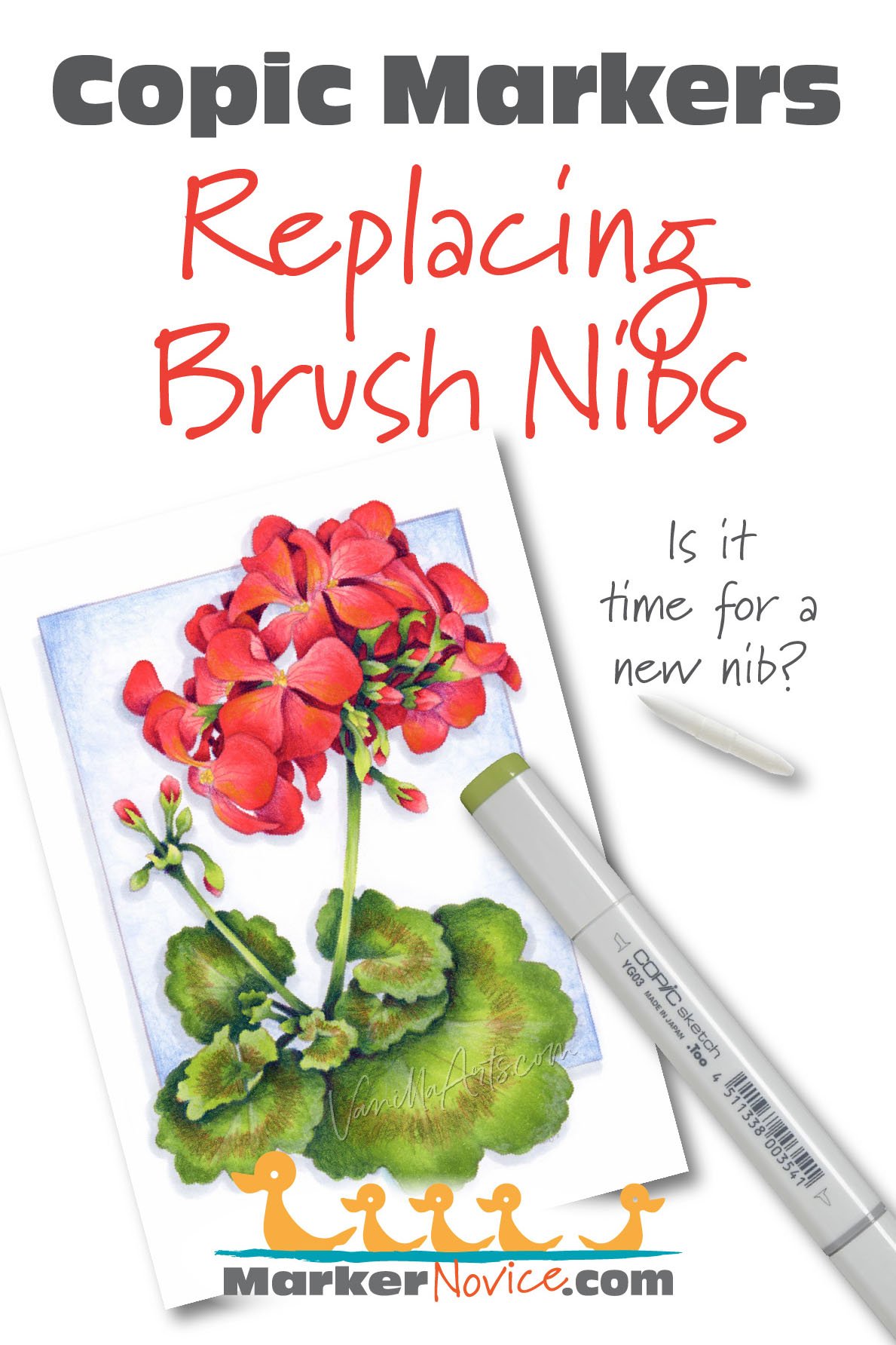

I purchased my first art markers in 1989 for a Marker Illustration class in art school. Back then, markers only had chisel nibs and when we damaged a nib, we threw the marker away, even if it wasn’t empty!
When Copic developed replaceable nibs, artists were thrilled. We could stop trashing otherwise-good markers.
Today, we love Copic Markers because of their replace & refill system. With proper care, Copics can last decades. I’m still using Copics from the 1990’s but I’m not using the original nibs!
As a marker instructor, here’s a frustrating observation:
Many Copic users have NEVER replaced a nib!
Yep, lots of people are coloring with dead marker nibs— floppy, squishy, or leaky brush nibs which actually make coloring harder!
Odds are, you’re one of them.
Today, let me show you how simple it is to install a fresh nib to instantly improve the look of your coloring.
Copic Marker Care and Maintenance
Copic Markers feature replaceable nibs because nibs do not last forever. For accurate coloring and easy blending, replace brush nibs when they show wear to insure juicy, springy, pointed nibs. In this article, we provide photos of worn nibs and offer tips plus the easy steps to install new Copic brush nibs.
Note: this article contains affiliate links to products mentioned. We only link to products we endorse and we source them to retailers we use and trust.
Why is it Important To Replace Copic Marker Nibs?
Thirty-some years ago when Copics were rare in the US, they were prized by designers, artists, and illustrators. No artist wants to fight with their supplies, so when we damage a nib, we swap it fast.
Artists know, the quality of our art suffers when we use broken supplies.

“Scarlet Geranium” by the author, Amy Shulke. Copic Markers and Prismacolor Premier Colored Pencils on X-Press It Blending Card. Take the online artistic coloring class which introduces color kissing technique for dynamic color. More info here.
But the modern Copic user is now more likely to be a student, a hobby colorer, or a paper crafter— people on tight budgets or who’d rather spend money on other craft supplies.
When you combine artistic inexperience with frugality, you get a population who don’t recognize the signs of a dying marker or who talk themselves out of normal marker maintenance.
Unfortunately…
Your coloring is only as good as your marker nibs.
When you open a Copic cap to find a crusty nib, you don’t have a choice, you must replace it.
But there are a lot of colorers who try to stretch their nibs past the replacement point. This is when the bad nib starts to make you look like a sloppy or incompetent colorer.
Brush nibs do not get better with age. No brush nib performs as well as it does the first time.
This is because paper is hard and nibs are soft.
Look, you don’t think twice about sharpening a pencil. Pencil leads wear down and lose their point because paper is abrasive.
Like pencil leads, a soft felt fiber brush nib is also no match for abrasive paper tooth.
Even if the paper feels smooth to your fingers, it’s still rough on your marker nibs. Paper acts like sandpaper, rounding-off the point of the nib. It also pulls fibers away from the felt causing the nib to gradually grow fuzzy over time.
Because we can’t sharpen a marker nib, you must replace it.
Marker nibs don’t just go dull and fuzzy, they also go limp.
With normal use, we press the marker nib into the paper to release ink. We physically bend the brush nib every time we color.
A new marker nib snaps back after it’s bent. But with every bend, it gets a little less snappy. Artists call this snap-back “spring” and markers lose spring much faster than paintbrushes.
Dull, fuzzy, or floppy nibs are difficult to control.
It really is the difference between a 21 year old Olympic athlete and your 79 year old grandpa with a cane.
Dull, rounded brush nibs do not place ink on the paper where you expect
They’re slow to respond to commands
They spread ink inconsistently with random surges and dry spells
Remember, forty years ago, we used to throw away a marker that misbehaved.
Now we’ve got a whole generation of Copic fans who are reluctant to change bad nibs.
And your coloring looks worse for it.
When To Replace a Copic Brush Nib
Keep in mind that we tend not to notice subtle changes over time. You grow accustomed to the feel of less spring in your brush nib and you won’t always notice the growing fuzz on a nib if you use it frequently.
When you uncap a Copic for the first time in a while, take a moment to evaluate the health of your brush nib.
I can’t tell you how often I catch dull nibs this way. “Dang, that’s really rounded! How did I not notice it last time?”
But before we discuss the signs of a dead or dying brush nib, it’s important to note:
Copic Brush Nibs are made out of two kinds of felt. Felt is not a woven fabric. Instead, felt is a dense tangle of fibers, bunched tightly together.
The center core of a Copic brush nib is hardened felt. It provides stability and spring.
The hard core wears a triangular “party hat” of softer felt. This soft cap is the ink applicator, the only part that makes contact with the paper.
When is it time to replace a brush nib?
Here’s what to look for:
1. Rounded End: Paper tooth slowly wears away the point of the nib. Dull nibs cause accuracy issues because it’s hard to predict exactly where you’re contacting the paper with a rounded nib. You’ll see more coloring outside the lines and fewer sharp corners or crisp details from blunt nibs. They’re also unexpectedly juicy because there’s less felt to hold-back the ink coming from the marker. Rounded nibs are disasters waiting to happen. Change them immediately.
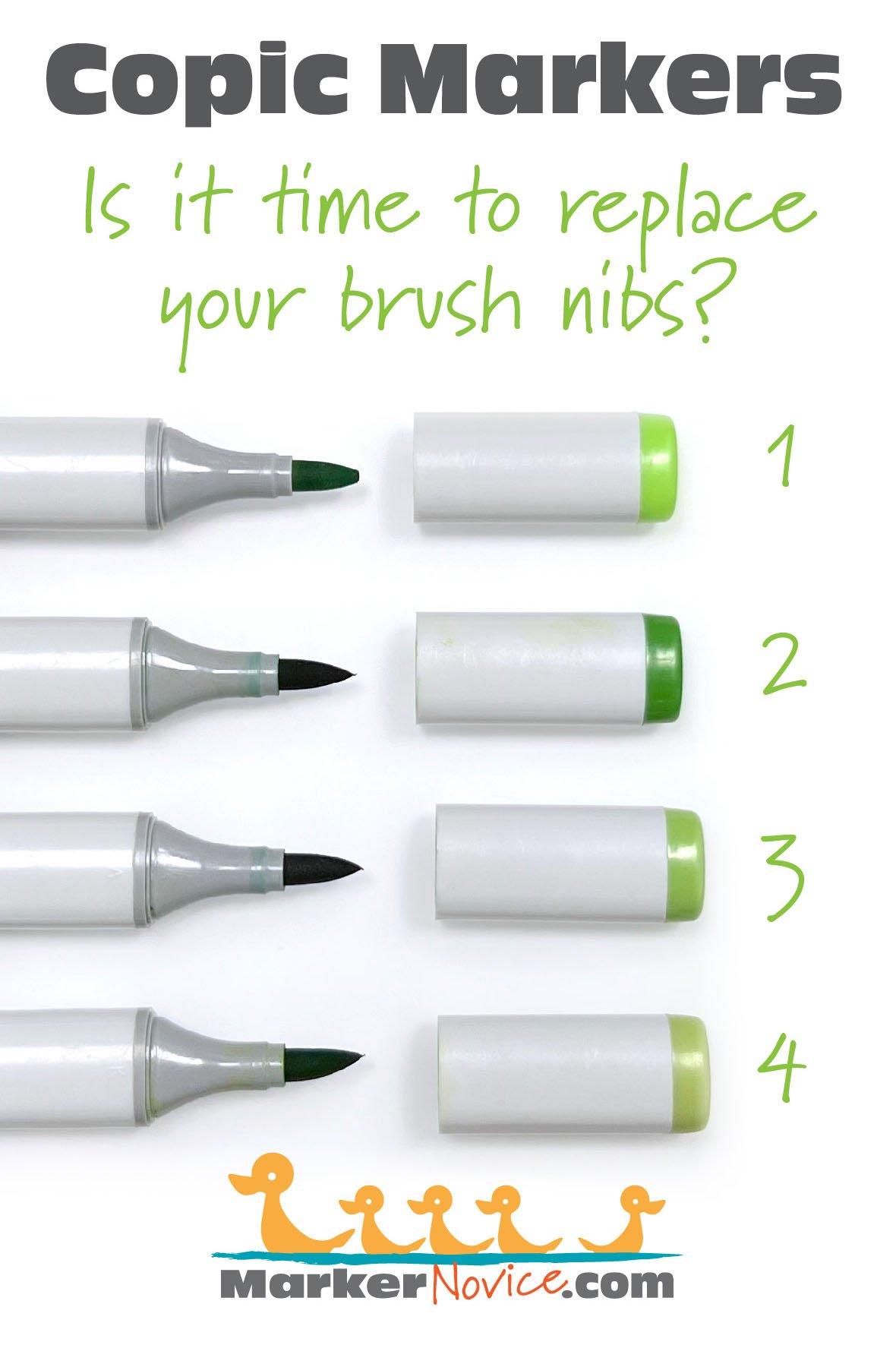
2. Stray Hairs: Before a nib becomes rounded, you’ll often see loose hairs hanging out from the point of the nib. These are fibers which have been pulled loose from the soft felt. Stray hairs can make unwanted marks as you color— it’s like a mini-marker with a mind of its own. One hair is usually the start of many more, as the felt fibers gradually untangle themselves. Instead of fighting the hair, just change the nib.
3. End Ball: These are related to stray hairs but worse. Instead of a few fibers, this is an entire clump separating from the soft felt hat. While a stray hair leaves little ink lines, a ball leaves darker squiggles and bumps. I’ve even had bumps fall off as I color, they lay on the paper making a dark spot. If you try to brush the ball away, they leave drag marks. I can deal with a hair but a ball is a no-go! Change the nib or you will regret it.
4. Bent Nib: See how this nib is flat on one side? It has lost the ability to spring back after bending. Basically, the hard-felt core in the center of the nib has started to go soft. This is a slight bend but I’ve seen students using far worse! I’ve seen nibs noticeably pointing in odd directions and I’ve seen (many!) students dragging floppy nibs across the paper like a wet rag mop. Change the nib immediately because this nib makes your coloring look sloppy.
The most important factor: FEEL
As you gain Copic experience, the markers become a natural extension of your hand. You’ll start to feel the nib as it glides across smooth or toothy paper.
Nib awareness is the first thing to tell me it’s time to change my nib.
New nibs feel springy and slick as I color. Old nibs feel spongy and they stutter across the surface. There’s also a slight response delay with old nibs, they resist turning and are slow to follow commands.
A good artist doesn’t waste time fighting their art supplies.
Change the nib when it feels wrong.
Not Shown Here: DEAD SPOTS
Dead or dry areas on the nib are another important reason to replace the marker nib, but today, I’m talking about signs of normal use, not marker abuse.
Dead spots are a symptom of Copic abuse.
White or light spots along the side of your brush nib are a sign that you’ve deliberately let your marker run dry by refusing to refill it properly.
You can kill a Copic Marker by failing to refill it regularly.
And I do mean kill. When you let a marker run dry, you allow the core to harden and cure. You can’t fix a cured core. You can’t replace the core, you can’t clean a core, you can’t soak it back to health. The marker is dead.
Because refill neglect is a much larger subject, I’ll link to my related article over on my other website, VanillaArts.com

How Long Do Copic Brush Nibs Last?
“Hey, Amy— I’ve only had my markers for a few months. Do I need new nibs already?”
Marker nibs are not like milk; they don’t have concrete expiration dates.
The longevity of a marker nib is determined by how you use it.

I’ve built a career using Copic Markers daily, so I wear-out nibs faster than someone who only colors on weekends.
The more you color, the sooner you’ll need new nibs.
My burn rate varies by color. My average is about one nib per year for most markers.
But I rarely touch some of my markers— many RVs, Ws, and some Es, can go years before I need a new nib.
Meanwhile B32, B60, BV23, V15, YG03, and YG17 may need 2-3 replacements per year.
But I’m an unusual case. My burn rate doesn’t help estimate yours.
Instead, let’s talk about common behaviors which cause excessive nib wear.
The more of these you do, the sooner you’ll need new nibs:
Do you use the same colors in most projects?
Do you draw with the marker?
Do you use paper not designed for markers? This includes copy paper, office grade cardstock, card maker’s premium cardstock, mixed media paper, any paper with laid or impressed texture, Bristol or illustration board, or watercolor paper.
As you draw or color, do you drive the marker? Driving is where you push the point of the marker as opposed to pulling the point where you want it to go. It’s like when you push the bristles of a paintbrush rather than pulling.
Do you color on the point of the nib more than on the side?
Do you color larger projects (over 8”) or expansive backgrounds?
Do you color with circular strokes?
Do you blend light to dark?
Do you blend using a scrubbing technique?
Okay, so those are all things which cause extra friction-wear on the soft felt cover of a brush nib.
Now let’s talk pressure.
Hand pressure shortens the lifespan of a Copic Brush Nib.
Heavy handed coloring where you physically use more force than necessary will kill a brush nib faster than friction. You’re not only wearing on the nib’s soft felt cover but you’re also breaking the hard felt core.
And this is where Copic beginners and once-in-a-while colorers lull themselves into a false sense of security.
Many beginners think “my markers are new”. Infrequent colors think “I only color once a month”. Both are trying to delay the inevitable purchase of replacement nibs.
The problem is, inexperience leads to greater nib damage.
Beginners and those with poor technique damage nibs faster than other colorers because they haven’t learned how to control hand pressure.
So there’s actually a similarity between my burn rate and the burn rate of a heavy handed novice using poor coloring technique.
Intermediate and advanced weekend colorers need fewer nib-changes than beginners and pros.
Weird but true.
Important Tip: Purchase Copic Nibs By the Dozen
When you shop for replacement brush nibs, I recommend buying several packs at once.
Buying in quantity may get you a nice discount but that’s not why. When you only have 3 extra nibs, it changes how you evaluate a worn nib.
Scarcity creates stupidity.
If you only have a couple replacement nibs, you’ll treat them as precious and you’ll color too long on a dead or dying nib.
On the other hand, if you have lots of extra nibs in a cute little jar by your coloring desk and they’re ready to go at a moment’s notice, you’ll start changing nibs as often as needed with no debate, drama, or angst.
How to Replace a Copic Brush Nib
Okay, let me start by saying— Copic makes a very nice set of serrated tweezers, designed especially for removing Copic nibs.
But if I’m honest, I never use the tweezers. Never.
I can see how they’re handy. Copic brush nibs are a bit fragile. It’s easy to accidentally pull off just the soft felt “party hat” instead of removing the whole nib.
And darn it, once you take off the party hat, it never goes back the right way.
So if you intend to remove a brush nib and then put the same brush nib back? That’s when a dedicated set of specialty tweezers makes sense.
But me? I’m throwing bad nibs in the trash.
Tweezers only slow me down.
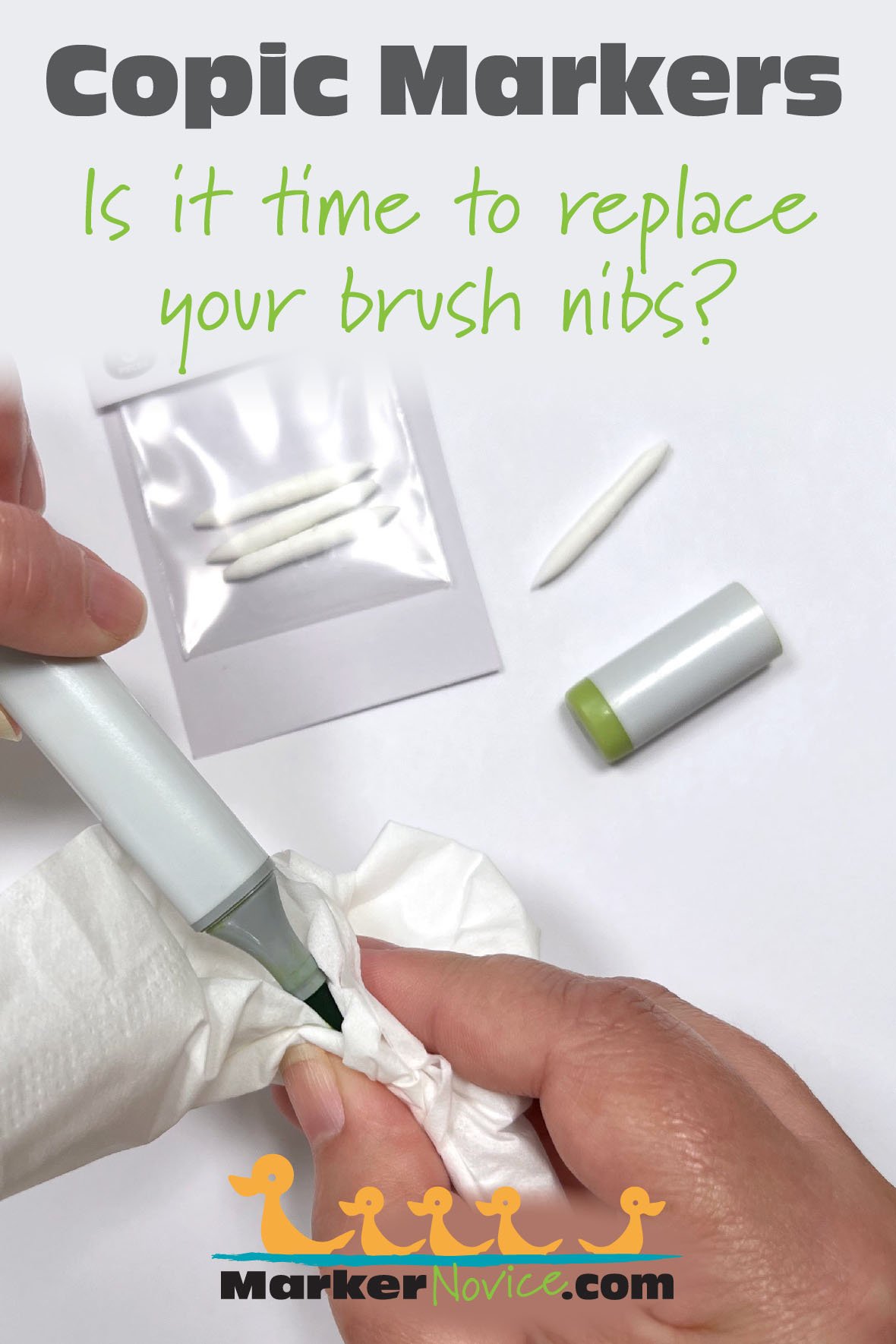
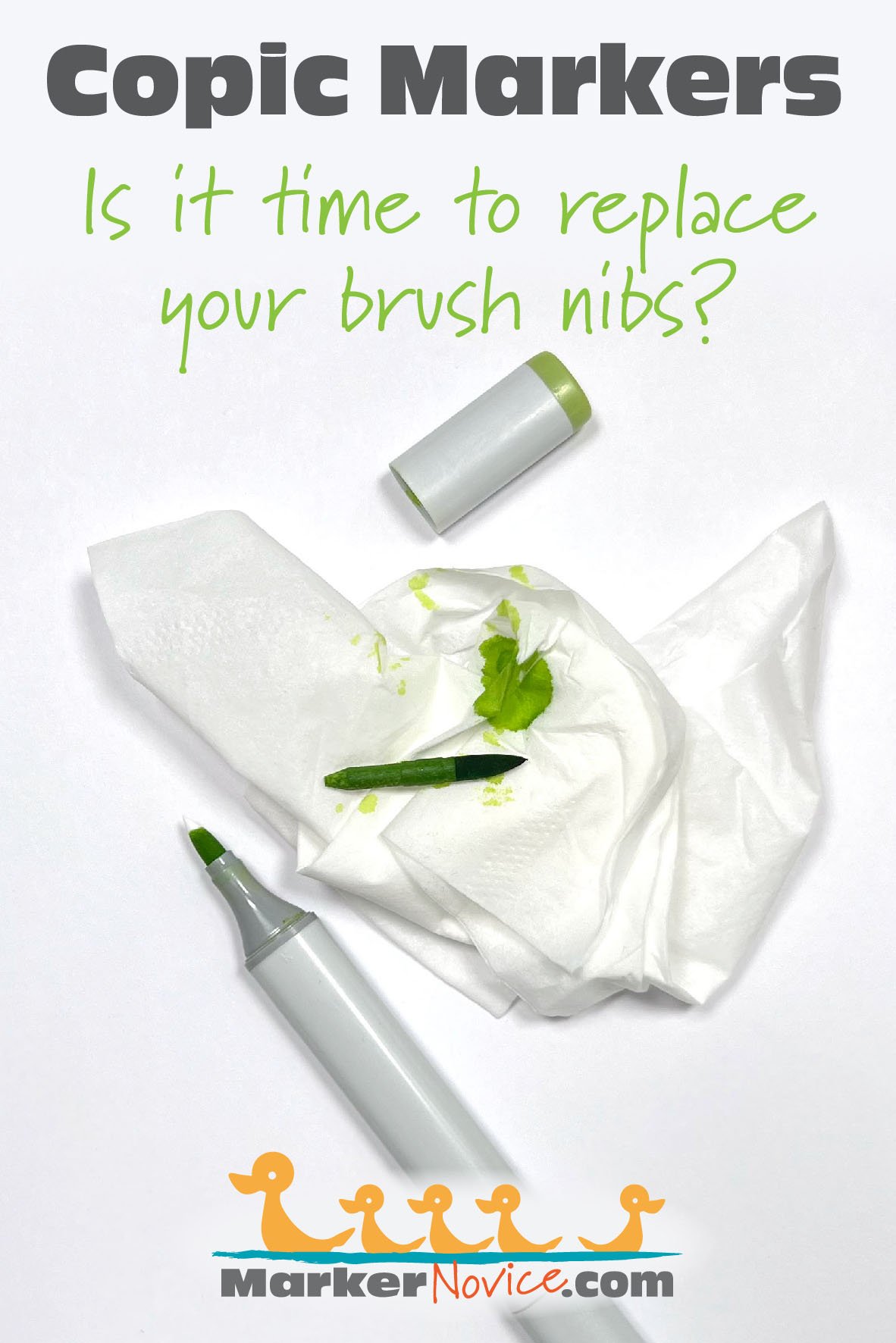
How to replace a Copic Brush Nib:
This method works for both Super Brush Nibs and Standard Brush Nibs. Actually, I use this method with chisel nibs too.
To prevent inky fingers, I grab the old brush nib with a wadded-up facial tissue. Don’t squeeze too hard because like a sponge, the nib will leak ink when pressed. Medium firm pressure will do.
Make sure you’re grasping the nib close to the plastic housing. If you pull just the point, you’ll only remove the soft felt “party hat”.
Pull firmly, straight out. If you accidentally remove just the party hat, go back for a second pull. The hard nib-core will not resist if you have a proper hold on it.
With the brush nib fully removed, I take the opportunity to refill my marker via the open end. I refill by weight using the method mentioned in the video and article below.
Look closely at the replacement brush nib. The drawing end is soft to the touch and comes to a perfect point. The insertion end is hard has a flattened point.
Using just your fingers (no tissue) insert the flattened point into the open end of the marker barrel. Push moderately firm until you feel the nib make contact with the stopper inside the marker. This doesn’t require excessive pressure, so don’t bend the nib trying to force it further than it wants to go. The nib will naturally stop when the bottom edge of the party hat is just inside the rim of the dark gray plastic. Pushing it farther with force will damage the entire marker.
Now watch and wait as the nib starts to pull ink from the marker. The righthand photo above shows a new nib, almost full. It takes 30-60 seconds for the ink to completely crawl up to the point. If it takes longer, your marker is either low on ink or the marker has permanent interior damage.
Once the nib is fully saturated with ink (color all the way to the point), it’s ready to be used again.
At this point, I clean the barrel and caps, removing both new ink smears and old crusted ink using the tissue we used earlier. Lightly moisten the tissue with rubbing alcohol. You want it damp but not dripping. Wipe the barrel and neck lightly, then push inside the cap to clean there. Avoid getting rubbing alcohol on the new nib (because rubbing alcohol contains 10-30% water).

Can You Revive a Dead Marker Nib?
Trim it with scissors! Rub it on a rough paper towel! Soak it in colorless blender! Soak it in rubbing alcohol! Dry it under the light of a full moon while reciting this incantation!
Can we not?
Cleaning an old nib is more trouble than it’s worth.
Granted, coloring is my job, so I’d have to clean a lot of nibs. Plus, I go back to the olden days before replacement parts when we routinely threw markers away without a second thought.
Maybe this is why I have a surgeon’s emotional detachment when it comes to tossing Copic brush nibs.
If it’s not working, rip it out!

I do not understand the whole drama about resuscitating damaged nibs.
Maybe if it was the last nib in the world? Then I might be able to justify it.
Maybe.
A replacement nib is under 2 bucks. Most rescue advice involves expensive solvent and several days.
Nope. No thanks.
My time is worth more than that. So is yours.
But here’s the other thing… soaking nibs in alcohol doesn’t work.
Back when I was younger and it took two weeks to receive a Copic order in the mail, I tried soak-cleaning a brush nib.
It was a dark red, possibly R39 or R59. One side of the nib was black and gummy, so I pulled out the nib and popped it into a glass baby food jar filled with laboratory grade Ethyl Alcohol. Lab grade alcohol is like colorless blender on steriods. Being married to an engineer in a chemistry lab has its perks.
I soaked the nib overnight but it didn’t come clean. I scraped away some of the gunk with my fingernail and popped it back in with fresh alcohol. Each day, I de-gunked and freshened the old ethyl until finally, the replacement nibs arrived. At that point, I forgot about the old nib and it got shelved with a bunch of acrylic inks.
THREE YEARS LATER, I found the baby food jar full of red ethyl and inside, the nib still had gooey gunk on it.
This is why I roll my eyes when folks talk about squishing a crusty nib in a ziplock bag with a couple tablespoons of rubbing alcohol.
It sounds like it’d work but my experience says otherwise.
It’s a waste of time and supplies.
Plus, soaking doesn’t fix the wear and tear from friction and pressure.
Just get a new nib. Your time is better spent coloring.


So there you go…
How and When to Replace Worn & Dull Brush Nibs
Copic nibs do not last forever.
Replace brush nibs when they show wear, stray hairs, bends, or off-color spots.
This will insure you always have a juicy, springy, pointed nib.
New nibs make your coloring look better, they also improve your blends and make it easier to stay inside the lines.
Your coloring is only as good as your nibs
So always keep your markers full and in good condition, ready to support your best coloring ever!
By the way…
This article talked about Copic brush nibs but the information also mostly applies to chisel style Broad or Medium nibs. Fewer people use their chisel ends much, but chisels still get fuzzy and wear down.
Amy Shulke is a professional illustrator who has used Copic Markers since 1990. She teaches artistic coloring classes online at VanillaArts.com and locally in south-eastern Michigan.
Marker Novice is Amy’s completely free resource devoted to beginner marker education. For intermediate/advanced artistic coloring articles, see her Studio Journal here.

Further reading on related topics:
(click the pic to read article)


Summer’s Kiss
Are you ready to add artistry to average coloring
Introduction to Color Kissing
You’ve been blending with light, medium, and dark blending combinations, which were fun at first but now they make you yawn. Is this all there is to coloring?
Heck, no! Join Amy for an eye-opening less which will change how you color— adding artistry and amazing pops of unexpected color.
Amy Shulke’s "Scarlet Geranium"
Scarlet Geranium is an intermediate level coloring classes. Basic blending techniques are not covered.
Class package includes full video desmonstration plus digital stamps in several formats. Easy print PDF guides include recipe, full color sample, photo reference, and grayscale guide.
Build your own Copic Maintenance Kit:


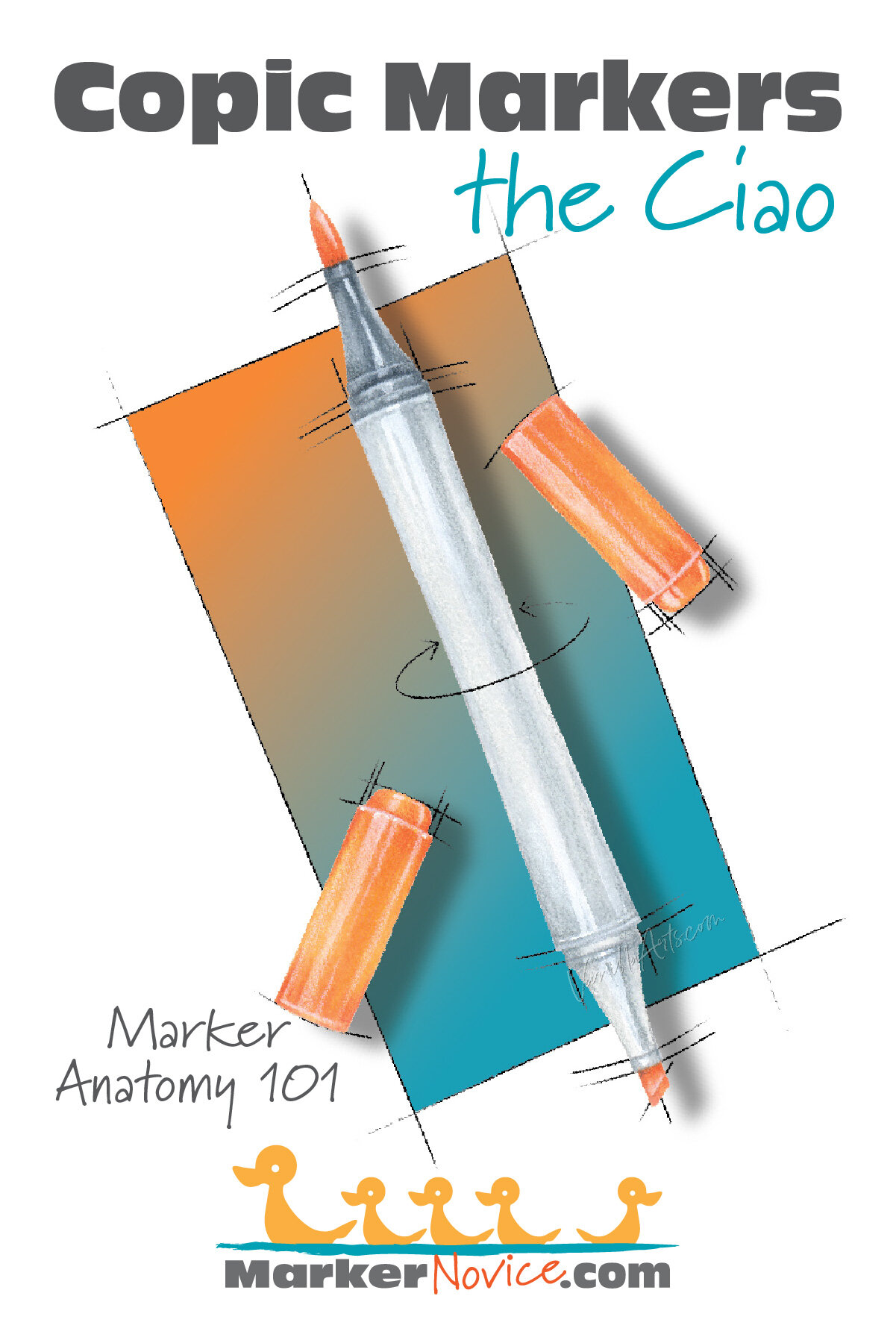
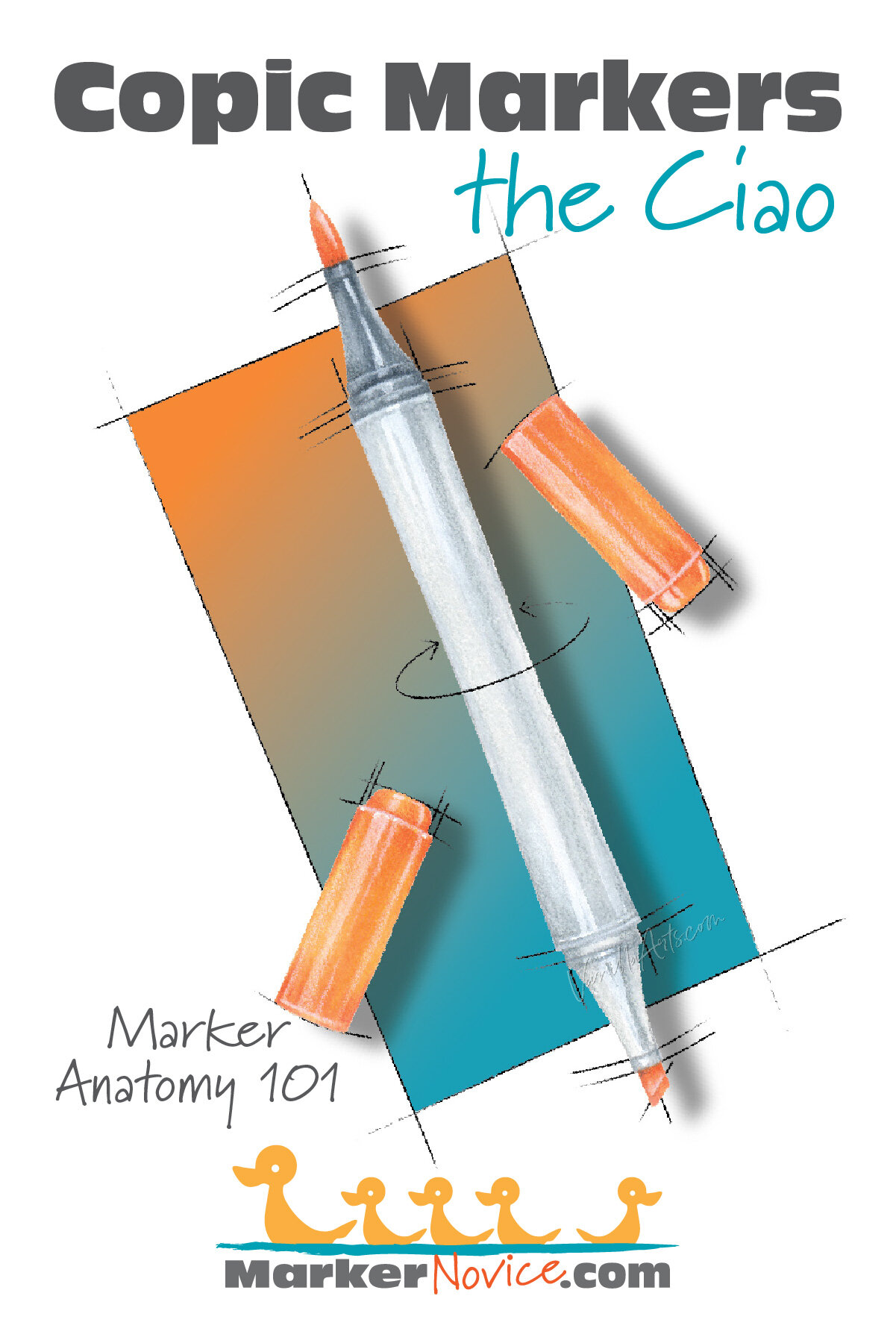
Copic Ciao Marker: All About the Ciao + Is This the Best Marker for You?
What’s a Copic Ciao Marker?
Getting ready to purchase your first Copic Markers?It’s easy to be overwhelmed by all the choices— Sketch, Ciao, Classic, Wide? What’s the difference anyway? Should you go cheap? Which nib is best?
Relax.
We’re here to help you understand which marker is best for you!

What’s a Copic Ciao Marker?
Getting ready to purchase your first Copic Markers?
It’s easy to be overwhelmed by all the choices— Sketch, Ciao, Classic, Wide? What’s the difference? Should you go cheap? Which nib is best?
Relax.
We’re here to help you understand which marker is best for you!
Copic Ciao Markers
Ciao style Copic Markers are an introductory budget conscious marker aimed at beginners and children. Ciao are designed for coloring and blending, sharing the same chisel and Super Brush nibs as the more expensive Copic Sketch. The Ciao does have drawbacks- a limited color range and a small ink capacity.
Let’s look closer at why the Copic Ciao may or may not suit your coloring goals.
Ciao Marker Overview
The Copic Ciao Marker is a starter level marker developed as an affordable alternative to the Copic professional styles. The target market for these markers is children and beginners which likely explains my serious love/hate relationship with them.
Before you write me off as an expensive marker snob, please read on. I honestly believe that people need to know ALL the pros/cons about the Ciao in order to decide which Copic is best for their own needs.
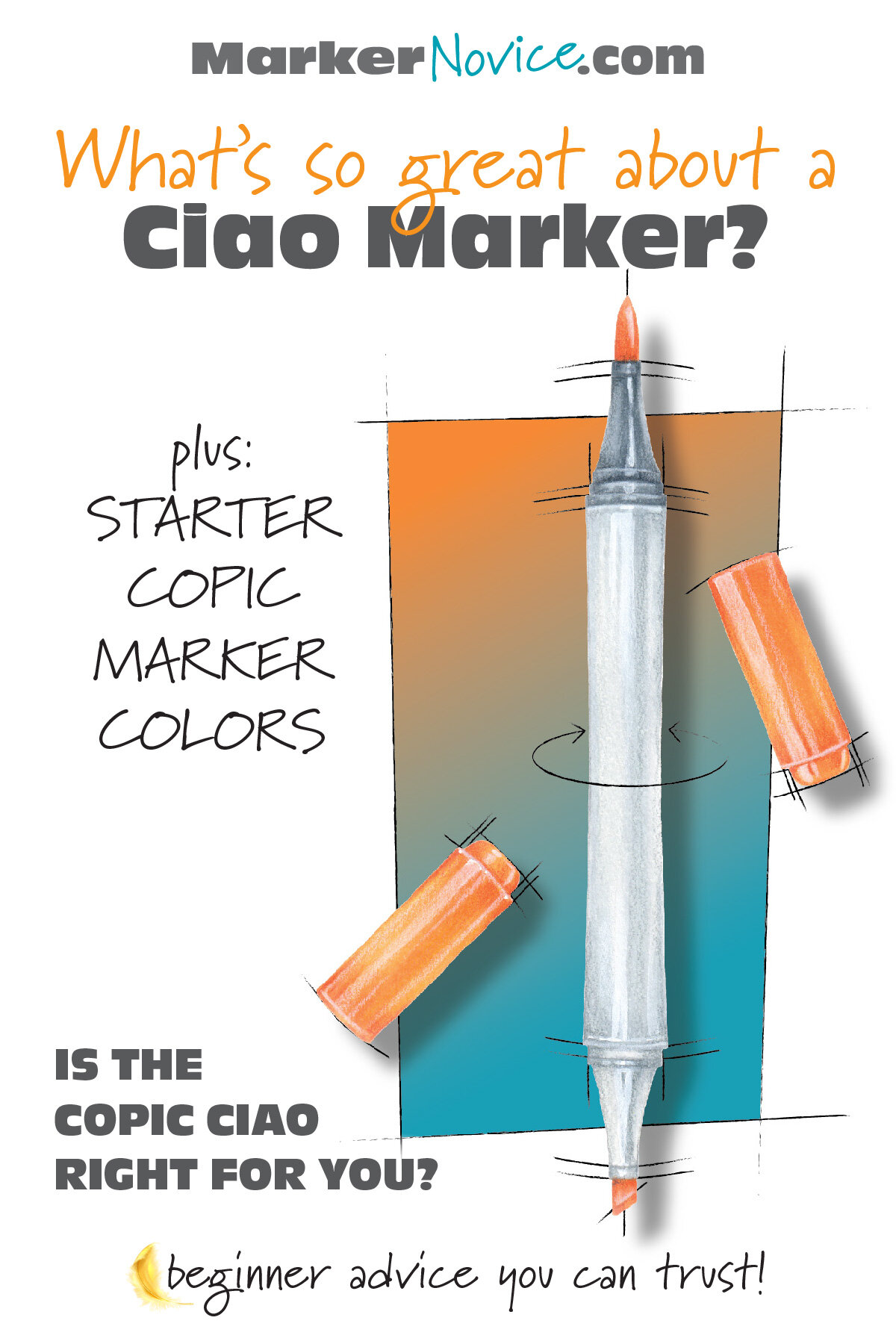
Ciao have a thin round barrel which is extremely lightweight feels more like a pen or pencil than any of the other Copic styles.
Portability is a key feature of the Ciao. They excel as a travel style Copic, perfect for classes, vacation, or even just moving to the bedroom for an evening of coloring. .
Copic Sketches are dual ended and come standard with excellent coloring nibs— the Super Brush Nib (the best blending nib on the market) and a Medium Broad Nib ( great for drawing). A gray band indicates the brush nib end.
Ciao are available in a limited range of 180 colors; many bright & happy hues.
Ciao are easily collectable markers. Too offers many starter sets of two, five, or six Ciao, sometimes in combination with Multiliner pens and Spica Glitter pens.
Ciao are refillable (further details below) which is important because the Ciao has a small ink receptacle that needs frequent refreshes.
FUN FACT: Ciao caps are child-proof; they’re designed to not block the airway if someone swallows one.
Who are Ciao Markers For?
It’s interesting how many people get upset when I refer to Ciao as “kid markers”. But how else would you describe a marker that features no-choke caps, sized for small hands, features Disney characters, and can be purchased in bulk for schools?
So yes, it’s a junior marker…
But folks, it’s a pretty darned good one!
Ciao are an excellent introductory Copic for anyone new to markers. They feature excellent nibs, premium ink, and a budget friendly price.

Can’t get better than that, eh?
Copic Ciaos may be marketed to beginners but the nibs make them awesome.
Super Brush Nibs excel at flooding spaces with generous swaths of color. This is especially important for smooth blending where moisture is the key to best results.
Super Brush Nibs are also good for filling large areas. I frequently color images as large as 18x24” with Copic Sketch Markers.
Lettering artists and modern style calligraphers also tend to favor the Super Brush Nib. It’s a springy, reactive nib which gives an expressive multi-weight line depending upon the amount of pressure used.
Copic Sketch Markers are ill-suited for drawing, detail work, and small coloring projects.
Sketch are often overkill for card-makers using stamp images less than 3” in size.
WE ASKED! All Vanilla Arts students who prefer Ciao markers also own a few Sketch markers. The Ciao isn’t available in many of our frequently used colors!
Copic Ciao Caps
Ciao caps are very colorful and are a large part of the appeal of Ciao markers. They simply look fun to use!
Ciao caps display of the ink color inside the marker. A few cap colors are not an exact color match… but remember, we select markers based on numbers rather than cap colors.
Ciao caps do not indicate the marker name or number (See design flaw 1 below.)

Ciao caps are interchangeable from end to end. Caps have a click lock which serves as a hepatic indication that you’ve closed the marker securely but it should be noted that because the Ciao plastic is softer and more flexible, this cap lock feels less and less secure over time with repeated use.
The caps also feature a bump at the rim which is intended to keep this round marker from rolling off a desk or table. It does not work. These lightweight markers roll and skitter with the slightest touch.
I recommend that you twist the caps to remove rather than pull straight off (which causes splatter).
Now for the sad news:
CIAO CAP DESIGN FLAW 1: The Copic numbers are NOT printed on the caps which means you can not quickly identify Ciao markers if they’re laying in a pile or nicely stored in a beautiful display rack. The only way to correctly identify a Ciao is to read the side of the barrel which wastes time and slows you down. This is a major fault because I can’t count the number of times a Ciao student has mistakenly used the wrong marker in class!
Note: You’ll find many tutorials for labeling Ciao caps but NONE of them are permanent solutions, they all peel off or wear off. I think it’s ridiculous to pay for a Copic and not receive cap numbers!
CIAO CAP DESIGN FLAW 2: The economy design for Ciao caps (which minimizes plastic used) created a design flaw that can damage your markers.
Be very mindful when re-capping a Ciao! There is a sharp ridge inside the cap which will cut into your nib if the cap is not properly centered around the nib. I’ve damaged more than one nib by not paying attention as I capped the marker.
HORIZONTAL OR VERTICAL? What’s the best way to store your Ciao Copics? Honestly? It doesn’t matter.
Copics are not gravity-fed and the ink has no sedimentary particles. This means you can store them however you’d like.

Ciao Numbering + Identification

All Copics use the same numbering system and the same refill inks.
The Copic number and color name is printed (NOT laser etched) in dark gray on the body of a Ciao Marker along with brand details. Symbols indicate the brush and chisel ends.
The printed lettering can eventually wear off. The other Copic styles have laser etched labeling and they are much more durable than the printed Ciao.
CIAO FLAW: There are NO color numbers or name markings on Ciao caps.
See the segment above for my strong feelings about this issue.
A thin, darker gray band indicates the brush nib end. The band is on the marker body, not the cap.
Ciao Nib Options
Copic makes replacement nibs for Ciao and all of their other marker styles. Nibs wear out and can get damaged but they’re easily replaceable.
WARNING: Dried, crusted, or hardened nibs can be replaced BUT the nib is not the only part damaged when a marker runs dry. The core inside the marker is made of a similar material and often hardens along with the nib. A nib can be replaced but you can not replace a core. A damaged core requires full marker replacement.
Copic makes many alternative nib options. UNFORTUNATELY, NONE OF THEM FIT CIAO MARKERS. When you buy a Ciao, you are stuck with the Super Brush and Chisel nibs. You can replace but not upgrade or customize your Ciao nibs.
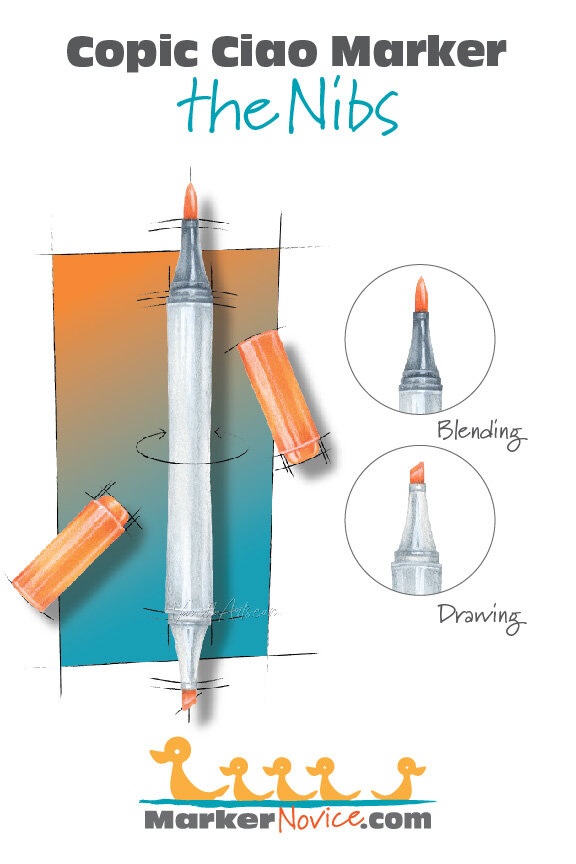
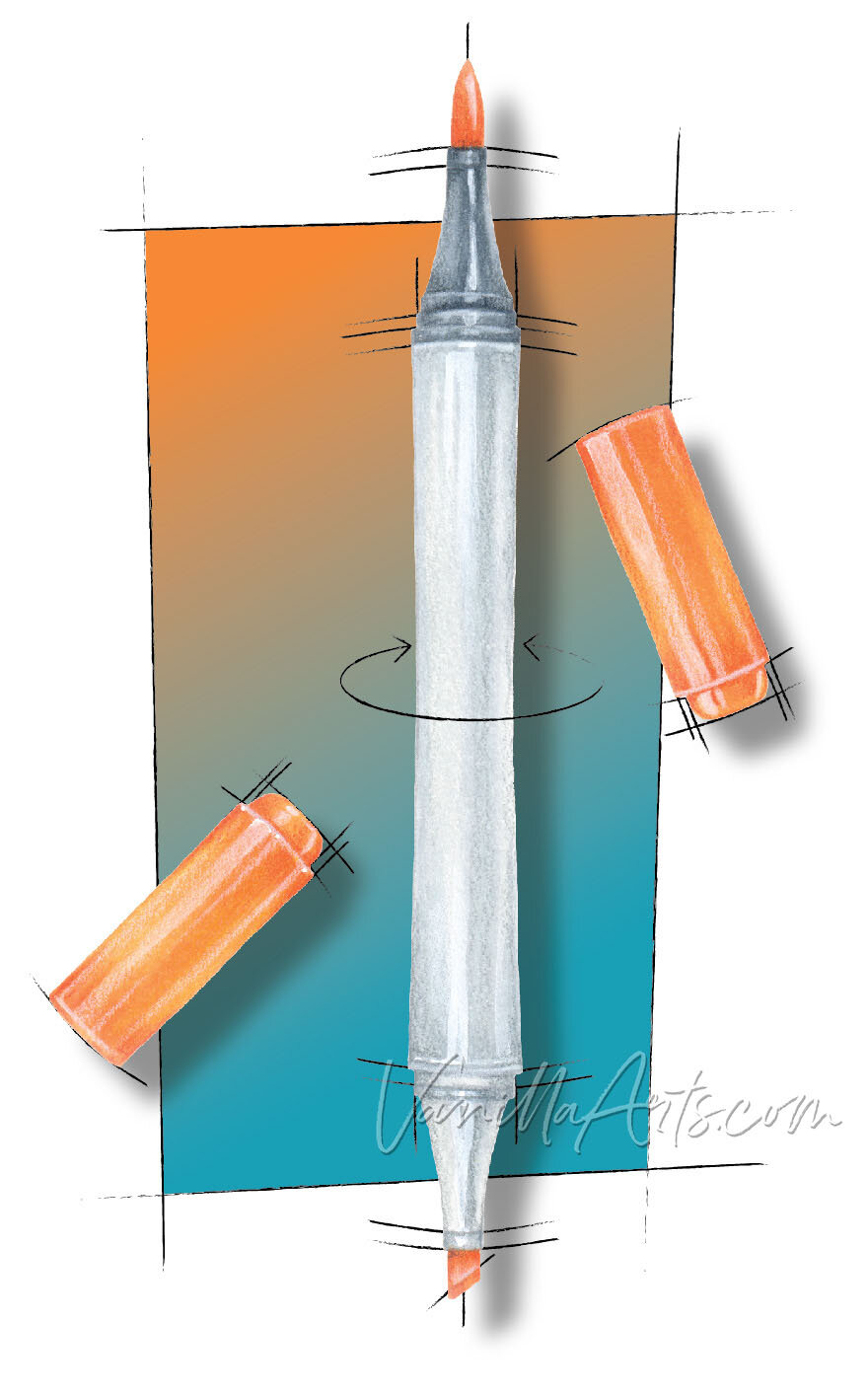
Ciao Standard Nib 1: Super Brush Nib. (Do not confuse the Super Brush with the Copic Round Brush Nib which fits Classic Markers only.)
The Super Brush Nib is an extremely juicy and springy nib which responds to changes in hand pressure. S.B. nibs excel at blending and filling larger areas because they deliver more ink to the paper than any other Copic nib.
The S.B. nib rests in the dark gray end of the marker.
WARNING: When refilling a Copic Sketch, I recommend you do not refill from the brush end (more details in the refill section below).
Ciao Standard Nib 2: Medium Broad Nib (chisel)
Copic users almost always refer to this as the “chisel nib” and many colorers ignore this nib entirely.
Chisel nibs are an old-school drawing nib capable of 3 different line weights. Chisel nibs are not generous with their ink flow and thus are not suitable for blending. Chisels are very firm and need to be broken in (softened a bit) before they give an even line with no skips or flow breaks.
The Chisel nib rests in the pale gray end of the marker.
I recommend refilling from the chisel end for ease and safety (more details in the section below).
WARNING: Copic makes more than a dozen different replacement nibs. The two listed here are the ONLY nibs which fit in Copic Ciao Markers.
BEST BUY? Consider purchasing a used Copic collection. Properly maintained Ciao Copics look and work like new! Many users upgrade from Ciao to Sketch Copics, so it’s easy to find whole Ciao sets for sale in online marker groups.
Refill a Ciao Marker
All styles of Copic use the same numbering system and the same refill inks. See the full Ciao color palette at Copic’s official website here.
A factory-weight Copic Ciao Marker should measure between 10.8 and 11 grams (with both caps on).
I do not recommend filling to factory weight as completely full markers are more prone to Copic Volcanoes (see my article at VanillaArts.com about volcanoes.)
I refill Ciaos to 10.6 grams (with both caps on). This weight is full enough for optimal blending but not so full that the markers leak.
Like all Copic markers, performance decreases and blending becomes more difficult as the marker empties. Noticeable blending changes begin at about 10.1 grams and you will encounter blending impairment at weights lower than 9.8 grams. This can be as few as 2-3 uses for your most-used colors!

It is a myth that Copics can go for years without refilling. The first thing I check when a student can’t blend well is their marker weight. I’ve seen markers as low as 11 grams! Read my article about common Copic Myths here and read details about Blending Issues at our sister site, VanillaArts.com.
Overfilling leads to marker leakage.
For accuracy, I recommend refilling by weight rather than the drip method. I find most drop recommendations to be wildly wrong. “10 to 12 drops” doesn’t tell you the size of the drop or how low the marker was to begin with. In my tests, 10 drops doesn’t come close to restoring an ideal weight.
See my refilling recommendations at VanillaArts.com which includes a link to a great weight refilling tutorial by Michelle Houghton from Copic in the Craft Room.
WARNING: To refill efficiently, you should remove one nib from your Ciao marker. I do not recommend removing the Super Brush Nib as this can easily damage the brush nib. Copic Tweezers are meant to reduce brush nib damage but it’s much safer and far easier to refill from the chisel end.

Is the look of your collection important? Be aware that most Ciao users have a mixed collection of Ciao + Sketch. The limited color range for Ciao makes a total-Ciao collection very hard for artists.
(But it’s not bad for occasional hobbyists!)
Personal Thoughts:
I use Sketch exclusively but I’ve owned a few Ciaos over the years.
I originally owned the square barreled Classic style because that was what existed at the time. I traded those in for Sketch markers later. I had most of my current collection before Ciaos were even invented.

I recommend Sketch rather than Ciao to all my artistic coloring students because I teach with many colors that are unavailable in the Ciao style. But honestly, Ciaos color just as well as Sketches.
If you’re on a budget, Ciao Markers are a very good beginner option.
I simply can’t endorse them fully because of the limited 180 color palette which is missing some of my most frequently used colors. The cap has design flaws which can damage the nibs if you’re not paying attention, will stretch over time, and the lack of cap numbers is very concerning. If you skipped around in this article, please read the cap section for further details on these issues.
Ciao have a couple of other minor drawbacks— Ciao must be refilled frequently, especially in my classes where we color larger image. And while this is anecdotal, they seem to be more prone to leakage and volcanoes.
I recommend Sketch over Ciao because of the larger Sketch color range and I really dislike the Ciao caps.
I recommend Ciao over Classics because of the Super Brush Nib.
I don’t completely dislike Ciaos and if you’re on a budget, I highly encourage you to purchase Ciaos. I simply don’t think Ciao are a lifetime marker and Sketches are a better value over the long run.
Amy Shulke is a professional technical illustrator who has used Copic Markers at school, work, and home since 1990. She teaches artistic coloring classes online at VanillaArts.com and locally in south-eastern Michigan.
Marker Novice is Amy’s completely free resource devoted to beginner marker education. For intermediate/advanced artistic coloring articles, see her Studio Journal here.



Click to receive Marker Novice & Vanilla updates in your Pinterest feed


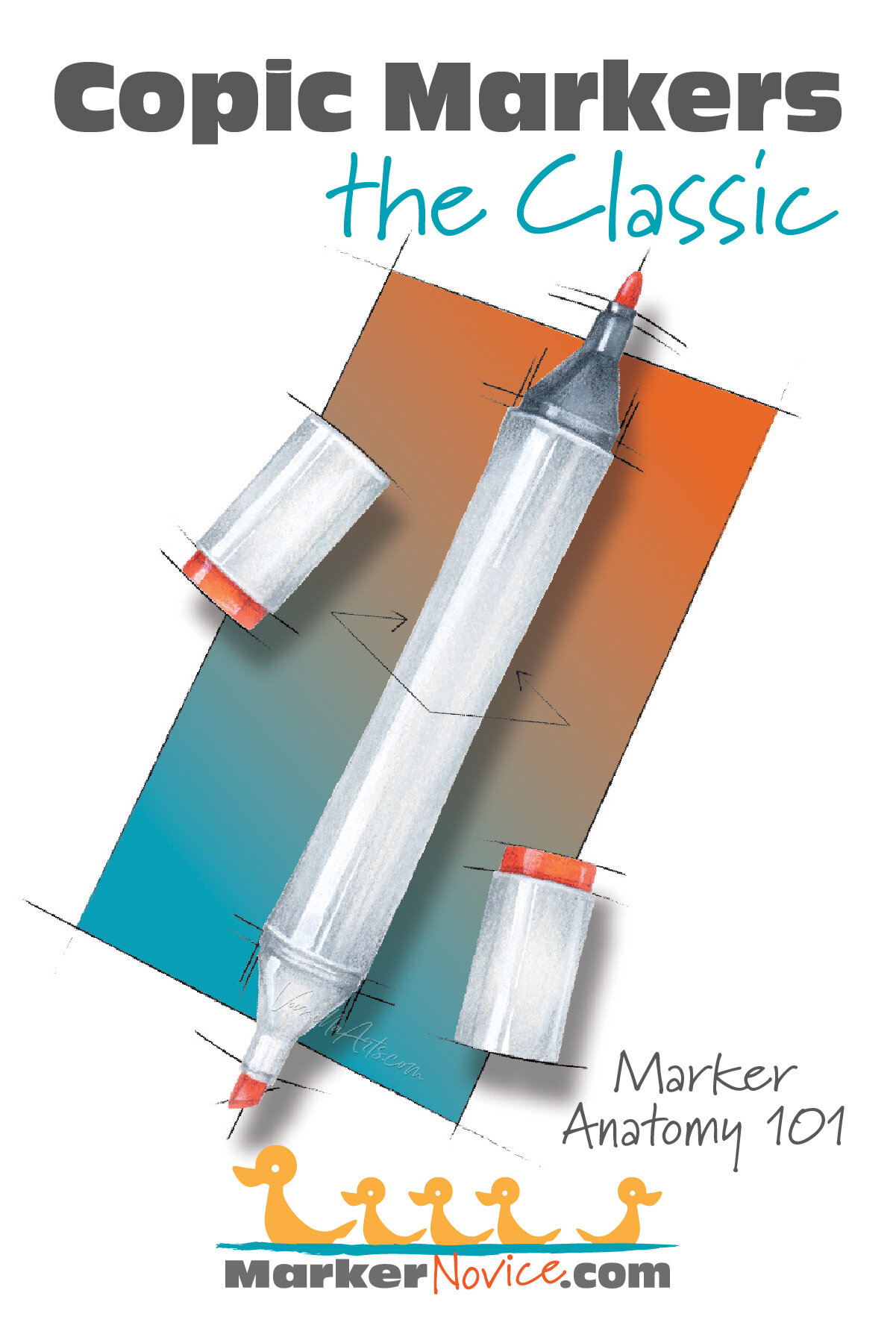
Copic Classic Marker: All About the Original Copic + Best Drawing Nibs
What’s a Copic Classic Marker?
Getting ready to purchase your first Copic Markers?
It’s easy to be overwhelmed by all the choices— Sketch, Ciao, Classic, Wide? What’s the difference? Should you go cheap? Which nib is best?
Relax.
We’re here to help you understand which marker is best for you!


What’s a Copic Classic Marker?
Getting ready to purchase your first Copic Markers?
It’s easy to be overwhelmed by all the choices— Sketch, Ciao, Classic, Wide? What’s the difference? Should you go cheap? Which nib is best?
Relax.
We’re here to help you understand which marker is best for you!
The Original Copic
Classic or Original Copic Markers are designed for drawing, with controlled ink flow and consistent line width. They feature a hard bullet nib and a chisel nib. The Classic is the most customizable of all Copics with alternative replacement nibs for calligraphy or fine lines.
Let’s look closer at why Classic Copics may or may not suit your coloring goals.
Classic Marker Overview
The Original Copic Marker was introduced in 1987 as a professional tool for Japanese designers (architecture, fashion, landscape, product, etc.). Comic artists worldwide soon started to prize the Copic as an exclusive and somewhat secretive marker.
The Too corporation made the markers easier for artists to track down (although they were scarce for a long time) and then developed several other styles. The original marker is still in use today and is now referred to as a Classic Copic.
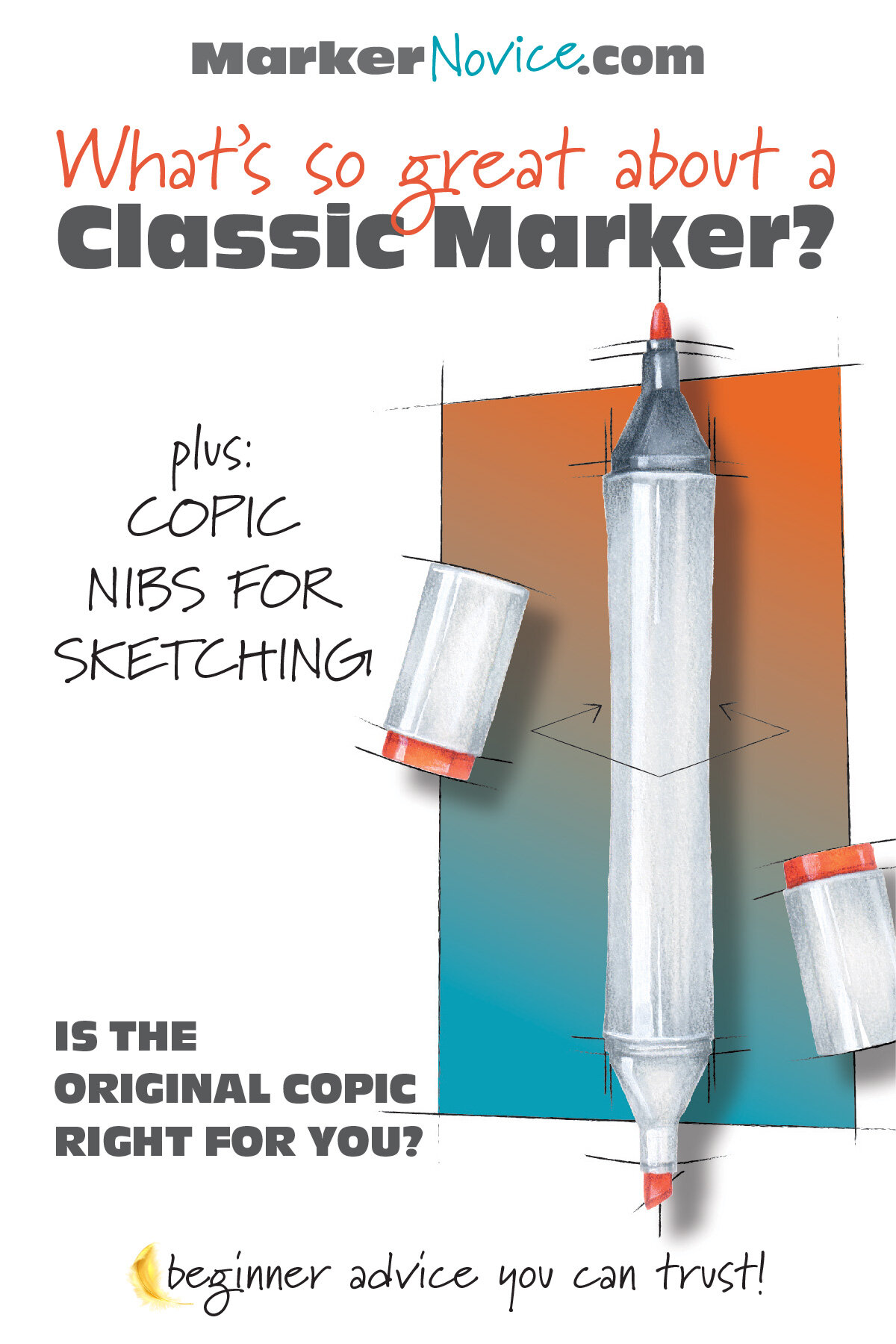
You may hear them called a “Square Copic” in online communities.
Classics have a square shaped barrel which fits nicely into your hand. The edges are rounded, not sharp— if you’ve ever experienced the sharp corners of many competitor brands, you’ll understand how important a rounded edge is. They simply feel good in the hand.
The Classic is a noticeably oversized tool which offers comfort to those with hand arthritis, carpal tunnel syndrome, tight grips, or those who color for extended periods.
The flattened sides are supposed keep the Classic from rolling off your desk… although I’ve proven this theory wrong on more than one occasion.
Classic Copics are dual ended and come standard with a Fine (bullet) Nib and a Medium Broad (chisel) Nib. A gray band indicates the brush nib end.
The Classic is available in 214 colors, including a #0 colorless blender.
Classics are refillable (further details below).
The Classic Copic has the largest ink receptacle of all the Copic Markers. It holds more than the Sketch and significantly more than a Ciao. Combine the large receptacle with the Classic’s dryer nibs and you get a Copic that doesn’t need to be refilled as often as other markers.
FUN FACT? I purchased my first Copic Markers in 1992 as part of a secret artist’s overseas group purchase. We felt like spies. They were Classic Copics.
Who Are Classic Markers For?
You’ve seen Sketch and Ciao markers everywhere. They’re all over blogs and YouTube videos. Some of you may even be scratching your head right now:
“I didn’t even know there was a square barrel Copic!”
Frankly, I’m not surprised that so few people know about them.
Classics are the most mis-understood of all the Copic styles.
Classic Copics are the perfect drawing marker.
In fact, they’re the only true design marker Copic makes. They were created for sketching out designs, NOT FOR COLORING.

Classic nibs are control specialists. The nibs are ultra firm which means no matter how hard you press, you get a consistent and stable line weight. The nibs are purposefully on the dry side, allowing you to make precise marks that do not feather.
Pssstttt… May I point out that this is the exact opposite of what you need for coloring and blending?
Original Copics are a used for general purpose design work in commercial settings. They’re a standard drawing tool in design departments, used by architects, landscape design, product design, fashion design, commercial art and production, illustration and art direction. Classics are also favored by lettering artists (calligraphers may prefer the brush nibs but lettering designers are traditionally trained with bullet nibs and computers).
As marker users shifted from drawing to coloring, improvements to the Classic were needed. That’s where the Sketch Marker with its Super Brush Nib comes in. Brush nibs are juicier and cover larger areas smoothly, so they’re better suited to coloring. Classics are great markers, they’re just not great for coloring.
If you’re drawing and sketching, you want the Classic Copic.
And if you want a custom marker, the Classic is the marker for you.
WE ASKED! Only 2% of Vanilla Arts students use Classic Copics. Of those that do, most have upgraded the chisel nib to a brush nib.
Classic Copic Caps
Classic caps match the pale gray color of the marker body.
The ends of Classic caps feature plastic color indicators which are intended to match the ink color. A few cap colors are not exact matches but they’re close. A few color ends are translucent plastic but most are opaque; there is no obvious reason for the translucent plastic.
Classic colored cap ends are laser etched with the color number and name. (More on this in the next section.)
Classic caps are interchangeable from end to end. No need to keep them straight, they’re identical. Because the barrel is square, these are the easiest of all the Copic Markers to cap and uncap. They’re stupid-simple.
The caps nest which means you can store the cap on the opposite end while you color. I wish the Sketch caps would do this!
Classic caps feature a secure click lock which serves as a hepatic indication that you’ve closed the marker securely.
I recommend that you twist the caps to remove rather than pull straight off, to prevent ink splatter.

Classic Numbering + Identification
All Copics use the same numbering system and the same refill inks.

The Copic number is laser etched in dark gray on the body of a Sketch Marker along with brand details. The color name is not listed on the barrel, only the number. Symbols indicate the brush and chisel ends.
The etched lettering does not wear off.
The Copic number AND the color name are laser etched on the end of both caps.
Black etching on pale colors and white etching on dark colors.
Because the numbers and names are on the end of the cap, it’s easy to select Sketch markers from upright storage. This is a definite advantage over the Ciao and Wide marker styles which have no end-cap markings.
A thin, darker gray gap between the cap and the barrel indicates the bullet nib end. The gap on the chisel end is pale gray. The gaps are not true gaps
Customize your Classic: Nib Options
Copic makes nine different nibs for Classic Copics. This is not true of the other styles which have just the standard replacement parts but few customizable options.
Nibs do wear out and can get damaged but they’re easily replaceable.
WARNING: Dried, crusted, or hardened nibs can be replaced BUT the nib is not the only part damaged when a marker runs dry. The core inside the marker is made of a similar material and often hardens along with the nib. A nib can be replaced but you can not replace a core. A damaged core requires full marker replacement.
Professional Copic users upgrade their Classic Markers with custom nibs designed for the kind of work they do most.
Classic Standard Nib 1: Fine Nib
The Fine Nib is a firm bullet nib which provides maximum control, even ink flow, a fine line, and is perfect for small details.
This nib sits on the dark gray end of the Classic marker and can be replaced by several detail nibs (listed below).
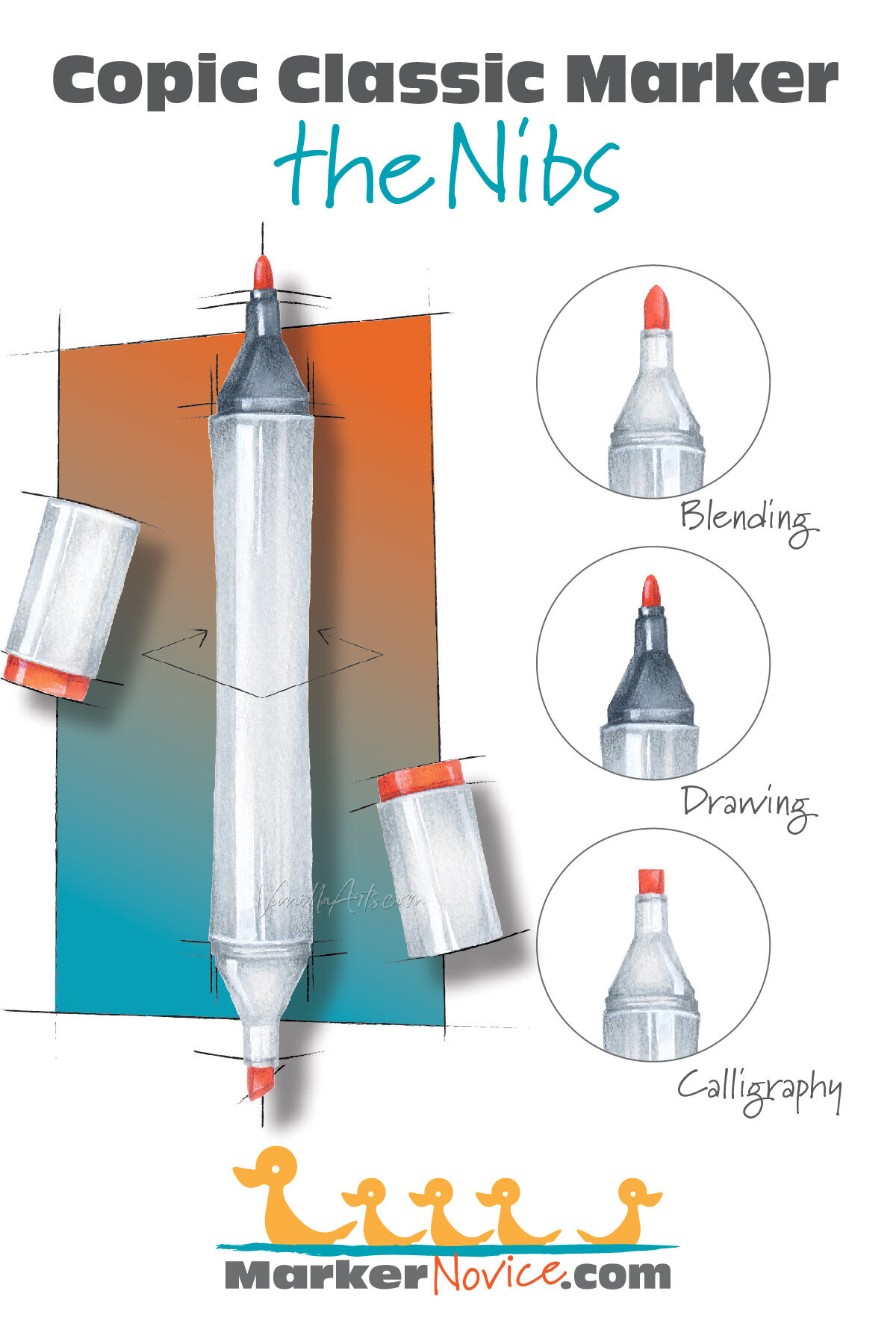
Classic Standard Nib 2: Medium Broad Nib
Copic users almost always refer to this as the “chisel nib” and many colorers ignore this nib entirely.
Chisel nibs are an old-school drawing nib capable of 3 different line weights. Chisel nibs are not generous but they are extremely consistent in ink flow. Chisels are very firm and need to be broken in (softened a bit) before they give an even line with no skips or flow breaks.
The Chisel nib rests in the pale gray end of the marker and can be replaced by several larger nibs (listed below).
RECOMMENDATION: Colorers who want to blend should replace the chisel nib with a Classic Brush Nib (listed below).
Classic Replacement Nib Options (Light Gray End):
Super Fine Plastic - the thinnest line a Copic can make
Semi Broad - a small chisel nib, ideal for design drawing
3mm Calligraphy - a flat nib for traditional pen lettering.
Classic Replacement Nib Options (Dark Gray End):
Classic Brush - a brush style nib for Classics. Smaller and less juicy than a Super Brush nib but highly recommended if you want to blend with a Classic.
WARNING: Classic markers are not intended for blending. If your goal is to do marker blending techniques, please purchase either Sketch or Ciao markers. The Classic Brush Nib kinda blends but not nearly as well as the Super Brushes on Sketch and Ciao Markers. Classic Brushes are smaller, firmer, and less juicy, all three things make blending harder!
NOTE: It can be confusing to tell a Super Brush from a Classic Brush nib online. The Classic Brush is the only nib with a metal collar on it.
Soft Broad - similar to the standard chisel but softer for a more generous ink application
Classic Round - a large bullet nib for control and even weight lines
5mm Calligraphy - a larger flat calligraphic nib to complete the transformation of a Classic into a Copic Calligraphy Marker.
WARNING: Not all nibs fit on all Copics! Classic nibs are all thinner than Sketch or Ciao nibs. Please double check before you purchase.
BEST BUY? Consider purchasing a used Copic collection. Copics can last a lifetime. Well-kept Copics look and work like new!
Refill a Classic Marker
All Copics use the same numbering system and the same refill inks.
See the full Classic color palette at Copic’s official website here.
A factory-weight Copic Sketch Marker should measure about 20 grams (with both caps on).
I do not recommend filling to factory weight; this decreases the odds of Copic Volcanoes (see my article at VanillaArts.com about volcanoes.)

It is a myth that Copics can go for years without refilling. Because Classics tend to be stingier with ink flow than Sketch or Ciao styles, it’s especially important to keep your Classics near-to-full. A Classic marker simply won’t squeak or skip until they’re dangerously low on ink. By danger, I mean your dry Classic may be hardening inside and there’s no fix for this issue. You can kill a Classic by letting it get too low on ink.
Remember: Overfilling leads to marker leakage.
For accuracy, I recommend refilling by weight rather than the drip method. I find most drop recommendations to be wildly wrong. “10 to 12 drops” doesn’t tell you the size of the drop, how low the marker was to begin with, and in my tests, 10 drops doesn’t come close to restoring an ideal weight.
See my refilling recommendations at VanillaArts.com which includes a link to a great weight refilling tutorial.

CHECK FIRST! Beginners often mistakenly purchase Classics because they look similar to Sketch online. AVOID CLASSICS IF YOU WANT TO BLEND!
Personal Thoughts:
My first Copics were Classics and I used them for several years. When I moved from school to a professional design studio we used a mix of Classics, DeSign Markers, and Prismacolor Markers.
When I started painting with markers, I sold my Classics and gradually purchased Sketch Copics. They’re better for blending and large scale artwork.
I do not recommend Classics to colorers who want to blend.
This is because you must retro-fit a Classic for blending and even then, it’s still not as good as a Sketch or Ciao.
If you’re a card maker who only colors SMALL images, you can almost get away with Classics due to the size of your projects. But you can never work larger. Why buy a marker that limits your future options?
And there’s the trap. I mentioned before that many beginning colorers accidentally purchase Classics. Why?
Many beginners don’t realize there are alternative Copics. They assume everything is either Sketch or Ciao.
Classics look very similar to Sketch online. If you don’t know to look at the shape of the colored end-cap, it’s very easy to be fooled.
Classics are usually less expensive than Sketches. Sometimes beginners assume they’ve found a great sale.
Colorers sometimes read the description and get scared by the words SUPER BRUSH NIB. Let’s face it, the Super Brush looks gigantic! Meanwhile we all know about bullet nibs and they sound a lot easier. They don’t realize a bullet is wrong for blending.
I do not recommend Classic Copics for colorers because they lock you into expensive retrofitting OR a lifetime of dinky sized projects.
But if you’re sketching or drawing, you should be using a Classic!
And if you’re into Calligraphy? A customized Classic is WONDERFUL!
Amy Shulke is a professional technical illustrator who has used Copic Markers since 1990. She teaches artistic coloring classes online at VanillaArts.com and locally in south-eastern Michigan.
Marker Novice is Amy’s completely free resource devoted to beginner marker education. For intermediate/advanced artistic coloring articles, see her Studio Journal here.

Click to receive Marker Novice & Vanilla updates in your Pinterest feed

Copic Sketch Marker: All About the Sketch + Why We Love Them!
What’s a Copic Sketch Marker?
Getting ready to purchase your first Copic Markers? It’s easy to be overwhelmed by all the choices— Sketch, Ciao, Classic, Wide? What’s the difference anyway? Should you go cheap? Which nib is best?
Relax.
We’re here to help you understand which marker is best for you!


What’s a Copic Sketch Marker?
Getting ready to purchase your first Copic Markers?
It’s easy to be overwhelmed by all the choices— Sketch, Ciao, Classic, Wide? What’s the difference? Should you go cheap? Which nib is best?
Relax.
We’re here to help you understand which marker is best for you!
What is a Copic Sketch Marker?
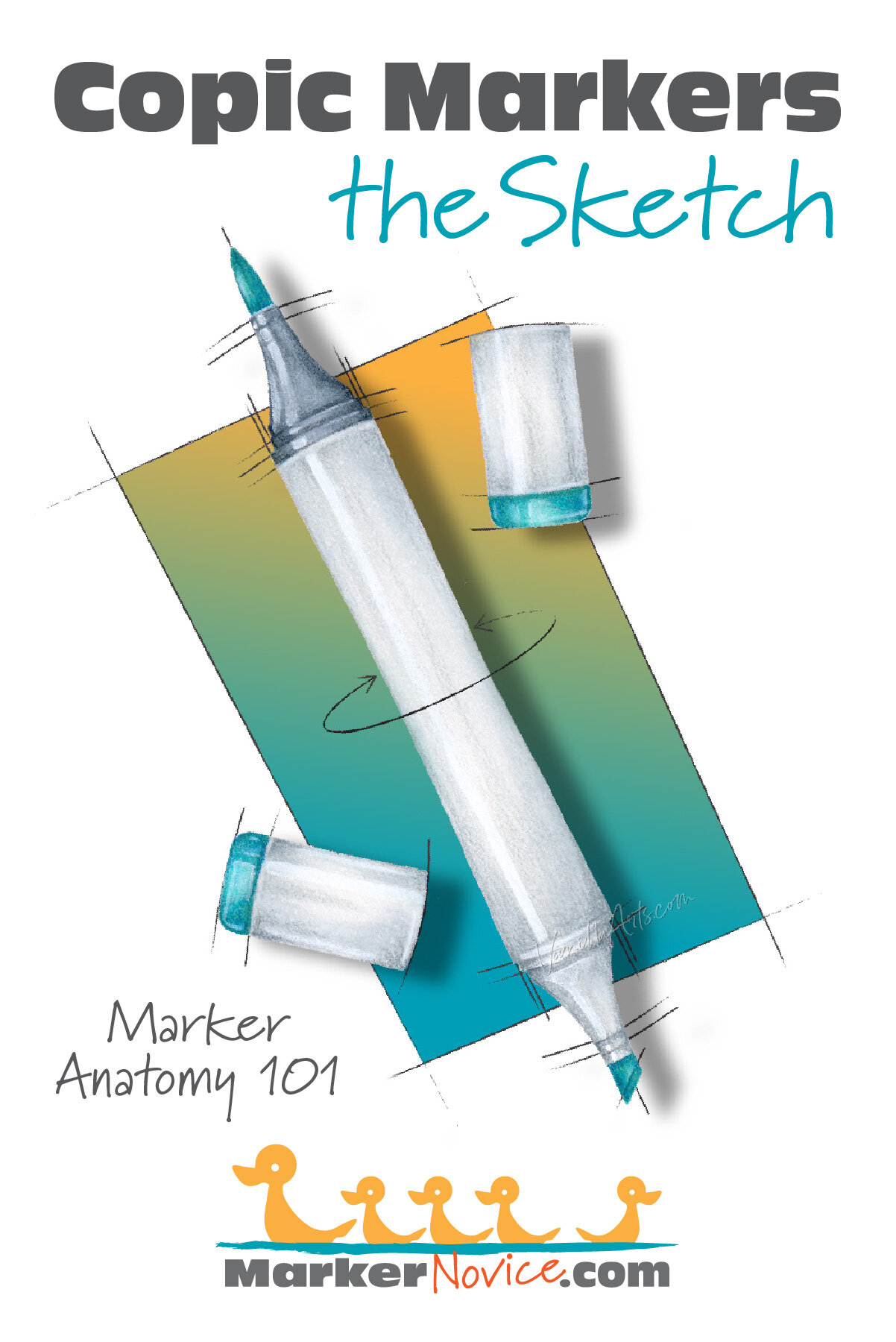
Copic Sketch Markers were designed for coloring. They are a juicy marker, making them ideal for blending and filling large areas with smooth color. The Sketch is Copic’s top selling style combining their exclusive Super Brush Nib, large ink reservoir, and a 358 color range.
Sketch Marker Overview
The Copic Sketch Marker was introduced in 1993. The Sketch is Too’s top selling marker style. They’re so ubiquitous that most people wrongly assume Sketches are the original Copic. The first Copics are actually what we now call a Classic but the Sketch with it’s improved design easily outsells the Classic.
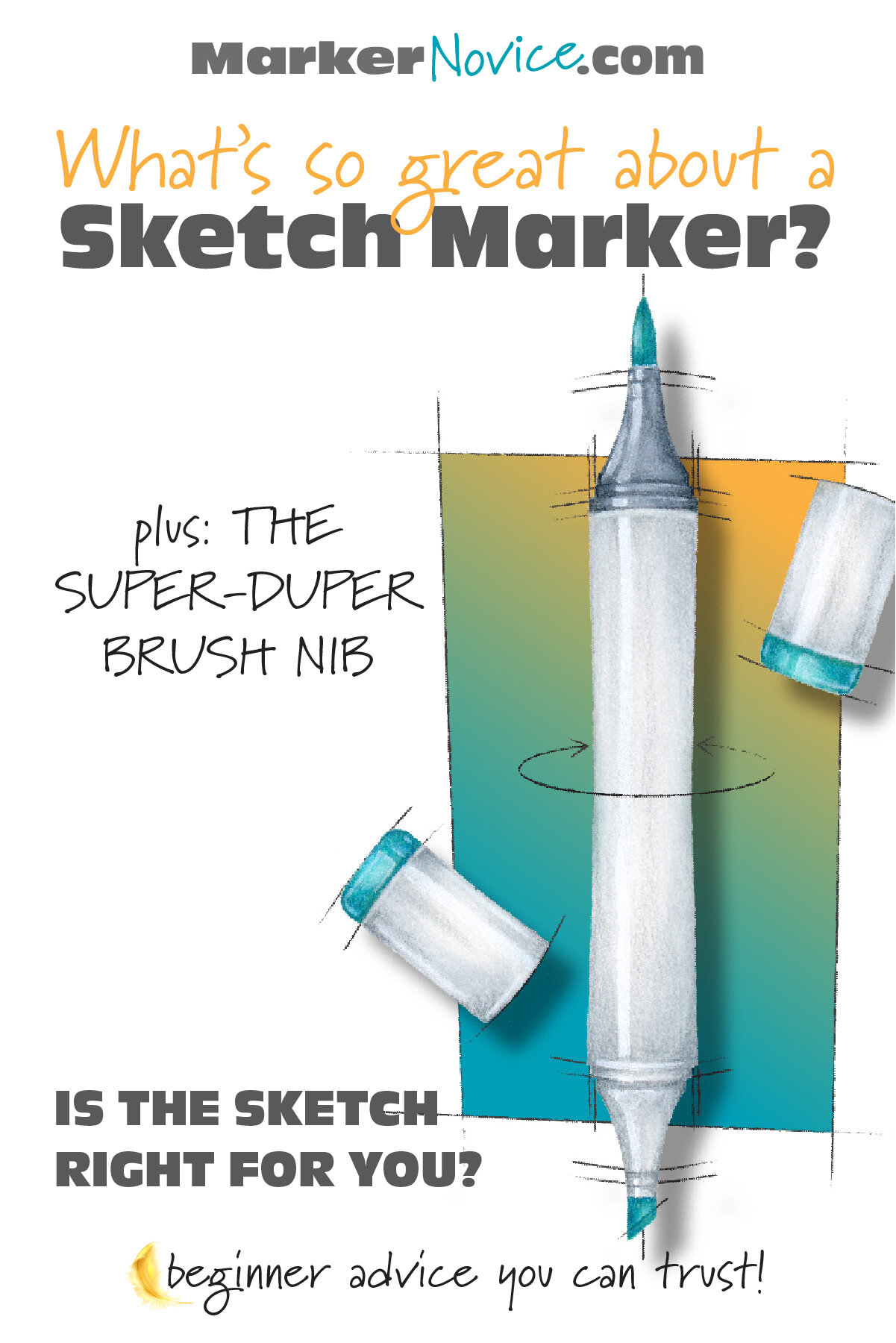
Sketches have an ergonomic flattened-oval shaped barrel which tucks nicely into your hand. It’s a slightly oversized tool which offers comfort to those with hand arthritis, carpal tunnel syndrome, tight grips, or those who color for extended periods of time.
The flattened sides keep the Sketch from rolling off your desk.
Copic Sketches are dual ended and come standard with a Super Brush Nib and a Medium Broad (chisel) Nib. A gray band indicates the brush nib end.
Sketch is the ONLY style of Copic available in ALL 358 colors.
To date, when Copic has introduced new ink colors, they’ve only offered them in the Sketch style.
If you’re someone who intends to collect every color and you will update your collection with future new releases, the Copic Sketch is your safest bet.
Sketches are refillable (further details below). The Sketch has a large ink receptacle. It holds less ink than a Classic but significantly more than a Ciao.
FUN FACT? I purchased my first Copic Markers in 1992. Yes, I’m old.
Who are Sketch Markers For?
Classic Copics (the original style) were primarily used by designers and comic, commercial, or storyboard artists. They’re an excellent drawing tool because they provide a consistent line with no bleed.
But as marker user shifted from drawing to coloring, improvements to the Classic were needed.
Sketches were developed for artists who want a juicier, more expressive stroke.
The Super Brush Nib makes all the difference.
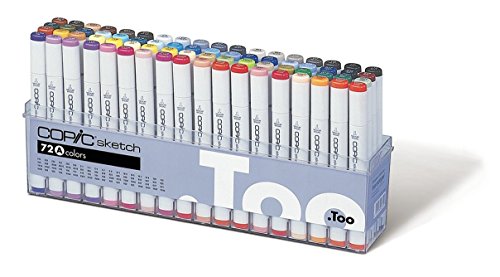
Super Brush Nibs excel at flooding spaces with generous swaths of color. This is especially important for smooth blending where moisture is the key to best results.
Super Brush Nibs are also good for filling large areas. I frequently color images as large as 18x24” with Copic Sketch Markers.
Lettering artists and modern style calligraphers also tend to favor the Super Brush Nib. It’s a springy, reactive nib which gives an expressive multi-weight line depending upon the amount of pressure used.
Copic Sketch Markers are ill-suited for drawing, detail work, and small coloring projects.
Sketch are often overkill for card-makers using stamp images less than 3” in size.
WE ASKED! 80% of Vanilla Arts students prefer the Sketch over other Copic styles.
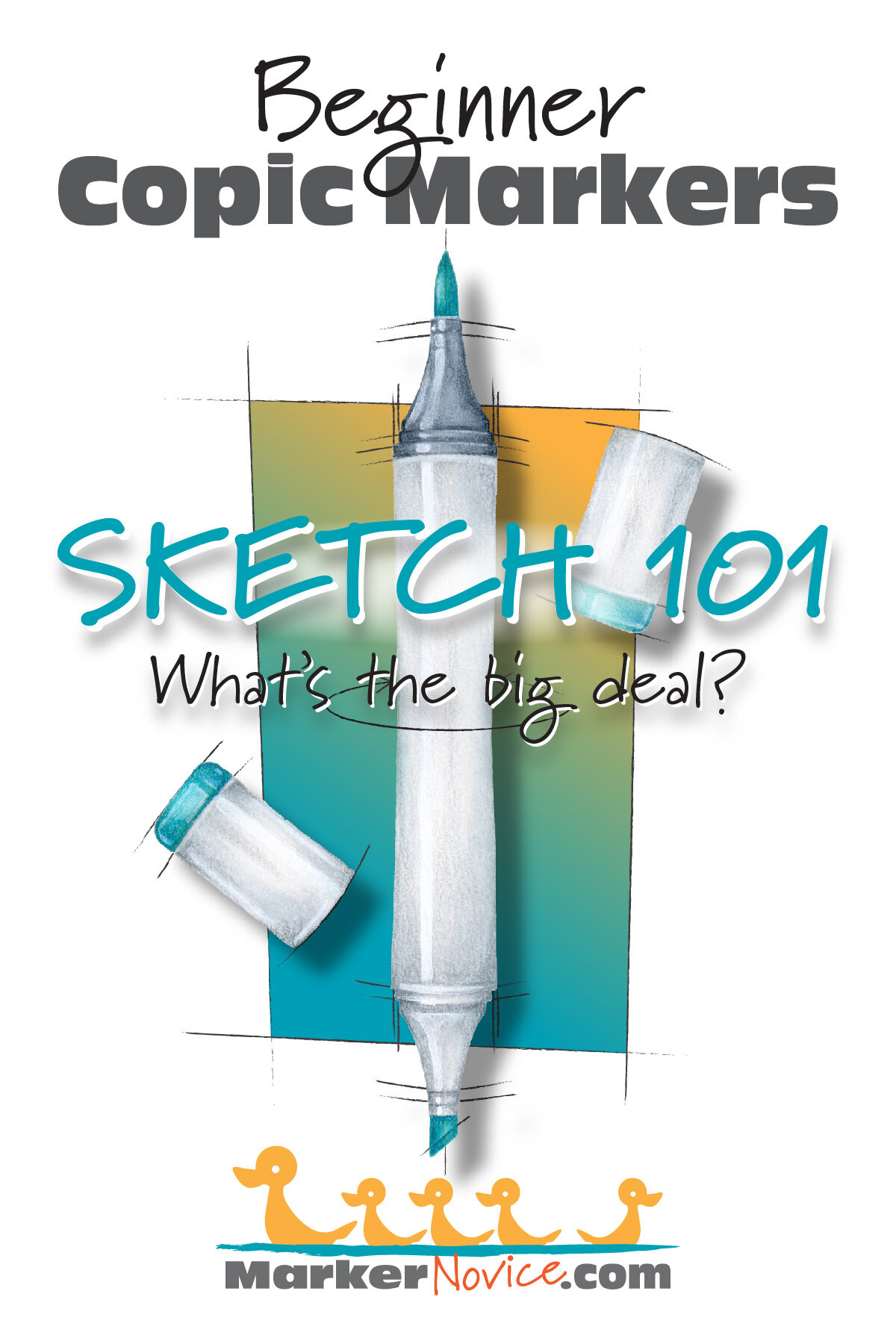
Copic Sketch Caps
Sketch caps match the pale gray color of the marker body.
The ends of Sketch caps feature plastic color indicators which are intended to match the ink color. A few cap colors are not exact matches but they’re close. A few color ends are translucent plastic but most are opaque; there’s no obvious reason for the translucent plastic.
Sketch colored cap ends are laser etched with the color number and name. (More on this in the next section.)
Sketch caps are interchangeable from end to end. No need to keep them straight, they’re identical.
Sketch caps feature a very secure click lock which serves as a hepatic indication that you’ve closed the marker securely. I’ve occasionally heard of Sketches drying out with the cap on but it’s so rare that I have my doubts. I’ve never personally had it happen.
I recommend that you twist the caps to remove rather than pull straight off, to prevent ink splatter.
Overall, I think Sketch caps are the best designed of all the Copic styles and they far surpass other brand caps in seal and security. The only downside to Sketch caps is that they do not nest, meaning you can’t store a Sketch cap on the opposite end while coloring. It’s a minor (but irritating) flaw.
HORIZONTAL OR VERTICAL? What’s the best way to store your Copics? Honestly? It doesn’t matter.
Copics are not gravity-fed and the ink has no sedimentary particles. This means you can store them however you’d like.

Sketch Numbering + Identification
All Copics use the same numbering system and the same refill inks.
The Copic number is laser etched in dark gray on the body of a Sketch Marker along with brand details. The color name is not listed on the barrel, only the number. Symbols indicate the brush and chisel ends.
The etched lettering does not wear off. A few of my markers are over 25 years old and they still look new.
The Copic number AND the color name are laser etched on the end of both caps.
Black etching on pale colors and white etching on dark colors.
Because the numbers are etched on the end of the cap, it’s easy to select Sketch markers from upright storage. This is a definite advantage over the Ciao and Wide marker styles which have no end-cap markings.
A thin, darker gray band indicates the brush nib end. The band is on the marker body, not the cap.
Sketch Nib Options
Copic makes a variety of replacement nibs for all of their markers. Nibs do wear out and can get damaged but they’re easily replaceable.
WARNING: Dried, crusted, or hardened nibs can be replaced BUT the nib is not the only part damaged when a marker runs dry. The core inside the marker is made of a similar material and often hardens along with the nib. A nib can be replaced but you can not replace a core. A damaged core requires full marker replacement.
Serious Copic users often install alternative nibs to upgrade their marker for specific tasks.
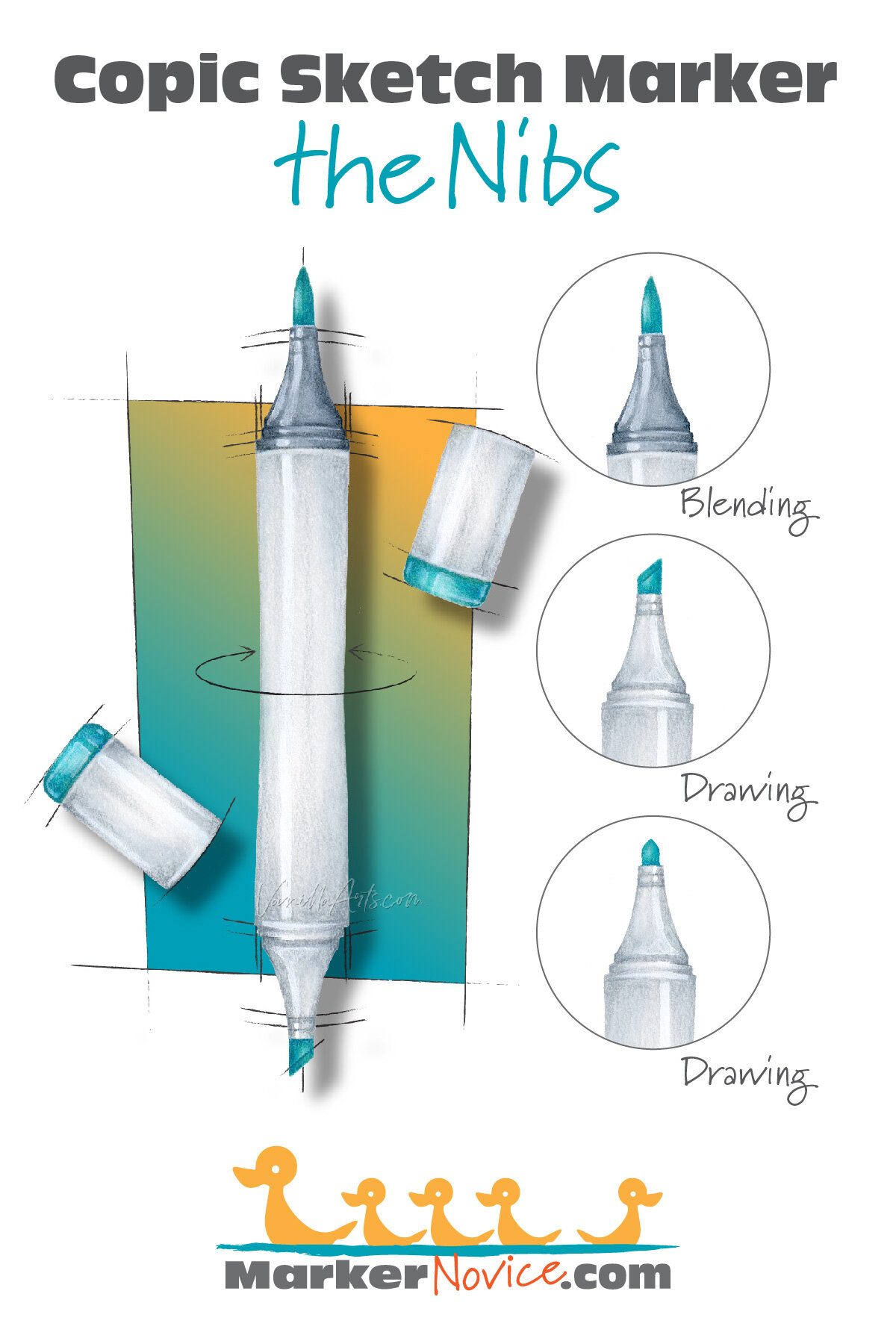
Sketch Standard Nib 1: Super Brush Nib. (Do not confuse the Super Brush with the Copic Round Brush Nib which fits Classic Markers only.)
The Super Brush Nib is an extremely juicy and springy nib which responds to changes in hand pressure. S.B. nibs excel at blending and filling larger areas because they deliver more ink to the paper than any other Copic nib.
The S.B. nib rests in the dark gray end of the marker.
WARNING: When refilling a Copic Sketch, I recommend you do not refill from the brush end (more details in the refill section below).
Sketch Standard Nib 2: Medium Broad Nib (chisel)
Copic users almost always refer to this as the “chisel nib” and many colorers ignore this nib entirely.
Chisel nibs are an old-school drawing nib capable of 3 different line weights. Chisel nibs are not generous with their ink flow and thus are not suitable for blending. Chisels are very firm and need to be broken in (softened a bit) before they give an even line with no skips or flow breaks.
The Chisel nib rests in the pale gray end of the marker.
I recommend refilling from the chisel end for ease and safety (more details in the section below).
Sketch Replacement Nib Option: Sketch Fine Point (bullet)
Ideal for lettering and detail coloring, the Sketch Fine Point is a firm bullet nib which provides maximum control, even ink flow, a fine line, and is perfect for small-ish details. This nib is designed to replace the Chisel nib and fits on the light gray end of the Sketch marker.
I recommend that card-makers and small stamp colorers switch to the fine nib on their most used colors (replacing all your chisel nibs can be costly). The fine nib is designed to replace the Chisel nib and fits on the light gray end of the Sketch marker.
WARNING: Copic makes more than a dozen different replacement nibs. The three listed here are the ONLY nibs which fit in Copic Sketch Markers.
BEST BUY? Consider purchasing a used Copic collection. Properly maintained Copics look and work like new!
Refill a Sketch Marker
All styles of Copic use the same numbering system and the same refill inks. See the full Sketch color palette at Copic’s official website here.
A factory-weight Copic Sketch Marker should measure between 14.5 and 14.8 grams (with both caps on). See the end of this section for an update on factory weight info.
I do not recommend filling to factory weight as completely full markers are more prone to Copic Volcanoes (see my article at VanillaArts.com about volcanoes.)
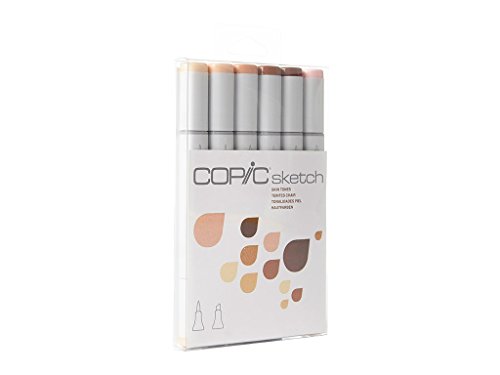
Like all Copic markers, performance decreases and blending becomes more difficult as the marker empties. Noticeable blending changes begin at about 13.5 grams and you will encounter blending impairment at weights lower than 13.2 grams. This can be as few as 2-3 uses for your most-used colors!
It is a myth that Copics can go for years without refilling. The first thing I check when a student can’t blend well is their marker weight. I’ve seen markers as low as 11 grams! Read my article about common Copic Myths here and read details about Blending Issues at our sister site, VanillaArts.com.
Overfilling leads to marker leakage.
For accuracy, I recommend refilling by weight rather than the drip method. I find most drop recommendations to be wildly wrong. “10 to 12 drops” doesn’t tell you the size of the drop or how low the marker was to begin with. In my tests, 10 drops doesn’t come close to restoring an ideal weight.
See my refilling recommendations at VanillaArts.com which includes a link to a great weight refilling tutorial by Michelle Houghton from Copic in the Craft Room.
WARNING: To refill efficiently, you should remove one nib from your Sketch marker. I do not recommend removing the Super Brush Nib as this can easily damage the brush nib. Copic Tweezers are meant to reduce brush nib damage but it’s much safer and far easier to refill from the chisel end.
__________
* UPDATE (December 2022): I’ve been hearing from readers/students that brand new Copic Sketch are now weighing closer to 14g. I reached out to Elena at Violeta-Ink.com and she confirms that the average weight of her fresh stock is more like 14.2g rather than the 14.6 average that I observed back in 2018. Has Copic has reduced the starter weight as a cost savings measure? We’ll keep watching to see!

CHECK FIRST! Beginners often mistakenly purchase Classics because they look similar to Sketch online. AVOID CLASSICS IF YOU WANT TO BLEND!
Personal Thoughts:
My first Copics were Classics because Sketch had not been invented yet. I used them for drawing and hand-lettering. In 1994, I sold my 46 Classics and gradually replaced them with Sketches. It took me a decade to complete my current collection. I do not own the T or F families and will likely never buy them.
I use Sketch exclusively and I recommend them to all my artistic coloring students.

The Super Brush Nib requires some bravery and training but it’s relatively easy to master and produces beautiful effects.
Sketch are the most expensive style and many people try to save money with Ciao. Ciao have drawbacks though— the caps do not have color numbers, the caps have a design flaw which can damage your nib, Ciao must be refilled frequently, and they seem to be more prone to leakage and volcanoes.
Additionally Ciao is only available in 180 of the 358 total colors. Many of my favorite colors are Sketch only. Buying Ciao means that by necessity, you will have a mixed collection which frankly, is hard to store and display.
I recommend Sketch over Ciao because of the larger Sketch color range and I really dislike the Ciao caps.
I recommend Sketch over Classics because of the Super Brush Nib.
I think Sketch are the best value Copic over a lifetime of use.
Amy Shulke is a professional technical illustrator who has used Copic Markers at school, work, and home since 1990. She teaches artistic coloring classes online at VanillaArts.com and locally in south-eastern Michigan.
Marker Novice is Amy’s completely free resource devoted to beginner marker education. For intermediate/advanced artistic coloring articles, see her Studio Journal here.

Click to receive Marker Novice & Vanilla updates in your Pinterest feed
