

Copic Markers: Various Ink, Copic Ink, or Copic Refills- What’s the difference?
“What’s the difference between Various Ink and Copic Refills?”
Sometimes people will say “there’s no such thing as a stupid question” and then snicker when you question something obvious to insiders.
Various versus Refill isn’t a stupid question! It’s an excellent question. For many years, people have been blogging and making videos using the terms interchangeably. Now for the first time in history, there’s an actual difference!
Some bottles of ink say “Copic Ink” and some bottles say “Various Ink”. Is there a difference?
Let’s look closer at what’s going on.


“What’s the difference between Various Ink and Copic Refills?”
Sometimes people will say “there’s no such thing as a stupid question” and then snicker when you ask a question that’s obvious to insiders.
Various versus Refill isn’t a stupid question! It’s an excellent question. For many years, people have been blogging and making videos using the terms interchangeably.
Now for the first time in history, there’s an actual difference!
Why are some bottles marked “Copic Ink” while others are labelled “Various Ink”?
Let’s look closer at what’s going on.
Copic Ink, Copic Refill, and Various Ink are all the same thing. For 30 years, the official name was Various Ink. In 2019, Copic changed the bottle design and labelling. For clarity, they retired Various Ink in favor of Copic Ink. “Copic Refill” is what most people say but it’s not the actual product name.

The name is on the bottle
And it all depends on which bottle you’re looking at.
I’m writing this article in August 2020. Right now, new bottles are on the market but old bottles are still on some store shelves. People will still be using the old bottles for years to come.
Different bottles with different names is confusing.
So let’s get specific. Old names lead to confusion for new beginners. A lot of blogs, articles, tutorials, videos, and even local stores or online shops are about to sound very dated.
The New Look of Copic Ink
This is the redesigned bottle for Copic refill inks.

New refill bottles are labelled “Copic Ink” and the Copic website now uses this name exclusively.

The new 12ml bottles are cylindrical; they fit easily into your hand and feel very much like a pen. Combined with a built-in needle nose dispenser, this design is supposed to make the refilling process more accurate and less messy.
Ridges have been added to the cap to keep the rounded bottles from rolling off your desk or table.
The bottles have been controversial because:
The new bottles only hold 12ml of fluid. The previous bottles were over twice the size at 25ml.
The retail price for the 12ml bottle is almost as much as previous 25ml bottle.
Copic and their US distributors now enforce rules on retailers. Sellers must abide by the Manufacturer’s Suggested Retail Price or lose their authorized retailer status. The higher price per milliliter is no longer a suggestion, it’s a mandate.
The new bottles are thinner plastic and the caps (as of today) do not seal as well. This is leading to many “exploded” delivery boxes where the bottles break open or leak during shipping. One retailer I spoke with says that no amount of bubblewrap prevents faulty caps from leaking and she can’t predict which caps are unreliable. I’m predicting the caps will be redesigned, based upon this shipping issue.
The thinner plastic bottle plus less air-space in the bottle is leading to big messes as people attempt to refill markers the first few times. I’ve got more than 20 years of experience with Copics and even I had ink on my hands and desk after my first try. At this point, I’m actively wishing for a complete redesign of the redesign!
I can’t see into the future but at the time I’m writing this, there’s a lot of grumbling about the new bottles. I will update this article if the new design gets dumped for a new-new design.
As with the old bottles, the new Copic Ink refills come in all 358 colors.

This is the Old Refill Bottle Style
This is the 25ml bottle which is no longer being manufactured.
Note that the label says “Various Ink”.
Official Copic literature published before 2019 exclusively used the term Various Ink.
As you explore Copic information online, notice that older articles and videos use the term Various Ink.
Various Ink is the same as Copic Ink.
As an instructor, I’m also predicting that many teachers, professional artists, and long time Copic fans will have issues with the name change. We’ve been saying Various Ink since 1987 and that’ll be a hard habit to break.
warning!!!
As you shop for Copic Ink refills, if you see a 25ml bottle for sale, please do a little mental math.
By my estimation, Too! (the parent company of Copic) stopped using the 25ml bottles in early 2019.
Any ink sold in a 25ml bottle was manufactured before 2019.
Copic ink has a guaranteed shelf life of three years.
Please make sure you’re not purchasing expired ink. The color has likely faded with time and the composition may have degraded as well.
.

And by the way…
Because I’ve had students ask this before…
All styles of Copic Marker use the same refill inks.
Use YR04 Copic Ink to refill a YR04 Sketch, a YR04 Ciao, or a YR04 Classic.
Don’t let the names confuse you.
Various Ink = Copic Ink = Copic Refill
They’re all names for the same product.
I hope this clarifies the inevitable name confusion. There are lots of excellent articles, tutorials, videos, and blogs created before 2019 and the information is still valuable and correct.
The only thing that’s different is the name.
Amy Shulke is a professional illustrator who has used Copic Markers since 1990. She teaches artistic coloring classes online at VanillaArts.com and locally in south-eastern Michigan.
Marker Novice is Amy’s completely free resource devoted to beginner marker education. For intermediate/advanced artistic coloring articles, see her Studio Journal here.
Other essential Marker Novice articles:


A Little Vitamin O?
A great excuse to use orange markers!
Orange coloring images are on the rare side. Most people don’t pull out their YR Copics until October and it’s for yet another pumpkin. But orange is a fun and appealing color, it deserves more attention!
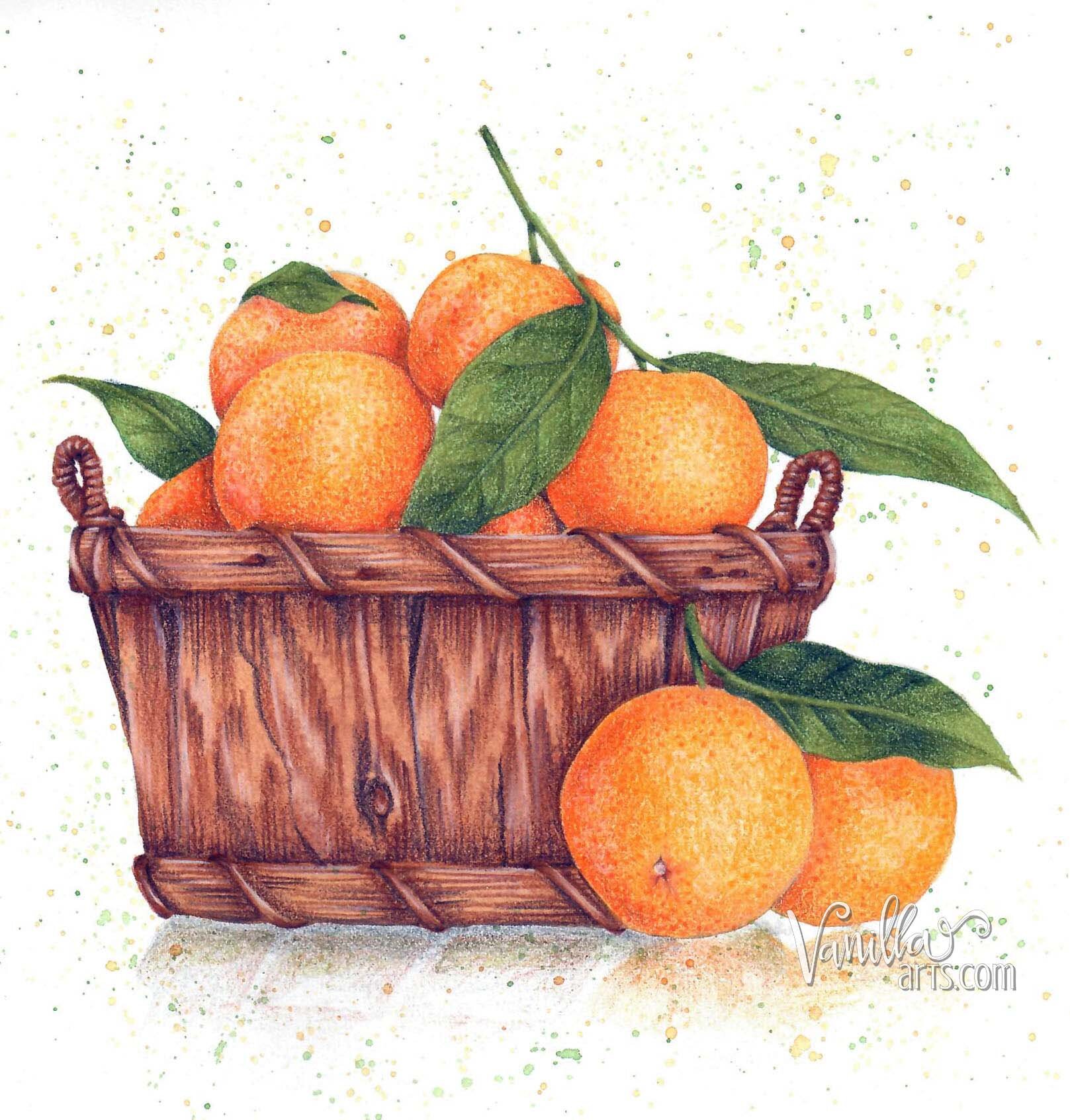
Amy Shulke’s "Tangerine Basket"
Sample shown uses Copic Markers and Prismacolor colored pencils.
Package includes PNG digital stamp with easy print PDF option plus recipe, full color sample, photo reference, and grayscale guide.




Click to receive Marker Novice & Vanilla updates in your Pinterest feed


Copic Ciao Marker: All About the Ciao + Is This the Best Marker for You?
What’s a Copic Ciao Marker?
Getting ready to purchase your first Copic Markers?It’s easy to be overwhelmed by all the choices— Sketch, Ciao, Classic, Wide? What’s the difference anyway? Should you go cheap? Which nib is best?
Relax.
We’re here to help you understand which marker is best for you!
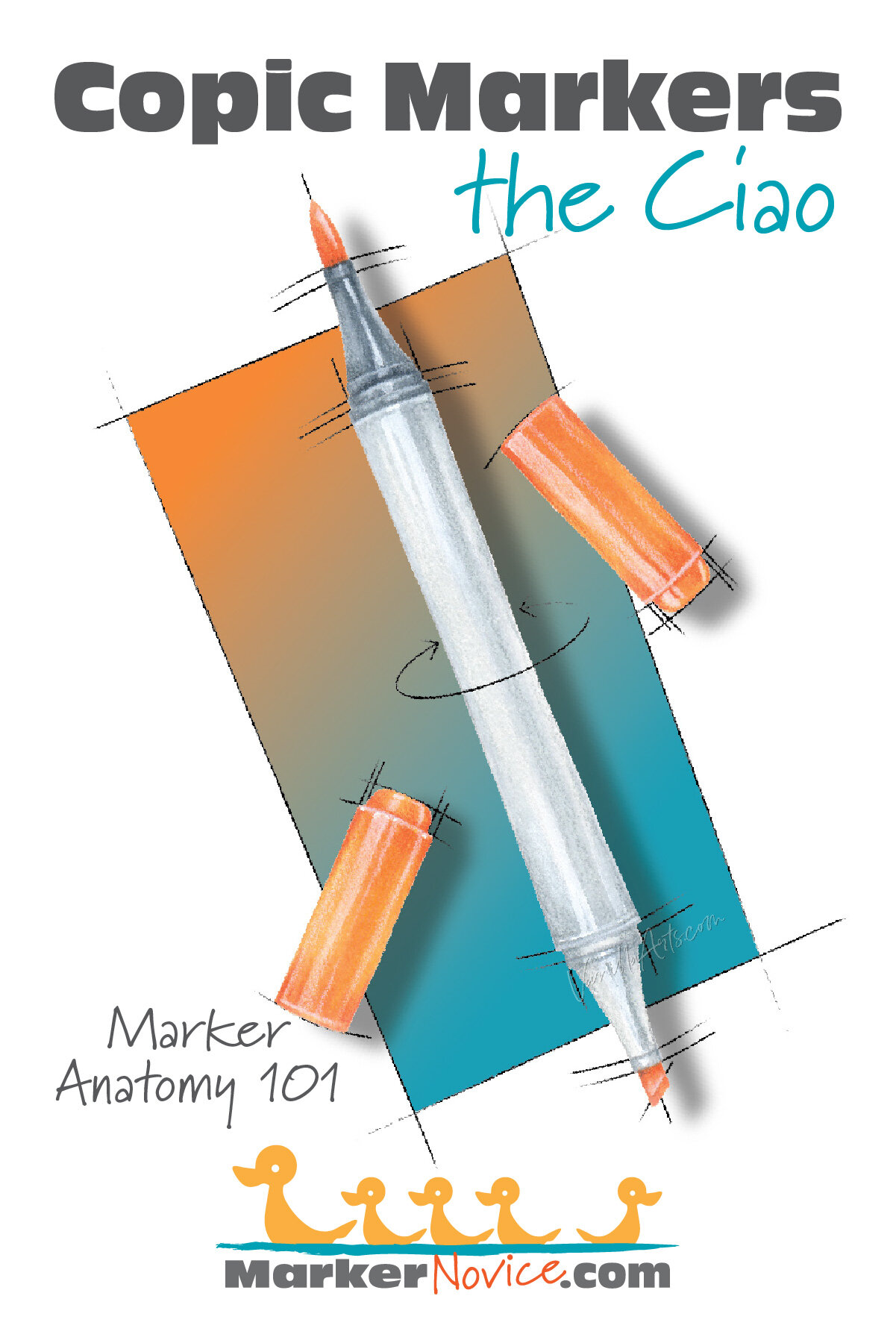

What’s a Copic Ciao Marker?
Getting ready to purchase your first Copic Markers?
It’s easy to be overwhelmed by all the choices— Sketch, Ciao, Classic, Wide? What’s the difference? Should you go cheap? Which nib is best?
Relax.
We’re here to help you understand which marker is best for you!
Copic Ciao Markers
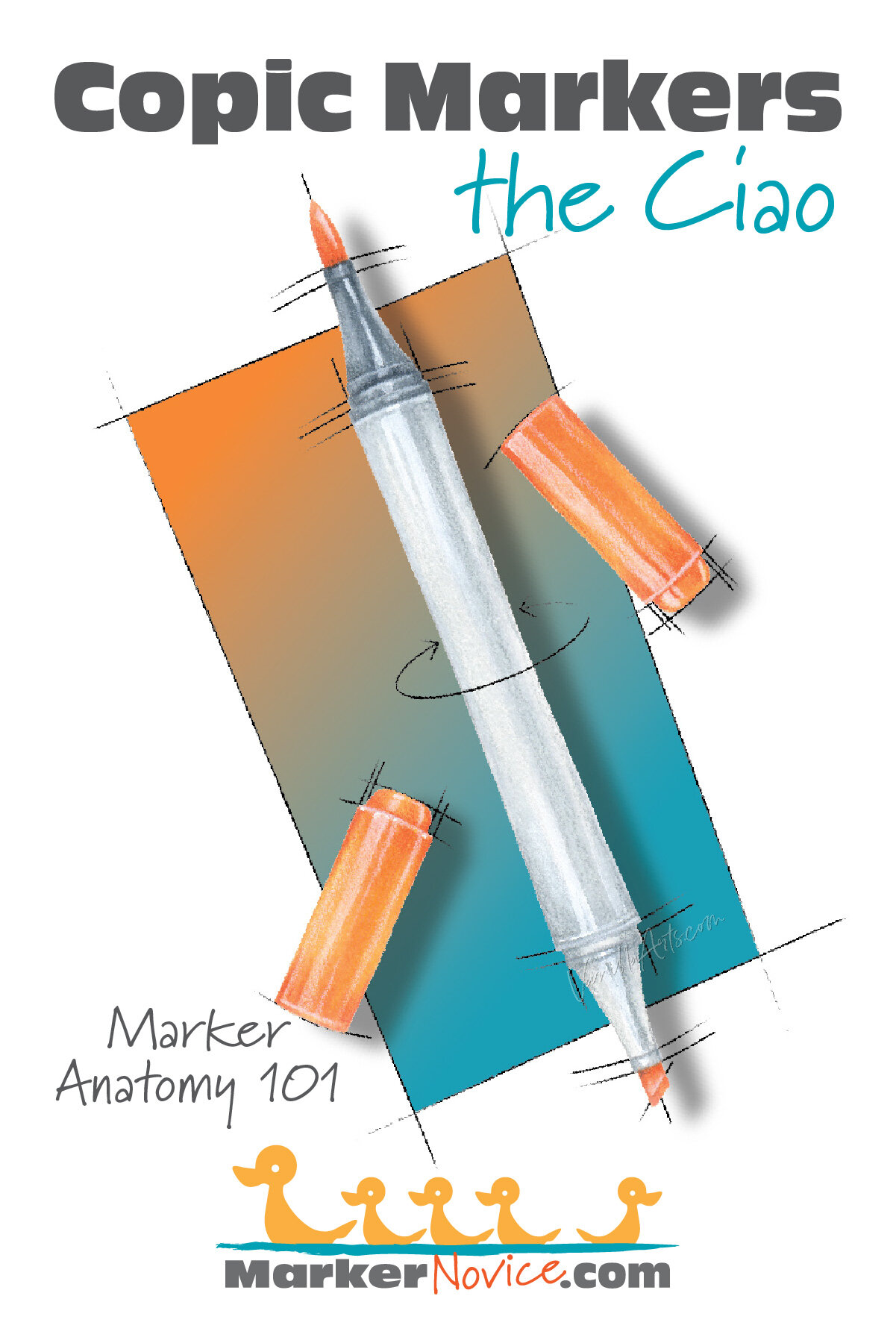
Ciao style Copic Markers are an introductory budget conscious marker aimed at beginners and children. Ciao are designed for coloring and blending, sharing the same chisel and Super Brush nibs as the more expensive Copic Sketch. The Ciao does have drawbacks- a limited color range and a small ink capacity.
Let’s look closer at why the Copic Ciao may or may not suit your coloring goals.
Ciao Marker Overview
The Copic Ciao Marker is a starter level marker developed as an affordable alternative to the Copic professional styles. The target market for these markers is children and beginners which likely explains my serious love/hate relationship with them.
Before you write me off as an expensive marker snob, please read on. I honestly believe that people need to know ALL the pros/cons about the Ciao in order to decide which Copic is best for their own needs.
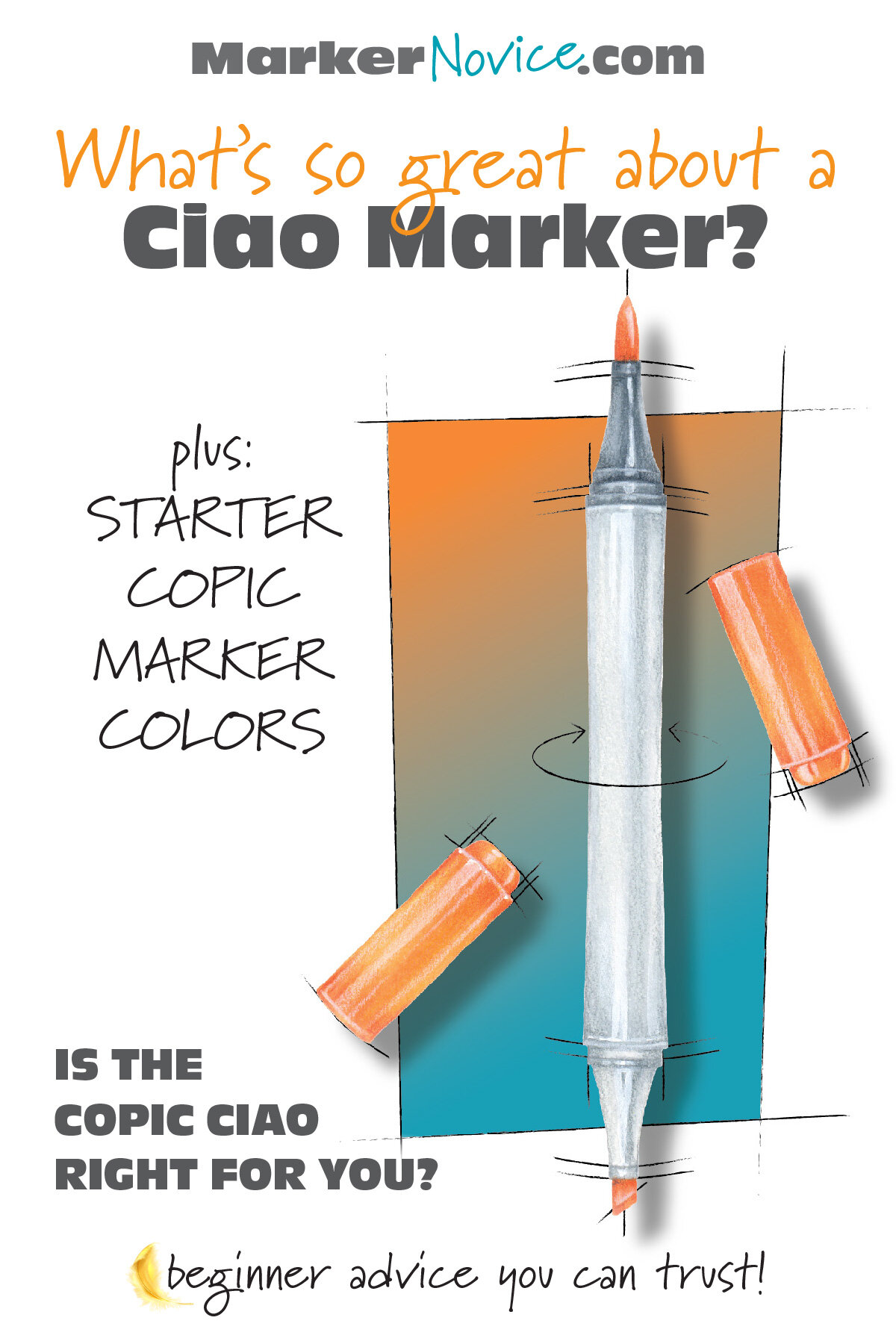
Ciao have a thin round barrel which is extremely lightweight feels more like a pen or pencil than any of the other Copic styles.
Portability is a key feature of the Ciao. They excel as a travel style Copic, perfect for classes, vacation, or even just moving to the bedroom for an evening of coloring. .
Copic Sketches are dual ended and come standard with excellent coloring nibs— the Super Brush Nib (the best blending nib on the market) and a Medium Broad Nib ( great for drawing). A gray band indicates the brush nib end.
Ciao are available in a limited range of 180 colors; many bright & happy hues.
Ciao are easily collectable markers. Too offers many starter sets of two, five, or six Ciao, sometimes in combination with Multiliner pens and Spica Glitter pens.
Ciao are refillable (further details below) which is important because the Ciao has a small ink receptacle that needs frequent refreshes.
FUN FACT: Ciao caps are child-proof; they’re designed to not block the airway if someone swallows one.
Who are Ciao Markers For?
It’s interesting how many people get upset when I refer to Ciao as “kid markers”. But how else would you describe a marker that features no-choke caps, sized for small hands, features Disney characters, and can be purchased in bulk for schools?
So yes, it’s a junior marker…
But folks, it’s a pretty darned good one!
Ciao are an excellent introductory Copic for anyone new to markers. They feature excellent nibs, premium ink, and a budget friendly price.

Can’t get better than that, eh?
Copic Ciaos may be marketed to beginners but the nibs make them awesome.
Super Brush Nibs excel at flooding spaces with generous swaths of color. This is especially important for smooth blending where moisture is the key to best results.
Super Brush Nibs are also good for filling large areas. I frequently color images as large as 18x24” with Copic Sketch Markers.
Lettering artists and modern style calligraphers also tend to favor the Super Brush Nib. It’s a springy, reactive nib which gives an expressive multi-weight line depending upon the amount of pressure used.
Copic Sketch Markers are ill-suited for drawing, detail work, and small coloring projects.
Sketch are often overkill for card-makers using stamp images less than 3” in size.
WE ASKED! All Vanilla Arts students who prefer Ciao markers also own a few Sketch markers. The Ciao isn’t available in many of our frequently used colors!
Copic Ciao Caps
Ciao caps are very colorful and are a large part of the appeal of Ciao markers. They simply look fun to use!
Ciao caps display of the ink color inside the marker. A few cap colors are not an exact color match… but remember, we select markers based on numbers rather than cap colors.
Ciao caps do not indicate the marker name or number (See design flaw 1 below.)

Ciao caps are interchangeable from end to end. Caps have a click lock which serves as a hepatic indication that you’ve closed the marker securely but it should be noted that because the Ciao plastic is softer and more flexible, this cap lock feels less and less secure over time with repeated use.
The caps also feature a bump at the rim which is intended to keep this round marker from rolling off a desk or table. It does not work. These lightweight markers roll and skitter with the slightest touch.
I recommend that you twist the caps to remove rather than pull straight off (which causes splatter).
Now for the sad news:
CIAO CAP DESIGN FLAW 1: The Copic numbers are NOT printed on the caps which means you can not quickly identify Ciao markers if they’re laying in a pile or nicely stored in a beautiful display rack. The only way to correctly identify a Ciao is to read the side of the barrel which wastes time and slows you down. This is a major fault because I can’t count the number of times a Ciao student has mistakenly used the wrong marker in class!
Note: You’ll find many tutorials for labeling Ciao caps but NONE of them are permanent solutions, they all peel off or wear off. I think it’s ridiculous to pay for a Copic and not receive cap numbers!
CIAO CAP DESIGN FLAW 2: The economy design for Ciao caps (which minimizes plastic used) created a design flaw that can damage your markers.
Be very mindful when re-capping a Ciao! There is a sharp ridge inside the cap which will cut into your nib if the cap is not properly centered around the nib. I’ve damaged more than one nib by not paying attention as I capped the marker.
HORIZONTAL OR VERTICAL? What’s the best way to store your Ciao Copics? Honestly? It doesn’t matter.
Copics are not gravity-fed and the ink has no sedimentary particles. This means you can store them however you’d like.

Ciao Numbering + Identification

All Copics use the same numbering system and the same refill inks.
The Copic number and color name is printed (NOT laser etched) in dark gray on the body of a Ciao Marker along with brand details. Symbols indicate the brush and chisel ends.
The printed lettering can eventually wear off. The other Copic styles have laser etched labeling and they are much more durable than the printed Ciao.
CIAO FLAW: There are NO color numbers or name markings on Ciao caps.
See the segment above for my strong feelings about this issue.
A thin, darker gray band indicates the brush nib end. The band is on the marker body, not the cap.
Ciao Nib Options
Copic makes replacement nibs for Ciao and all of their other marker styles. Nibs wear out and can get damaged but they’re easily replaceable.
WARNING: Dried, crusted, or hardened nibs can be replaced BUT the nib is not the only part damaged when a marker runs dry. The core inside the marker is made of a similar material and often hardens along with the nib. A nib can be replaced but you can not replace a core. A damaged core requires full marker replacement.
Copic makes many alternative nib options. UNFORTUNATELY, NONE OF THEM FIT CIAO MARKERS. When you buy a Ciao, you are stuck with the Super Brush and Chisel nibs. You can replace but not upgrade or customize your Ciao nibs.
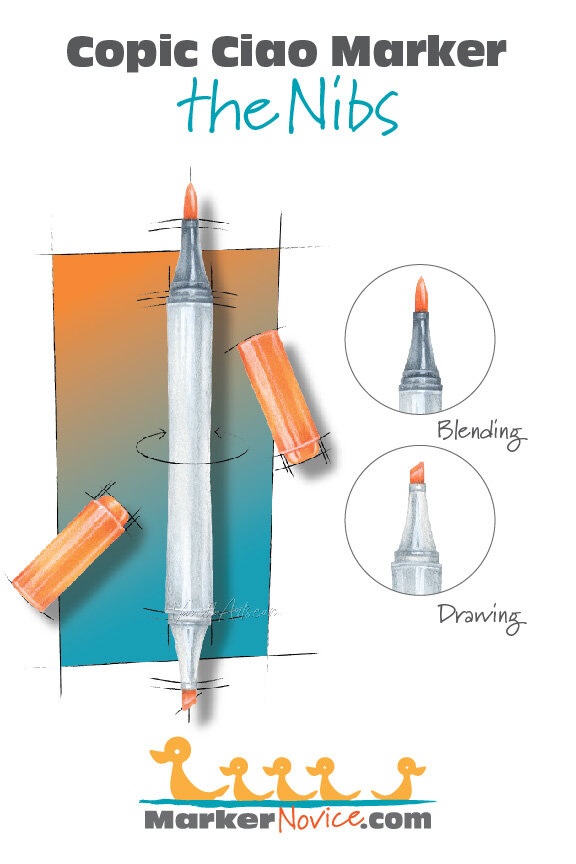
Ciao Standard Nib 1: Super Brush Nib. (Do not confuse the Super Brush with the Copic Round Brush Nib which fits Classic Markers only.)
The Super Brush Nib is an extremely juicy and springy nib which responds to changes in hand pressure. S.B. nibs excel at blending and filling larger areas because they deliver more ink to the paper than any other Copic nib.
The S.B. nib rests in the dark gray end of the marker.
WARNING: When refilling a Copic Sketch, I recommend you do not refill from the brush end (more details in the refill section below).
Ciao Standard Nib 2: Medium Broad Nib (chisel)
Copic users almost always refer to this as the “chisel nib” and many colorers ignore this nib entirely.
Chisel nibs are an old-school drawing nib capable of 3 different line weights. Chisel nibs are not generous with their ink flow and thus are not suitable for blending. Chisels are very firm and need to be broken in (softened a bit) before they give an even line with no skips or flow breaks.
The Chisel nib rests in the pale gray end of the marker.
I recommend refilling from the chisel end for ease and safety (more details in the section below).
WARNING: Copic makes more than a dozen different replacement nibs. The two listed here are the ONLY nibs which fit in Copic Ciao Markers.
BEST BUY? Consider purchasing a used Copic collection. Properly maintained Ciao Copics look and work like new! Many users upgrade from Ciao to Sketch Copics, so it’s easy to find whole Ciao sets for sale in online marker groups.
Refill a Ciao Marker
All styles of Copic use the same numbering system and the same refill inks. See the full Ciao color palette at Copic’s official website here.
A factory-weight Copic Ciao Marker should measure between 10.8 and 11 grams (with both caps on).
I do not recommend filling to factory weight as completely full markers are more prone to Copic Volcanoes (see my article at VanillaArts.com about volcanoes.)
I refill Ciaos to 10.6 grams (with both caps on). This weight is full enough for optimal blending but not so full that the markers leak.
Like all Copic markers, performance decreases and blending becomes more difficult as the marker empties. Noticeable blending changes begin at about 10.1 grams and you will encounter blending impairment at weights lower than 9.8 grams. This can be as few as 2-3 uses for your most-used colors!

It is a myth that Copics can go for years without refilling. The first thing I check when a student can’t blend well is their marker weight. I’ve seen markers as low as 11 grams! Read my article about common Copic Myths here and read details about Blending Issues at our sister site, VanillaArts.com.
Overfilling leads to marker leakage.
For accuracy, I recommend refilling by weight rather than the drip method. I find most drop recommendations to be wildly wrong. “10 to 12 drops” doesn’t tell you the size of the drop or how low the marker was to begin with. In my tests, 10 drops doesn’t come close to restoring an ideal weight.
See my refilling recommendations at VanillaArts.com which includes a link to a great weight refilling tutorial by Michelle Houghton from Copic in the Craft Room.
WARNING: To refill efficiently, you should remove one nib from your Ciao marker. I do not recommend removing the Super Brush Nib as this can easily damage the brush nib. Copic Tweezers are meant to reduce brush nib damage but it’s much safer and far easier to refill from the chisel end.

Is the look of your collection important? Be aware that most Ciao users have a mixed collection of Ciao + Sketch. The limited color range for Ciao makes a total-Ciao collection very hard for artists.
(But it’s not bad for occasional hobbyists!)
Personal Thoughts:
I use Sketch exclusively but I’ve owned a few Ciaos over the years.
I originally owned the square barreled Classic style because that was what existed at the time. I traded those in for Sketch markers later. I had most of my current collection before Ciaos were even invented.

I recommend Sketch rather than Ciao to all my artistic coloring students because I teach with many colors that are unavailable in the Ciao style. But honestly, Ciaos color just as well as Sketches.
If you’re on a budget, Ciao Markers are a very good beginner option.
I simply can’t endorse them fully because of the limited 180 color palette which is missing some of my most frequently used colors. The cap has design flaws which can damage the nibs if you’re not paying attention, will stretch over time, and the lack of cap numbers is very concerning. If you skipped around in this article, please read the cap section for further details on these issues.
Ciao have a couple of other minor drawbacks— Ciao must be refilled frequently, especially in my classes where we color larger image. And while this is anecdotal, they seem to be more prone to leakage and volcanoes.
I recommend Sketch over Ciao because of the larger Sketch color range and I really dislike the Ciao caps.
I recommend Ciao over Classics because of the Super Brush Nib.
I don’t completely dislike Ciaos and if you’re on a budget, I highly encourage you to purchase Ciaos. I simply don’t think Ciao are a lifetime marker and Sketches are a better value over the long run.
Amy Shulke is a professional technical illustrator who has used Copic Markers at school, work, and home since 1990. She teaches artistic coloring classes online at VanillaArts.com and locally in south-eastern Michigan.
Marker Novice is Amy’s completely free resource devoted to beginner marker education. For intermediate/advanced artistic coloring articles, see her Studio Journal here.
Click to receive Marker Novice & Vanilla updates in your Pinterest feed

Copic Classic Marker: All About the Original Copic + Best Drawing Nibs
What’s a Copic Classic Marker?
Getting ready to purchase your first Copic Markers?
It’s easy to be overwhelmed by all the choices— Sketch, Ciao, Classic, Wide? What’s the difference? Should you go cheap? Which nib is best?
Relax.
We’re here to help you understand which marker is best for you!


What’s a Copic Classic Marker?
Getting ready to purchase your first Copic Markers?
It’s easy to be overwhelmed by all the choices— Sketch, Ciao, Classic, Wide? What’s the difference? Should you go cheap? Which nib is best?
Relax.
We’re here to help you understand which marker is best for you!
The Original Copic
Classic or Original Copic Markers are designed for drawing, with controlled ink flow and consistent line width. They feature a hard bullet nib and a chisel nib. The Classic is the most customizable of all Copics with alternative replacement nibs for calligraphy or fine lines.
Let’s look closer at why Classic Copics may or may not suit your coloring goals.
Classic Marker Overview
The Original Copic Marker was introduced in 1987 as a professional tool for Japanese designers (architecture, fashion, landscape, product, etc.). Comic artists worldwide soon started to prize the Copic as an exclusive and somewhat secretive marker.
The Too corporation made the markers easier for artists to track down (although they were scarce for a long time) and then developed several other styles. The original marker is still in use today and is now referred to as a Classic Copic.
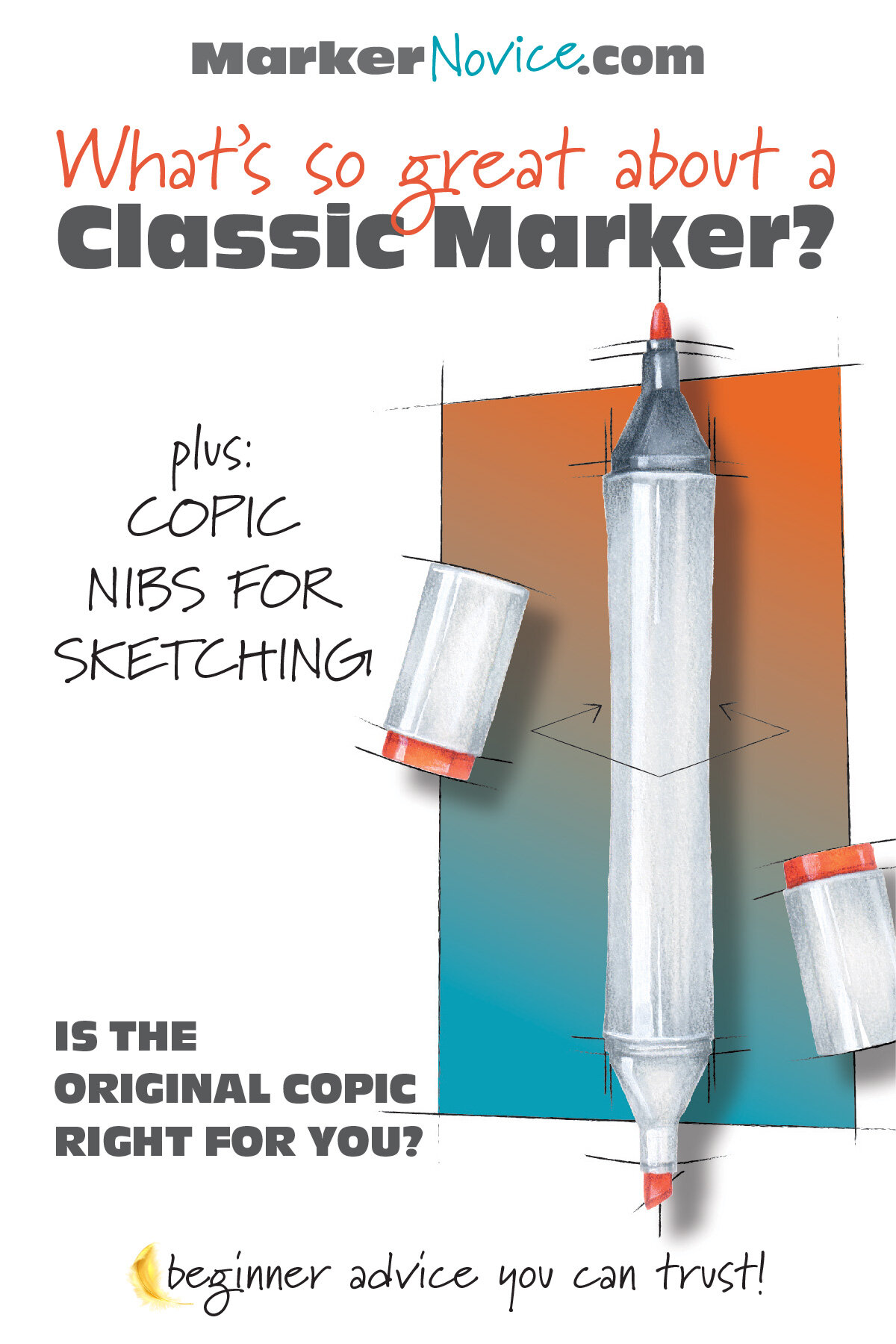
You may hear them called a “Square Copic” in online communities.
Classics have a square shaped barrel which fits nicely into your hand. The edges are rounded, not sharp— if you’ve ever experienced the sharp corners of many competitor brands, you’ll understand how important a rounded edge is. They simply feel good in the hand.
The Classic is a noticeably oversized tool which offers comfort to those with hand arthritis, carpal tunnel syndrome, tight grips, or those who color for extended periods.
The flattened sides are supposed keep the Classic from rolling off your desk… although I’ve proven this theory wrong on more than one occasion.
Classic Copics are dual ended and come standard with a Fine (bullet) Nib and a Medium Broad (chisel) Nib. A gray band indicates the brush nib end.
The Classic is available in 214 colors, including a #0 colorless blender.
Classics are refillable (further details below).
The Classic Copic has the largest ink receptacle of all the Copic Markers. It holds more than the Sketch and significantly more than a Ciao. Combine the large receptacle with the Classic’s dryer nibs and you get a Copic that doesn’t need to be refilled as often as other markers.
FUN FACT? I purchased my first Copic Markers in 1992 as part of a secret artist’s overseas group purchase. We felt like spies. They were Classic Copics.
Who Are Classic Markers For?
You’ve seen Sketch and Ciao markers everywhere. They’re all over blogs and YouTube videos. Some of you may even be scratching your head right now:
“I didn’t even know there was a square barrel Copic!”
Frankly, I’m not surprised that so few people know about them.
Classics are the most mis-understood of all the Copic styles.
Classic Copics are the perfect drawing marker.
In fact, they’re the only true design marker Copic makes. They were created for sketching out designs, NOT FOR COLORING.

Classic nibs are control specialists. The nibs are ultra firm which means no matter how hard you press, you get a consistent and stable line weight. The nibs are purposefully on the dry side, allowing you to make precise marks that do not feather.
Pssstttt… May I point out that this is the exact opposite of what you need for coloring and blending?
Original Copics are a used for general purpose design work in commercial settings. They’re a standard drawing tool in design departments, used by architects, landscape design, product design, fashion design, commercial art and production, illustration and art direction. Classics are also favored by lettering artists (calligraphers may prefer the brush nibs but lettering designers are traditionally trained with bullet nibs and computers).
As marker users shifted from drawing to coloring, improvements to the Classic were needed. That’s where the Sketch Marker with its Super Brush Nib comes in. Brush nibs are juicier and cover larger areas smoothly, so they’re better suited to coloring. Classics are great markers, they’re just not great for coloring.
If you’re drawing and sketching, you want the Classic Copic.
And if you want a custom marker, the Classic is the marker for you.
WE ASKED! Only 2% of Vanilla Arts students use Classic Copics. Of those that do, most have upgraded the chisel nib to a brush nib.
Classic Copic Caps
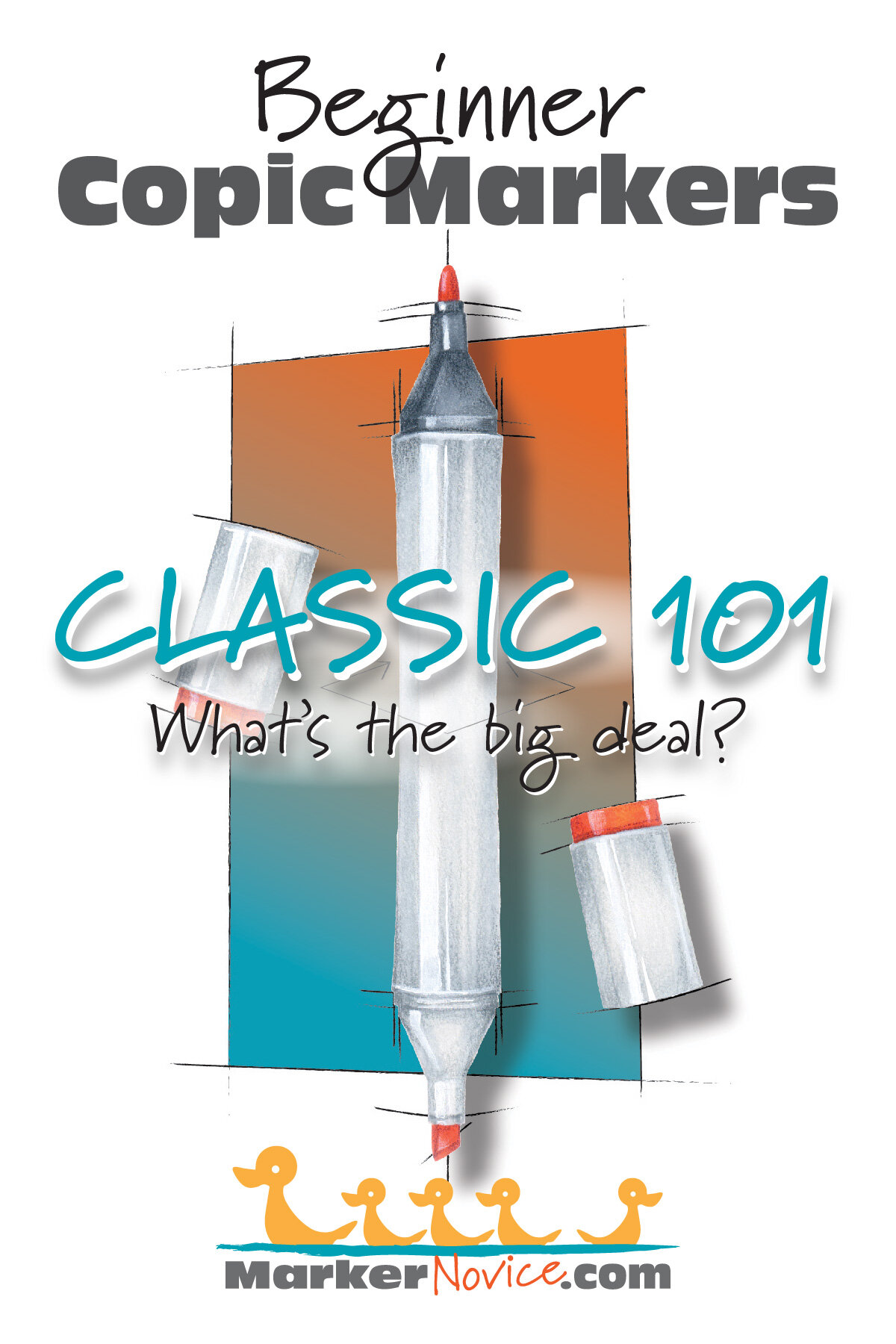
Classic caps match the pale gray color of the marker body.
The ends of Classic caps feature plastic color indicators which are intended to match the ink color. A few cap colors are not exact matches but they’re close. A few color ends are translucent plastic but most are opaque; there is no obvious reason for the translucent plastic.
Classic colored cap ends are laser etched with the color number and name. (More on this in the next section.)
Classic caps are interchangeable from end to end. No need to keep them straight, they’re identical. Because the barrel is square, these are the easiest of all the Copic Markers to cap and uncap. They’re stupid-simple.
The caps nest which means you can store the cap on the opposite end while you color. I wish the Sketch caps would do this!
Classic caps feature a secure click lock which serves as a hepatic indication that you’ve closed the marker securely.
I recommend that you twist the caps to remove rather than pull straight off, to prevent ink splatter.

Classic Numbering + Identification
All Copics use the same numbering system and the same refill inks.

The Copic number is laser etched in dark gray on the body of a Sketch Marker along with brand details. The color name is not listed on the barrel, only the number. Symbols indicate the brush and chisel ends.
The etched lettering does not wear off.
The Copic number AND the color name are laser etched on the end of both caps.
Black etching on pale colors and white etching on dark colors.
Because the numbers and names are on the end of the cap, it’s easy to select Sketch markers from upright storage. This is a definite advantage over the Ciao and Wide marker styles which have no end-cap markings.
A thin, darker gray gap between the cap and the barrel indicates the bullet nib end. The gap on the chisel end is pale gray. The gaps are not true gaps
Customize your Classic: Nib Options
Copic makes nine different nibs for Classic Copics. This is not true of the other styles which have just the standard replacement parts but few customizable options.
Nibs do wear out and can get damaged but they’re easily replaceable.
WARNING: Dried, crusted, or hardened nibs can be replaced BUT the nib is not the only part damaged when a marker runs dry. The core inside the marker is made of a similar material and often hardens along with the nib. A nib can be replaced but you can not replace a core. A damaged core requires full marker replacement.
Professional Copic users upgrade their Classic Markers with custom nibs designed for the kind of work they do most.
Classic Standard Nib 1: Fine Nib
The Fine Nib is a firm bullet nib which provides maximum control, even ink flow, a fine line, and is perfect for small details.
This nib sits on the dark gray end of the Classic marker and can be replaced by several detail nibs (listed below).
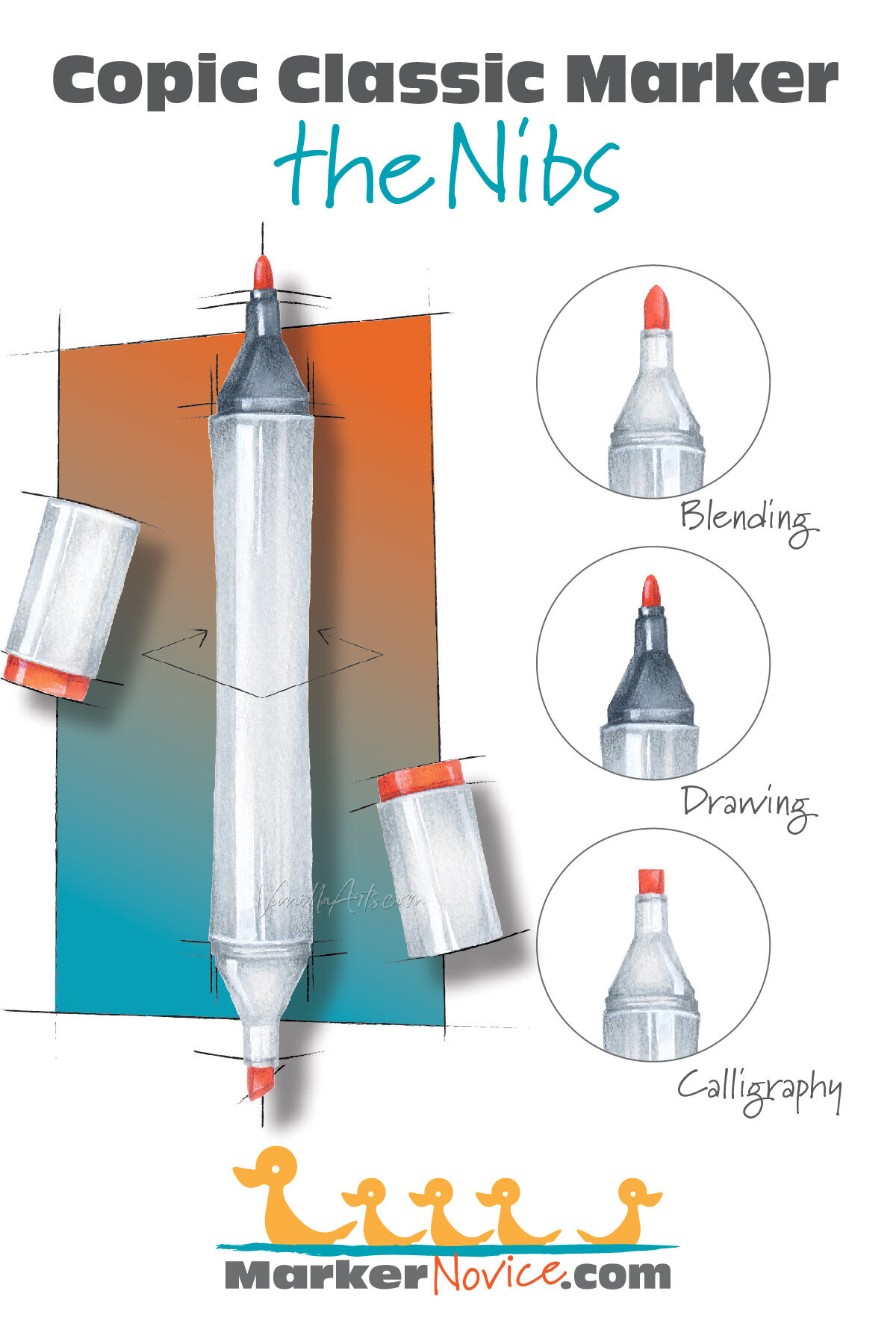
Classic Standard Nib 2: Medium Broad Nib
Copic users almost always refer to this as the “chisel nib” and many colorers ignore this nib entirely.
Chisel nibs are an old-school drawing nib capable of 3 different line weights. Chisel nibs are not generous but they are extremely consistent in ink flow. Chisels are very firm and need to be broken in (softened a bit) before they give an even line with no skips or flow breaks.
The Chisel nib rests in the pale gray end of the marker and can be replaced by several larger nibs (listed below).
RECOMMENDATION: Colorers who want to blend should replace the chisel nib with a Classic Brush Nib (listed below).
Classic Replacement Nib Options (Light Gray End):
Super Fine Plastic - the thinnest line a Copic can make
Semi Broad - a small chisel nib, ideal for design drawing
3mm Calligraphy - a flat nib for traditional pen lettering.
Classic Replacement Nib Options (Dark Gray End):
Classic Brush - a brush style nib for Classics. Smaller and less juicy than a Super Brush nib but highly recommended if you want to blend with a Classic.
WARNING: Classic markers are not intended for blending. If your goal is to do marker blending techniques, please purchase either Sketch or Ciao markers. The Classic Brush Nib kinda blends but not nearly as well as the Super Brushes on Sketch and Ciao Markers. Classic Brushes are smaller, firmer, and less juicy, all three things make blending harder!
NOTE: It can be confusing to tell a Super Brush from a Classic Brush nib online. The Classic Brush is the only nib with a metal collar on it.
Soft Broad - similar to the standard chisel but softer for a more generous ink application
Classic Round - a large bullet nib for control and even weight lines
5mm Calligraphy - a larger flat calligraphic nib to complete the transformation of a Classic into a Copic Calligraphy Marker.
WARNING: Not all nibs fit on all Copics! Classic nibs are all thinner than Sketch or Ciao nibs. Please double check before you purchase.
BEST BUY? Consider purchasing a used Copic collection. Copics can last a lifetime. Well-kept Copics look and work like new!
Refill a Classic Marker
All Copics use the same numbering system and the same refill inks.
See the full Classic color palette at Copic’s official website here.
A factory-weight Copic Sketch Marker should measure about 20 grams (with both caps on).
I do not recommend filling to factory weight; this decreases the odds of Copic Volcanoes (see my article at VanillaArts.com about volcanoes.)

It is a myth that Copics can go for years without refilling. Because Classics tend to be stingier with ink flow than Sketch or Ciao styles, it’s especially important to keep your Classics near-to-full. A Classic marker simply won’t squeak or skip until they’re dangerously low on ink. By danger, I mean your dry Classic may be hardening inside and there’s no fix for this issue. You can kill a Classic by letting it get too low on ink.
Remember: Overfilling leads to marker leakage.
For accuracy, I recommend refilling by weight rather than the drip method. I find most drop recommendations to be wildly wrong. “10 to 12 drops” doesn’t tell you the size of the drop, how low the marker was to begin with, and in my tests, 10 drops doesn’t come close to restoring an ideal weight.
See my refilling recommendations at VanillaArts.com which includes a link to a great weight refilling tutorial.

CHECK FIRST! Beginners often mistakenly purchase Classics because they look similar to Sketch online. AVOID CLASSICS IF YOU WANT TO BLEND!
Personal Thoughts:
My first Copics were Classics and I used them for several years. When I moved from school to a professional design studio we used a mix of Classics, DeSign Markers, and Prismacolor Markers.
When I started painting with markers, I sold my Classics and gradually purchased Sketch Copics. They’re better for blending and large scale artwork.
I do not recommend Classics to colorers who want to blend.
This is because you must retro-fit a Classic for blending and even then, it’s still not as good as a Sketch or Ciao.
If you’re a card maker who only colors SMALL images, you can almost get away with Classics due to the size of your projects. But you can never work larger. Why buy a marker that limits your future options?
And there’s the trap. I mentioned before that many beginning colorers accidentally purchase Classics. Why?
Many beginners don’t realize there are alternative Copics. They assume everything is either Sketch or Ciao.
Classics look very similar to Sketch online. If you don’t know to look at the shape of the colored end-cap, it’s very easy to be fooled.
Classics are usually less expensive than Sketches. Sometimes beginners assume they’ve found a great sale.
Colorers sometimes read the description and get scared by the words SUPER BRUSH NIB. Let’s face it, the Super Brush looks gigantic! Meanwhile we all know about bullet nibs and they sound a lot easier. They don’t realize a bullet is wrong for blending.
I do not recommend Classic Copics for colorers because they lock you into expensive retrofitting OR a lifetime of dinky sized projects.
But if you’re sketching or drawing, you should be using a Classic!
And if you’re into Calligraphy? A customized Classic is WONDERFUL!
Amy Shulke is a professional technical illustrator who has used Copic Markers since 1990. She teaches artistic coloring classes online at VanillaArts.com and locally in south-eastern Michigan.
Marker Novice is Amy’s completely free resource devoted to beginner marker education. For intermediate/advanced artistic coloring articles, see her Studio Journal here.

Click to receive Marker Novice & Vanilla updates in your Pinterest feed

Copic Sketch Marker: All About the Sketch + Why We Love Them!
What’s a Copic Sketch Marker?
Getting ready to purchase your first Copic Markers? It’s easy to be overwhelmed by all the choices— Sketch, Ciao, Classic, Wide? What’s the difference anyway? Should you go cheap? Which nib is best?
Relax.
We’re here to help you understand which marker is best for you!


What’s a Copic Sketch Marker?
Getting ready to purchase your first Copic Markers?
It’s easy to be overwhelmed by all the choices— Sketch, Ciao, Classic, Wide? What’s the difference? Should you go cheap? Which nib is best?
Relax.
We’re here to help you understand which marker is best for you!
What is a Copic Sketch Marker?
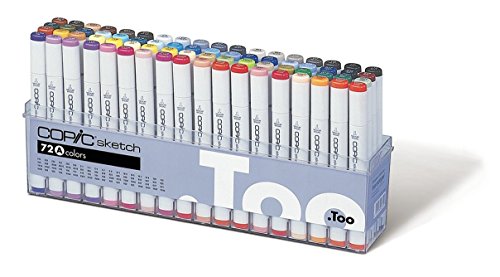
Copic Sketch Markers were designed for coloring. They are a juicy marker, making them ideal for blending and filling large areas with smooth color. The Sketch is Copic’s top selling style combining their exclusive Super Brush Nib, large ink reservoir, and a 358 color range.
Sketch Marker Overview
The Copic Sketch Marker was introduced in 1993. The Sketch is Too’s top selling marker style. They’re so ubiquitous that most people wrongly assume Sketches are the original Copic. The first Copics are actually what we now call a Classic but the Sketch with it’s improved design easily outsells the Classic.
Sketches have an ergonomic flattened-oval shaped barrel which tucks nicely into your hand. It’s a slightly oversized tool which offers comfort to those with hand arthritis, carpal tunnel syndrome, tight grips, or those who color for extended periods of time.
The flattened sides keep the Sketch from rolling off your desk.
Copic Sketches are dual ended and come standard with a Super Brush Nib and a Medium Broad (chisel) Nib. A gray band indicates the brush nib end.
Sketch is the ONLY style of Copic available in ALL 358 colors.
To date, when Copic has introduced new ink colors, they’ve only offered them in the Sketch style.
If you’re someone who intends to collect every color and you will update your collection with future new releases, the Copic Sketch is your safest bet.
Sketches are refillable (further details below). The Sketch has a large ink receptacle. It holds less ink than a Classic but significantly more than a Ciao.
FUN FACT? I purchased my first Copic Markers in 1992. Yes, I’m old.
Who are Sketch Markers For?
Classic Copics (the original style) were primarily used by designers and comic, commercial, or storyboard artists. They’re an excellent drawing tool because they provide a consistent line with no bleed.
But as marker user shifted from drawing to coloring, improvements to the Classic were needed.
Sketches were developed for artists who want a juicier, more expressive stroke.
The Super Brush Nib makes all the difference.
Super Brush Nibs excel at flooding spaces with generous swaths of color. This is especially important for smooth blending where moisture is the key to best results.
Super Brush Nibs are also good for filling large areas. I frequently color images as large as 18x24” with Copic Sketch Markers.
Lettering artists and modern style calligraphers also tend to favor the Super Brush Nib. It’s a springy, reactive nib which gives an expressive multi-weight line depending upon the amount of pressure used.
Copic Sketch Markers are ill-suited for drawing, detail work, and small coloring projects.
Sketch are often overkill for card-makers using stamp images less than 3” in size.
WE ASKED! 80% of Vanilla Arts students prefer the Sketch over other Copic styles.
Copic Sketch Caps
Sketch caps match the pale gray color of the marker body.
The ends of Sketch caps feature plastic color indicators which are intended to match the ink color. A few cap colors are not exact matches but they’re close. A few color ends are translucent plastic but most are opaque; there’s no obvious reason for the translucent plastic.
Sketch colored cap ends are laser etched with the color number and name. (More on this in the next section.)
Sketch caps are interchangeable from end to end. No need to keep them straight, they’re identical.
Sketch caps feature a very secure click lock which serves as a hepatic indication that you’ve closed the marker securely. I’ve occasionally heard of Sketches drying out with the cap on but it’s so rare that I have my doubts. I’ve never personally had it happen.
I recommend that you twist the caps to remove rather than pull straight off, to prevent ink splatter.
Overall, I think Sketch caps are the best designed of all the Copic styles and they far surpass other brand caps in seal and security. The only downside to Sketch caps is that they do not nest, meaning you can’t store a Sketch cap on the opposite end while coloring. It’s a minor (but irritating) flaw.
HORIZONTAL OR VERTICAL? What’s the best way to store your Copics? Honestly? It doesn’t matter.
Copics are not gravity-fed and the ink has no sedimentary particles. This means you can store them however you’d like.

Sketch Numbering + Identification
All Copics use the same numbering system and the same refill inks.
The Copic number is laser etched in dark gray on the body of a Sketch Marker along with brand details. The color name is not listed on the barrel, only the number. Symbols indicate the brush and chisel ends.
The etched lettering does not wear off. A few of my markers are over 25 years old and they still look new.
The Copic number AND the color name are laser etched on the end of both caps.
Black etching on pale colors and white etching on dark colors.
Because the numbers are etched on the end of the cap, it’s easy to select Sketch markers from upright storage. This is a definite advantage over the Ciao and Wide marker styles which have no end-cap markings.
A thin, darker gray band indicates the brush nib end. The band is on the marker body, not the cap.
Sketch Nib Options
Copic makes a variety of replacement nibs for all of their markers. Nibs do wear out and can get damaged but they’re easily replaceable.
WARNING: Dried, crusted, or hardened nibs can be replaced BUT the nib is not the only part damaged when a marker runs dry. The core inside the marker is made of a similar material and often hardens along with the nib. A nib can be replaced but you can not replace a core. A damaged core requires full marker replacement.
Serious Copic users often install alternative nibs to upgrade their marker for specific tasks.
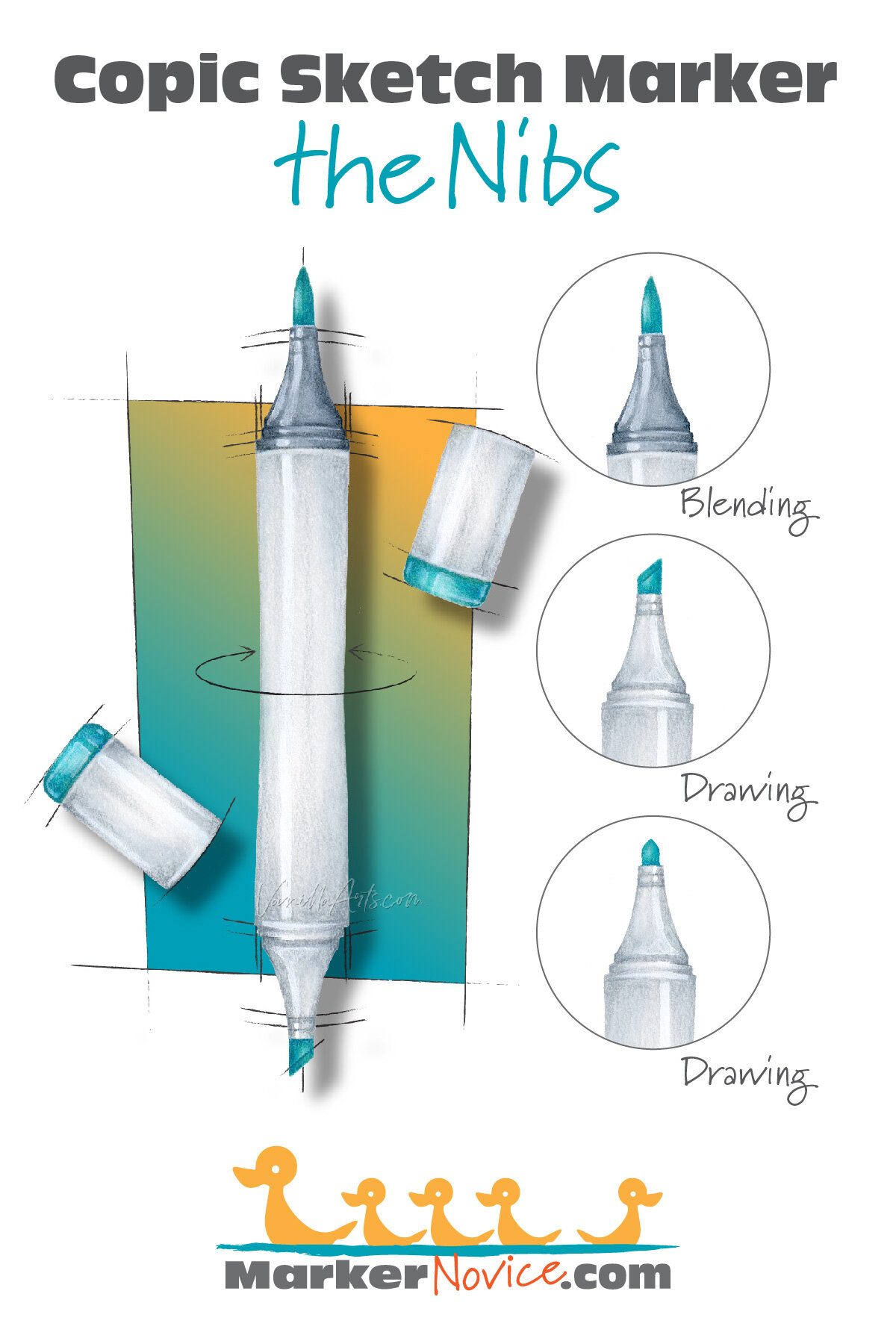
Sketch Standard Nib 1: Super Brush Nib. (Do not confuse the Super Brush with the Copic Round Brush Nib which fits Classic Markers only.)
The Super Brush Nib is an extremely juicy and springy nib which responds to changes in hand pressure. S.B. nibs excel at blending and filling larger areas because they deliver more ink to the paper than any other Copic nib.
The S.B. nib rests in the dark gray end of the marker.
WARNING: When refilling a Copic Sketch, I recommend you do not refill from the brush end (more details in the refill section below).
Sketch Standard Nib 2: Medium Broad Nib (chisel)
Copic users almost always refer to this as the “chisel nib” and many colorers ignore this nib entirely.
Chisel nibs are an old-school drawing nib capable of 3 different line weights. Chisel nibs are not generous with their ink flow and thus are not suitable for blending. Chisels are very firm and need to be broken in (softened a bit) before they give an even line with no skips or flow breaks.
The Chisel nib rests in the pale gray end of the marker.
I recommend refilling from the chisel end for ease and safety (more details in the section below).
Sketch Replacement Nib Option: Sketch Fine Point (bullet)
Ideal for lettering and detail coloring, the Sketch Fine Point is a firm bullet nib which provides maximum control, even ink flow, a fine line, and is perfect for small-ish details. This nib is designed to replace the Chisel nib and fits on the light gray end of the Sketch marker.
I recommend that card-makers and small stamp colorers switch to the fine nib on their most used colors (replacing all your chisel nibs can be costly). The fine nib is designed to replace the Chisel nib and fits on the light gray end of the Sketch marker.
WARNING: Copic makes more than a dozen different replacement nibs. The three listed here are the ONLY nibs which fit in Copic Sketch Markers.
BEST BUY? Consider purchasing a used Copic collection. Properly maintained Copics look and work like new!
Refill a Sketch Marker
All styles of Copic use the same numbering system and the same refill inks. See the full Sketch color palette at Copic’s official website here.
A factory-weight Copic Sketch Marker should measure between 14.5 and 14.8 grams (with both caps on). See the end of this section for an update on factory weight info.
I do not recommend filling to factory weight as completely full markers are more prone to Copic Volcanoes (see my article at VanillaArts.com about volcanoes.)
Like all Copic markers, performance decreases and blending becomes more difficult as the marker empties. Noticeable blending changes begin at about 13.5 grams and you will encounter blending impairment at weights lower than 13.2 grams. This can be as few as 2-3 uses for your most-used colors!
It is a myth that Copics can go for years without refilling. The first thing I check when a student can’t blend well is their marker weight. I’ve seen markers as low as 11 grams! Read my article about common Copic Myths here and read details about Blending Issues at our sister site, VanillaArts.com.
Overfilling leads to marker leakage.
For accuracy, I recommend refilling by weight rather than the drip method. I find most drop recommendations to be wildly wrong. “10 to 12 drops” doesn’t tell you the size of the drop or how low the marker was to begin with. In my tests, 10 drops doesn’t come close to restoring an ideal weight.
See my refilling recommendations at VanillaArts.com which includes a link to a great weight refilling tutorial by Michelle Houghton from Copic in the Craft Room.
WARNING: To refill efficiently, you should remove one nib from your Sketch marker. I do not recommend removing the Super Brush Nib as this can easily damage the brush nib. Copic Tweezers are meant to reduce brush nib damage but it’s much safer and far easier to refill from the chisel end.
__________
* UPDATE (December 2022): I’ve been hearing from readers/students that brand new Copic Sketch are now weighing closer to 14g. I reached out to Elena at Violeta-Ink.com and she confirms that the average weight of her fresh stock is more like 14.2g rather than the 14.6 average that I observed back in 2018. Has Copic has reduced the starter weight as a cost savings measure? We’ll keep watching to see!

CHECK FIRST! Beginners often mistakenly purchase Classics because they look similar to Sketch online. AVOID CLASSICS IF YOU WANT TO BLEND!
Personal Thoughts:
My first Copics were Classics because Sketch had not been invented yet. I used them for drawing and hand-lettering. In 1994, I sold my 46 Classics and gradually replaced them with Sketches. It took me a decade to complete my current collection. I do not own the T or F families and will likely never buy them.
I use Sketch exclusively and I recommend them to all my artistic coloring students.

The Super Brush Nib requires some bravery and training but it’s relatively easy to master and produces beautiful effects.
Sketch are the most expensive style and many people try to save money with Ciao. Ciao have drawbacks though— the caps do not have color numbers, the caps have a design flaw which can damage your nib, Ciao must be refilled frequently, and they seem to be more prone to leakage and volcanoes.
Additionally Ciao is only available in 180 of the 358 total colors. Many of my favorite colors are Sketch only. Buying Ciao means that by necessity, you will have a mixed collection which frankly, is hard to store and display.
I recommend Sketch over Ciao because of the larger Sketch color range and I really dislike the Ciao caps.
I recommend Sketch over Classics because of the Super Brush Nib.
I think Sketch are the best value Copic over a lifetime of use.
Amy Shulke is a professional technical illustrator who has used Copic Markers at school, work, and home since 1990. She teaches artistic coloring classes online at VanillaArts.com and locally in south-eastern Michigan.
Marker Novice is Amy’s completely free resource devoted to beginner marker education. For intermediate/advanced artistic coloring articles, see her Studio Journal here.

Click to receive Marker Novice & Vanilla updates in your Pinterest feed
